


If you process, store, or transmit Controlled Unclassified Information under a federal contract, NIST 800-171 compliance is not optional. It’s a contract requirement, and it’s enforced through DFARS clauses your contracting officer already put in your agreement. Your first move: pull up your contract and check for DFARS 252.204-7012, then look at what’s actually marked as CUI in the documents you handle.
If both are present, you’re in scope. Start here:
- Confirm the contract clause and any CUI markings on deliverables or specs
- Scope which systems touch that CUI (servers, laptops, shared drives, CAD stations)
- Draft a System Security Plan (SSP) documenting how you meet each control
- Check whether your contract references NIST SP 800-171 Rev.3 or the older Revision 2
The technical rulebook is NIST SP 800-171 Rev. 3. The enforcement mechanism runs through DFARS and the Supplier Performance Risk System (SPRS), where your assessment score gets posted and checked before contract award.
Key Takeaways
NIST 800-171 compliance requires scoping CUI accurately, documenting controls in an SSP, and maintaining a current, evidence-backed assessment posted to SPRS.
| Point | Details |
|---|---|
| Check your contract first | Look for DFARS 252.204-7012, 7019, and 7020 clauses before assuming compliance applies. |
| Build to Rev.3, verify against your contract | DoD enforcement often still references Revision 2 for active assessments. |
| Score drives eligibility | SPRS scores range from -203 to 110 and must stay current within three years for award consideration. |
| Evidence beats good intentions | Missing logs and access records, not unfinished technical controls, most often sink a Basic self-assessment. |
| Scope narrowly in production settings | Isolating CUI to specific servers and file shares cuts cost without weakening security. |
Table of Contents
- What NIST SP 800-171 Compliance Actually Covers
- Who Must Comply: Contract Triggers and Subcontractor Flow-Down
- NIST 800-171 Requirements: The Control Families That Matter
- How the DoD Scores Your Assessment: SPRS and Confidence Levels
- The Compliance Roadmap: From Scoping to SPRS Submission
- What NIST 800-171 Compliance Actually Costs You in Time and Money
- Common Pitfalls That Put Contracts at Risk
- How Manufacturing Firms Should Apply These Controls
- Get a Compliance-Ready Manufacturing Partner
- Perspective: What the Rev.3 Transition Actually Means for You
- Sources
What NIST SP 800-171 Compliance Actually Covers
NIST 800-171 compliance applies to nonfederal systems that handle CUI, the sensitive but unclassified information categories the National Records and Archives Administration catalogs in its CUI registry. Think technical drawings, unclassified defense specs, export-controlled data, and certain personnel records.
Revision 3, published in May 2024, reorganized the standard into 17 control families and added three new standalone families: Planning, Supply Chain Risk Management, and System and Services Acquisition. It also introduced organization-defined parameters (ODPs), which let your organization set specific thresholds (like password rotation intervals) within NIST’s boundaries rather than following one fixed rule for everyone.
The catch: most DoD contracts and the current CMMC assessment framework still reference Revision 2, even though Rev.3 is the published standard. Build your program to Rev.3’s structure, since it’s clearly where the requirements are heading, but confirm which revision your specific contract or assessment actually requires before you finalize your SSP.
Who Must Comply: Contract Triggers and Subcontractor Flow-Down
Compliance isn’t triggered by industry or company size. It’s triggered by contract language. Here’s how to check:
- Search your contract for DFARS 252.204-7012. This clause obligates you to safeguard covered defense information and report cyber incidents. If it’s in your contract, NIST 800-171 applies.
- Check for 252.204-7019 and 252.204-7020. These clauses require you to have a current assessment posted in SPRS before you’re eligible for award, and they set the rules for who can access those scores.
- Verify flow-down to subcontractors. If your prime’s contract carries these clauses, they’re contractually required to push equivalent obligations down to you, even as a second- or third-tier supplier. Ask your prime for the specific clause text if it’s not in your subcontract.
- Call your contracting officer if anything is ambiguous. Guessing wrong here costs far more than a phone call.
NIST 800-171 Requirements: The Control Families That Matter
Rev.3’s 17 families cover the full range of what a security program needs, but a handful demand attention first. Here’s the practical digest:
- Access Control — who can reach CUI and under what conditions
- Awareness and Training — staff know what CUI looks like and how to handle it
- Audit and Accountability — logs exist and get reviewed
- Configuration Management — systems are hardened and changes are tracked
- Identification and Authentication — multi-factor authentication for privileged and remote access
- Incident Response — a documented plan, not a mental note
- Media Protection — controls over how CUI moves on removable drives or shared storage
- Physical Protection — locked server rooms, controlled facility access
- Risk Assessment and Planning — the newer Rev.3 addition that ties everything together
- System and Communications Protection — encryption in transit and at rest
- System and Services Acquisition and Supply Chain Risk Management — Rev.3’s other new standalone families, addressing vendor and product risk
Multi-factor authentication, encryption, and audit logging tend to be the controls assessors scrutinize hardest, because they’re the easiest to verify with concrete evidence.
Not every gap needs to be closed before you submit an assessment. Controls you can’t fully implement yet belong in your Plan of Action and Milestones (POA&M), with a documented timeline. But controls tied to basic access hygiene and authentication generally need to be in place now, not on a future roadmap.
Pro Tip: Build your POA&M with named owners and calendar dates, not vague target quarters. Assessors and auditors treat a POA&M with “Q3” as evidence you haven’t actually planned the remediation.
How the DoD Scores Your Assessment: SPRS and Confidence Levels
The DoD Assessment Methodology sorts assessments into three tiers, each carrying a different confidence level for the government reviewing your score.
| Assessment Type | Who Performs It | Confidence Level |
|---|---|---|
| Basic | Contractor self-assessment | Low |
| Medium | DCMA/DIBCAC review of self-assessment evidence | Medium |
| High | On-site or thorough DCMA/DIBCAC review | High |
Your score, whether Basic or government-verified, converts unmet controls into a summary-level number ranging from -203 to 110. A perfect 110 means every requirement is fully met; negative scores reflect unmet controls weighted by risk severity. That number, not a pass/fail label, is what shows up in SPRS.
- SPRS stores only the summary score and assessment date, not the underlying evidence
- DFARS 252.204-7019 requires a current assessment, generally no more than three years old, posted before you’re eligible for contract award
- 252.204-7020 governs who can access your posted score and how government reviewers request supporting documentation
Miss the currency window and you’re out of the award pool regardless of how strong your actual security posture is.
The Compliance Roadmap: From Scoping to SPRS Submission
Getting from “we think we need this” to a posted SPRS score follows a fairly consistent sequence, even though the details vary by organization size and system complexity.
- Confirm contract scope. Identify which systems actually touch CUI. Isolating CUI to a limited set of servers or file shares, rather than trying to lock down your entire network, cuts both cost and timeline dramatically.
- Build or update your SSP. Document how each of the 17 control families is met, partially met, or not yet met. This is your assessment’s backbone.
- Run a gap assessment against NIST SP 800-171A, the companion assessment procedures document that tells you exactly what evidence satisfies each requirement. Calculate your preliminary SPRS score here.
- Draft your POA&M for every unmet requirement, with a named owner and a real target date, not a placeholder.
- Remediate prioritized gaps. Fix the controls that carry the most risk weight first, and collect evidence as you go, not after the fact.
- Submit your Basic assessment score to SPRS, or schedule a Medium/High government review if your contract requires it.
Pro Tip: Collect operational evidence, logs, access reviews, maintenance records, at the same time you remediate a control, not months later. Missing evidence, not missing technical controls, is the most common reason a Basic self-assessment gets reversed under government review.
What NIST 800-171 Compliance Actually Costs You in Time and Money
Timelines vary widely with how mature your existing security program already is. Organizations starting close to scratch often need 2 to 24 months to move from initial scoping through a submitted assessment, depending on gap size and remediation complexity.
Cost drivers break down predictably:
- Internal staff hours spent on SSP documentation and evidence gathering
- Consultant or C3PAO fees if you pursue third-party validation
- Tooling for logging, MFA, and encryption you don’t already have
- Remediation labor for the technical gaps your assessment surfaces
Phase your remediation against actual contract milestones. Fix the highest-risk gaps, unmanaged remote access and missing encryption tend to top that list, before you touch lower-priority items.
Common Pitfalls That Put Contracts at Risk
The mistakes that sink assessments are rarely exotic. They’re procedural.
- Treating compliance as a one-time project instead of an ongoing program
- Submitting a SPRS score without evidence to back it up if reviewed
- Inaccurate self-attestation, which the Civil Cyber-Fraud Initiative treats as a False Claims Act exposure, not a paperwork error
- Letting your SSP go stale after a system change or new vendor relationship
Schedule quarterly control reviews, maintain an evidence library as you go, and put change control around anything touching a CUI system.
How Manufacturing Firms Should Apply These Controls
For machine shops and contract manufacturers, CUI usually shows up in a specific, findable set of places: CAD files, work orders, inspection reports, and supplier drawings. You don’t need to lock down the entire facility. You need to isolate the systems that actually touch that data, CAD servers, ERP modules handling defense part numbers, and controlled file shares, and build your evidence trail around those.
Manufacturing environments that scope narrowly, rather than attempting full-facility compliance, consistently cut both cost and assessment complexity without weakening protection where it matters.
Documentation worth keeping on hand:
- Configuration baselines for machines and workstations touching CUI
- Maintenance and calibration logs tied to controlled equipment
- Operator access records showing who touched what, and when
- Chain-of-custody logs for any removable media carrying CUI
Machiningtechllc has operated a 70,000 square foot precision machining facility since 1985, producing over 20 million parts annually for aerospace, defense, and firearms manufacturing clients, environments where this kind of documentation discipline is already part of daily operations, not a new burden layered on top.
Get a Compliance-Ready Manufacturing Partner
Meeting NIST 800-171 requirements gets harder when your production partner can’t document their own controls. If you’re sourcing parts for a defense contract that carries these clauses, your supply chain’s compliance posture becomes your problem too, since flow-down obligations apply to everyone touching the CUI, not just the prime.

Machiningtechllc has built its Hydromat, CNC milling and turning, and Wire EDM operations around the documentation and process discipline that regulated contracts demand, work order tracking, operator access records, and configuration control that align directly with several NIST 800-171 control families. If you need a machining partner who understands what “audit-ready” actually means in a production environment, explore contract machining services built for OEM and defense supply chains.
Perspective: What the Rev.3 Transition Actually Means for You
Most guidance on NIST 800-171 treats Revision 3 like a light update. It isn’t. Adding Planning and Supply Chain Risk Management as standalone families signals that NIST expects organizations to manage vendor and product risk formally, not as an afterthought bolted onto procurement. That’s a real shift in what “compliant” looks like on paper.
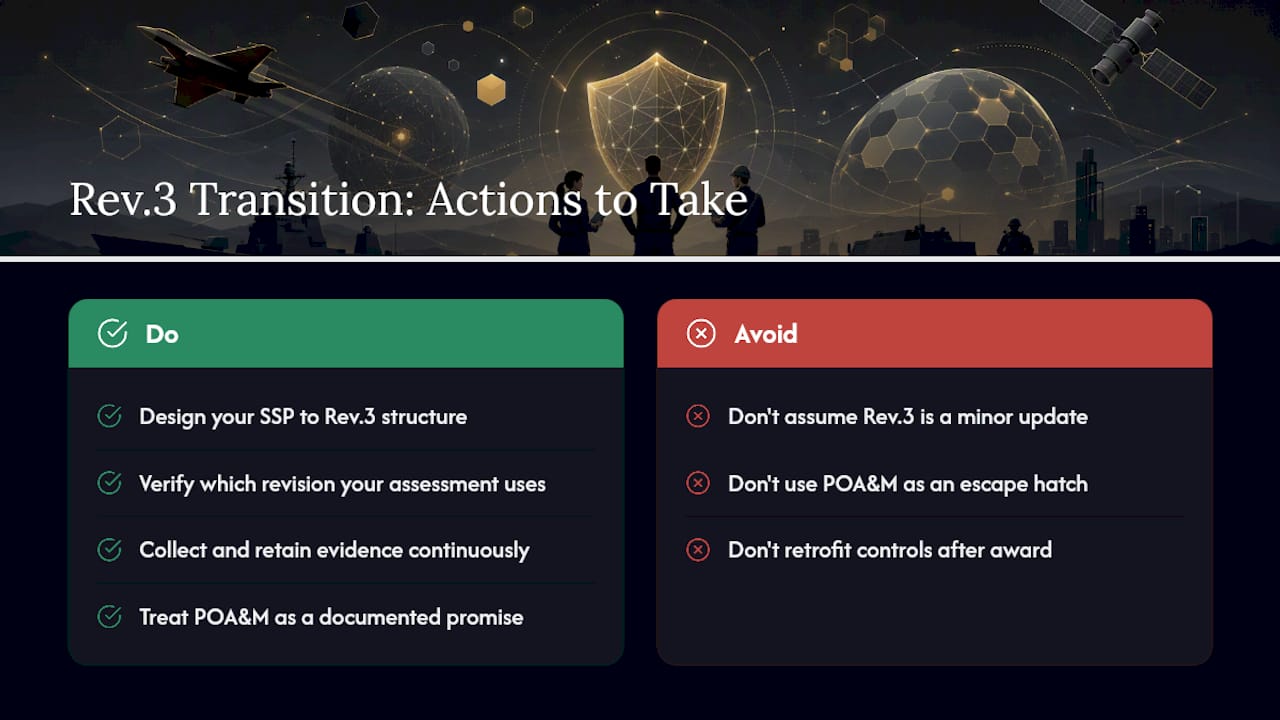
But here’s the disconnect nobody flags clearly enough: DoD enforcement and CMMC assessments still largely reference Revision 2. So you’re stuck building toward a newer, more rigorous standard while getting graded against an older one. My advice is to build your SSP and control implementation to Rev.3’s structure now, since retrofitting later costs more than building right the first time, but verify with your contracting officer exactly which revision your specific assessment will use before you submit anything to SPRS.
The bigger failure I see isn’t technical. It’s treating a POA&M as a compliance escape hatch rather than what it actually is: a documented promise with a deadline. Organizations that collect evidence continuously, not just before an assessment, are the ones that survive a government review without their score getting reversed.
— Andrew
Sources
- NIST SP 800-171 Rev. 3, Protecting Controlled Unclassified Information in Nonfederal Systems and Organizations
- Acquisition
- 48 CFR § 252.204-7019 – Notice of NIST SP 800-171 DoD Assessment Requirements (e-CFR / LII)
Recommended
- Industrial machining safety protocols: Proven compliance tips | Machining Technologies
- Achieve Consistent Quality Assurance in Firearms Parts | Machining Technologies
- Why Precision Matters in Defense: Reliability & Performance | Machining Technologies
- Machinist Certifications Explained for OEM Procurement | Machining Technologies