
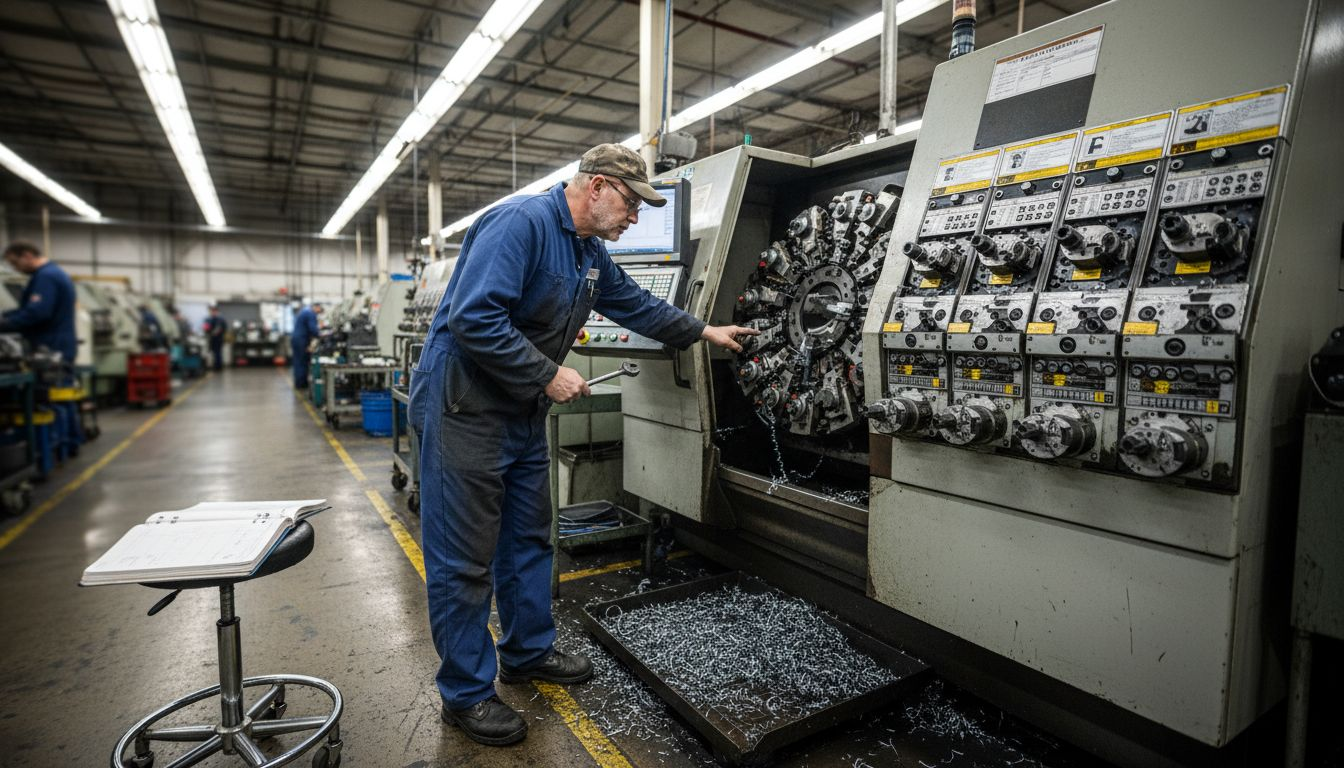
Few american manufacturing technologies have matched the speed and precision of Hydromat rotary transfer systems. With the ability to reduce production cycle times by up to 70 percent, these platforms are transforming how complex parts are produced for demanding aerospace and defense applications. American manufacturing engineers looking for a competitive edge now have new options for achieving unmatched accuracy and efficiency in high-volume, high-tolerance component machining.
Table of Contents
- Defining Hydromat Machining And Rotary Transfer Systems
- Hydromat Machine Types And Modular Configurations
- How Hydromat Machining Works: Rotary Transfer Operations
- Applications In Aerospace, Defense, And Industry
- Cost, Productivity, And Quality Benefits For OEMs
- Comparing Hydromat Machining To Other Production Methods
Key Takeaways
| Point | Details |
|---|---|
| Modular Design | Hydromat systems feature customizable configurations, allowing manufacturers to adapt to diverse part requirements seamlessly. |
| Simultaneous Operations | The ability to perform multiple machining processes simultaneously enhances production efficiency and reduces cycle times significantly. |
| Precision Control | Advanced CNC integration ensures tight tolerances, resulting in high-quality components that meet stringent industry standards. |
| Cost Efficiency | Manufacturers can achieve substantial cost savings through lower labor requirements and reduced material waste in high-volume production. |
Defining Hydromat Machining and Rotary Transfer Systems
Hydromat machining represents an advanced manufacturing technology specifically designed for high-volume precision component production. Rotary transfer machines are sophisticated manufacturing platforms that enable manufacturers to process complex metal parts with remarkable efficiency and accuracy. These systems utilize an indexing table that allows multiple machining operations to occur simultaneously across different stations, dramatically reducing production cycle times.
At the core of Hydromat systems is a modular, CNC-controlled platform that supports horizontal and vertical machining stations. Manufacturers can configure these machines to handle up to 16 horizontal and 8 vertical stations, enabling simultaneous processing of bar stock and blank materials without repeated workpiece repositioning. This unique design allows for intricate part manufacturing with minimal handling, ensuring consistent precision across large production volumes.
The key distinguishing feature of Hydromat rotary transfer technology is its ability to perform multiple complex machining operations in a single, integrated system. By eliminating the need for multiple machine setups and reducing material transfer between stations, these systems significantly enhance manufacturing productivity. Automotive, aerospace, and industrial equipment manufacturers particularly benefit from Hydromat machines, which can dramatically reduce production cycle times while maintaining extremely tight dimensional tolerances.
Pro tip: When evaluating Hydromat machining for your production needs, carefully analyze your part complexity, annual volume requirements, and potential configuration flexibility to maximize your manufacturing efficiency.
Hydromat Machine Types and Modular Configurations
Hydromat rotary transfer machines come in several specialized configurations designed to meet diverse manufacturing requirements. Rotary transfer machines like the EPIC HF series, Eclipse 12-100, and ICON series represent advanced technological platforms that can be precisely tailored to specific production needs. These machine types feature modular station designs with varying numbers of workstations and comprehensive CNC capabilities, enabling manufacturers to create highly customized machining solutions.
The primary machine configurations include horizontal and vertical machining units that can be strategically combined to handle complex part manufacturing. Horizontal configurations typically support bar stock processing, while vertical stations excel at handling blank materials. Manufacturers can select from machine types supporting anywhere from 8 to 24 simultaneous machining units, allowing unprecedented flexibility in production design. This modularity means engineers can configure machines to perform multiple operations like drilling, turning, milling, and broaching within a single integrated system.
Industry-specific Hydromat machine types are engineered to address unique manufacturing challenges across sectors such as automotive, aerospace, and industrial equipment production. The EPIC HF series, for instance, offers exceptional versatility for precision components, while the Eclipse series provides robust performance for high-volume applications. Each machine type incorporates advanced CNC controls that enable real-time monitoring, precise tool positioning, and adaptive machining strategies that optimize production efficiency and part quality.
Pro tip: When selecting a Hydromat machine configuration, carefully evaluate your specific part complexity, annual production volume, and required machining operations to identify the most cost-effective and efficient system design.
Below is a summary of key Hydromat machine features and their business impact:
| Feature | Function | Business Impact |
|---|---|---|
| Modular Stations | Customizable configuration | Adapts to diverse part needs |
| CNC Integration | Precision tool controls | Enhances accuracy, reduces errors |
| Horizontal/Vertical Machining | Handles bar and blank stock | Increases part versatility |
| Rapid Changeover | Quick station retooling | Reduces downtime, boosts output |
| Tight Tolerances | Achieves ±0.0005 inch | Supports critical component quality |
How Hydromat Machining Works: Rotary Transfer Operations
Hydromat rotary transfer machining is a sophisticated manufacturing process that enables simultaneous multi-station part processing through an innovative indexed workpiece handling system. Rotary transfer machines utilize a central indexing table equipped with precision collets that securely hold multiple workpieces while moving them sequentially through a radial arrangement of specialized machining stations. This unique design allows for continuous production, with each station performing specific manufacturing operations like drilling, milling, turning, or tapping simultaneously.
The operational mechanism of Hydromat systems involves a systematic progression of workpieces through carefully configured machining stations. As the indexing table rotates, each part moves to a new station, enabling consecutive manufacturing steps without manual intervention. Precision CNC controls coordinate tool movements, ensuring extremely tight tolerances and consistent part quality across high-volume production runs. This automated approach significantly reduces cycle times by eliminating secondary operations and minimizing human handling, which directly translates to improved manufacturing efficiency and reduced production costs.
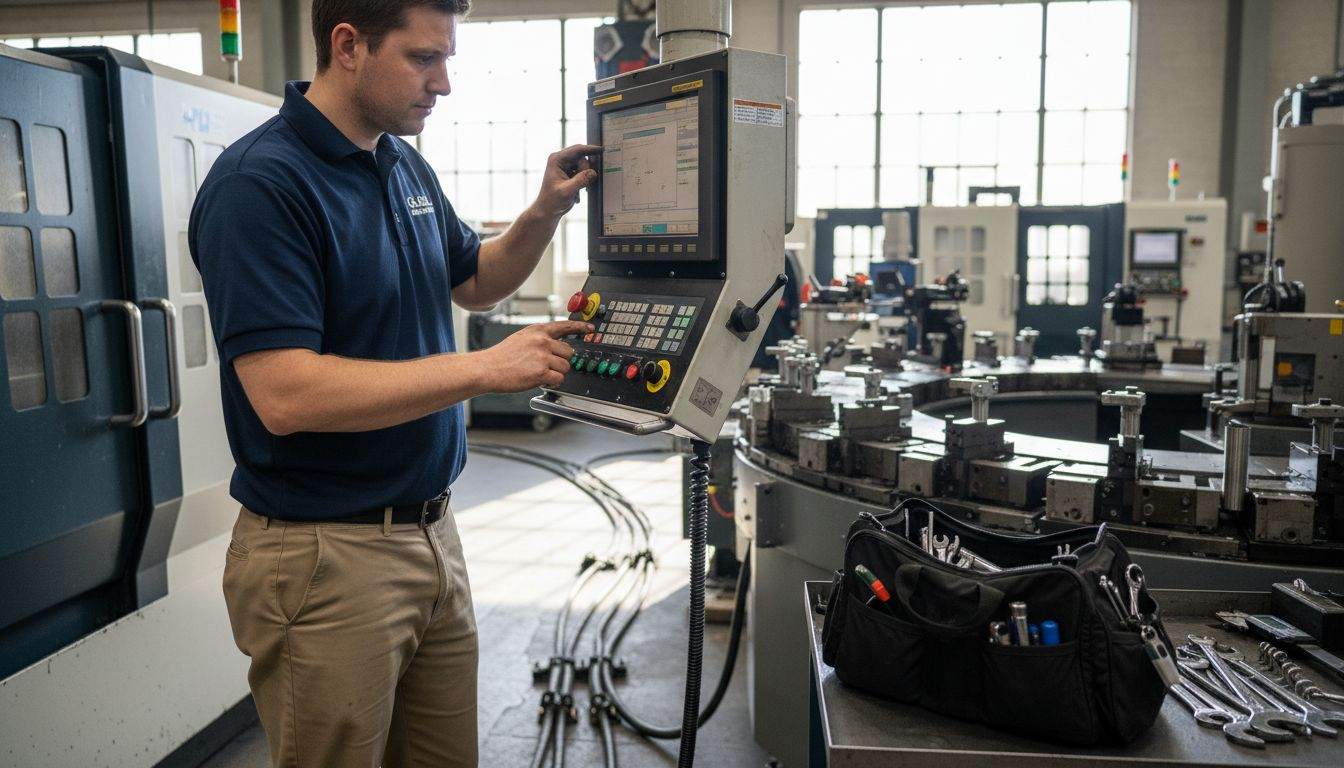
Different machining stations can be strategically configured to perform complementary operations, creating a seamless and integrated manufacturing workflow. For example, one station might perform initial rough drilling, while an adjacent station completes precision threading, and another station handles surface milling. The modular nature of Hydromat rotary transfer machines allows manufacturers to customize station configurations based on specific part requirements, making these systems incredibly versatile for complex component production across aerospace, automotive, and industrial manufacturing sectors.
Pro tip: When implementing Hydromat machining, collaborate closely with process engineers to design an optimal station configuration that maximizes throughput and minimizes tool changeover times.
Applications in Aerospace, Defense, and Industry
Precision machining plays a critical role in manufacturing complex components for aerospace, defense, and industrial sectors, with Hydromat rotary transfer technology emerging as a game-changing solution for high-performance part production. Hydromat machining enables manufacturers to create intricate components with unprecedented accuracy and efficiency, meeting the stringent quality requirements of mission-critical industries that demand exceptional dimensional tolerances and mechanical performance.
In aerospace manufacturing, Hydromat systems are particularly valuable for producing sophisticated components like turbine engine parts, aircraft structural elements, and precision hydraulic system components. The technology’s ability to perform multiple machining operations simultaneously allows for creating complex geometries with extremely tight tolerances, which are essential in aerospace engineering. Defense contractors rely on similar capabilities for manufacturing advanced weapon systems, communication equipment components, and specialized mechanical assemblies that require consistent, high-precision parts with minimal production variations.
Industrial manufacturing sectors, including automotive, medical device production, and industrial machinery, also benefit significantly from Hydromat machining capabilities. The technology’s modular design enables manufacturers to rapidly adapt production configurations for different part requirements, supporting everything from small precision components to larger, more complex mechanical assemblies. By reducing manual interventions and minimizing production cycle times, Hydromat systems help manufacturers achieve higher throughput, lower production costs, and more consistent quality across diverse manufacturing applications.
Pro tip: When evaluating Hydromat machining for your manufacturing process, conduct comprehensive performance testing across multiple part configurations to fully understand the system’s adaptability and precision capabilities.
Cost, Productivity, and Quality Benefits for OEMs
Manufacturing economics are fundamentally transformed by Hydromat rotary transfer technology, offering Original Equipment Manufacturers (OEMs) a compelling solution for reducing production costs while simultaneously improving part quality and manufacturing efficiency. Precision machining technologies enable manufacturers to achieve significant economic advantages through integrated, high-volume production strategies that minimize manual labor, reduce material waste, and accelerate overall production throughput.
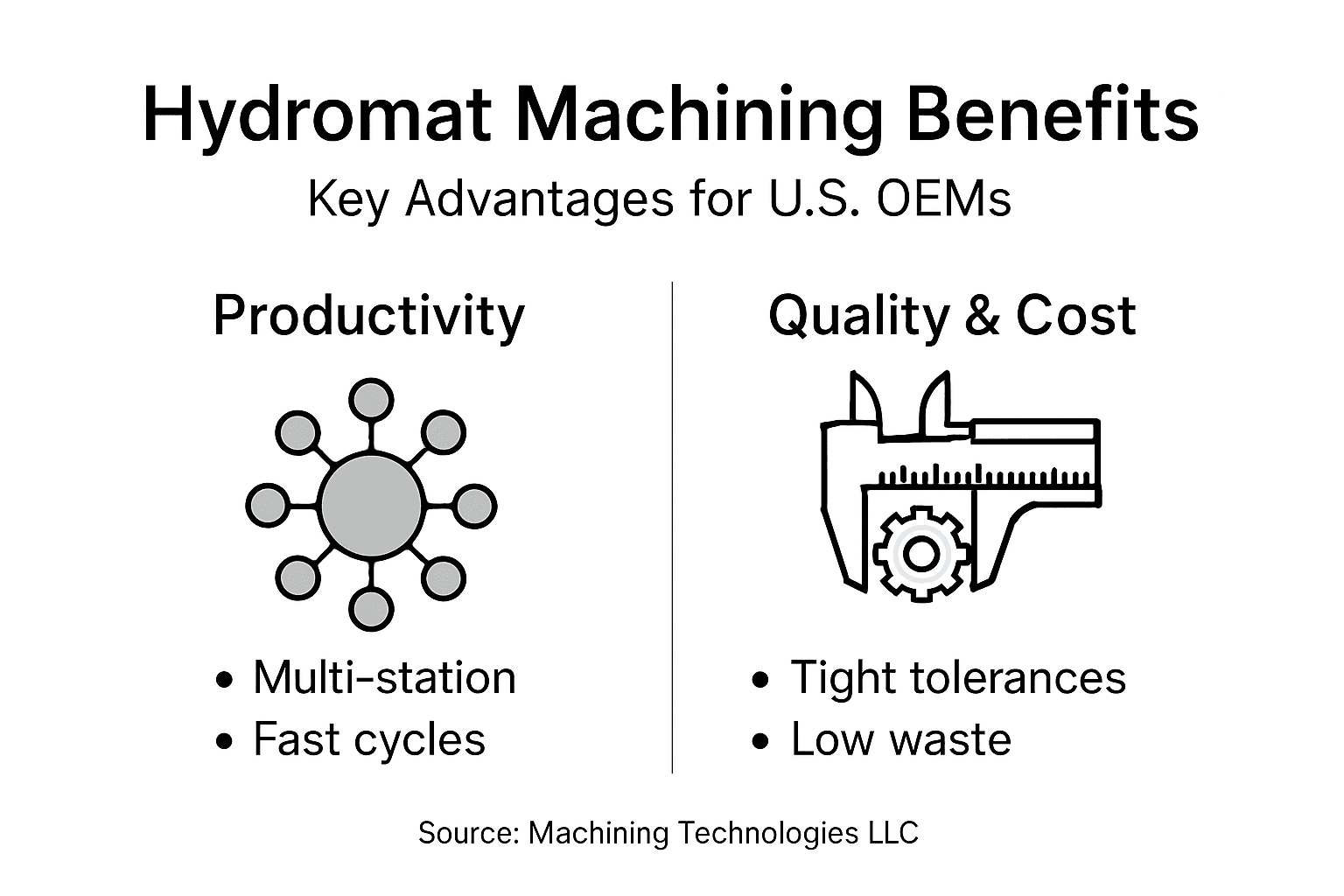
The productivity benefits of Hydromat machining are particularly pronounced in high-volume manufacturing environments. By enabling simultaneous multi-station machining operations, these systems can reduce production cycle times by up to 60-70% compared to traditional manufacturing approaches. OEMs can realize substantial cost savings through reduced labor requirements, minimal tool changeovers, and the ability to produce complex parts with near-zero defect rates. The modular design allows for rapid configuration changes, enabling manufacturers to quickly adapt to evolving production requirements without massive reinvestment in manufacturing infrastructure.
Quality represents another critical advantage of Hydromat machining for OEMs across aerospace, defense, and industrial sectors. The technology’s advanced CNC controls and precision indexing mechanisms ensure consistently tight dimensional tolerances, typically achieving accuracy within 0.0005 inches across multiple manufacturing stations. This level of precision translates directly into higher-quality components with improved mechanical performance, reduced post-production inspection costs, and enhanced reliability. Manufacturers can produce intricate parts with complex geometries that would be challenging or impossible to manufacture using conventional machining approaches, opening new possibilities for innovative product design.
Pro tip: Conduct a comprehensive total cost of ownership analysis that considers not just initial equipment investment, but long-term productivity gains, reduced labor costs, and improved part quality when evaluating Hydromat machining technologies.
Comparing Hydromat Machining to Other Production Methods
Manufacturing technologies vary significantly in their approach to precision part production, with Hydromat rotary transfer machining representing a quantum leap beyond traditional manufacturing methods. Rotary transfer machines distinguish themselves from conventional CNC machining centers and screw machines through their ability to perform multiple machining processes simultaneously, fundamentally transforming production efficiency and part complexity capabilities.
Traditional machining approaches like individual CNC centers or Swiss-style screw machines require sequential processing, with each operation demanding separate machine setups, tool changes, and part transfers. In contrast, Hydromat systems enable simultaneous multi-station machining, dramatically reducing cycle times and eliminating numerous secondary operations. While the initial investment for Hydromat technology is higher, the economic advantages become pronounced at production volumes exceeding 100,000 parts annually, where per-part manufacturing costs can be reduced by up to 40% compared to conventional machining strategies.
The technological superiority of Hydromat machining becomes especially evident when manufacturing complex, high-precision components requiring intricate geometries and tight dimensional tolerances. Unlike traditional methods that struggle with complex part designs, Hydromat systems can integrate drilling, milling, turning, and threading operations within a single, integrated platform. This comprehensive approach not only improves manufacturing precision but also reduces potential error points introduced by multiple machine transfers, ultimately delivering higher-quality components with more consistent performance characteristics.
Here’s a comparison of Hydromat rotary transfer machining and traditional production methods:
| Aspect | Hydromat Rotary Transfer | Traditional CNC/Screw Machines |
|---|---|---|
| Cycle Time | Reduced by 60-70% | Significantly longer |
| Operations Performed | Multiple simultaneously | One operation at a time |
| Setup Complexity | Single integrated setup | Multiple setups required |
| Suitable Volumes | 100,000+ parts/year | Lower or varied volumes |
| Cost Efficiency | Up to 40% cost reduction | Higher per-part cost for high volumes |
Pro tip: Conduct a comprehensive cost-benefit analysis that considers long-term production volumes, part complexity, and potential quality improvements when evaluating Hydromat machining against traditional manufacturing technologies.
Unlock High-Volume Precision with Hydromat Machining at Machining Technologies LLC
If your manufacturing challenges include meeting tight tolerances while reducing cycle times and handling complex part geometries, Hydromat rotary transfer technology offers a proven solution. The article highlights pain points like minimizing manual handling, maximizing throughput, and achieving ±0.0005 inch precision—goals that align perfectly with what we deliver. Our advanced Hydromat systems combined with CNC milling and turning capabilities enable OEMs in aerospace, defense, and industrial sectors to increase productivity without compromising quality.
Experience rapid turnaround and scalable production from prototypes through full-scale runs at our 70,000 square foot facility. Discover how our modular Hydromat machining setups can adapt to your part complexity and volume demands while slashing production costs. Connect today with industry leaders at Machining Technologies LLC and explore tailored solutions through our automated high-volume machining services. Don’t let time or precision hold you back — elevate your manufacturing now.
Frequently Asked Questions
What is Hydromat machining?
Hydromat machining is an advanced manufacturing technology focusing on high-volume precision component production using rotary transfer systems that enable multiple machining operations to occur simultaneously.
What are the benefits of using Hydromat machining for manufacturing?
The key benefits of Hydromat machining include reduced production cycle times, enhanced precision with tight tolerances, improved productivity through simultaneous operations, and the ability to handle complex geometries without requiring multiple setups.
How does Hydromat rotary transfer technology compare to traditional machining methods?
Hydromat rotary transfer technology allows for multiple machining processes to take place simultaneously, significantly reducing cycle times and overall production costs compared to traditional CNC machining centers that perform operations sequentially.
What industries can benefit from Hydromat machining?
Hydromat machining is particularly beneficial for industries such as aerospace, automotive, and industrial manufacturing, where high precision and efficiency are crucial for producing complex components.