

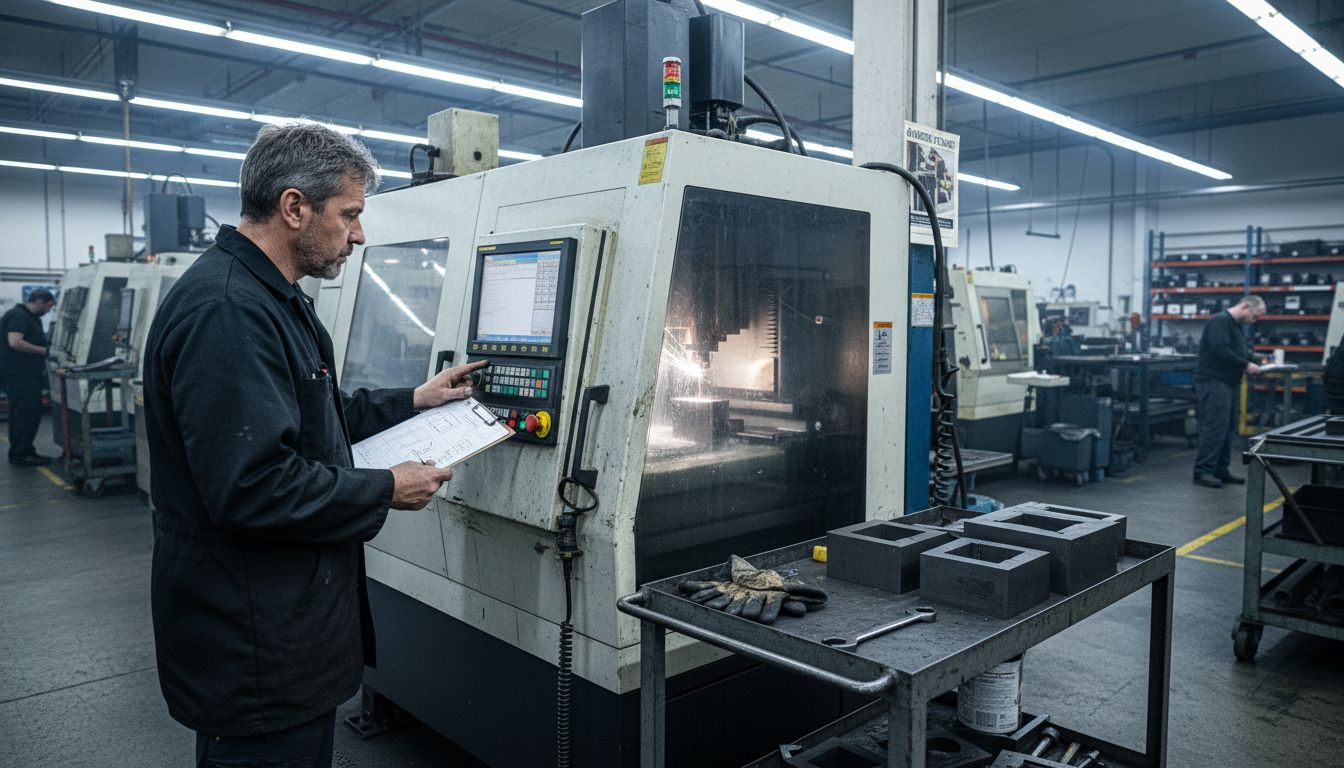
Precision requirements in American aerospace and defense manufacturing often push the limits of conventional machining. Producing high-tolerance components from hardened alloys or exotic materials demands more than brute force—it calls for a method that delivers accuracy without mechanical stress or burrs. This is where Wire Electrical Discharge Machining (Wire EDM) stands out, offering non-contact precision cutting for complex shapes and critical materials. Understanding Wire EDM and clearing up misconceptions is essential for teams aiming to meet the toughest production standards.
Table of Contents
- Wire Edm Defined And Common Misconceptions
- How Wire Edm Works Step By Step
- Types Of Wire Edm Equipment And Materials Used
- Key Applications In Aerospace And Defense
- Comparing Wire Edm To Cnc Milling And Alternatives
- Cost Drivers, Limitations, And What To Avoid
Key Takeaways
| Point | Details |
|---|---|
| Wire EDM Advantages | Wire EDM excels in machining complex geometries in hardened materials without introducing residual stresses, making it ideal for aerospace and defense applications. |
| Cost Efficiency | While traditionally perceived as expensive, Wire EDM often proves more cost-effective than conventional methods due to reduced tool changes and consolidated operations. |
| Surface Finish and Tolerance | Modern Wire EDM systems achieve high-quality surface finishes and tight tolerances, minimizing the need for secondary operations like grinding. |
| Supplier Selection | When choosing a Wire EDM supplier, prioritize those with robust maintenance protocols and certifications like NADCAP to ensure consistency and quality in production. |
Wire EDM Defined and Common Misconceptions
Wire Electrical Discharge Machining (Wire EDM) operates on a deceptively simple principle that produces extraordinarily complex results. The process uses a continuously moving thin metal wire submerged in a dielectric fluid, typically deionized water, as the cutting tool. Instead of physical contact between tool and workpiece, controlled electrical sparks jump the gap and melt or vaporize material from your conductive component. This absence of mechanical cutting forces makes Wire EDM uniquely capable of machining materials that conventional methods struggle with: hardened tool steels, tungsten carbide, ceramics, and other heat-treated alloys that aerospace and defense specifications demand. The wire itself never touches the part; the dielectric fluid does the heavy lifting by cooling the machining zone, flushing away debris, and maintaining the electrical path for each successive spark.
Here’s where misconceptions typically derail procurement and planning decisions. Many manufacturing teams assume Wire EDM works like traditional CNC milling, just with different tooling. That’s backwards. The lack of mechanical forces means you can machine parts with zero tool deflection, zero vibration, and zero stress on the workpiece. You can cut intricate cavities in hardened materials without annealing or heat-treating after machining. The wire moves continuously, and each electrical discharge removes approximately 0.01 to 0.1 millimeters of material per pass, depending on your power settings and wire speed. Another common misconception: that Wire EDM produces rough surfaces requiring finishing passes. Modern wire systems deliver surface finishes in the range of 0.4 to 1.6 micrometers in a single pass on aerospace-grade materials. Your tolerance stack-ups don’t require post-EDM grinding for most applications.
What trips up procurement specialists is assuming wire EDM costs more than conventional machining for complex geometries. Actually, the opposite holds true for your use case. When you’re producing critical components with tight tolerances in hardened materials, conventional methods require multiple operations, tool changes, heat treatment cycles, and secondary finishing. Wire EDM consolidates those into a single operation. Your lead times compress. Tool costs disappear since the wire degrades predictably and costs just a few dollars per spool. The real differentiator for aerospace and defense applications is the consistency and repeatability. Every part comes out identical because the process depends on precise electrical parameters you control through CNC programming, not operator skill or tool wear curves.
Pro tip: Before starting your next contract procurement, verify your supplier’s wire EDM capability by asking about their dielectric fluid maintenance protocols and actual surface finish measurements on your specific material grade, not theoretical specifications from equipment brochures.
How Wire EDM Works Step by Step
Understanding the Wire EDM process starts with grasping the fundamental mechanics. The operation begins when you position a thin conductive wire electrode and your workpiece with a precise gap between them, both submerged in dielectric fluid. High-frequency electrical discharges, or sparks, jump across that gap at rates typically between 5,000 and 200,000 times per second depending on your machine settings. Each spark generates temperatures exceeding 8,000 degrees Celsius in the localized discharge zone, causing a tiny explosion that vaporizes a minuscule amount of material from both the wire and your workpiece. The key insight here is that high-frequency electrical discharges remove material through thermal vaporization, not mechanical cutting. This distinction matters tremendously for your aerospace components because there’s zero mechanical stress applied to the part during machining.
The process flows through several coordinated stages that modern CNC systems manage automatically. First, the wire continuously advances through servo motors to maintain a consistent gap, typically 0.01 to 0.05 millimeters. The dielectric fluid circulates through the cutting zone at controlled pressure, serving three critical functions simultaneously: it cools the machined area to prevent thermal damage to your workpiece, flushes away the vaporized metal particles so they don’t interfere with subsequent sparks, and maintains electrical conductivity for the next discharge cycle. Your CNC controller guides the wire movement in two horizontal axes while the workpiece can shift vertically, allowing you to cut intricate profiles with wall thicknesses as thin as 0.1 millimeters. The wire itself gradually erodes during the process, but because it feeds continuously, you maintain cutting precision throughout the entire operation. On your critical aerospace components, this means no tool wear degradation affecting surface finish or dimensional accuracy across your production run.
The actual material removal rate depends on several parameters you control. Current setting determines how much energy each spark releases, directly affecting how much material vaporizes per discharge. Higher current speeds up cutting but can affect surface finish and introduce micro-cracks in hardened materials. Wire speed controls how fast fresh electrode material enters the cutting zone; slower speeds allow more spark energy to concentrate on material removal while faster speeds improve surface finish. Pulse duration determines how long each electrical discharge lasts. Your dielectric fluid type and condition profoundly impact performance too. Clean, properly maintained fluid with the correct conductivity level enables consistent, stable sparking patterns that translate to repeatable parts. When your fluid becomes contaminated with metal particles or loses its dielectric properties, spark gaps become erratic and your dimensional consistency suffers. This is why fluid filtration and maintenance directly impacts your ability to hold tight tolerances on that next batch of turbine blade platforms.
Pro tip: Request your wire EDM supplier provide actual dielectric fluid analysis reports and spark gap stability data specific to your material grade, not just generic machine capabilities, as fluid condition is the single largest variable affecting repeatability on hardened aerospace alloys.
Types of Wire EDM Equipment and Materials Used
Wire EDM equipment comes in two distinct configurations, each optimized for different production scenarios you’ll encounter in aerospace and defense manufacturing. High-speed wire EDM (WEDM-HS) operates with the electrode wire reciprocating rapidly at speeds of 8 to 10 meters per second, allowing the wire to be reused multiple times throughout a production run. This approach delivers faster processing speeds and lower wire costs, making it economical for higher-volume production of less critical components. However, high-speed systems introduce what’s called “wire walking,” a phenomenon where the wire deflects slightly under electrical and mechanical stress, potentially affecting dimensional accuracy on tight-tolerance features. The alternative is low-speed wire EDM (WEDM-LS), where the electrode wire moves slowly in one direction at speeds below 0.2 meters per second and gets discarded after use. Low-speed systems sacrifice processing speed for superior precision and surface finish quality. For your aerospace turbine blades and defense fire control components requiring tolerances in the 0.001-inch range, low-speed machines are the only viable choice because they eliminate wire deflection and deliver consistent dimensional accuracy across your entire production batch.
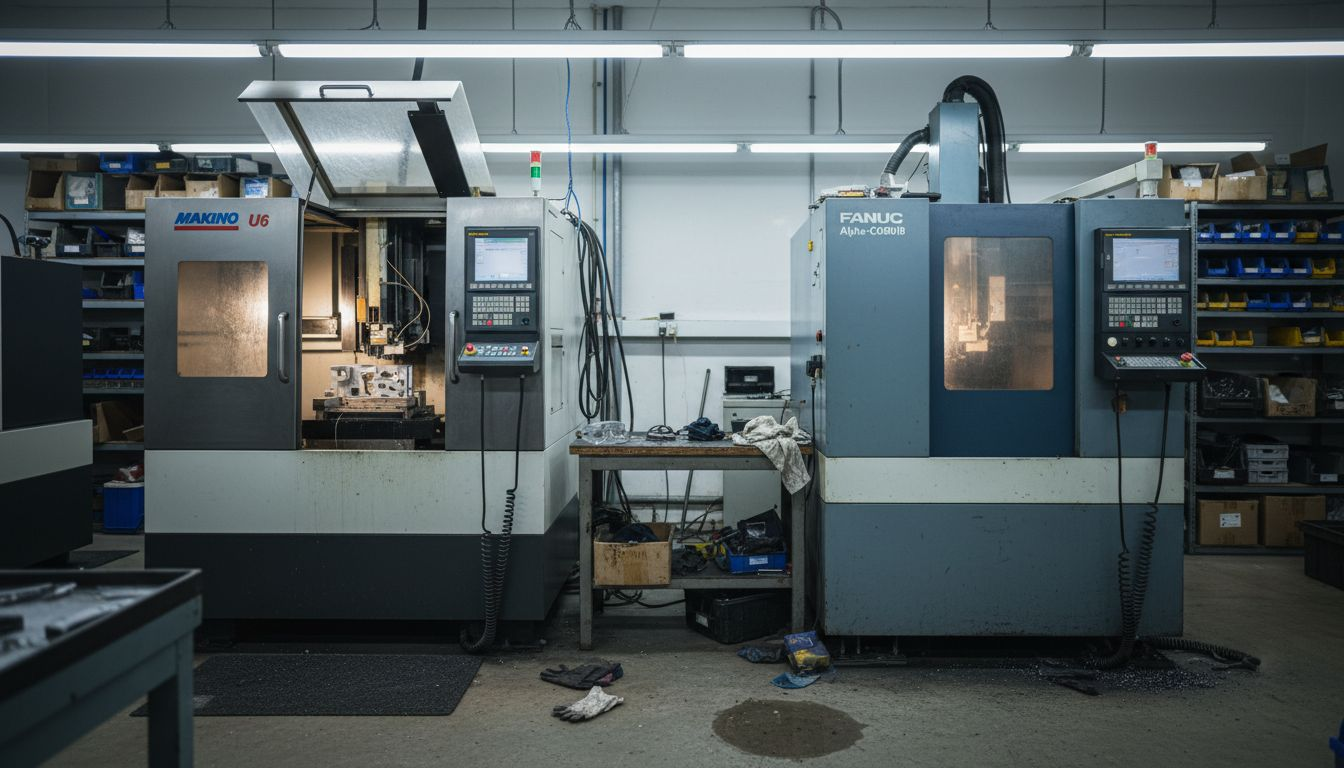
Regardless of which system you select, the supporting equipment infrastructure remains critical to your success. Wire electrodes are typically made from fine brass or zinc-coated copper wire, chosen for their excellent electrical conductivity and erosion characteristics. The machine frame includes precision tensioning and guiding mechanisms that maintain wire alignment within micrometers, preventing the deflection problems that plague less rigid systems. Your dielectric fluid system circulates deionized water or proprietary fluid formulations through the cutting zone at controlled pressure. The fluid serves as the cooling medium, debris remover, and electrical conductor simultaneously. A robust power supply generates pulsed electrical discharges with microsecond precision, typically operating in the 50 to 200-ampere range depending on your material and desired surface finish. The CNC control system orchestrates all these components, positioning your wire path with nanometer-level repeatability across multiple axes. For aerospace-grade work, your machine should feature closed-loop feedback systems that constantly monitor wire position and automatically compensate for thermal growth and mechanical drift during extended production runs.
The materials you can machine with Wire EDM expand dramatically compared to conventional machining. Standard candidates include stainless steel alloys, titanium and titanium aluminides used in compressor stages, tungsten for X-ray components, and nickel-based superalloys like Inconel 718 and Rene 77 that conventional tools cannot touch without rapid dulling. Hardened tool steels including H13, A2, and O1 that have been heat-treated to 62 Rockwell hardness are Wire EDM-friendly, eliminating the need for expensive pre-hardening operations and secondary finishing. Tungsten carbide and other cemented carbides machine cleanly, producing burr-free edges critical for bearing races and precision valve seats. Even conductive ceramics and some composite materials with conductive matrices respond well to Wire EDM. The common thread binding all these materials is electrical conductivity. If your material conducts electricity, Wire EDM can machine it, regardless of hardness or toughness. This capability directly addresses your biggest procurement challenge: producing final-hardened components that skip the traditional soft-machine, heat-treat, hard-machine sequence. You get parts to final dimensions and surface finish in a single operation after heat treatment.
Pro tip: When selecting a Wire EDM vendor for critical aerospace components, ask specifically whether they operate low-speed systems with closed-loop servo feedback and what their wire tension stability is over an eight-hour production run, as these specifications directly determine whether your tightest tolerance stacks are achievable.
Key Applications in Aerospace and Defense
Wire EDM has become indispensable in aerospace and defense manufacturing precisely because it solves problems that conventional machining cannot. Your turbine engine manufacturers rely on Wire EDM to produce compressor and turbine blade platforms from nickel-based superalloys that would destroy carbide tooling within minutes of conventional cutting. The ability to machine these components from the fully hardened state eliminates the soft-machine, heat-treat, hard-machine sequence that traditionally added weeks to production schedules and introduced dimensional inconsistencies between heat treatment cycles. Similarly, airframe structural components fabricated from titanium alloys benefit from Wire EDM’s stress-free cutting characteristics. Since the process applies zero mechanical force to your workpiece, you avoid the subsurface damage and residual stress that conventional machining creates in titanium. This matters tremendously when those components will experience high-cycle fatigue loading in service. Precision components from difficult-to-machine materials like titanium alloys and superalloys represent the sweet spot for Wire EDM application, delivering both quality and schedule advantages simultaneously.
Defense applications drive even more demanding Wire EDM requirements. Fire control systems, guidance components, and targeting mechanisms demand tolerances so tight and geometries so complex that Wire EDM is often the only viable manufacturing method. You’re producing small, fragile parts where conventional cutting forces would damage the finished surface or introduce micro-cracks that would compromise reliability under shock or vibration loads. Weapons system components manufactured from hardened tool steels maintain their metallurgical integrity through the machining process because there’s no heat buildup or mechanical work-hardening. Your defense contractors understand that a part machined by Wire EDM from the hardened state arrives at final inspection ready to assemble. There’s no secondary stress-relief cycle, no hard-finish grinding operation, and no rework. The complexity of defense applications also drives Wire EDM adoption. Components with internal cooling passages, intricate cavity networks, and wall thicknesses under 0.050 inches are routine Wire EDM work that would be impossible or economically prohibitive with conventional tooling.
The tooling and die-making sectors within aerospace and defense represent another critical application area. Injection molds for composite production, progressive die sets for precision stamping, and electroform dies all benefit from Wire EDM’s ability to produce intricate cavities with excellent surface finish and dimensional repeatability. Your aerospace suppliers who manufacture composite structures depend on injection mold tooling that Wire EDM produces with the precision needed for repeatable part geometry and minimal flash. This becomes increasingly important as composite structures move toward tighter tolerances and more complex architectures. The regulatory environment reinforces Wire EDM’s importance across all these applications. Your suppliers must maintain NADCAP accreditation for electrical discharge machining, which means they follow stringent requirements that govern process control, equipment maintenance, traceability, and quality documentation. These standards exist because aerospace and defense customers recognize that Wire EDM is not merely a machining process; it’s a critical manufacturing capability that directly impacts component reliability and field performance.
Pro tip: When qualifying a new Wire EDM supplier for aerospace defense contracts, request their NADCAP audit reports and specifically review the corrective action history section to understand how seriously they manage process deviations and equipment maintenance issues.
Comparing Wire EDM to CNC Milling and Alternatives
The fundamental difference between Wire EDM and conventional CNC milling comes down to how material gets removed. CNC milling uses sharp cutting tools that physically engage the workpiece, applying mechanical forces to shear away material. Wire EDM, by contrast, is a non-contact process using sparking to erode metal without any tool touching the part. This distinction shapes everything about how you should approach your manufacturing decisions. When you’re producing aerospace components from hardened superalloys or defense fire control parts with wall thicknesses under 0.050 inches, CNC milling struggles because conventional cutting tools dull rapidly on hard materials and vibration during cutting can introduce micro-cracks or subsurface damage. Wire EDM handles these scenarios effortlessly because electrical discharges care nothing about material hardness. A part heat-treated to 62 Rockwell hardness machines just as easily as annealed material, with zero residual stress introduced into the metallurgical structure. CNC milling remains superior for bulk material removal on softer materials and simpler geometries where speed and throughput matter more than precision. Your production schedule for thousand-piece orders of aluminum brackets favors CNC milling. Your limited-quantity orders of hardened tool steel fire control components favor Wire EDM.
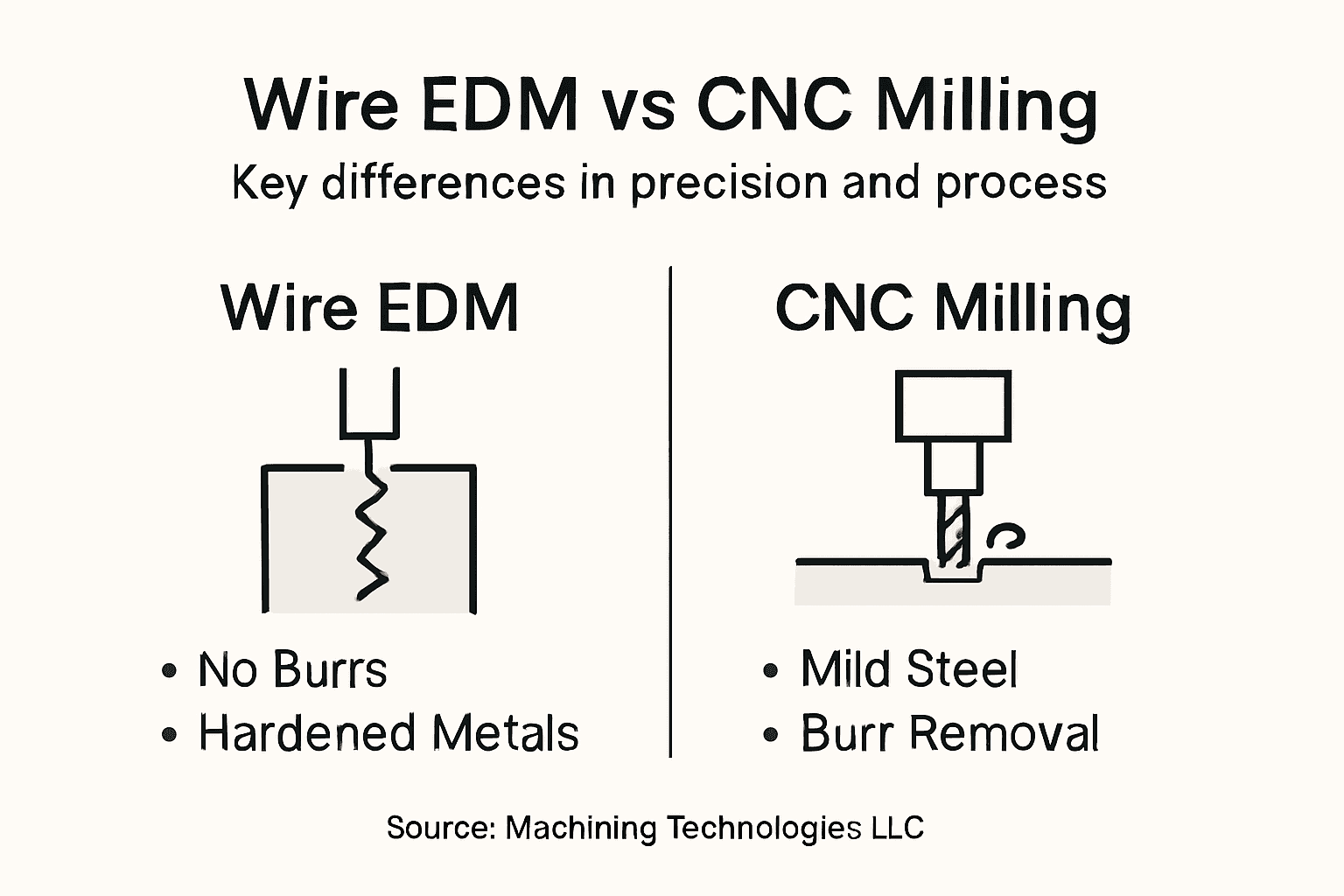
The precision and surface finish capabilities tell another story. Wire EDM eliminates burr formation entirely because there are no mechanical cutting forces tearing grain boundaries. Your parts come off the wire clean, requiring no secondary deburring operations. CNC milling creates burrs on external edges and internal cavities that require post-machining cleanup time. On surface finish, Wire EDM delivers consistent micro-inch-level finishes in a single pass on aerospace-grade materials. CNC milling produces respectable finishes but may require semi-finish and finish passes to achieve equivalent results, adding time and tooling costs. The accuracy picture complicates the comparison. CNC milling achieves tight tolerances through rigid machine construction and sharp tooling that doesn’t deflect under cutting loads. Wire EDM achieves tight tolerances through precise electrical control and continuous wire feeding that compensates for wire erosion. Both can hold your 0.0005-inch tolerance stack-ups reliably, but they get there through completely different mechanisms. The real question becomes economic. For a single prototype fire control component, Wire EDM costs less than setting up CNC milling with custom fixturing and multiple tool changes. For a production run of 500 identical brackets, CNC milling beats Wire EDM on unit cost and throughput.
Alternative processes deserve mention here, though they occupy specific niches. Sinker EDM machines cavities and internal features using a shaped electrode that erodes downward, ideal for mold and die production. However, sinker EDM lacks the profile cutting precision of Wire EDM and cannot produce external contours with the same accuracy. Laser cutting handles some applications on thin materials, but induces heat-affected zones and melted edges on precision aerospace components that violate material specifications. Water jet cutting works well on softer materials but cannot achieve the surface finishes and dimensional tolerances your defense specifications demand on hardened steels. Conventional grinding produces excellent finishes but is phenomenally slow for producing intricate cavities and complex profiles. The reality is that none of these alternatives compete directly with Wire EDM when your requirements involve intricate shapes in hardened, conductive materials. They occupy parallel manufacturing spaces, each optimized for different material characteristics and tolerance demands.
Your decision framework should center on material hardness, complexity, and quantity. If your component is relatively simple geometry in mild steel or aluminum and you need 1,000 pieces by next month, CNC milling wins. If your component is complex geometry in hardened tool steel, nickel-based superalloy, or tungsten carbide and you need 50 pieces with surface finishes in the 0.4-micrometer range and zero residual stress, Wire EDM wins decisively. Most production programs benefit from partnering with a supplier who masters both processes and recommends the optimal method based on your specific engineering requirements rather than equipment utilization targets.
Here is a quick comparison of Wire EDM, CNC Milling, and alternative processes for precision component manufacturing:
| Process | Ideal Materials | Best For | Key Limitations |
|---|---|---|---|
| Wire EDM | Hardened, conductive | Intricate profiles, tight | Must cut through part |
| metals, superalloys | tolerances, burr-free edges | Cannot make blind holes | |
| CNC Milling | Aluminum, steels, softer | Bulk removal, simple parts | Tool wear on hard metals |
| alloys | high-quantity production | Residual stresses | |
| Laser Cutting | Thin metals, some alloys | Fast, 2D shapes | Heat-affected zones |
| Sinker EDM | Tool steel, alloys | Deep cavities, molds/dies | Limited external contours |
| Water Jet Cutting | Soft, thick materials | No heat-affected zones | Lower finish, thick parts |
| Grinding | Hard/heat-treated metals | Fine surface finish | Slow on complex features |
Pro tip: When evaluating manufacturing quotes from competing suppliers, compare not just the unit price but the total landed cost including secondary operations, tooling charges, and schedule compression, as Wire EDM often delivers better overall value than CNC milling when you factor in elimination of post-machining finishing work.
Cost Drivers, Limitations, and What to Avoid
Wire EDM costs break down into several distinct categories that directly impact your manufacturing budget. Wire consumption represents the largest variable expense, but modern machines have made dramatic improvements here. Advanced technologies have reduced wire consumption by over 60% compared to older systems through fiber optic monitoring and high-speed spark detection that optimize material removal rates and minimize unnecessary wire erosion. That efficiency translates directly to your bottom line on large production runs. Machine uptime drives costs through labor allocation and facility overhead. Wire breakage, poor flushing, or maintenance issues idle your machine, extending lead times and tying up shop floor space. Operator efficiency matters tremendously because Wire EDM requires skilled setup and monitoring, especially when running unattended overnight cycles. Machines with auto-threading capabilities and advanced controls reduce operator touch time, but operators need training to use these features effectively. Your dielectric fluid costs add up faster than many engineers anticipate. Fluid degrades over time, collects metal particles and contaminants, and requires regular filtration or replacement. Neglecting fluid maintenance transforms a precision process into an unreliable one. The wire electrode itself costs just a few dollars per spool, but quality matters enormously. Cheap wire with inconsistent diameter or poor surface finish causes frequent breakage and dimensional inconsistency. Your procurement decision on wire grade directly impacts your scrap rates and production consistency.
Wire EDM carries real geometric limitations that can eliminate it as an option entirely. The most critical restriction is this: the wire must pass completely through the workpiece. You cannot machine blind holes, closed cavities, or internal features that don’t extend fully through the part. This single limitation eliminates Wire EDM for many defense components with internal cooling passages or precision cavities that don’t intersect the part boundary. If your design requires blind holes for fasteners or internal ports, you need CNC milling or sinker EDM for those features. The wire approach also struggles with very thick parts because cutting speed slows dramatically as you move deeper into the material. A 0.5-inch thick aerospace bracket machines reasonably fast. A 3-inch thick forged steel housing cuts at a crawl. Wire path complexity adds cost and time. Your intricate internal contours require multiple wire passes and significant setup planning. Parts with sharp internal corners also challenge Wire EDM because the wire diameter creates minimum corner radii. Limitations include the requirement for the wire to pass fully through the workpiece, restricting some part geometries that would be trivial for conventional milling.
Common mistakes separate reliable Wire EDM operations from frustrating ones. Poor wire quality tops the list. Using budget-grade wire introduces diameter variation that causes inconsistent spark gaps and dimensional drift across your production run. The cost savings on wire vanish the first time you scrap ten parts due to out-of-tolerance features. Inadequate wire tensioning creates the same problems. Loose wire deflects under spark forces, producing dimensional inconsistency and poor surface finish. Your supplier’s tensioning system must maintain wire tension within tight tolerances throughout the entire machining cycle. Insufficient flushing represents another major trap. When dielectric fluid doesn’t adequately flush away debris from the cutting zone, metal particles accumulate, creating electrical paths that cause short circuits and wire breakage. Proper fluid circulation, maintained at the correct pressure and flow rate, prevents this completely. Poor setup geometry causes preventable failures. Loading your workpiece with inadequate clamping allows minute vibration that affects surface finish and accuracy. Workpiece positioning relative to the wire path requires precision that sloppy setup cannot deliver. Your supplier should verify setup repeatability with test cuts before committing to full production runs on critical aerospace components. Neglecting preventive maintenance transforms a reliable process into an unreliable one. Machine guides accumulate metallic debris, servo motors develop drift, fluid filtration systems fail, and electrical contacts oxidize. Suppliers operating under NADCAP standards maintain strict maintenance schedules that prevent these issues.
The following table summarizes key cost drivers and errors to avoid for successful Wire EDM manufacturing:
| Factor | Cost Impact | What to Avoid |
|---|---|---|
| Wire Quality | Drives scrap rates | Low-grade or inconsistent wire |
| Dielectric Fluid | Affects repeatability | Ignoring routine maintenance |
| Machine Uptime | Impacts labor/overhead | Delays from lack of training |
| Wire Tension/Guides | Influences accuracy | Improper tension setup |
| Setup Geometry | Impacts dimensional repeat | Loose clamping/vibration |
Pro tip: When submitting Wire EDM drawings for quote, explicitly note any internal features or blind holes that cannot be produced by Wire EDM and identify the alternative processes needed for those features, preventing supplier delays when they discover design conflicts during programming.
Unlock Precision and Performance with Expert Wire EDM Services
The article highlights the challenge of machining complex, hardened materials for aerospace, defense, and other high-demand industries without compromising surface finish or dimensional accuracy. If you need burr-free edges, consistent tolerances, and rapid turnaround on parts made from tough alloys like Inconel or tool steel, traditional methods often fall short. Wire EDM solves these problems by removing material through controlled electrical discharges, eliminating mechanical stress and ensuring repeatable precision. However, success depends on advanced equipment, careful dielectric fluid management, and skilled operators.
At Machining Technologies LLC, we specialize in delivering high-volume, precision Wire EDM machining from our 70,000 square foot facility in Webster Massachusetts. Our experienced team uses state-of-the-art CNC-controlled wire EDM systems combined with rigorous quality controls aligned to aerospace and defense requirements. We understand the critical importance of factors like wire tension stability, dielectric fluid maintenance, and minimizing wire consumption to reduce costs while providing unmatched accuracy and surface finish on the most complex components.
Discover how our wire EDM capabilities can transform your production challenges into streamlined solutions.
Contact Machining Technologies LLC today to partner with a trusted contract manufacturer that delivers precision, speed, and repeatability every time. Whether your needs are prototypes or full-scale production runs, count on us to meet your industry standards with on-time delivery and exceptional customer service.
Frequently Asked Questions
What is Wire EDM and how does it work?
Wire Electrical Discharge Machining (Wire EDM) is a machining process that uses a thin metal wire submerged in dielectric fluid to cut conductive materials. Controlled electrical sparks jump across the gap between the wire and the workpiece, eroding material without any mechanical contact, which allows for high precision and complex geometries.
What materials can be machined using Wire EDM?
Wire EDM can machine a variety of conductive materials, including hardened tool steels, superalloys like Inconel and Rene, ceramics, and tungsten carbide. If a material conducts electricity, it can typically be machined using Wire EDM, making it ideal for aerospace and defense applications.
How does Wire EDM compare to CNC milling in terms of precision and cost?
Wire EDM offers superior precision and surface finish for intricate geometries in hardened materials compared to CNC milling, which struggles with tool wear on hard materials. While Wire EDM has higher per-part costs, it often consolidates multiple machining operations into one, reducing overall expenditures for complex components when considering time and quality.
What are the key advantages of using Wire EDM in aerospace and defense manufacturing?
The key advantages of Wire EDM in aerospace and defense include the ability to machine complex shapes from the fully hardened state, minimal residual stress on finished components, and precise control over tolerances. This process eliminates the need for multiple machining steps, thereby simplifying workflows and reducing lead times.