

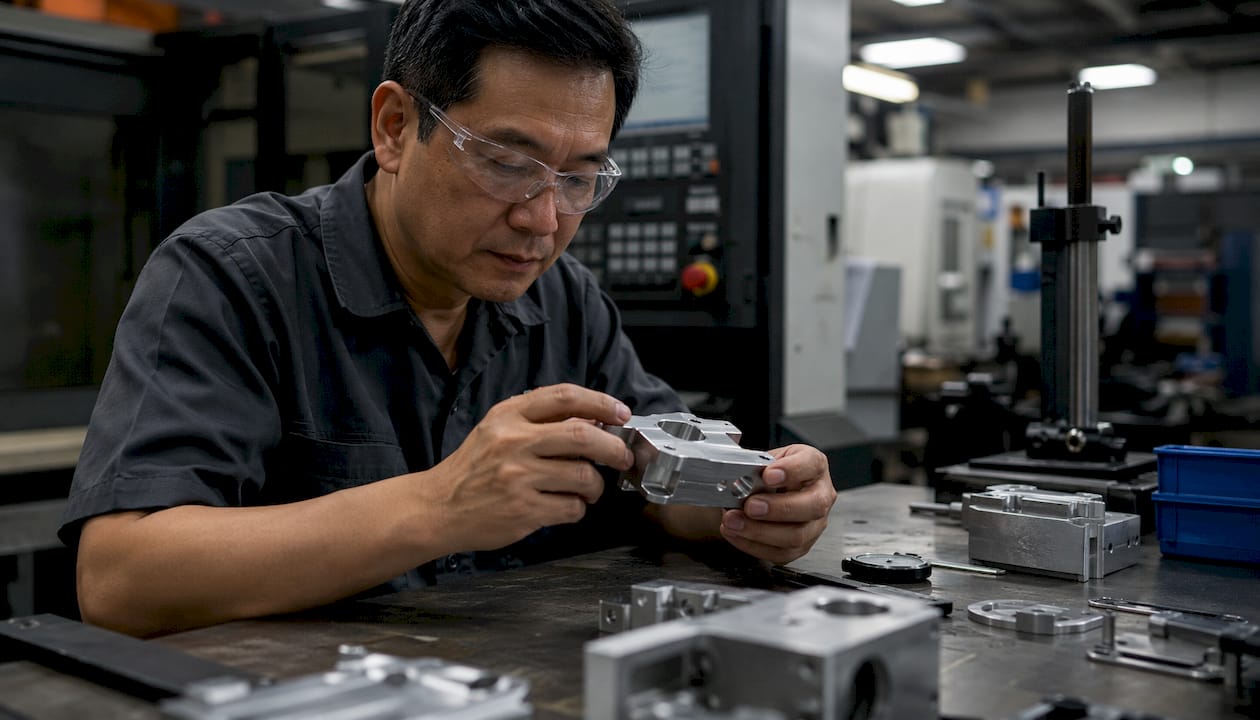
Rapid prototyping is the fastest way to surface and fix design problems before you commit to tooling and mass production. For OEMs and industrial manufacturers, that single fact drives the decision. A prototype made on production-grade equipment confirms three things that no simulation can fully replace:
- Manufacturability validation: Can the part actually be made to spec on your production process?
- Tolerance verification: Do the dimensions hold under real cutting forces, material behavior, and fixturing?
- Time-to-market acceleration: Does the design clear functional testing early enough to avoid a tooling rework cycle?
Machiningtechllc has run prototyping programs since 1985, producing millions of parts annually from a 70,000 sq ft facility in Webster, Massachusetts. The guidance below draws on that depth.
Table of Contents
- Why rapid prototyping matters strategically for OEMs
- Which rapid prototyping methods work for precision metal parts?
- How to choose the right method for your prototyping goal
- What drives prototyping lead times and costs?
- How a contract machining partner reduces risk from prototype to production
- Questions to ask before you approve a prototyping partner
- Key Takeaways
- The prototyping mistake most OEMs make too late
- Machiningtechllc delivers production-grade prototypes that scale
Why rapid prototyping matters strategically for OEMs
The core argument is simple: discovering design failures after tooling is cut costs orders of magnitude more than catching them in a prototype. Hard tooling for a precision metal component can run tens of thousands of dollars. A tooling rework cycle adds weeks or months to a program. Warranty and recall exposure compounds that cost further.
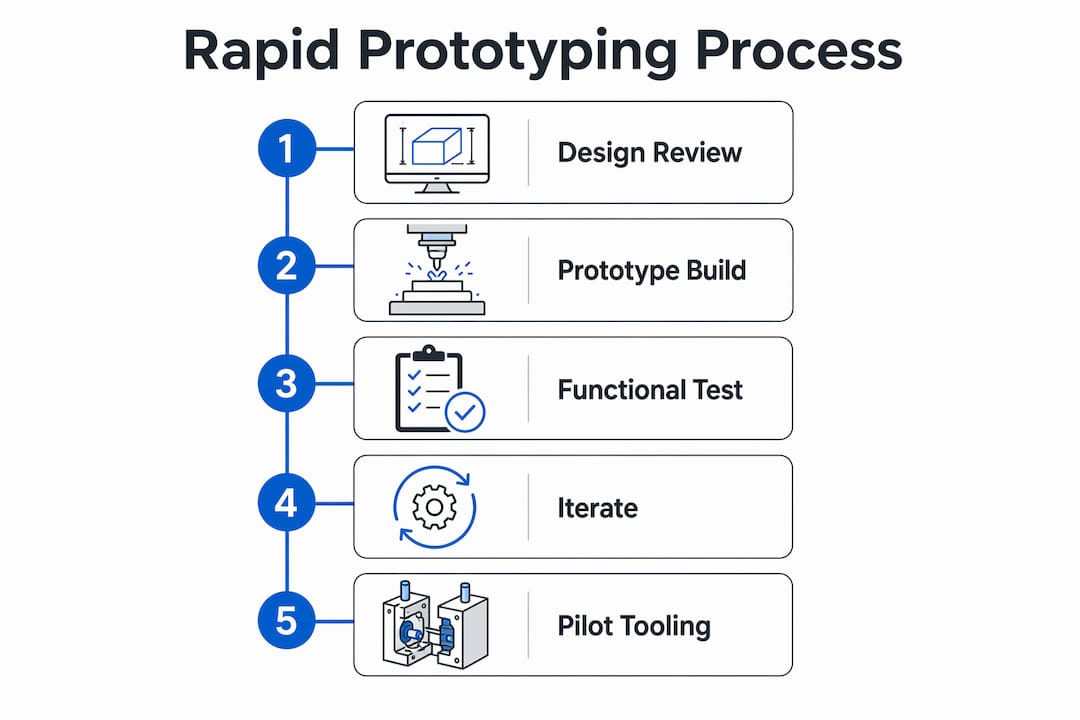
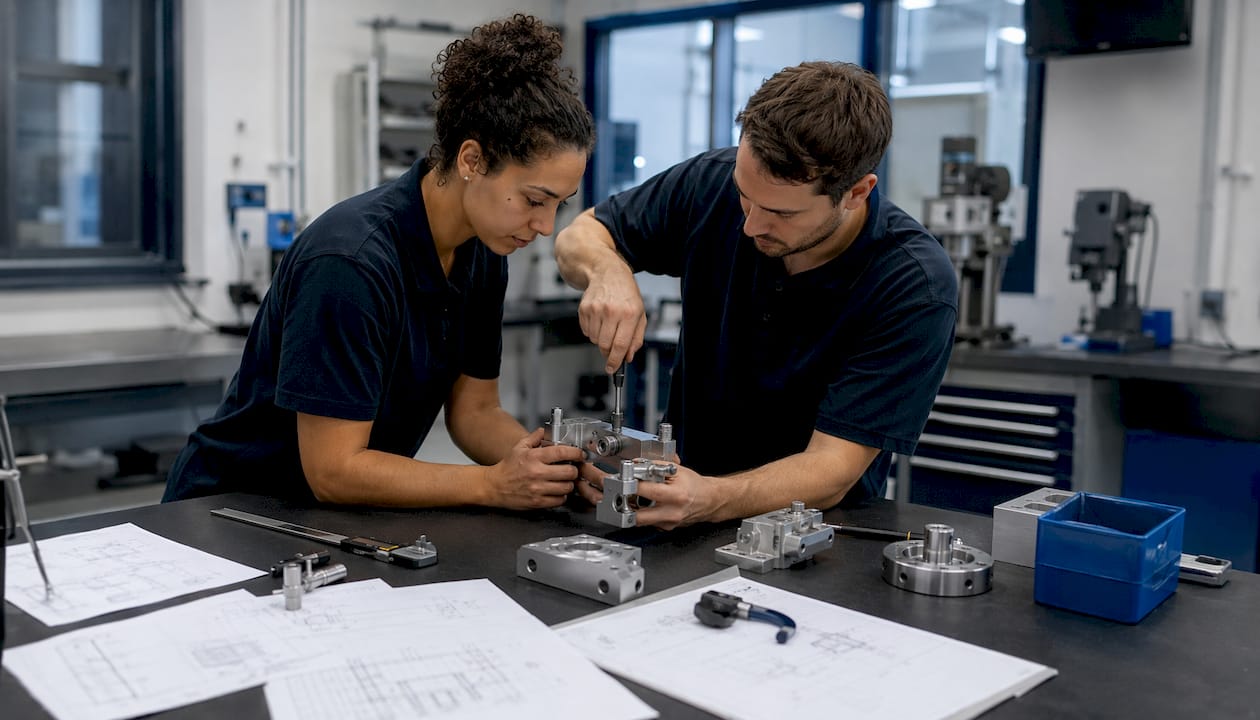
Functional prototypes accelerate decisions by exposing fit issues, tolerance stack-up, thermal behavior, and mechanical assumptions while changes are still inexpensive. The prototype is not a deliverable. It is a question-answering machine. Every iteration narrows the gap between what the design assumes and what the production process can reliably deliver.
Pro Tip: Stop iterating a prototype and move to pilot tooling when two consecutive builds produce no new failure modes and dimensional results fall within your production tolerance band. Continuing past that point is spending money on confirmation, not discovery.
Which rapid prototyping methods work for precision metal parts?
The right method depends on what question you need answered. CNC milling and turning produce the highest dimensional accuracy and use production-grade metals, making them the default for functional and production-validation prototypes. Wire EDM handles tight internal features, thin walls, and hard materials that conventional cutting cannot reach cleanly. Metal additive manufacturing suits part consolidation and complex internal geometries where traditional machining would require multiple setups or assemblies. For plastics, SLA delivers the smoothest surface finish for form and fit checks, while SLS handles complex geometry with near-injection-molded strength. Short-run molding and urethane casting bridge the gap when you need a small batch of production-representative plastic or elastomeric parts without cutting a production tool.
| Method | Prototype purpose | Lead time | Material fidelity | Tolerance capability | Single-piece vs. short-run cost | Scalability to production |
|---|---|---|---|---|---|---|
| CNC milling/turning | Function, fit, production validation | 3 days | High (production metals) | ±0.005" | Moderate / drops with volume | Direct; no additional tooling for bridge runs |
| Wire EDM | Function, tight-feature validation | 3 days | High (production metals) | ±0.001" | Higher / moderate at short run | Direct for low-volume; scales with CNC |
| Metal additive (DMLS/SLM) | Form, function, part consolidation | 5 days | Moderate (post-process needed) | ±0.010" | High / moderate at low volume | Limited; requires process validation |
| SLA (resin) | Form, visual approval | 1–3 days | Low (not production material) | ±0.010" | Low / low | Not scalable to metal production |
| SLS (nylon/PA) | Form, fit, functional plastic | 2–5 days | Moderate (engineering plastics) | — | Low–moderate / low | Limited; bridge to injection molding |
| Urethane casting | Fit, functional plastic, small batch | 5 days | Moderate (simulates production resin) | — | Moderate / low batch sizes | Bridge only; not a production process |
A few cases worth calling out specifically:
- Hydromat systems excel at bridging from prototype to high-volume production for rotational and multi-operation parts; validated parameters from a prototype run transfer directly to the Hydromat cell.
- Wire EDM is the right call when a feature requires a surface finish or positional tolerance that milling cannot hold reliably, particularly in hardened steels or carbide.
- Metal additive earns its place when part consolidation reduces assembly count or when internal channels make conventional machining impractical, but quality controls and process knowledge must be vetted before treating AM parts as production-representative.
How to choose the right method for your prototyping goal
Start with the primary question the prototype must answer, then pick the method that resolves it most directly.
| Prototype goal | Recommended method(s) | Key trade-off |
|---|---|---|
| Visual/stakeholder approval | SLA, FFF | Fast and cheap; no material fidelity |
| Dimensional fit check | CNC milling/turning, SLS | CNC for metal assemblies; SLS for plastic housings |
| Functional stress/mechanical test | CNC milling/turning, wire EDM | Requires production material and tolerances |
| Thermal or sealing behavior | CNC milling/turning | Only production-grade metal gives valid data |
| Production validation (PV&V) | CNC on production equipment | Must match production material, process, and parameters |
| Small-batch bridge | CNC short run, urethane casting, Hydromat | Cost per piece drops; validates production workflow |
Hybrid approaches make sense in two situations. First, when you need fast stakeholder sign-off before committing machining time: a 3D-printed master pattern fed into urethane casting gives you 20–50 representative plastic parts in days. Second, when a CNC prototype reveals a surface-finish requirement that needs a secondary operation: running the finish step during prototyping documents the process before it becomes a production assumption. The signal to escalate to production-grade tooling is when your prototype results are repeatable and your process parameters are documented. See real machining examples for how this plays out across part families.
What drives prototyping lead times and costs?
For CNC metal prototypes, lead times often run from a few days to a couple of weeks depending on part complexity and method, with wire EDM and additive metal processes generally requiring longer lead times.
The main cost drivers, in rough order of impact:
- Material choice: Titanium and Inconel cost significantly more in raw stock and machine time than aluminum or mild steel.
- Tolerance requirements: Tighter tolerances mean slower feeds, more setups, and mandatory inspection steps.
- Surface finish: A ground or lapped surface adds operations; an as-machined finish does not.
- Number of iterations: Each revision cycle resets setup costs; consolidating change requests before re-cutting saves money.
- Inspection and validation: First-article inspection (FAI), CMM reports, and material certifications add cost but are non-negotiable for aerospace and defense programs.
- Secondary operations: Heat treat, plating, anodizing, and assembly all extend the timeline and add cost.
The spend concentrates at two points: the first article (setup, fixturing, programming) and any iteration that requires a new setup. In-house desktop 3D printing can absorb early concept iterations cheaply, but once the question shifts to material behavior or production tolerances, outsourcing to a production-grade partner is the only way to get valid data.
How a contract machining partner reduces risk from prototype to production
A production-grade partner does something a job shop cannot: they run your prototype on the same equipment, with the same materials and process parameters, that will produce your production parts. That means validated manufacturing parameters transfer directly to the production floor without re-qualification surprises.
The single best predictor of smooth scale-up is whether prototypes are made on production-grade equipment or at least use production-grade materials and validated process parameters. When that condition is met, the prototype is not just a test article. It is the first data point in your production process record.
The mechanisms that make this work: design for manufacturability (DFM) feedback during quoting, production-material procurement, documented fixturing and tooling setups, first-article inspection against the drawing, and a process record that travels with the part into production. Machiningtechllc’s 70,000 sq ft facility runs CNC milling and turning, Hydromat multi-spindle systems, and wire EDM under one roof, which means the path from prototype to high-volume production does not require rebuilding a supply chain.
| Partner capability | What it prevents |
|---|---|
| DFM feedback at quoting | Tooling rework from unmachineable features |
| Production-grade equipment for prototypes | Process surprises during scale-up |
| CMM inspection and FAI | Tolerance escapes reaching assembly |
| Traceable process documentation | Re-qualification delays at production launch |
| In-house finishing and secondary ops | Supply chain gaps between prototype and pilot |
Before sharing CAD files with any partner, confirm their data protection workflow covers CAD files and BOMs. IP exposure during prototyping is a real risk that procurement teams often overlook.
Questions to ask before you approve a prototyping partner
Start with these five before you issue an RFQ:
- Do you prototype on the same equipment used for production runs?
- What materials do you stock, and can you source certified material for aerospace or defense programs?
- What inspection capability do you have in-house (CMM, surface profilometer, optical comparator)?
- What is your documented lead time for a first article, and what causes it to slip?
- Can you provide DFM feedback before you quote, and do you document it?
Red flags that should stop an RFQ:
- No first-article inspection report offered as standard
- DFM feedback is verbal only, with no written record
- Finishing and secondary operations are outsourced with no traceability
- Lead times are quoted without a capacity check
- No quality certifications relevant to your industry (ISO 9001 at minimum; AS9100 for aerospace)
For OEM prototyping programs, also confirm the partner can provide material certifications, process records, and a documented path to production pricing. A partner who cannot show you that path is a prototype-only vendor, not a scale-up partner.
Key Takeaways
Rapid prototyping reduces OEM risk most effectively when prototypes are made on production-grade equipment with documented process parameters that transfer directly to the production floor.
| Point | Details |
|---|---|
| Prototype as risk tool | Use prototyping to resolve known unknowns before tooling, not to produce deliverables. |
| Match method to goal | CNC and wire EDM for functional/production validation; SLA/SLS for form and fit only. |
| Cost concentrates early | Setup and first-article inspection drive prototype cost; consolidate changes before re-cutting. |
| Production-grade equipment matters | Prototypes on production machines give valid scale-up data; desktop prints do not. |
| Machiningtechllc | Offers CNC, Hydromat, and wire EDM under one roof for prototypes through high-volume production. |
The prototyping mistake most OEMs make too late
The most common avoidable error in OEM prototyping programs is treating the prototype as a proof-of-concept rather than a process validation. Teams spend weeks iterating a 3D-printed model for stakeholder approval, then hand a “finalized” design to a machinist and discover the part has features that cannot be held to tolerance in production. The tooling gets cut. The tolerance escape shows up in assembly. The rework is expensive and the schedule slips.
The fix is not complicated: require that at least one prototype in the sequence be made on production-grade equipment, in production material, with documented process parameters. That one build will surface more actionable information than a dozen printed concept models. The step-by-step prototyping process that separates successful programs from costly rework cycles almost always includes that production-representative build as a gate before tooling approval.
Machiningtechllc delivers production-grade prototypes that scale
When your program cannot afford a tooling rework cycle, you need a partner whose prototype is already a production data point. Machiningtechllc has operated from a large manufacturing facility in Webster, Massachusetts since 1985, producing millions of parts annually across CNC milling and turning, Hydromat multi-spindle machining, and wire EDM. Prototypes run on the same equipment as production orders, which means DFM feedback, process parameters, and inspection records carry forward without re-qualification.
Three things that set this apart for OEM programs: rapid turnaround on first articles, production-grade machines used from the first prototype, and full DFM and PV&V support documented for your process record. Whether you need a single functional prototype or a bridge run of 500 parts before full production, the CNC milling and turning and wire EDM capabilities are in-house and ready. Request a quote at machiningtechllc.com and get a DFM review with your first response.