
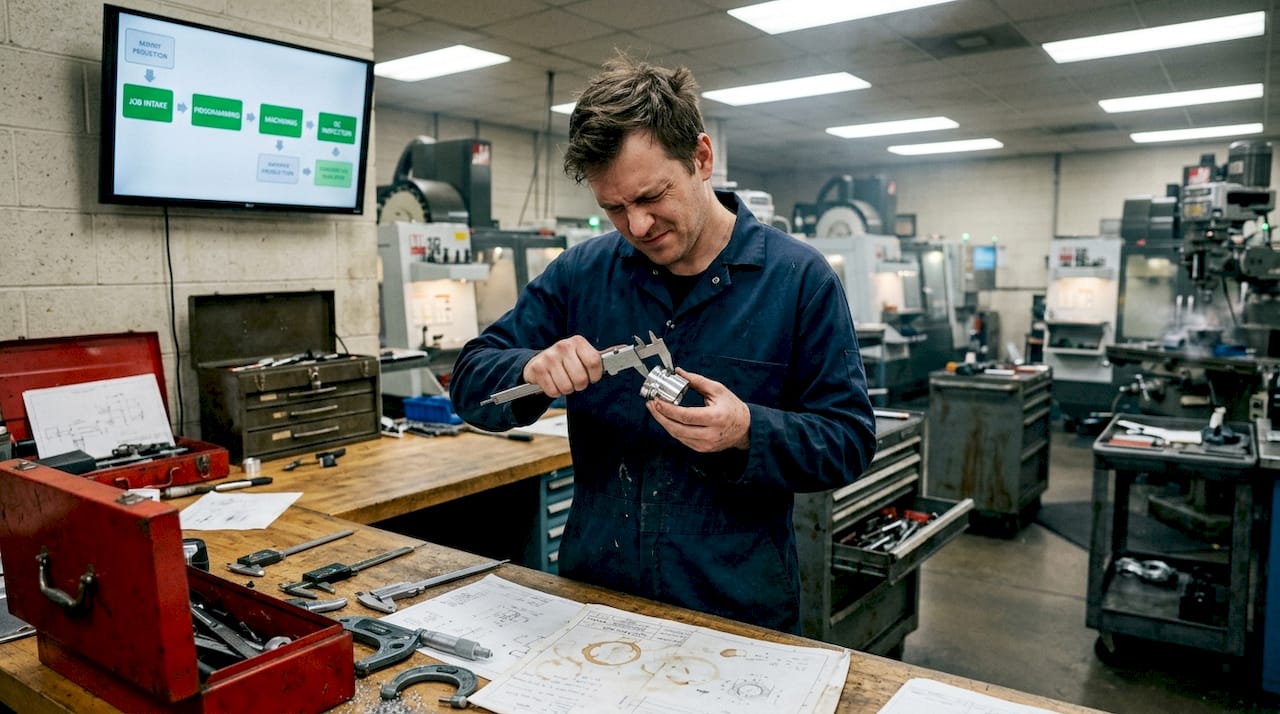
Many manufacturers assume keeping machining in-house guarantees better control and faster delivery. Yet empirical data tells a different story. Contract machining partners equipped with specialized technology and optimized workflows have delivered production rate improvements exceeding 80%, slashing lead times and recovering delayed schedules. For OEMs and industrial manufacturers navigating aerospace, defense, and high-precision applications, understanding when and how to leverage contract machining can unlock speed, quality, scalability, and risk mitigation that in-house operations struggle to match.
Table of Contents
- What is contract machining?
- Top benefits of contract machining for OEMs and manufacturers
- Comparing in-house machining and contract machining
- How to choose the right contract machining partner
- Real-world outcomes: Contract machining in action
- Next steps: Get total manufacturing reliability
- Frequently asked questions
Key Takeaways
| Point | Details |
|---|---|
| Dramatic lead time reduction | Contract machining can speed up production cycles by over 80% for critical parts. |
| Superior precision and repeatability | Advanced machine shops use multi-axis setups to minimize errors and ensure high-precision output. |
| Adaptable for complex industries | Aerospace, defense, and industrial manufacturers benefit most from contract machining’s capabilities and scalability. |
| Better risk management | Contract machining supports schedule recovery and mitigates supply chain disruptions. |
| Proven real-world results | Case studies show contract machining consistently delivers ahead-of-schedule, high-quality parts. |
What is contract machining?
Contract machining means outsourcing precision part manufacturing to specialized machine shops that handle everything from prototype development through high-volume production runs. Instead of investing capital in new equipment, hiring specialized machinists, and managing complex workflows internally, you partner with a shop that already possesses the technology, expertise, and capacity.
How does it work? You provide specifications, drawings, and material requirements. The contract shop programs toolpaths, sets up machines, runs first articles for approval, then scales to full production. Modern contract machining leverages multi-axis CNC, Swiss machining, and turn-mill centers that enable single-setup processing, crucial for complex geometries and minimizing errors. This approach is especially valuable for multi-axis machining in aerospace where tight tolerances and intricate features demand advanced capabilities.
Delivery models vary based on your needs:
- Project-based contracts: One-time orders for prototypes or limited runs
- Ongoing supply agreements: Scheduled deliveries tied to production forecasts
- Capacity overflow partnerships: Surge support during peak demand periods
- Full turnkey manufacturing: Design assistance, material sourcing, finishing, and assembly
When should you consider contract machining? Anytime you face capacity constraints, lack specialized equipment, need faster turnaround than internal resources allow, or want to avoid capital expenditure on machines that may sit idle between projects. Explore comprehensive contract machining services to understand the full scope of what partners can deliver.
Top benefits of contract machining for OEMs and manufacturers
Contract machining delivers measurable operational and strategic advantages that directly impact your bottom line and competitive position. Let’s examine the evidence.
Lead time reduction
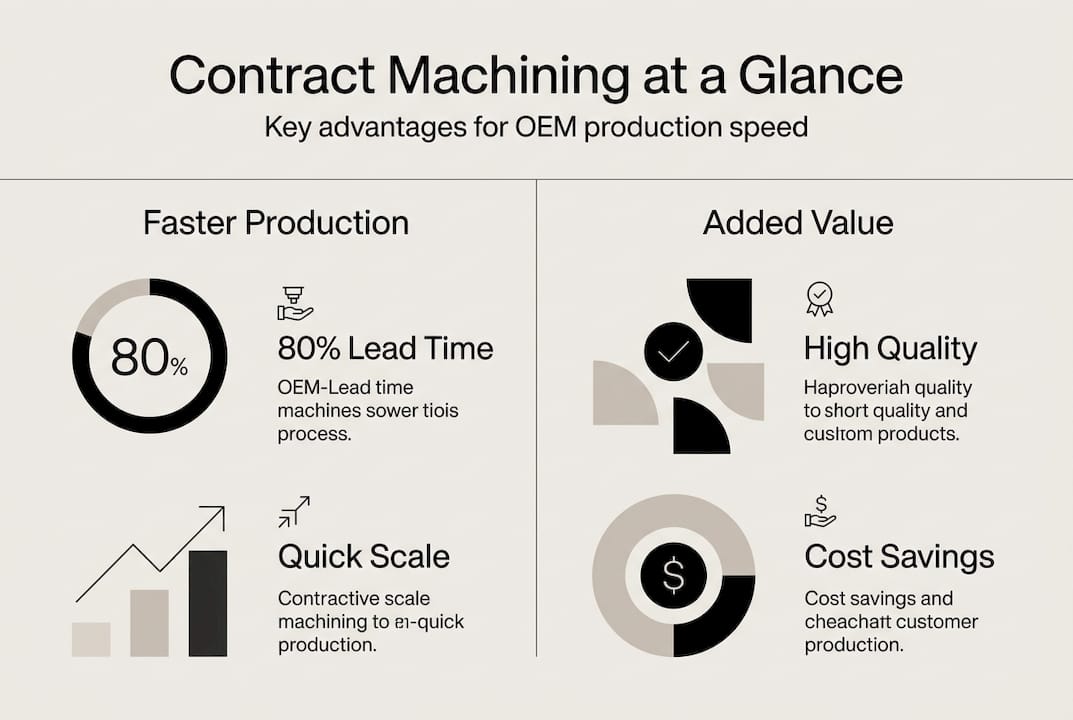
Specialized contract shops operate with optimized machine scheduling, dedicated setups, and experienced machinists who eliminate trial-and-error delays. Real-world results show production rates improving by more than 80%, with first units reaching customers weeks ahead of original schedules. When aerospace manufacturers faced aluminum investment casting bottlenecks, contract machining partners recovered timelines and accelerated delivery.
Consistent high quality for precision-critical parts
Contract machinists stake their reputation on repeatability. They invest in advanced inspection equipment, implement statistical process control, and validate every setup before production begins. For aerospace, defense, and industrial applications where tolerances measure in microns, this focus on quality assurance often exceeds what in-house teams can maintain across multiple product lines. Learn more about key benefits of precision machining and how they translate to your operations.
Optimized machine scheduling and cost efficiencies
Contract shops run machines at high utilization rates across diverse customer orders, spreading fixed costs and achieving economies of scale impossible for single-product manufacturers. You pay only for the parts you need, avoiding depreciation, maintenance, and idle time costs associated with owned equipment.
Flexible scaling for aerospace, defense, and industrial spikes
Demand fluctuates. Contract machining lets you scale production up or down without hiring, training, or capital investment. When defense contracts spike or aerospace programs accelerate, your partner absorbs the capacity surge. Discover how faster lead times in machining support agile manufacturing strategies.
Risk reduction through schedule recovery and supply chain agility
Internal delays, equipment failures, or workforce shortages can cripple production schedules. Contract machining provides a safety valve. Partners with excess capacity can step in, recover lost time, and keep your supply chain moving. This agility protects customer relationships and revenue streams.
Pro Tip: Demand detailed process metrics from potential partners. Request data on first-pass yield rates, on-time delivery percentages, and average lead times for parts similar to yours. Numbers reveal capability better than marketing claims.
| Benefit | Impact | Measurement |
|---|---|---|
| Lead time reduction | 80%+ faster production | Weeks saved on delivery |
| Quality consistency | Reduced scrap and rework | First-pass yield >98% |
| Cost efficiency | Lower per-part costs at scale | 15-30% savings vs. in-house |
| Scalability | Rapid capacity expansion | Zero capital investment |
| Risk mitigation | Schedule recovery | Delivery reliability >95% |
Comparing in-house machining and contract machining
Choosing between in-house and contract machining requires evaluating multiple factors beyond simple cost per part. Here’s how they stack up.
Cost factors: labor, equipment, training
In-house machining demands significant capital for CNC equipment, tooling, and fixtures. Add ongoing costs for skilled machinists, programmers, maintenance technicians, and continuous training as technology evolves. Contract machining converts these fixed costs into variable expenses, paying only for parts produced. For low-volume or intermittent production, contract machining almost always wins on total cost of ownership.
Capacity and scaling flexibility
Internal capacity is finite. Expanding requires months of equipment procurement, installation, and workforce development. Contract partners scale instantly, absorbing demand spikes without your involvement. When production drops, you’re not stuck with idle machines and underutilized staff.
Quality control and repeatability
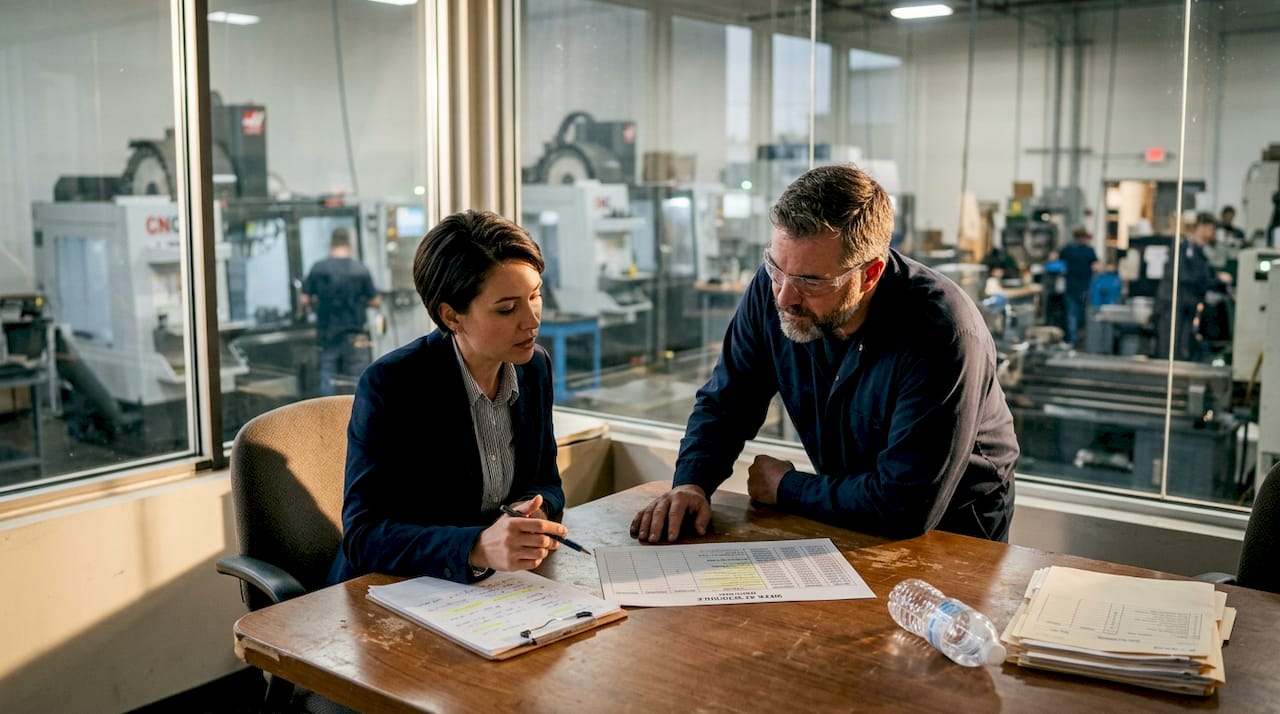
Both models can achieve high quality, but contract shops specialize in it. They run similar parts repeatedly, refining processes and eliminating variables. In-house teams juggling multiple product lines may struggle to maintain the same consistency. Empirical benchmarks demonstrate contract machining can deliver first units two weeks ahead of in-house schedules while maintaining tighter tolerances.
Urgency and schedule recovery
When deadlines compress, contract machining provides rapid response. Partners with available capacity can start immediately, bypassing internal scheduling conflicts and resource allocation battles. This speed advantage proves critical for aerospace and defense programs with firm delivery commitments.
When in-house may still be preferable
- Proprietary processes: Highly confidential or patented manufacturing methods you cannot share
- Continuous high-volume production: When machines run 24/7 on identical parts, ownership economics improve
- Tight integration with assembly: Parts moving directly from machining to adjacent assembly lines with minimal handling
- Strategic capability development: Building internal expertise for long-term competitive advantage
“The decision isn’t binary. Smart manufacturers use contract machining strategically, outsourcing overflow, specialized work, and new product launches while keeping core competencies in-house.”
| Factor | In-House Machining | Contract Machining |
|---|---|---|
| Capital investment | High upfront costs | Zero equipment investment |
| Scalability | Limited by capacity | Virtually unlimited |
| Lead time | Depends on queue | Often 50-80% faster |
| Quality control | Variable across products | Specialized, consistent |
| Cost structure | Fixed + variable | Pure variable |
| Risk exposure | Equipment, labor, schedule | Minimal operational risk |
Explore precision strategies for complex parts to understand how contract machining handles challenging geometries and tight tolerances. For insights on maximizing quality and throughput, examine how leading shops balance speed with precision.
How to choose the right contract machining partner
Not all contract machine shops deliver equal results. Selecting the right partner requires rigorous evaluation across technical, operational, and cultural dimensions.
- Verify certifications and compliance: Aerospace and defense work demands AS9100, ITAR registration, and ISO certifications. Request current certificates and audit reports.
- Assess technical capabilities: Does the shop have the specific machines, tooling, and expertise for your parts? Single-setup processing with advanced technology minimizes errors in high-precision applications.
- Review inspection and QA practices: Ask about measurement equipment, inspection frequency, and statistical process control methods. Request sample inspection reports.
- Evaluate capacity and scalability: Can they handle your current volume and future growth? What’s their lead time under normal and surge conditions?
- Check track record and references: Request customer references from similar industries. Ask about on-time delivery, quality issues, and responsiveness to problems.
- Test communication and responsiveness: How quickly do they respond to inquiries? Do engineers engage directly with technical questions?
- Assess cultural fit: Do they understand your industry’s urgency and quality standards? Will they proactively flag potential issues?
Pro Tip: Always request machining process validation data and speak directly with customer references before committing to production volumes. A shop’s willingness to share detailed process documentation signals confidence and transparency.
For aerospace and defense applications, consider partners specializing in custom machining for aerospace and defense who understand the unique requirements and regulatory landscape.
Real-world outcomes: Contract machining in action
Theory matters less than results. Here’s what manufacturers actually achieve when they choose the right contract machining partner.
Case study: Aerospace aluminum investment castings
An aerospace manufacturer faced severe production delays on complex aluminum investment castings requiring extensive CNC finishing. Internal capacity couldn’t meet delivery commitments. By partnering with a contract machinist equipped with advanced multi-axis centers and optimized workflows, they achieved production rate improvements exceeding 80%. Even more impressive, production schedules were recovered and parts delivered two weeks ahead of the revised timeline, salvaging customer relationships and avoiding penalties.
Scaling production spikes without capital investment
A defense contractor won a major program requiring immediate capacity expansion. Rather than investing millions in new equipment with uncertain future utilization, they engaged a contract machining partner. Production ramped within weeks instead of months, and when the program concluded, they simply reduced order volumes without stranded assets.
Tangible results manufacturers report:
- Lead times cut by 50-80% compared to internal production
- First-pass quality yields exceeding 98% on complex geometries
- Zero capital expenditure for capacity expansion
- Schedule recovery measured in weeks, not months
- Ability to accept new business without capacity constraints
- Reduced inventory carrying costs through just-in-time delivery
These outcomes aren’t theoretical. They represent measurable business impact from strategic contract machining partnerships. Explore high-volume manufacturing strategies and CNC milling and turning outcomes to see how advanced capabilities translate to production results.
Next steps: Get total manufacturing reliability
You’ve seen the evidence. Contract machining delivers faster lead times, higher quality, flexible scaling, and risk mitigation that in-house operations struggle to match. The question isn’t whether contract machining can improve your manufacturing outcomes, it’s finding the right partner to make it happen.
Machining Technologies LLC operates a 70,000 square foot facility in Webster, Massachusetts, equipped with advanced Hydromat systems, multi-axis CNC milling and turning centers, and wire EDM capabilities. Since 1985, we’ve produced over 20 million precision parts annually for aerospace, defense, and industrial manufacturers who demand tight tolerances, rapid turnaround, and absolute reliability.
Whether you need complex part manufacturing for intricate geometries, high-volume production runs, or rapid prototyping, our team brings the expertise and capacity to deliver on time, every time. Explore our comprehensive contract machining services or dive into our CNC milling and turning capabilities to see how we solve your toughest manufacturing challenges.
Ready to experience the contract machining advantage? Contact us today for a detailed capability review and quote on your next project.
Frequently asked questions
How does contract machining reduce lead times?
By leveraging specialized equipment and optimized workflows, contract shops can cut production cycles by up to 80%, delivering parts much faster than many in-house setups. Dedicated setups and experienced machinists eliminate trial-and-error delays.
What types of projects benefit most from contract machining?
Complex, high-precision, or high-volume aerospace, defense, and industrial components gain the most from contract machining. Multi-axis CNC, Swiss machines, and turn-mill centers excel at intricate geometries requiring tight tolerances and single-setup processing.
Is quality control better with contract machining?
Leading contract machinists use advanced QA methods and process validation to ensure high repeatability for each part, often exceeding in-house quality standards. Statistical process control and dedicated inspection equipment maintain consistency across production runs.
How do I know if a contract machine shop can handle my industry’s requirements?
Request proof of relevant certifications like AS9100 or ITAR registration, process validation data, and references from similar projects before committing. Direct conversations with customer references reveal real-world performance better than marketing materials.
When should I keep machining in-house instead of outsourcing?
Keep machining in-house for proprietary processes you cannot share, continuous high-volume production where ownership economics improve, tight integration with adjacent assembly lines, or when building strategic internal capabilities for long-term competitive advantage.