

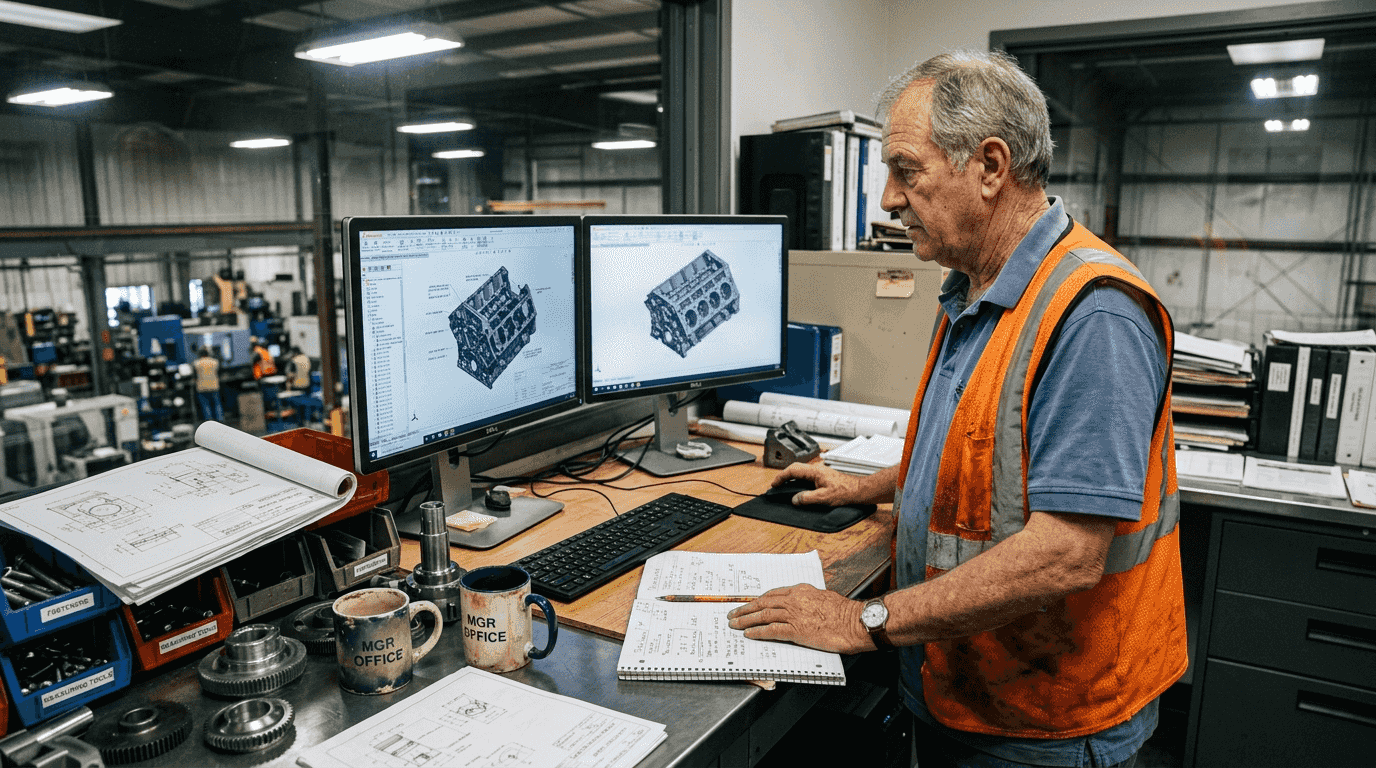
Manufacturing complex aerospace and defense parts isn’t just harder, it’s fundamentally different. Most managers underestimate how traditional planning fails when precision tolerances drop below 0.5 microns and geometries involve multi-axis surfaces. Model-based manufacturing and advanced CNC strategies now solve these challenges, transforming how you achieve both rapid prototyping and cost-effective production.
Table of Contents
- The Role Of Model-Based Manufacturing In Complex Parts
- CNC Machining For Complex Part Prototyping And Production
- Managing Precision Challenges And Residual Stresses In Complex Parts
- Design Strategies And Emerging Technologies To Optimize Complex Part Manufacturing
- Partner With Machining Experts For Precision Complex Parts
- Frequently Asked Questions
Key takeaways
| Point | Details |
|---|---|
| Model-based manufacturing drives right-first-time production | Digital threads replace isolated documents, enabling early validation and reducing costly redesigns. |
| Separate prototype and production designs optimize outcomes | Distinct variants balance speed, cost, and precision across development and manufacturing phases. |
| CNC machining enables rapid, precise prototyping | CAD-to-part conversion in days supports fast iterations with tight tolerances essential for aerospace. |
| Machining strategies critically impact quality and time | Tool parameters like radial depth and tip radius balance surface finish with cutting efficiency. |
| Residual stresses create major cost risks | Distortions from internal stresses have caused $290 million in rework; advanced mitigation is essential. |
The role of model-based manufacturing in complex parts
Leading manufacturers are shifting from document-based, sequential planning to model-based manufacturing enabling right-first-time production. Traditional approaches rely on isolated CAD files, spreadsheets, and process documents that fragment information across teams. Model-based manufacturing integrates all product data into a unified digital thread connecting design, engineering, and production.
This integration enables early validation of manufacturability, catching design issues before they reach the shop floor. You reduce expensive redesigns and achieve higher first-pass yield, especially critical when working with costly aerospace alloys and tight delivery schedules. Digital threads also provide complete traceability from initial design through final inspection, supporting compliance requirements in regulated industries.
The agility benefits are substantial. When design changes occur or supply disruptions force material substitutions, model-based systems automatically propagate updates across all affected work instructions and tooling plans. You respond faster without manual coordination across siloed teams.
A comprehensive digital twin extends beyond part geometry to include production equipment, tooling, and assembly sequences. Virtual testing identifies bottlenecks and validates processes before committing to physical setup. This approach dramatically reduces trial runs and accelerates time to market for new complex parts.
Pro Tip: Implement model-based manufacturing incrementally by starting with your most complex, high-value parts where the ROI from reduced rework justifies the digital infrastructure investment.
Key model-based manufacturing advantages:
- Unified digital thread eliminates data silos and version control issues
- Early virtual validation catches manufacturability problems before production
- Automated change propagation speeds response to design updates
- Complete traceability supports quality audits and regulatory compliance
- Digital twins enable virtual testing of tooling and sequences
Partnering with experienced providers who leverage precision parts manufacturing quality systems ensures your complex parts benefit from these digital advantages throughout the development and production lifecycle.
CNC machining for complex part prototyping and production
CNC machining transforms CAD files into physical parts rapidly, supporting fast iterations and faster time-to-market. For complex aerospace and defense prototypes, CNC offers unmatched flexibility compared to specialized tooling approaches. You can machine functional prototypes in production-grade materials, validating fit and performance before committing to volume manufacturing.
Machining parameters critically influence both part quality and economics. Machining strategy most influences surface quality and cutting time for multi-axis milling in aerospace alloys. Adjusting radial depth of cut and tool tip radius creates distinct tradeoffs between surface finish and production speed.
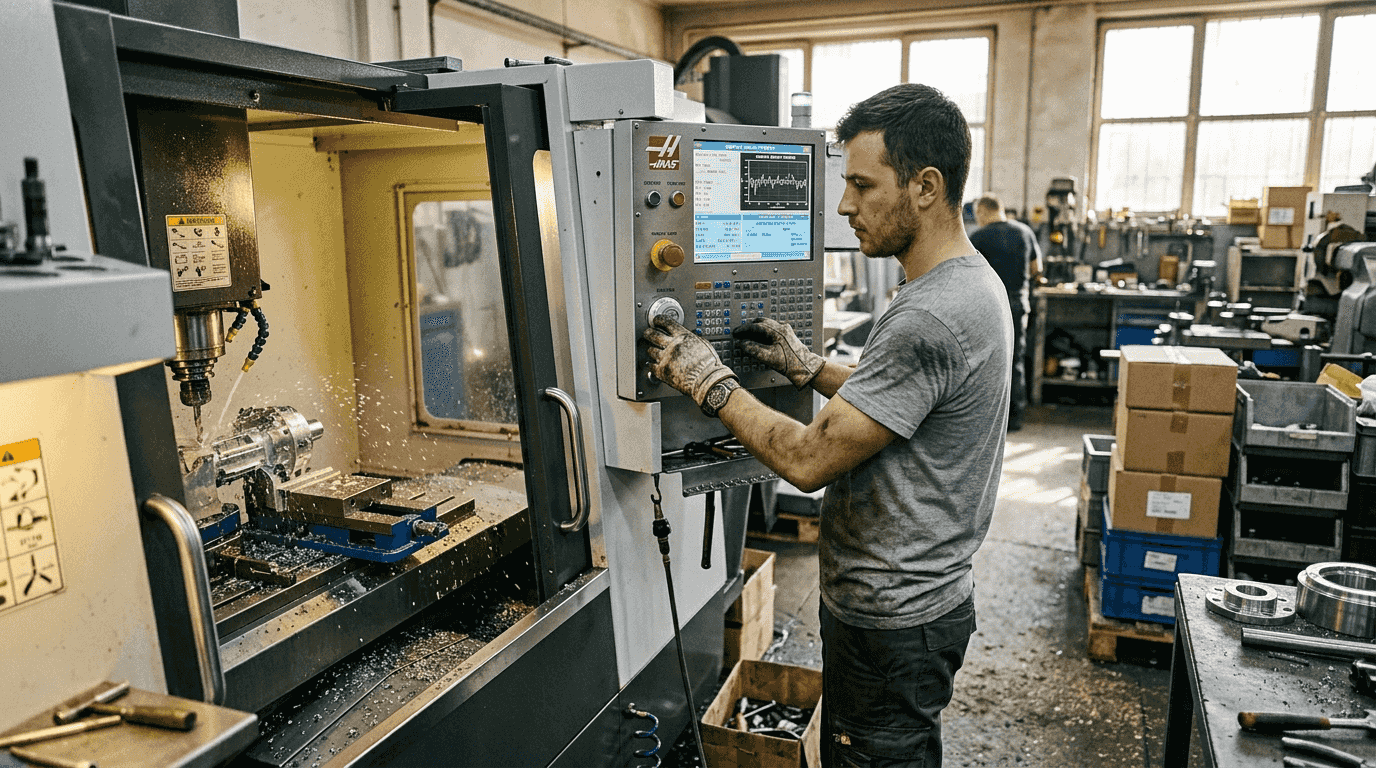
Research shows the Flow strategy with a 4 mm tool tip radius and 0.05 mm radial depth of cut balances speed and surface finish in aerospace machining. This approach produces surface roughness values meeting turbine blade and impeller vane specifications (0.25 to 0.40 μm Ra) while maintaining reasonable cutting times.
Complex geometries demand multi-axis capabilities. Five-axis CNC machines access compound angles and internal features impossible with three-axis equipment. This capability is essential for turbine components, aircraft structural parts, and defense system housings where every surface matters for aerodynamic or stealth performance.
Small batch sizes and ultra-tight tolerances increase per-part costs but remain manageable with proper planning. The key is matching machining strategy to your specific requirements rather than using generic approaches. Programs optimized for your part geometry, material, and tolerance requirements minimize both cycle time and tool wear.
Pro Tip: Request detailed machining strategies during your RFQ process, not just price quotes. Suppliers who provide specific tooling plans and cutting parameters demonstrate the technical depth needed for complex aerospace work.
Critical CNC considerations for complex parts:
- Multi-axis capability accesses compound angles and internal features
- Optimized cutting parameters balance surface quality with cycle time
- Material-specific strategies address challenges in titanium and nickel alloys
- Fixture design ensures rigidity for maintaining tight tolerances
- In-process measurement validates dimensions before completing operations
Leveraging advanced CNC milling and turning capabilities accelerates your path from prototype to production while maintaining the precision aerospace and defense applications demand.
Managing precision challenges and residual stresses in complex parts
Residual stresses cause distortions that have led to hundreds of millions in aerospace rework costs. Boeing alone reported $290 million in rework expenses across multiple aircraft programs due to part distortions from residual stresses. These internal stresses lock into metal during initial processing and release unpredictably during machining, causing warping that ruins expensive near-finished parts.
The problem intensifies with complex geometries and advanced materials. Thin-walled aerospace structures are particularly vulnerable because removing material during machining disturbs the internal stress balance. A turbine blade that measures perfectly in the fixture can warp beyond tolerance limits within hours after release.
Current mitigation strategies like stress relief and sequence optimization often fall short for complex geometries and titanium alloys. Traditional stress relief annealing helps but adds process steps and can affect material properties. Optimizing machining sequences to balance material removal reduces but doesn’t eliminate distortion risk.
| Mitigation Method | Effectiveness | Limitations |
|---|---|---|
| Stress relief annealing | Moderate | Adds time; may alter properties |
| Optimized machining sequence | Good for simple parts | Less effective with complex geometry |
| Adaptive clamping | Variable | Requires specialized fixtures |
| Hybrid offline-online methods | Promising | Still under development |
Emerging research explores hybrid approaches combining offline finite element modeling with online monitoring. These methods predict distortion before it occurs and adapt toolpaths in real time. Adaptive monitoring systems detect dimensional drift during machining, triggering corrective actions before parts exceed tolerance.
The cost impact extends beyond scrap. Rework consumes machine time that could produce new parts, creating downstream schedule delays. Quality inspectors spend extra time validating corrected dimensions. Customer confidence erodes when delivery dates slip.
Pro Tip: Specify residual stress requirements in your procurement documents, not just final dimensions. Ask potential suppliers about their distortion prediction and mitigation capabilities before awarding contracts.
Critical residual stress management strategies:
- Initial material selection affects baseline stress levels
- Thermal treatments before machining reduce locked-in stresses
- Symmetrical machining sequences balance material removal
- Intermediate dimensional checks catch distortion early
- Post-machining stress relief stabilizes critical dimensions
“Managing residual stresses isn’t optional for precision aerospace work. It’s the difference between profitable production and constant firefighting.”
Working with suppliers experienced in CNC turning precision manufacturing and specifying machining tolerances ensures your complex parts receive the stress management attention they require from initial setup through final inspection.
Design strategies and emerging technologies to optimize complex part manufacturing
Designing separate prototypes and production designs maximizes efficiency and minimizes costs. Prototype designs prioritize rapid iteration and design validation over manufacturing efficiency. Production designs optimize for repeatability, cost reduction, and quality consistency.
This two-track approach acknowledges different objectives. Prototypes need quick turnaround to validate concepts and test functionality. You might accept higher per-part costs and manual operations to compress development schedules. Production parts require tooling investments and process optimization to hit target costs at volume.
| Design Approach | Benefits | Considerations |
|---|---|---|
| Prototype Design | Rapid iteration; design flexibility; early validation | Higher per-part cost; manual operations |
| Production Design | Optimized cost; automated processes; consistent quality | Longer setup; tooling investment required |
Generative modeling empowers design automation, quality control, and predictive maintenance in smart manufacturing. These AI-driven approaches synthesize process data to predict outcomes, automate design optimization, and detect potential defects before they occur. Generative models learn patterns from historical manufacturing data, identifying relationships human engineers might miss.
For complex part design, generative modeling suggests geometry modifications that improve manufacturability while maintaining functional requirements. The technology evaluates thousands of design variations against manufacturing constraints, recommending options that balance performance, cost, and producibility.
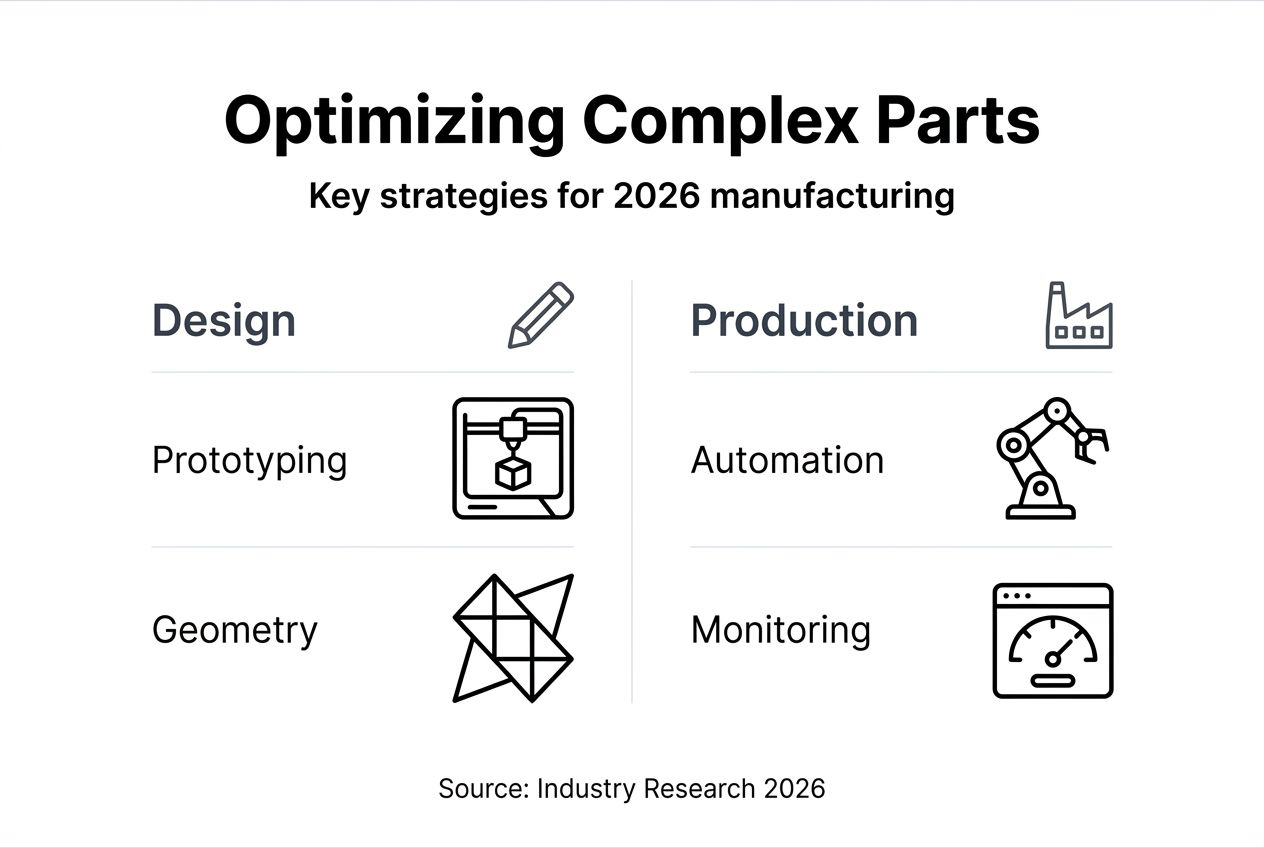
Automation extends beyond part geometry to encompass entire manufacturing workflows. Digital systems coordinate material flow, tooling changes, and inspection sequences without manual intervention. This integration reduces human error and accelerates throughput for complex parts requiring multiple operations.
Pro Tip: Conduct formal design for manufacturability reviews before finalizing production designs. Invest two weeks upfront analyzing manufacturing challenges to avoid months of production problems later.
Emerging technologies reshaping complex part manufacturing:
- Digital twins simulate entire production systems for virtual optimization
- Adaptive toolpath generation adjusts cutting strategies based on real-time sensor data
- Collaborative robotics handle material loading and part transfers safely
- Cloud-based manufacturing execution systems coordinate distributed production
- Blockchain traceability creates immutable records for regulatory compliance
Future trends focus on supply chain resilience through distributed manufacturing networks. When single-source suppliers face disruptions, qualified alternates with compatible digital systems can quickly ramp production using shared process data.
Leveraging automation benefits in machining positions your organization to capitalize on these emerging technologies while maintaining the flexibility complex aerospace and defense programs demand.
Partner with machining experts for precision complex parts
Navigating complex part manufacturing challenges requires partners who combine advanced technology with deep process expertise. Machining Technologies brings over 35 years of experience delivering precision parts manufacturing quality for aerospace, defense, and industrial applications.
Our 70,000 square foot facility houses state-of-the-art CNC milling and turning equipment capable of producing parts with tolerances down to 0.0001 inches. We specialize in custom machining for aerospace and defense applications where precision and reliability are non-negotiable.
From rapid prototyping through high-volume production, we deliver over 20 million precision parts annually. Our automated systems ensure consistency while maintaining the flexibility to adapt quickly when your requirements change. Contact us to discuss how our capabilities align with your complex part manufacturing needs.
Frequently asked questions
What is model-based manufacturing and why is it important?
Model-based manufacturing uses integrated digital models to connect design and production processes through a unified digital thread. It improves accuracy, traceability, and flexibility compared to traditional document-based approaches where information fragments across teams. Early validation through digital twins reduces costly redesigns and speeds time to market by catching manufacturability issues before physical production. The approach is essential for complex aerospace parts where coordination across engineering, quality, and manufacturing teams determines success. Learn more about precision parts manufacturing quality systems.
How does CNC machining support rapid prototyping of complex parts?
CNC machining converts CAD models into physical parts within days, enabling quick design iterations essential for aerospace development programs. It offers flexibility for design changes and achieves tight tolerances without requiring specialized tooling investments. You can machine prototypes in production-grade materials to validate both fit and performance before committing to volume manufacturing. This capability dramatically compresses development timelines compared to traditional prototyping methods. Explore custom prototype machining companies for your next project.
What are residual stresses and how do they affect manufacturing costs?
Residual stresses are internal stresses locked into metal parts during initial processing like forging or heat treatment. They cause distortions when released during machining, leading to scrap, extensive rework, and significant cost increases. Boeing reported $290 million in rework across multiple aircraft programs specifically due to residual stress distortions. Advanced mitigation strategies include stress relief annealing, optimized machining sequences that balance material removal, and emerging adaptive monitoring systems that detect and correct dimensional drift in real time.
What design strategies help optimize complex part manufacturing?
Use distinct design variants for prototypes and production to balance efficiency and precision at each development stage. Prototypes prioritize rapid iteration while production designs optimize for repeatability and cost. Incorporate design for manufacturability reviews early to identify challenges before finalizing drawings. Leverage generative modeling and automation benefits in machining to improve adaptability and quality control. This strategic approach reduces total program costs while accelerating time to market for new complex aerospace and defense parts.