

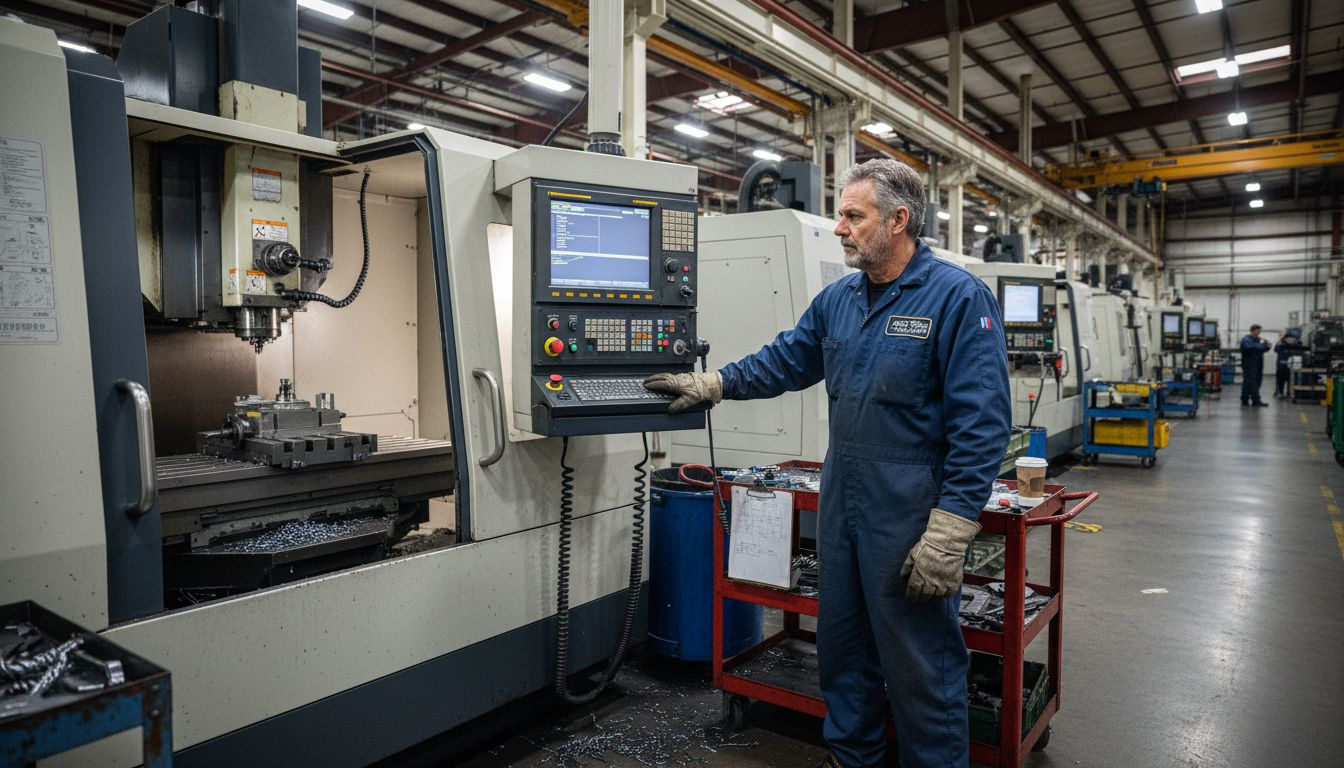
Aerospace components demand tolerances as tight as ±0.0001 inches, where even microscopic deviations can mean catastrophic failure. Custom machining delivers the precision, material expertise, and regulatory compliance required for mission-critical parts in aerospace, defense, and firearms manufacturing. This guide reveals how advanced technologies, specialized processes, and experienced partners enable reliable, scalable production that meets the extreme standards these industries demand.
Table of Contents
- Why Precision Matters: Meeting Extreme Tolerances And Safety Standards
- Technologies Driving Custom Machining Excellence
- Material Challenges And Custom Solutions
- Common Misconceptions About Custom Machining
- Practical Benefits For OEMs And Manufacturers
- Choosing The Right Custom Machining Partner
- Conclusion And Next Steps
- Discover Precision Custom Machining Services For Aerospace And Defense
Key takeaways
| Point | Details |
|---|---|
| Precision ensures safety | Custom machining achieves ±0.0001-inch tolerances critical for aerospace and defense reliability. |
| Advanced technologies enable complexity | Multi-axis CNC and EDM produce intricate geometries and features traditional methods cannot achieve. |
| Automation improves quality and scale | AI-powered inspection and automated processes reduce human error while enabling high-volume consistency. |
| Custom machining reduces total costs | Minimizing rework and improving first-pass accuracy often lowers overall expenses versus standard approaches. |
| Partner expertise matters critically | AS9100 and ITAR certifications signal the quality controls and security standards aerospace and defense require. |
Why precision matters: meeting extreme tolerances and safety standards
In aerospace and defense manufacturing, precision isn’t just about quality. It’s about survival. A turbine blade with dimensional errors can cause engine failure at 35,000 feet. A firearms component with improper tolerances can malfunction in combat situations.
Aerospace components often require tolerances as tight as ±0.0001 inches to ensure safety and performance. These specifications aren’t arbitrary. They emerge from rigorous testing and real-world failure analysis. When parts operate under extreme temperatures, pressures, and vibrations, even microscopic variations compound into catastrophic problems.
Regulatory frameworks enforce these standards. AS9100 and ITAR standards govern critical aerospace and defense manufacturing processes, establishing traceability requirements, quality controls, and security protocols. Manufacturers must demonstrate not just capability but consistent compliance across every production run.
Material integrity amplifies precision’s importance. Aerospace-grade titanium and exotic alloys demand specific machining approaches to prevent work hardening, thermal damage, or microstructure changes. Surface finish directly affects fatigue resistance. Parts experiencing cyclical stress loads need Ra values measured in microinches to prevent crack initiation.
Key precision considerations include:
- Geometric dimensioning and tolerancing (GD&T) defining exact part relationships
- Surface finish specifications affecting aerodynamic performance and stress concentration
- Material certification and traceability throughout the supply chain
- Environmental stability during manufacturing to prevent thermal expansion errors
- Inspection protocols using coordinate measuring machines (CMM) and optical comparators
Understanding firearm parts tolerance reliability principles applies equally to aerospace components where function under stress is non-negotiable. Learning how to specify machining tolerances ensures engineering drawings communicate requirements clearly, preventing costly interpretation errors during production.
Technologies driving custom machining excellence
Advanced machining technologies transform complex engineering designs into physical reality. Multi-axis CNC machining, EDM, and automated inspection systems enable the production of parts that were impossible just decades ago.
Multi-axis CNC machining enables complex geometries with high precision and reduces manufacturing time by allowing multiple surfaces to be machined in a single setup. Five-axis systems rotate parts during cutting, accessing difficult angles without repositioning. This eliminates cumulative setup errors and maintains tighter tolerances across features.
EDM creates intricate internal features in hardened materials not achievable by traditional machining. The process uses electrical discharge to erode material with extreme precision, producing cooling channels, complex cavities, and fine details in hardened tool steels or carbides. Wire EDM cuts intricate profiles with tolerances measured in ten-thousandths of an inch.
Automation and AI-powered inspection revolutionize quality control. Vision systems detect surface defects invisible to human inspectors. Statistical process control monitors dimensional trends, predicting when tools need replacement before they produce out-of-spec parts. This proactive approach maintains consistent quality across millions of parts.
| Technology | Best Applications | Key Advantages | Limitations |
|---|---|---|---|
| Multi-axis CNC | Complex geometries, compound angles | Reduced setups, tight tolerances, efficient | Higher programming complexity |
| Wire EDM | Intricate profiles, hardened materials | Extreme precision, no tool pressure | Slower than conventional machining |
| Sinker EDM | Internal cavities, mold details | Creates impossible features | Electrode fabrication required |
| Automated inspection | High-volume production, critical dimensions | Consistent measurement, 100% inspection capable | Initial investment costs |
Exploring custom prototype machining companies reveals how technology selection affects development timelines. Understanding precision parts manufacturing quality systems shows how technology integrates with processes to ensure reliability.
Pro Tip: Match machining technology to part complexity early in design. Consulting with machinists during engineering prevents designing features that require inefficient processes or compromise precision.
Material challenges and custom solutions
Aerospace and defense materials present unique machining challenges. Titanium alloys, Inconel, hardened steels, and exotic composites demand specialized approaches to maintain dimensional accuracy and surface integrity.
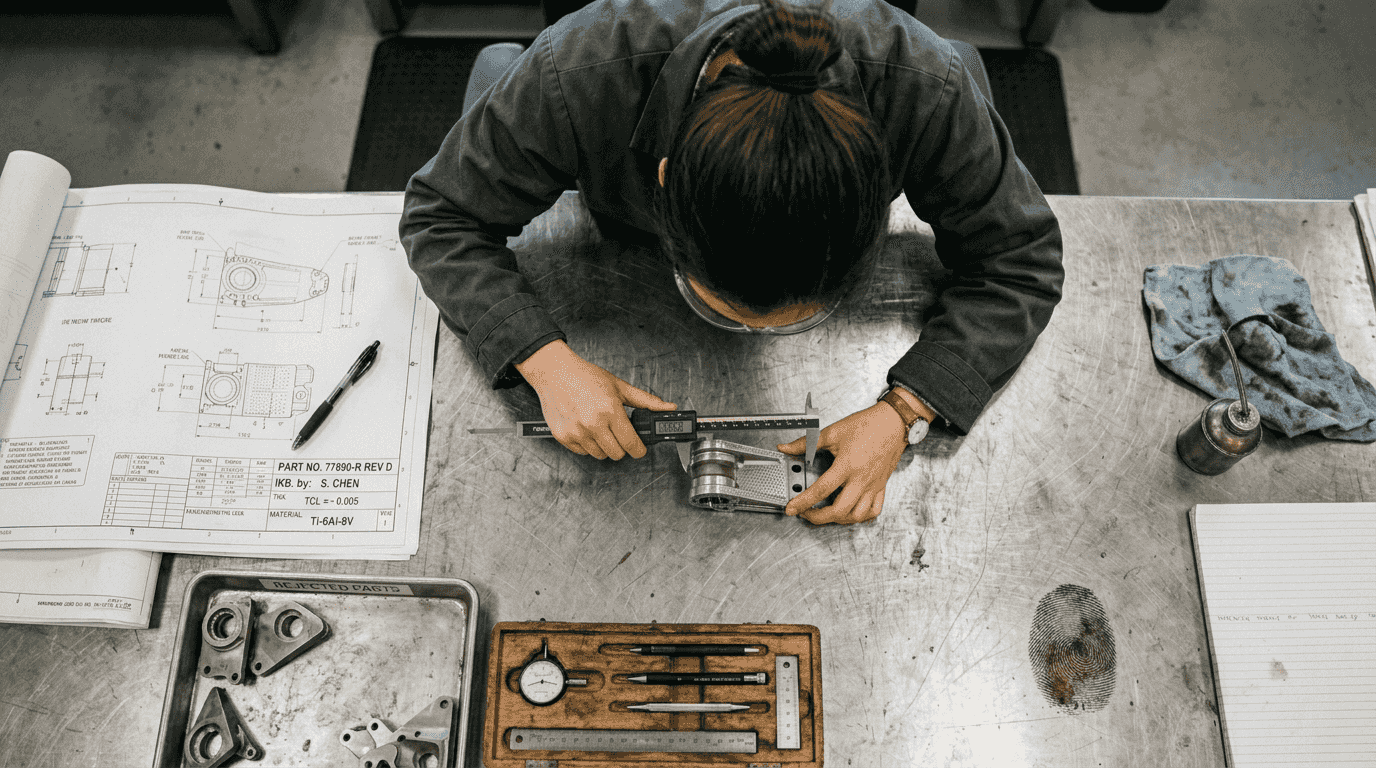
Titanium’s low thermal conductivity causes heat to concentrate at the cutting edge, accelerating tool wear. Its tendency to work harden requires precise cutting parameters. Inconel’s high strength at elevated temperatures makes it ideal for turbine components but notoriously difficult to machine. These materials can destroy cutting tools in minutes without proper techniques.
Material selection criteria include machinability, strength, corrosion resistance, and compliance with industry standards. Engineers balance performance requirements against manufacturing feasibility. A slightly different alloy composition might offer identical strength while reducing machining time by 40%.
Machining adaptations address these challenges:
- Specialized cutting tool geometries and coatings for specific materials
- Optimized feed rates and spindle speeds preventing work hardening
- High-pressure coolant systems removing heat and chips efficiently
- Climb milling techniques reducing tool deflection and improving finish
- Cryogenic cooling for materials prone to thermal damage
- Carbide or ceramic tooling for hardened materials
Surface finish requirements add complexity. Aerospace parts often need Ra values below 32 microinches to prevent stress risers. Achieving this in difficult materials requires multiple finishing passes with progressively finer tools. Some applications demand electropolishing or chemical treatments after machining.
Dimensional stability during machining presents another challenge. Removing material releases internal stresses, causing parts to warp. Stress-relief heat treatments between roughing and finishing operations stabilize dimensions. Fixturing strategies support parts without inducing distortion.
Reviewing the precision machining workflow for firearms illustrates how material properties influence process sequencing and quality checkpoints throughout production.
Pro Tip: Engage material scientists and machinists during design review. Their insights on grain structure, heat treatment response, and machinability prevent expensive redesigns when prototypes reveal manufacturing issues.
Common misconceptions about custom machining
Several myths about custom machining persist, influencing decisions and preventing manufacturers from realizing its full benefits. Evidence reveals a different reality.
Misconception: Custom machining costs more than standard processes. Custom machining can reduce lead times and costs by minimizing rework and improving part accuracy. Tailored processes eliminate unnecessary operations. Precision fixturing and optimized tool paths reduce cycle times. Getting parts right the first time avoids the massive costs of scrap, rework, and delayed deliveries.
Misconception: Longer lead times offset any quality benefits. Modern custom machining often delivers faster than conventional approaches. Automated systems run unattended overnight. Parallel operations on multi-axis equipment compress schedules. Digital workflows eliminate manual programming errors that cause delays.
Misconception: Automation increases risk and variability. The opposite is true. Automation with CNC reduces human error and enhances quality control through consistent execution and real-time monitoring. Machines don’t fatigue, get distracted, or misread drawings. Statistical process control detects trends before they produce defects.
Misconception: Custom machining only suits low-volume specialty parts. High-volume production benefits equally. Once processes are optimized and validated, custom approaches scale efficiently. Automated part loading, tool changers, and pallet systems enable lights-out manufacturing of thousands of parts daily.
“Integrating automation and robotics with CNC machines has revolutionized our ability to maintain micron-level precision across production runs exceeding 100,000 parts. What was once considered impossible is now our standard operating procedure.”
Understanding the real benefits of automating machining processes reveals how technology investment delivers measurable ROI through reduced scrap, faster throughput, and improved consistency.
Practical benefits for OEMs and manufacturers
Custom machining delivers concrete operational advantages that directly impact manufacturing success and business performance.
Scalability from prototype through production: Start with low-volume prototypes using the same processes that will produce thousands of parts monthly. This continuity eliminates the costly transition from development to manufacturing. Design validation occurs on production-intent processes.
Faster turnaround with higher confidence: Optimized custom processes compress schedules while improving quality. Digital twin simulations predict outcomes before cutting metal. Validated processes reduce trial-and-error iterations. Quality built in from the start accelerates qualification and certification.
Regulatory compliance and traceability: Custom machining systems integrate documentation automatically. Every part links to material certifications, process parameters, inspection results, and operator credentials. This traceability satisfies AS9100 and ITAR requirements without manual paperwork.
Design flexibility without tooling constraints: Unlike stamping or forging, custom machining accommodates design changes without retooling investments. Engineering improvements implement quickly. Product variants share common processes with parameter adjustments.
Automation and robotics integrated with CNC machines reduce human error and improve consistency, enabling high-volume production with aerospace-grade quality. Repeatability reaches Cpk values above 1.67, ensuring virtually zero defects across production runs.
CNC machining reproducibility lowers failure rates crucial in mission-critical defense applications where field failures have catastrophic consequences. When components perform in combat vehicles, aircraft, or weapons systems, reliability isn’t negotiable.
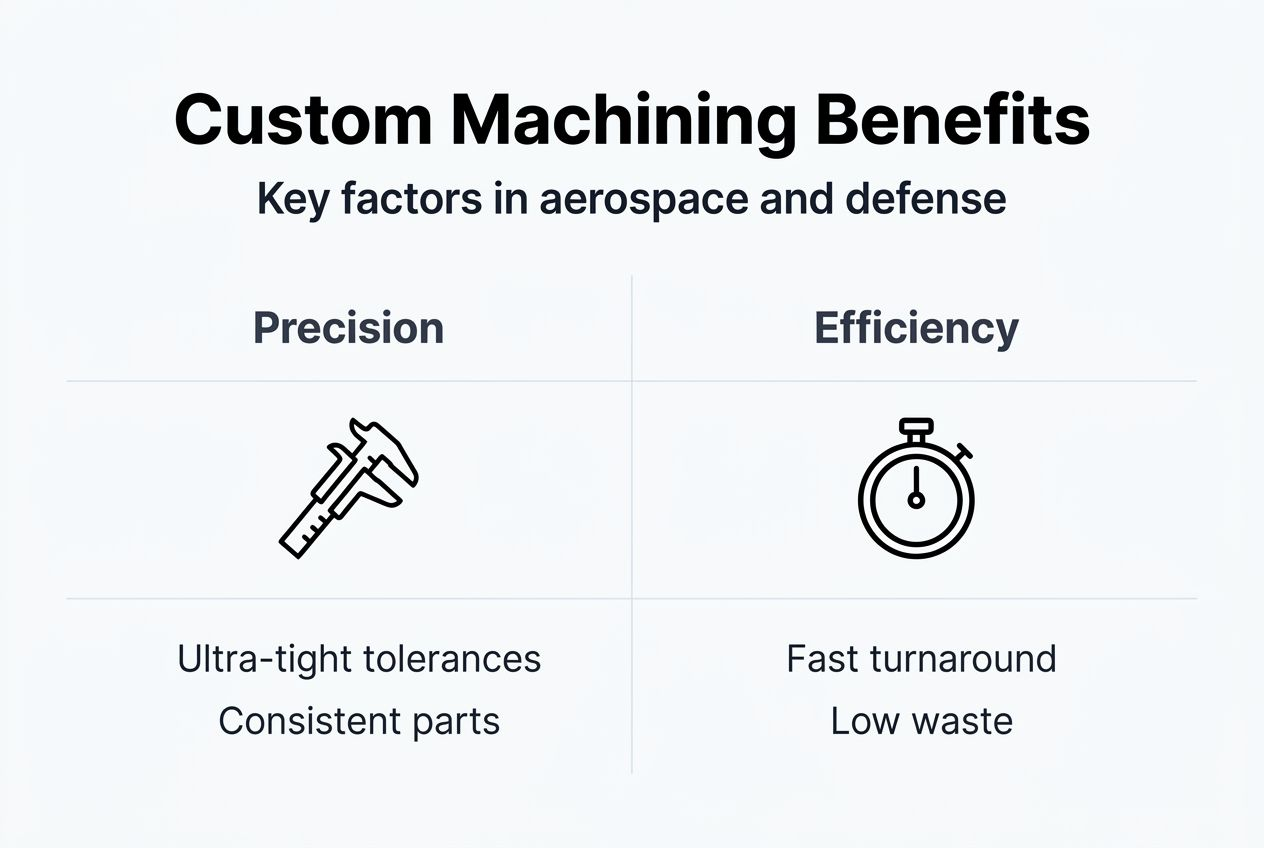
Material optimization reduces costs while maintaining performance. Custom processes minimize waste through efficient nesting and near-net-shape production. Scrap titanium costs hundreds of dollars per pound. Optimized tool paths and fixturing maximize yield from expensive raw materials.
Supply chain resilience improves with custom machining capabilities. Dependence on single-source suppliers creates vulnerability. Developing in-house or partnered custom machining provides alternatives when disruptions occur. This flexibility proved critical during recent supply chain crises.
Exploring the benefits of precision machining for manufacturers reveals how these advantages compound across product lifecycles, affecting total cost of ownership and competitive positioning.
Choosing the right custom machining partner
Selecting a machining partner determines whether you realize custom machining’s benefits or struggle with quality issues and delays. Critical evaluation criteria separate capable providers from those merely claiming expertise.
Industry experience matters immensely. Aerospace and defense manufacturing differs fundamentally from commercial production. Understanding why certain specifications exist, how to interpret military standards, and what regulators expect during audits comes only from years of focused work. Ask about specific programs they’ve supported and challenges they’ve solved.
Certifications validate capabilities and commitment. AS9100 certification demonstrates aerospace quality management systems. ITAR registration proves security controls for defense-related manufacturing. ISO 9001 provides baseline quality assurance. These aren’t just paperwork. They represent audited, functioning systems ensuring consistent performance.
Technology capabilities must align with your parts’ complexity. Visit facilities to see equipment firsthand. Modern multi-axis CNC machines, EDM systems, and CMM inspection equipment indicate investment in precision. Ask about machine maintenance schedules and calibration procedures. Equipment is only as good as its upkeep.
Evaluation criteria include:
- Production capacity matching your volume requirements now and as you scale
- Quality control systems with statistical process control and preventive measures
- Engineering support for design optimization and manufacturability review
- Supply chain management ensuring material traceability and certified sources
- Delivery performance with metrics on on-time delivery rates
- Financial stability indicating they’ll be there for long-term programs
Production capacity extends beyond machine count. Effective capacity considers staffing, shift coverage, and utilization rates. A facility running single shift with excess capacity offers more flexibility than one at maximum utilization across three shifts.
Quality control systems should prevent defects, not just detect them. Ask about first article inspection processes, in-process verification, and final inspection protocols. Request actual Cpk data on similar parts. Review their corrective action procedures when issues arise.
On-time delivery consistently ranks among top supplier evaluation criteria. Late deliveries disrupt your production, disappoint customers, and damage reputations. Review delivery metrics over time. Occasional delays happen. Chronic lateness indicates systemic problems.
Explore potential partners’ machining facility capabilities through tours and documentation review. Understanding their machining services portfolio reveals whether they’re specialists or generalists, and which approach fits your needs.
Conclusion and next steps
Custom machining stands as the foundation enabling aerospace, defense, and firearms manufacturers to meet extreme precision requirements, regulatory compliance, and production scalability demands. The technologies driving excellence, from multi-axis CNC to EDM and automated inspection, transform complex designs into reliable components that perform under the most demanding conditions.
Material expertise, process optimization, and quality systems separate capable custom machining partners from those who merely claim competence. The evidence contradicts common misconceptions, showing custom machining often reduces both costs and lead times while improving quality through precision and automation.
For OEMs and manufacturers, success requires selecting partners with demonstrated aerospace and defense experience, relevant certifications, advanced technology capabilities, and proven delivery performance. These relationships become strategic assets, enabling product innovation and manufacturing agility.
Assess your current machining strategy against the criteria outlined here. Evaluate whether your partners possess the technology, certifications, and expertise your programs demand. Consider how custom machining could improve your precision, reduce your total costs, and accelerate your time to market in increasingly competitive industries.
Discover precision custom machining services for aerospace and defense
Machining Technologies LLC brings over 35 years of specialized experience delivering precision components for aerospace, defense, and firearms applications. Our 70,000-square-foot facility houses advanced multi-axis CNC systems, wire EDM capabilities, and automated inspection equipment ensuring the tight tolerances and quality consistency mission-critical parts demand.
We understand the regulatory environment surrounding aerospace and defense manufacturing. Our custom machining services maintain AS9100 compliance and support ITAR-controlled programs with appropriate security protocols. From prototype development through high-volume production exceeding 20 million parts annually, we scale with your requirements.
Explore our proven firearms machining workflow demonstrating process rigor applicable across defense sectors. Our wire EDM machining capabilities produce the intricate geometries and tight tolerances complex assemblies require. Partner with a team that understands precision isn’t just a specification but a commitment to your success.
FAQ
What are the typical tolerances achievable with custom machining in aerospace?
Custom machining commonly achieves tolerances as tight as ±0.0001 inches, essential for aerospace safety and performance. Multi-axis CNC and EDM processes maintain these precision levels across complex geometries. Actual achievable tolerance depends on part size, material, and feature complexity.
How does automation improve quality control in custom machining?
Automation integrates AI-powered defect detection, reducing human error and variability while improving yield and reliability. Statistical process control monitors dimensional trends in real time, predicting tool wear before it produces defects. This proactive approach maintains consistent quality across high-volume production runs. Discover more automation benefits in machining processes.
Is custom machining more expensive and slower than standard machining?
Custom machining can reduce total costs and lead times by minimizing rework and ensuring part accuracy from the start. Optimized processes eliminate unnecessary operations while precision reduces scrap rates. The investment in process development pays back through higher first-pass yields and faster qualification cycles.
What certifications should I look for in a custom machining partner?
Look for AS9100 and ITAR certifications, which demonstrate compliance with aerospace and defense quality and security standards. AS9100 extends ISO 9001 with aerospace-specific requirements for traceability and process control. ITAR registration indicates approved security measures for defense-related manufacturing and data protection.