

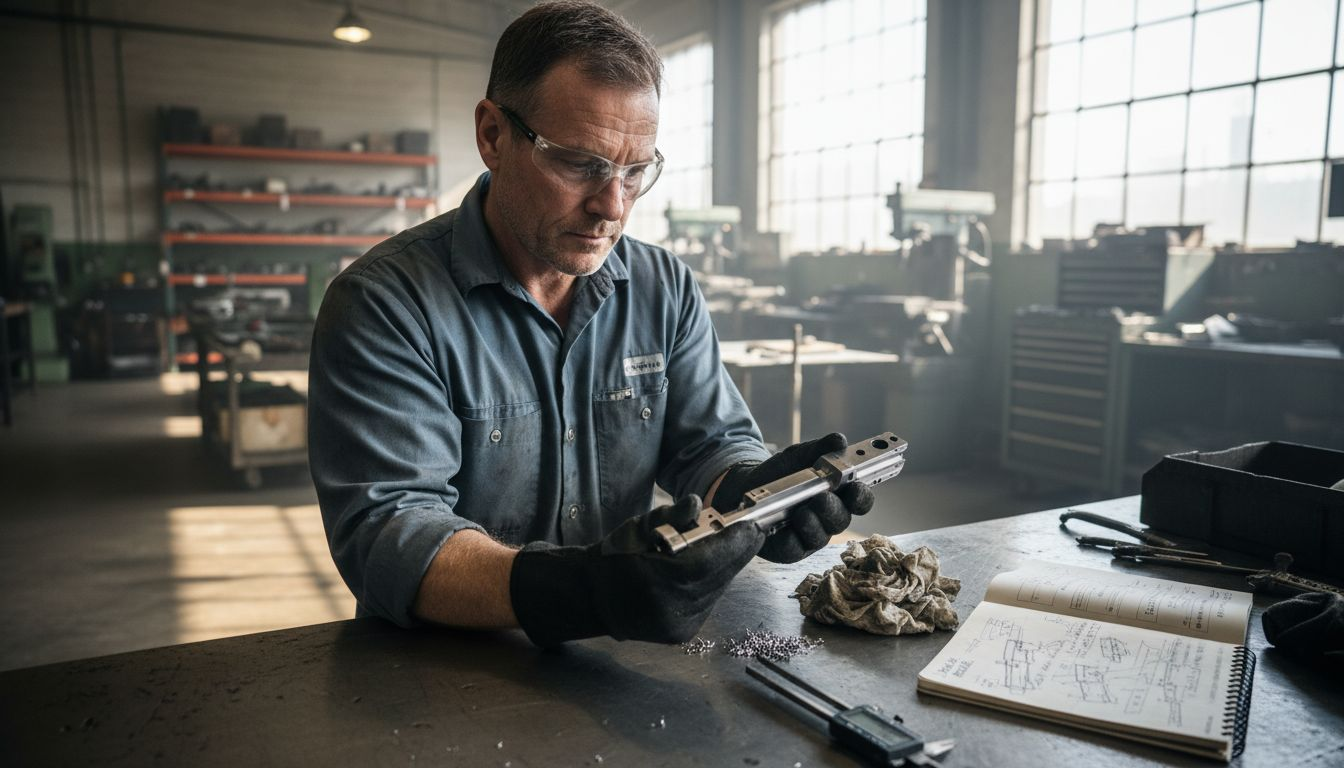
Dimensional inaccuracies cause up to 20% production losses in firearm manufacturing, costing OEMs millions in rework and recalls. Success hinges on mastering precise material specifications and advanced machining technology. This guide prepares you to understand machining processes, inspection methods, and scaling strategies that ensure every component meets critical tolerances and regulatory standards for safe, reliable firearms production.
Table of Contents
- Introduction To Firearm Parts Machining For OEMs
- Material Selection And Properties For Firearm Components
- Tolerance Standards And Dimensional Accuracy In Firearms Machining
- Advanced Machining Techniques For Firearm Parts
- Inspection Technologies And Quality Control In Firearm Machining
- High-Volume Production Challenges And Solutions
- Common Misconceptions In Firearm Parts Machining
- Bridging Knowledge To Practice: Selecting A Machining Partner
- Partner With Machining Experts Specialized In Firearm Precision
- Frequently Asked Questions
Key takeaways
| Point | Details |
|---|---|
| Precision tolerances | Firearm components must be machined to ±0.001 inches for proper fit and function. |
| Material selection | Aluminum alloys, stainless steel, and titanium offer strength, corrosion resistance, and traceability. |
| Advanced CNC and EDM | Multi-axis CNC and wire EDM enable complex geometries with repeatable accuracy. |
| CMM inspection | Coordinate Measuring Machines digitally verify dimensions against CAD models for batch consistency. |
| Fixture design | Custom fixtures enable production of over 10,000 units with consistent high precision. |
Introduction to firearm parts machining for OEMs
Precision machining forms the backbone of reliable firearm manufacturing. Every trigger assembly, receiver, and bolt carrier group depends on exacting dimensional control to function safely under extreme stress. Firearm components must be machined to critical dimensions within tolerances often as tight as ±0.001 inches to ensure proper fit, function, and reliability in high-volume production environments.
The U.S. firearm market demands both quality and compliance. OEMs face mounting pressure to deliver complex parts at scale while maintaining stringent dimensional accuracy. Regulatory requirements add another layer of scrutiny, requiring full traceability and documentation for every component batch.
Key challenges OEMs encounter when selecting machining partners include:
- Finding suppliers with proven experience in firearm OEM manufacturing standards and materials
- Verifying capability to hold tight tolerances across thousands of production runs
- Ensuring proper quality systems and inspection protocols are in place
- Balancing cost pressures with non-negotiable safety and compliance requirements
- Securing reliable capacity for both prototype development and full production scaling
Understanding these fundamentals helps you evaluate potential partners and avoid costly production disruptions. The following sections break down material properties, tolerance requirements, and advanced machining techniques that separate exceptional firearm parts suppliers from those that simply claim precision.
Material selection and properties for firearm components
Material choice directly impacts durability, machinability, and regulatory compliance. The wrong alloy can lead to premature wear, corrosion failures, or catastrophic malfunctions in the field. Selecting optimal materials requires understanding both mechanical properties and how they behave during precision machining operations.
Aluminum alloys dominate receiver and frame applications where weight reduction matters. 7075-T6 aluminum offers excellent strength-to-weight ratio and machines cleanly, though it demands sharp tooling to prevent work hardening. 6061-T6 provides easier machinability for less critical components while maintaining good corrosion resistance for outdoor use.
Stainless steel grades serve high-stress applications like barrels, bolts, and firing pins. 416 stainless combines good machinability with adequate corrosion resistance for most environments. 17-4 PH stainless delivers superior strength after heat treatment, ideal for slide components and extractors that endure repeated impact cycles.
Titanium alloys appear in premium applications demanding maximum strength at minimal weight. Grade 5 titanium (Ti-6Al-4V) resists corrosion exceptionally well but requires specialized tooling and reduced cutting speeds. The material’s tendency to work harden makes fixture design and cutting parameters critical for consistent results.
Key machining considerations across firearm parts materials include:
- Tool wear rates vary dramatically between materials, affecting production costs
- Fixture design must account for thermal expansion during machining cycles
- Chip evacuation becomes critical with deep pockets and internal features
- Material certification and traceability documentation ensure regulatory compliance
Proper material selection early in design prevents costly retooling later. Work with machining partners who maintain certified material stock and understand how each alloy’s properties affect production feasibility and final part performance.
Tolerance standards and dimensional accuracy in firearms machining
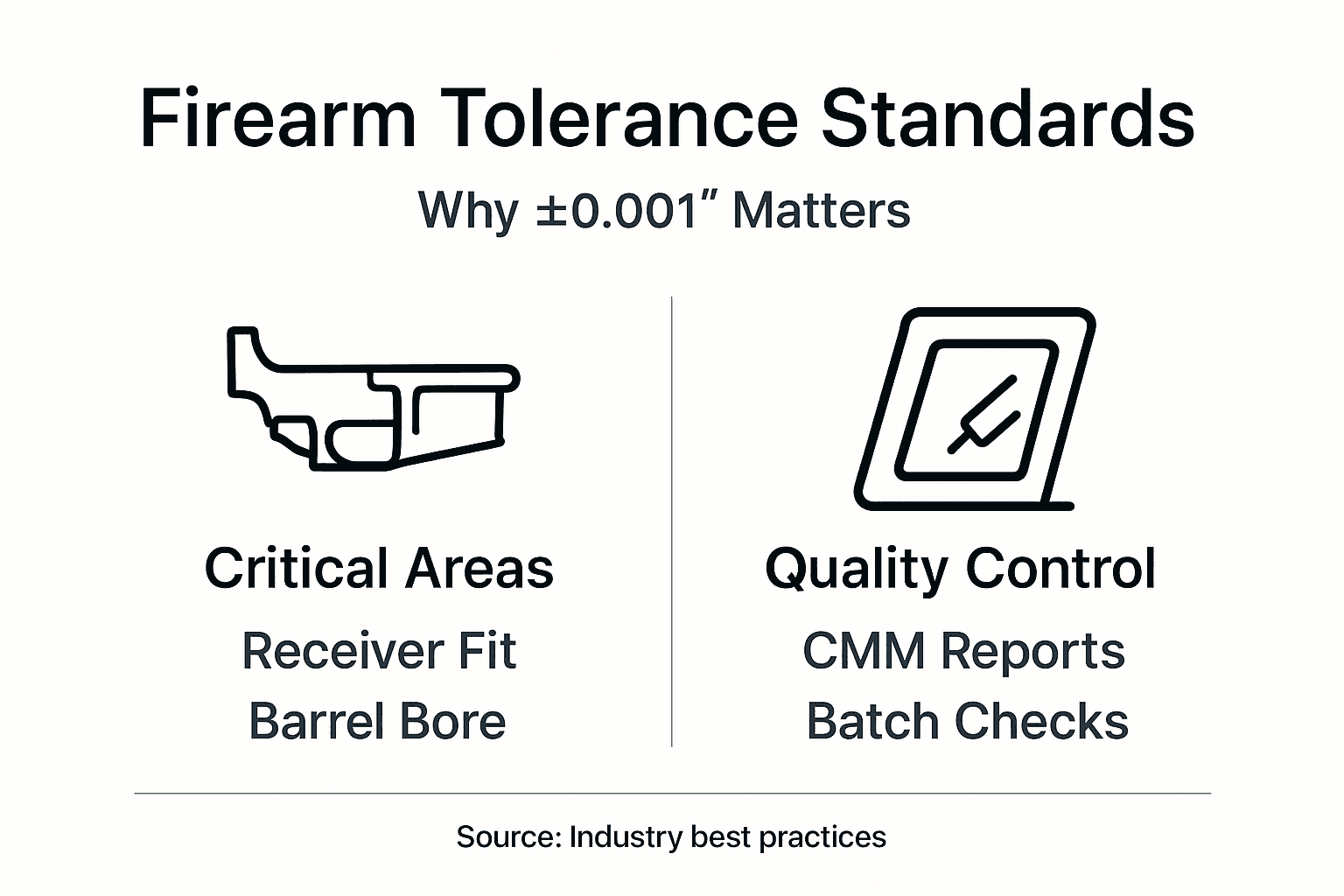
Tolerance control separates functional firearms from dangerous failures. Critical dimensions with tolerances as tight as ±0.001 inches ensure proper headspace, consistent trigger pull, and reliable cycling under varied conditions. Loose tolerances invite malfunctions, while excessively tight specifications drive costs without improving function.
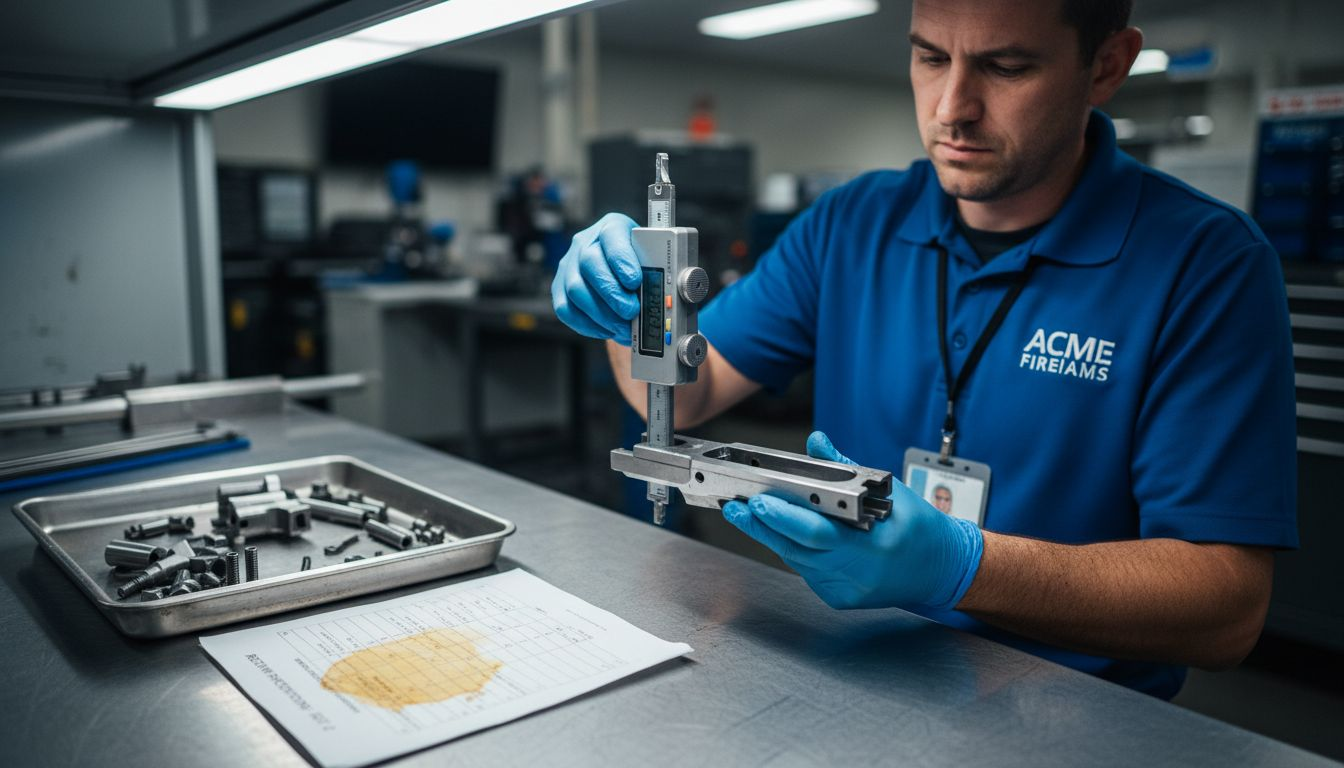
Receiver dimensions govern how all other components interact. The magazine well must accept magazines within specified tolerances to ensure reliable feeding. Barrel threads require precise pitch and depth control, typically within 0.002 inches, to maintain proper torque and alignment. Bolt carrier group dimensions affect cycling speed and extraction reliability.
Trigger assemblies demand the tightest control. Sear engagement surfaces often specify tolerances to 0.0005 inches to achieve consistent pull weight and prevent dangerous doubling. Pin holes throughout the receiver must maintain position within 0.001 inches to ensure parts align correctly during assembly.
Critical components and their typical tolerance requirements include:
- Barrel chamber dimensions: ±0.0005 inches for headspace control
- Bolt face to locking lug clearance: 0.001 to 0.003 inches for reliable lockup
- Trigger pin holes: ±0.0005 inches for consistent sear engagement
- Magazine well opening: ±0.005 inches for reliable magazine insertion
- Gas port diameter: ±0.002 inches affecting cycling reliability
Tolerances connect directly to firearms machining tolerances and regulatory compliance. Out-of-spec parts can cause catastrophic failures leading to injury, litigation, and mandatory recalls. The 2024 recall of over 15,000 pistols due to dimensional issues in slide manufacturing illustrates real consequences of inadequate tolerance control.
Maintaining these standards across high-volume production requires robust process controls and frequent verification. Statistical process control helps identify drift before parts fall out of specification, preventing scrapped batches and production delays.
Advanced machining techniques for firearm parts
Achieving firearm tolerances demands sophisticated equipment and proven processes. Modern CNC technology enables complex geometries impossible with manual methods while maintaining repeatability across thousands of cycles. Selecting appropriate techniques for each component optimizes both quality and production efficiency.
Multi-axis CNC milling handles complex 3D geometries in receivers and frames. Four-axis machines rotate parts during cutting to access multiple surfaces without repositioning, reducing setup time and improving accuracy. Five-axis systems tilt the cutting tool relative to the workpiece, enabling compound angles and undercuts common in ergonomic grip designs. These capabilities reduce secondary operations and maintain tighter tolerances by eliminating multiple setups.
Wire EDM machining excels at intricate internal features and hard materials. The process uses electrical discharge to erode material with a thin wire electrode, achieving internal radii as tight as 0.005 inches. Wire EDM cuts hardened tool steels for custom fixtures and produces complex trigger components with surface finishes to 32 microinches. No cutting forces mean delicate features remain dimensionally stable.
Swiss screw machining produces high volumes of small, precise parts like firing pins and extractors. The guide bushing supports work material close to the cutting tool, enabling tight tolerances on long, slender components. Multiple spindles machine several operations simultaneously, dramatically increasing throughput for pin and fastener production.
Comparing machining methods helps match process to application:
| Method | Best For | Typical Tolerance | Production Rate |
|---|---|---|---|
| 3-axis CNC | Simple flat parts, slides | ±0.002 inches | Medium to high |
| 4/5-axis CNC | Complex receivers, frames | ±0.001 inches | Low to medium |
| Wire EDM | Intricate internals, hard materials | ±0.0005 inches | Low |
| Swiss screw | Small cylindrical parts, pins | ±0.0005 inches | Very high |
Selecting machining approaches based on part geometry and volume:
- Evaluate part complexity and required tolerance levels first
- Consider production volume to justify tooling and setup costs
- Assess material hardness and machinability characteristics
- Factor secondary operations like heat treatment into process planning
- Balance precision requirements against delivery timeline constraints
Pro Tip: Integrate precision machining workflows early in design. Consulting with machinists during CAD development prevents costly redesigns when features prove difficult or impossible to manufacture within tolerance. Design for manufacturability saves months and significant tooling expenses.
Advanced CNC milling and turning capabilities enable previously impossible designs. Today’s firearms incorporate weight-reducing pockets, enhanced ergonomics, and integrated accessory mounting, all while maintaining structural integrity and dimensional accuracy. Understanding these processes helps you specify realistic requirements and evaluate partner capabilities.
Inspection technologies and quality control in firearm machining
Machining precision means nothing without verification. Coordinate Measuring Machines (CMM) are critical inspection tools for digitally verifying dimensions against CAD models and ensuring batch-to-batch consistency before parts leave production. Modern quality control integrates inspection throughout manufacturing rather than relegating it to final checks.
CMM systems probe parts with micron-level accuracy, generating detailed dimensional reports comparing actual measurements to nominal specifications. Three-dimensional inspection captures complex geometries impossible to verify with manual gauges. Automated CMM programming pulls directly from CAD files, eliminating human transcription errors and accelerating inspection cycles.
Batch sampling maintains consistency across mass production without inspecting every piece. Statistical sampling plans determine how many parts per lot require full CMM verification based on production volume and process capability. First article inspection validates new setups before production runs, while in-process checks catch dimensional drift before entire batches fall out of specification.
Quality management systems provide the framework for consistent results. ISO 9001 certification demonstrates commitment to documented procedures and continuous improvement. AS9100 extends these requirements for aerospace and defense applications, adding traceability and configuration management critical for firearm components. These certifications require regular audits and corrective action processes that prevent recurring defects.
Best practices for integrating inspection throughout production include:
- Implementing Statistical Process Control (SPC) to monitor trending and predict potential drift
- Calibrating measurement equipment to NIST-traceable standards on defined schedules
- Training operators on proper gauge use and when to alert quality personnel
- Maintaining detailed inspection records with part serial numbers for full traceability
- Conducting failure mode analysis to identify critical dimensions requiring tighter control
Pro Tip: Require partners to provide detailed inspection reports with every shipment. Reports should include CMM data files, material certifications, and process control charts demonstrating stable production. This documentation proves due diligence in the event of field failures and supports continuous improvement initiatives.
Traceability via proper marking ensures accountability. Laser engraving or electro-chemical etching adds permanent serial numbers and batch codes without affecting part function. Quality assurance manufacturing protocols link these markings to raw material certifications, machining parameters, inspection data, and shipping records, creating complete genealogy for every component.
High-volume production challenges and solutions
Scaling from prototype to production reveals hidden obstacles. Processes that worked for 50 parts often fail at 5,000 due to cumulative tool wear, thermal effects, and material variation across larger batches. Maintaining precision while increasing throughput requires systematic process optimization and specialized tooling investments.
Repeatability challenges emerge as production scales. Fixture wear introduces positioning errors that accumulate across production runs. Tool deflection varies with cutting forces, affecting dimensions on long production cycles. Material lot changes bring subtle property variations that alter machining behavior despite identical part specifications.
Using specialized fixtures and in-house tooling custom designed for firearm components improves repeatability and enables cost-effective production of over 10,000 units with consistent high precision. Custom workholding locates parts identically for every cycle, eliminating setup variation. Hard tooling withstands production volumes that would destroy standard fixtures, justifying upfront investment through reduced per-piece costs.
In-process sampling catches defects early, preventing scrapped batches. Automated gauge stations integrated into machining cells check critical dimensions every few cycles without removing parts from production flow. Operators respond immediately to trending data rather than discovering problems during final inspection when entire batches require rework.
Supply chain stability impacts production consistency beyond machining operations. Material suppliers must maintain lot-to-lot chemistry consistency and certify properties to specified standards. Tooling vendors need reliable delivery for replacement inserts and cutters. Disruptions cascade through production schedules, delaying customer deliveries and increasing carrying costs.
Balancing throughput with quality control requires:
- Implementing preventive maintenance schedules that minimize unplanned downtime
- Qualifying backup suppliers for critical materials and consumables
- Building buffer inventory at constraint operations to smooth production flow
- Training cross-functional teams who understand both machining and quality requirements
- Investing in automation for repetitive operations while maintaining skilled oversight
Effective scaling of firearm parts machining depends on robust process documentation. Detailed work instructions, setup procedures, and inspection plans ensure consistency across multiple machines and operators. Configuration management tracks drawing revisions and engineering changes, preventing obsolete specifications from reaching production.
Common misconceptions in firearm parts machining
Misunderstandings about materials, tolerances, and inspection lead to costly mistakes. Clearing these misconceptions helps OEMs make informed decisions that balance cost with safety and reliability. Experienced machining partners guide customers away from these common pitfalls.
Myth: Cheaper materials suffice for non-critical components. Reality is that compromises anywhere in the firearm affect overall reliability and safety. Using uncertified or lower-grade alloys saves pennies per part but risks catastrophic failures, product recalls, and litigation. The 2023 recall of budget pistol frames manufactured from substandard aluminum cost the OEM over $2 million in direct expenses plus immeasurable brand damage.
Myth: Loose tolerances reduce machining costs significantly. While tighter specifications do increase process complexity, relaxing critical dimensions to save money multiplies malfunction risks. Dimensional stack-up from multiple loose-tolerance parts creates unpredictable interactions. A receiver with 0.005-inch magazine well tolerance might function perfectly, but combined with loose magazine body tolerances causes feeding failures in the field.
Myth: Visual inspection provides adequate quality control. Human inspection catches obvious defects but cannot verify dimensional accuracy to 0.001 inches. CMM and digital verification methods prove compliance objectively, providing documentation that protects against liability claims. Relying on visual checks alone invites undetected drift that surfaces as field failures after thousands of units ship.
Key truths that counter these myths:
- Certified materials with full traceability cost marginally more but eliminate recall risks
- Appropriate tolerances based on function cost less than warranty claims from loose specs
- Automated inspection systems pay for themselves through reduced scrap and rework
- Investment in proper processes prevents exponentially larger costs from field failures
Ignoring these realities impacts both immediate costs and long-term brand reputation. One major manufacturer learned this lesson when improperly heat-treated extractors led to a 50,000-unit recall, costing the company its largest distributor contract.
“Quality is never an accident. It is always the result of intelligent effort.” This principle applies doubly to firearms manufacturing, where lives depend on every component performing exactly as designed under extreme conditions.
Understanding true cost drivers helps OEMs invest wisely in manufacturing partnerships. Short-term savings from relaxed standards inevitably cost more through warranty claims, recalls, and damaged reputation than proper precision machining from the start.
Bridging knowledge to practice: selecting a machining partner
Translating technical knowledge into partner selection requires concrete evaluation criteria. The right machining partner combines advanced capabilities with proven firearms industry experience and robust quality systems. Systematic evaluation prevents costly mistakes and establishes productive long-term relationships.
Key criteria for evaluating potential machining partners:
Verify ISO 9001 certification as baseline quality management system. AS9100 certification indicates aerospace-level process control and documentation practices applicable to firearms manufacturing. Request copies of current certificates and audit dates to confirm active compliance.
Assess advanced CNC, EDM, and Swiss machining capabilities directly. Tour facilities to observe equipment condition and operator skill levels. Ask about machine tool age, maintenance schedules, and recent capital investments in new technology.
Confirm experience with firearm-specific materials and regulatory requirements. Request sample parts and case studies from similar projects. Verify understanding of ATF marking requirements, material traceability needs, and industry-specific documentation standards.
Evaluate production capacity for both prototype and high-volume manufacturing. Confirm availability of custom fixture design and manufacturing services. Assess ability to scale from initial development through full production without changing suppliers.
Review quality control processes including CMM capabilities, sampling protocols, and inspection reporting. Request sample inspection reports showing level of detail and traceability provided with shipments.
Investigate customer service approach and technical support offerings. Gauge responsiveness during quoting process as indicator of communication during production. Confirm availability of engineering consultation during design phase.
Request references from current OEM customers in firearms or similarly regulated industries. Contact references directly to discuss on-time delivery performance, quality consistency, and problem resolution effectiveness.
Examine compliance support capabilities including export control knowledge and regulatory documentation assistance. Confirm understanding of ITAR requirements if applicable to your products.
Thorough partner evaluation prevents production disruptions and quality issues that damage your brand reputation. Investing time upfront to verify capabilities and cultural fit pays dividends through smooth production launches and reliable ongoing supply.
Partner with machining experts specialized in firearm precision
Mastering firearm parts machining requires both technical knowledge and experienced execution. The complexity of tight tolerances, specialized materials, and regulatory compliance demands partners who understand these unique challenges deeply.
Machining Technologies brings decades of precision manufacturing expertise to firearm component production. Our 70,000 square foot facility houses advanced CNC equipment, wire EDM services, and Swiss screw machines capable of holding ±0.001-inch tolerances across high-volume production runs. We combine CNC milling and turning services with comprehensive quality control including CMM inspection and full traceability documentation.
Our team works directly with OEMs from prototype development through full production scaling, providing engineering support and custom fixture design that ensures consistent results. ISO 9001 certified processes and rigorous inspection protocols deliver the reliability your brand demands. Explore our complete precision machining services and discover how we help firearm manufacturers achieve their most challenging specifications on schedule.
Frequently asked questions
What materials are best for machining durable firearm parts?
Aluminum alloys like 7075-T6 and 6061-T6 offer excellent strength-to-weight ratios for receivers and frames. Stainless steel grades including 416 and 17-4 PH serve high-stress components like barrels and bolts. Titanium alloys provide maximum strength at minimal weight for premium applications. Certified materials with full traceability ensure reliability and regulatory compliance.
How tight are tolerance requirements for critical firearm components?
Critical firearm components commonly require tolerances to ±0.001 inches, with some trigger and sear surfaces held to ±0.0005 inches. Barrel chamber dimensions may specify ±0.0005 inches for proper headspace control. These tight tolerances ensure reliable function, consistent accuracy, and safe operation under varied conditions and extended use.
What inspection methods ensure firearm parts meet specifications?
Coordinate Measuring Machines (CMM) digitally verify dimensions against CAD models with micron-level accuracy. Statistical batch sampling maintains consistency across production without inspecting every part. First article and in-process inspection catch dimensional drift early. ISO 9001 and AS9100 quality management systems provide documented procedures and traceability for regulatory compliance.
How can OEMs evaluate machining partners effectively?
Verify ISO 9001 and AS9100 certifications for quality management systems. Assess machining technology capabilities including multi-axis CNC, wire EDM, and Swiss screw equipment. Confirm firearm industry experience through case studies and customer references. Review sample inspection reports and tour facilities to observe process controls. Check capacity for both prototype development and high-volume production scaling.
Recommended
- Master Precision Machining Workflow for Firearms Components | Machining Technologies
- Firearm Parts | Machining Technologies
- Precision Parts Manufacturing: Maximizing Quality and Throughput | Machining Technologies
- Precision Parts, Fast Turnaround | Machining Technologies
- Violin Bridge Fitting Steps for Precise Setup Results