

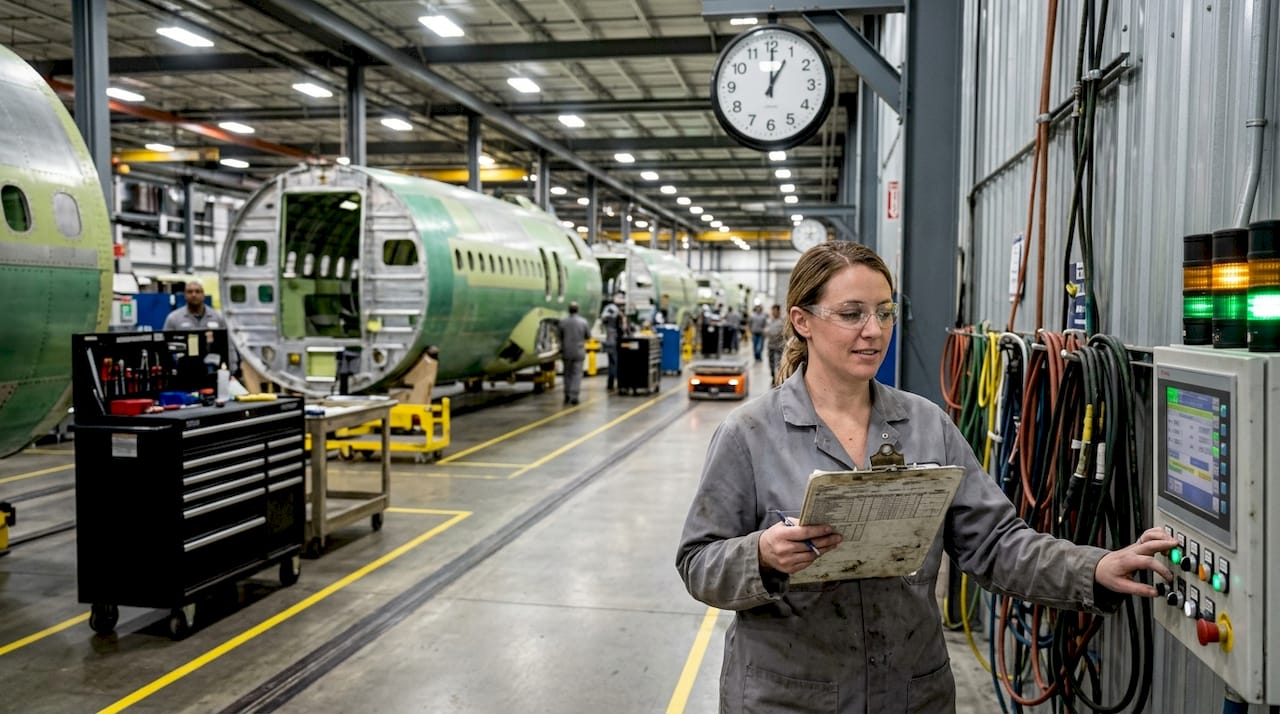
Sourcing a high-volume machining partner is one of the highest-stakes decisions an OEM procurement manager makes. One wrong choice means missed delivery windows, scrap rates that erode margins, and compliance failures that can ground programs. The examples in this article pull from aerospace, defense, and industrial production environments where the cost of failure is measured in millions, not thousands. Each case delivers a concrete lesson you can apply when evaluating your supply base or writing your next RFQ.
Table of Contents
- What defines high-volume manufacturing?
- Example 1: Lockheed Martin F-35 integrated production line
- Example 2: Collins Aerospace lean production for aircraft wheels
- Example 3: Northrop Grumman’s automated fuselage assembly
- Example 4: LeanWerks and high-speed casting machining with Mazak Integrex
- Trade-offs in high-volume machining: Speed vs. precision
- Summary comparison: How leading high-volume production lines stack up
- Ready to implement high-volume strategies in your supply chain?
- Frequently asked questions
Key Takeaways
| Point | Details |
|---|---|
| Define high-volume standards | High-volume manufacturing depends on stable processes, automation, and predictable results—not gut feel. |
| Lean and automation drive speed | Lead times can be reduced by over 80% using lean layouts and multitasking CNC platforms. |
| Robotics raise quality and output | Fully automated lines like those at Lockheed Martin and Northrop Grumman enable 24/7 throughput with tight quality control. |
| Cycle speed brings trade-offs | Aggressive settings increase output but may compromise precision required for critical parts. |
| Benchmark before scaling | Comparing top industry implementations clarifies the questions to ask vendors before scaling production. |
What defines high-volume manufacturing?
High-volume manufacturing means producing thousands to millions of identical or near-identical parts with consistent quality across every run. It is not simply running a machine faster. It requires stable, documented processes, automated quality checks, and equipment that performs the same way on day one as it does on day three hundred.
Here is what separates high-volume from low-volume or prototype work:
- Process stability: Every operation is locked in, documented, and repeatable without relying on operator judgment.
- Automation: Material handling, tool changes, and inspection happen with minimal manual intervention.
- Lead time consistency: Cycle times are predictable, not variable, so you can build a reliable delivery schedule.
- Quality presetting: Tools are set offline, and first-article inspection is built into the flow, not bolted on at the end.
- 24/7 capability: True high-volume lines run around the clock, not just during a single shift.
High-volume machining requires intentional process stability over instinct, with a focus on year-long repeatability. That distinction matters enormously when you are sourcing parts for a multi-year defense contract. Understanding the automated machining benefits of a well-structured line helps you ask the right questions before you commit.
Pro Tip: Before awarding a long-run job, ask your supplier for their process documentation package. If they cannot produce a control plan and a tool-life management protocol on the spot, that is a red flag for year-long repeatability.
Example 1: Lockheed Martin F-35 integrated production line
Few manufacturing environments on earth match the scale and complexity of the F-35 program. The Fort Worth facility runs a mile-long assembly line, operating 24 hours a day, seven days a week, to meet a production target of over 150 aircraft annually. Each jet takes roughly 18 months from start to delivery, which means dozens of aircraft are in various stages of completion at any given moment.
Key features of the F-35 production line include:
- Modular sub-assemblies: Major sections are built in parallel by suppliers and merged at final assembly, compressing the critical path.
- Digital tracking: Every part carries a digital identity that feeds real-time status into the production management system.
- Embedded quality checkpoints: Inspection is not a final gate. It happens at every station, catching deviations before they compound.
- Flexible line configuration: The line can accommodate multiple F-35 variants (A, B, C) without a full reconfiguration.
“A mile-long factory running 24/7 to build stealth fighters is not just impressive engineering. It is a masterclass in synchronized supply chain management and automated flow.”
The 18-month cycle per aircraft underscores how complexity and throughput can coexist when the system is engineered correctly. Reviewing aerospace automation practices at the component level shows how suppliers feeding a line like this must match its discipline.
Example 2: Collins Aerospace lean production for aircraft wheels
Whole-aircraft production is one thing. Component-level transformation is where most OEM suppliers actually operate, and Collins Aerospace delivered a remarkable result at that scale. The team cut lead time from 45 days to 7 for aircraft wheels, an 84% reduction, by combining lean layout redesign with advanced CNC technology.
The core changes that drove the result:
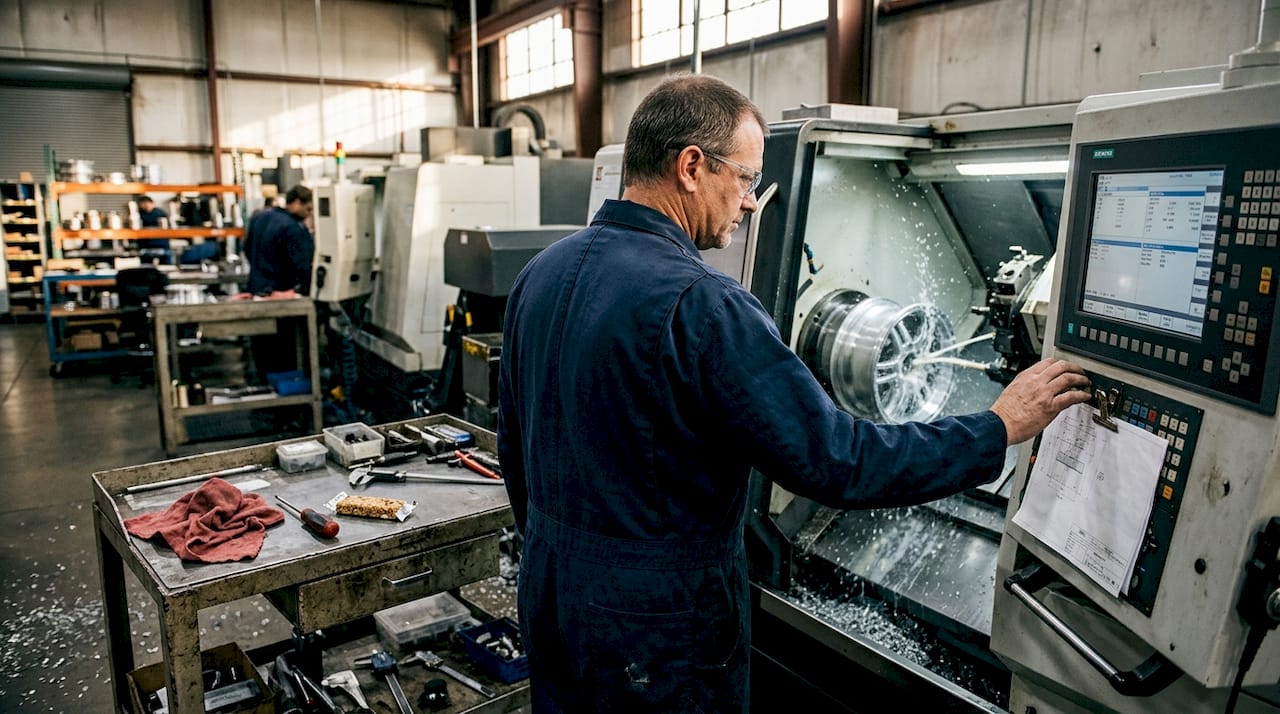
- Multitask CNC centers: Replaced multiple standalone machines with single multitask units capable of turning, milling, and drilling in one setup.
- Automated pallet changers: Kept spindles cutting while operators loaded the next part, eliminating idle time between cycles.
- Simplified part flow: Reduced the number of handoffs between operations, which cut queue time and rework risk.
- Offline QC and visual controls: Inspection data was captured at the machine, not at a separate CMM station down the hall.
The trends for shorter lead times in aerospace machining point directly at this kind of consolidation. Combining milling and turning integration into a single work center is now a baseline expectation for competitive suppliers.
Pro Tip: If your current supplier runs five separate machines to complete one part, ask them what a multitask consolidation study would show. The answer often reveals 40 to 60% of your lead time is queue time, not cut time.
Example 3: Northrop Grumman’s automated fuselage assembly
High-volume success is not just about faster machines. It is about building systems that combine efficiency, stability, and real-time intelligence. Northrop Grumman’s Integrated Assembly Line (IAL) for the F-35 center fuselage does exactly that, delivering one fuselage every 30 hours with over 1,400 units delivered to date.
The IAL borrows heavily from automotive production logic:
- Conveyor-based flow: Fuselages move through stations on a continuous conveyor, just like cars on an assembly line.
- Robotic drilling and fastening: Robots perform thousands of precision holes per fuselage with consistent force and depth control.
- Composite layup automation: Automated fiber placement reduces variability in structural panels.
- Fully digitized feedback: Every measurement feeds back into the production system, enabling real-time adjustments.
| Metric | IAL (Northrop Grumman) | Traditional assembly |
|---|---|---|
| Cycle time per unit | 30 hours | 60 to 90 hours |
| Operator touchpoints | Reduced by robotics | High manual involvement |
| Quality feedback | Real-time digital | End-of-line inspection |
| Units delivered | 1,400+ | Varies by program |
“One center fuselage every 30 hours, sustained over years and thousands of units, is what separates a production system from a production experiment.”
For procurement managers evaluating suppliers, the IAL model highlights precision best practices that translate directly to component machining: automate repetitive operations, digitize feedback, and never let inspection be an afterthought.
Example 4: LeanWerks and high-speed casting machining with Mazak Integrex
Efficiency breakthroughs do not always require a billion-dollar facility. LeanWerks, a precision CNC shop, cut aluminum investment casting cycle time by over 80%, moving from 10 hours per part to under 2 hours, using a Mazak Integrex multi-tasking machine and smart process redesign.
The methods that drove the improvement:
- 5-sided single-setup machining: The Integrex completed all major features in one clamping, eliminating repositioning errors.
- In-process probing: The machine measured critical features mid-cycle and adjusted tool paths automatically.
- Form tools: Custom form tools cut multiple features in a single pass, reducing cycle steps.
- Automated QC integration: Inspection data was captured at the spindle, not after the fact.
This example is directly relevant to industrial and defense OEMs sourcing complex castings. Integrated CNC turning and milling in a single setup is one of the highest-leverage changes a shop can make. Pairing that with precision strategies for complex parts closes the loop on quality risk.
Pro Tip: One-setup machining eliminates the tolerance stack-up that accumulates every time a part is re-fixtured. For tight-tolerance aerospace and defense components, that single change can be the difference between a capable process and a chronic scrap problem.
Trade-offs in high-volume machining: Speed vs. precision
After reviewing these examples, it is worth addressing the engineering tension that every procurement manager should understand. Pushing for faster cycle times is not free. Aggressive cutting creates larger geometric deviations compared to balanced cycles, particularly in critical features like bores, datum surfaces, and threaded interfaces.
Here is when each approach makes sense:
- Prioritize speed when: Tolerances are loose (above ±0.005 in.), material is forgiving (aluminum, soft steel), and volume is extremely high with low per-part value.
- Prioritize precision when: Tolerances are tight (below ±0.001 in.), parts are safety-critical, or the cost of a field failure far exceeds the cost of slower throughput.
- Balance both when: You are running aerospace or defense components where AS9100 or ITAR compliance requires documented process control at every step.
| Factor | Aggressive cycle | Balanced cycle |
|---|---|---|
| Output rate | High | Moderate |
| Tolerance stability | Lower | Higher |
| Tool wear rate | Faster | Slower |
| Best application | High-volume, loose-tolerance parts | Safety-critical, tight-tolerance parts |
| Rework risk | Higher | Lower |
Matching your supplier’s cycle strategy to your component specs is not optional. It is a core part of supplier qualification. Use precision strategy comparisons to frame that conversation with your machining partners.
Summary comparison: How leading high-volume production lines stack up
Bringing all four examples together gives you a practical benchmark for evaluating your own supply base or structuring RFP questions.
| Example | Key technology | Lead time or cycle result | Primary lesson |
|---|---|---|---|
| Lockheed Martin F-35 line | Modular assembly, digital tracking | 150+ aircraft per year | Synchronized supply and embedded QC drive scale |
| Collins Aerospace wheels | Multitask CNC, lean layout | 45 days to 7 days (84% faster) | Consolidation cuts queue time, not just cut time |
| Northrop Grumman IAL | Robotics, conveyor flow, digital feedback | 1 fuselage per 30 hours | Automotive flow principles work in aerospace |
| LeanWerks castings | Mazak Integrex, in-process probing | 10 hours to under 2 hours (80%+ faster) | Single-setup machining eliminates tolerance stack-up |
Every one of these results came from a deliberate combination of technology, process discipline, and quality integration. None of them happened by running the same process faster. That is the core lesson for procurement managers building or auditing a high-volume supply chain.
Ready to implement high-volume strategies in your supply chain?
The examples above show what is possible when automation, process discipline, and precision engineering work together. If you are sourcing complex components for aerospace, defense, or industrial machinery programs, the gap between a capable supplier and an average one shows up in delivery performance, scrap rates, and long-term cost.
At Machining Technologies LLC, we have been producing over 20 million parts annually from our 70,000 square foot facility in Webster, Massachusetts since 1985. Our full service portfolio covers CNC milling, turning, Hydromat systems, and wire EDM, all built around the same principles these world-class examples demonstrate. Whether you need a prototype validated or a full production run scaled, our team applies precision manufacturing strategies that match your component specs and compliance requirements. Contact us to discuss your program requirements and get a production-ready solution.
Frequently asked questions
What industries most commonly rely on high-volume manufacturing?
Aerospace, defense, automotive, and major industrial equipment sectors depend heavily on high-volume manufacturing for both cost control and quality consistency. These industries share a common need for repeatable precision at scale across multi-year production programs.
How do automation and robotics impact quality in high-volume machining?
Automation standardizes every operation and removes the variability that comes from manual handling, supporting repeatable quality even across millions of parts. Northrop Grumman’s automated lines demonstrate how robotics can sustain precision over thousands of production cycles.
What is the main challenge when scaling from pilot to high-volume production?
Maintaining process stability and dimensional precision across thousands of parts is consistently the hardest part of scaling up. Stability and repeatability require documented processes and automated controls, not just faster machines.
Why do some manufacturers prioritize balanced cycles over aggressive cutting?
Balanced cycles preserve geometric accuracy and reduce deviation in critical features, which matters enormously for aerospace and defense components where tolerances are tight and failures are costly. Aggressive cuts produce more deviation in key features compared to controlled, balanced cycle strategies.