

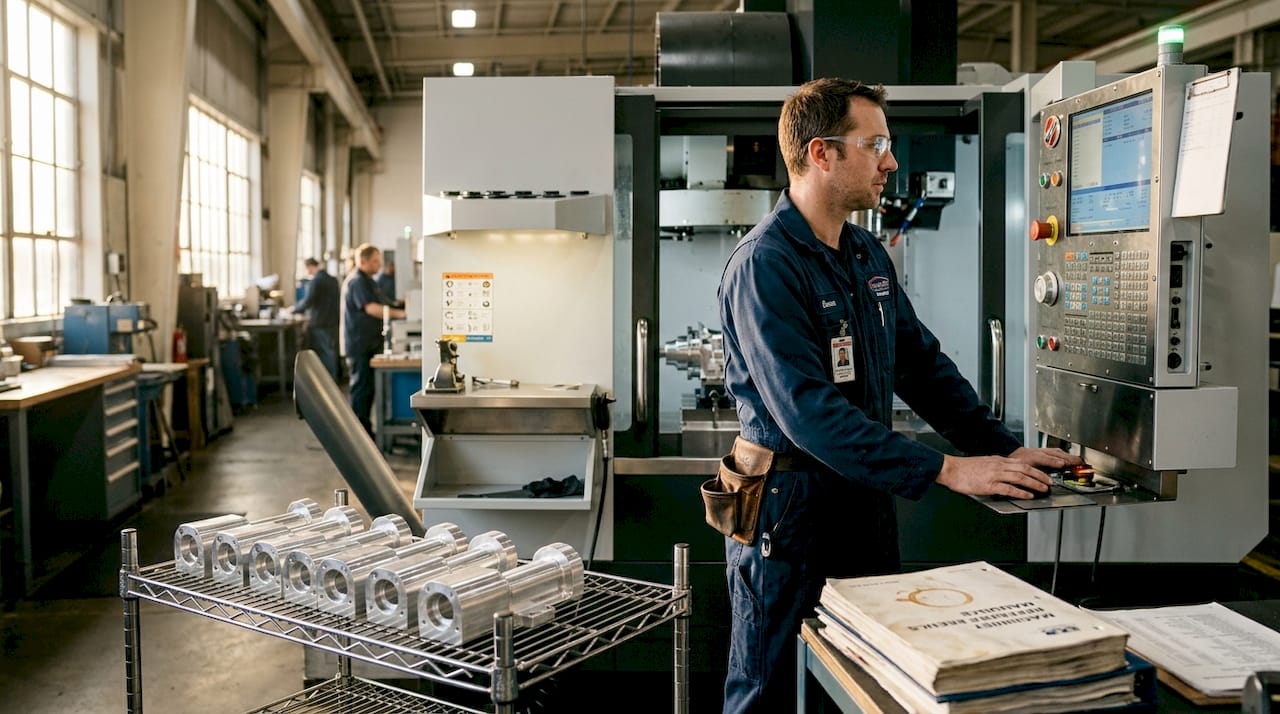
Aerospace and defense manufacturers face relentless pressure to deliver components with tolerances measured in ten-thousandths of an inch while maintaining production schedules that leave zero room for error. A single defective turbine blade or landing gear component can ground an aircraft, trigger safety investigations, and cost millions in recalls. CNC automation has emerged as the definitive solution, transforming how precision parts reach production floors. This article explores the measurable advantages CNC automation delivers for aerospace manufacturing stakeholders in 2026, from precision improvements to financial returns and advanced techniques that redefine what’s possible in high-stakes manufacturing environments.
Table of Contents
- Essential Precision Advantages Of Cnc Automation In Aerospace Manufacturing
- Boosting Production Efficiency And Reducing Operational Costs Through Automation
- Advanced Automation Techniques Enhancing Production Rates And Precision Tasks
- Challenges And Considerations In Implementing Cnc Automation
- Explore Advanced Cnc Automation Solutions With Machining Technologies
- Frequently Asked Questions
Key takeaways
| Point | Details |
|---|---|
| Precision capabilities | CNC automation achieves tolerances as tight as ±0.0001 inches, essential for safety-critical aerospace components. |
| Productivity gains | Setup times drop 20 to 30 percent while output increases 15 percent through automated processes. |
| Financial returns | Documented aerospace shop investments show 129 percent first-year ROI with 18-month payback periods. |
| Advanced techniques | Multi-axis machining and cobots enable complex geometries and repeatable precision in confined spaces. |
| Implementation challenges | High upfront costs and integration complexity require careful planning for batch sizes and part types. |
Essential precision advantages of CNC automation in aerospace manufacturing
CNC automation represents computer-controlled machining systems that execute programmed tool paths with minimal human intervention, achieving tolerances as tight as ±0.0001 inches for aerospace safety-critical parts. These tolerance levels matter because turbine blades spinning at 10,000 RPM cannot tolerate dimensional variations that create imbalance, and landing gear components must fit precisely to withstand forces exceeding 50 tons during touchdown. Traditional manual machining simply cannot maintain this consistency across production runs of thousands of identical parts.
The precision consistency CNC automation delivers transforms quality assurance protocols. Every part emerges from the automated cell matching the first article inspection dimensions, eliminating the drift that occurs when operators fatigue or cutting tools wear unpredictably. This repeatability directly supports regulatory compliance, as aerospace manufacturers must demonstrate statistical process control to FAA and EASA auditors who scrutinize production data.
Scrap rates plummet when machines hold tolerances within microns rather than relying on operator skill to compensate for setup variations. Aerospace manufacturers report scrap reductions exceeding 40 percent after implementing automated cells for complex geometries, translating to substantial material savings when working with titanium alloys costing $30 per pound. Understanding why tight tolerances matter aerospace machining becomes critical when evaluating automation investments.
Key precision advantages include:
- Dimensional consistency across production runs eliminates part-to-part variation
- Reduced operator-induced errors from fatigue or inconsistent technique
- Real-time tool wear compensation maintains tolerances throughout tool life
- Automated inspection integration catches deviations before parts leave the cell
Pro Tip: Specify tool life monitoring systems that automatically offset tool wear, maintaining tolerances even as cutting edges degrade through production runs.
Boosting production efficiency and reducing operational costs through automation
CNC automation delivers measurable efficiency gains that directly impact your bottom line. Manufacturing facilities implementing automated systems report setup time reduced 20 to 30 percent, output increased 15 percent, and energy use 15 to 20 percent lower compared to manual operations. These improvements compound over production runs, transforming marginally profitable contracts into solid revenue generators.
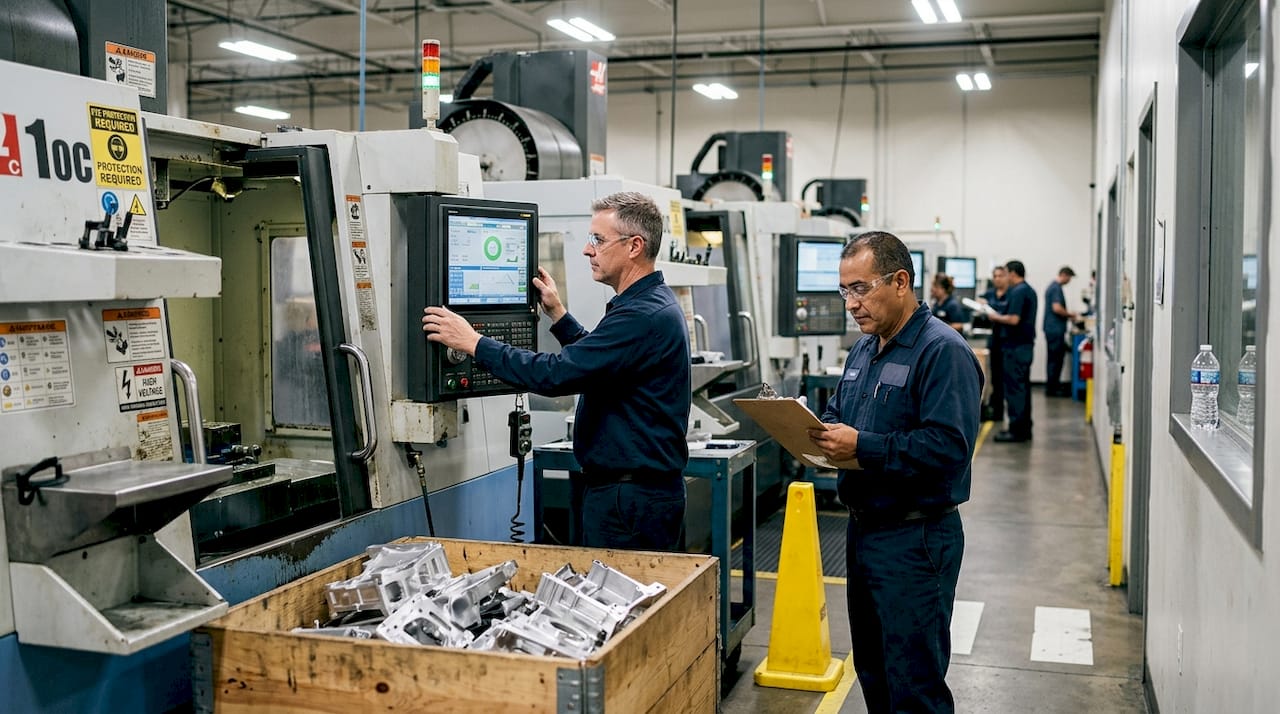
The financial case for automation becomes compelling when examining documented returns. An aerospace machine shop invested $266,000 in a 5-axis CNC system and achieved 129 percent Year 1 ROI with an 18-month payback through new contracts their previous equipment couldn’t handle. This return stemmed from winning bids requiring complex geometries and tight delivery schedules that manual operations simply couldn’t meet.
Energy efficiency represents an often-overlooked advantage. Automated CNC systems consume approximately one-seventh the energy of traditional machining methods while producing more parts per shift. This efficiency gain matters increasingly as utility costs rise and sustainability reporting becomes mandatory for defense contractors. The reduced energy footprint also qualifies for utility rebates in many jurisdictions, further improving project economics.
Automation facilitates contract opportunities previously beyond reach. When you can guarantee delivery of 10,000 identical components within tolerance windows measured in microns, procurement managers notice. Defense contractors increasingly require suppliers to demonstrate automated capabilities as a qualification criterion, making automation investment a market access issue rather than merely an efficiency play. Exploring why automate machining processes reveals strategic advantages beyond immediate cost savings.
| Efficiency Metric | Manual Operation | Automated CNC | Improvement |
|---|---|---|---|
| Setup time per batch | 4.5 hours | 3.2 hours | 29% reduction |
| Parts per 8-hour shift | 47 units | 54 units | 15% increase |
| Energy consumption per part | 2.8 kWh | 0.4 kWh | 86% reduction |
| Scrap rate | 6.2% | 2.1% | 66% reduction |
Labor reallocation represents another financial benefit. Operators transition from running individual machines to overseeing multiple automated cells, effectively multiplying their productive capacity. This shift doesn’t eliminate jobs but rather elevates skill requirements, as technicians manage systems rather than manually controlling spindles. The labor cost per part drops substantially even as you maintain or increase total employment. CNC turning precision manufacturing demonstrates how automation enhances rather than replaces skilled labor.
Pro Tip: Calculate lifecycle costs including energy savings, reduced scrap, and labor reallocation when evaluating CNC automation, not just equipment purchase price and installation.
Advanced automation techniques enhancing production rates and precision tasks
Five-axis and multi-axis CNC automation transforms how manufacturers approach complex aerospace geometries. These systems machine intricate titanium and aluminum components in single setups that previously required multiple operations with repositioning between each. The elimination of repositioning removes cumulative tolerance stack-up, where small errors compound across operations. Production facilities report aluminum aerospace castings production rate improved over 80 percent through optimized probing and workholding strategies enabled by advanced automation.
Adaptive control techniques address the unique challenges of aerospace alloys. Titanium and hardened steel work-harden rapidly under cutting forces, requiring variable speed and feed adjustments mid-operation. Automated systems monitor cutting forces in real-time and adjust parameters to prevent work-hardening that would compromise subsequent operations or cause premature tool failure. This adaptive capability proves essential when machining Inconel turbine components where cutting conditions change as tools penetrate varying material densities.
Collaborative robots, or cobots, bring automation capabilities to tasks requiring human-like dexterity and precision. These systems enable large-scale precision tasks like drilling millions of holes with high repeatability in confined spaces where traditional automation cannot fit. Aerospace fuselage assembly involves drilling thousands of precisely positioned fastener holes, a task where cobots excel by combining positioning accuracy with force sensing that prevents damage to thin aluminum skins.
| Automation Technique | Primary Application | Key Advantage | Typical ROI Period |
|---|---|---|---|
| 5-axis machining | Complex titanium components | Single-setup operations eliminate repositioning errors | 18 to 24 months |
| Adaptive controls | Hardened alloy machining | Real-time parameter adjustment prevents work-hardening | 12 to 18 months |
| Collaborative robots | Assembly and drilling | Precision tasks in confined spaces with safety features | 24 to 36 months |
| Automated inspection | In-process quality verification | Immediate deviation detection reduces scrap | 15 to 20 months |
IoT integration and AI-driven predictive maintenance minimize unexpected downtime that disrupts aerospace supply chains. Sensors monitor vibration signatures, temperature profiles, and power consumption patterns to predict bearing failures or spindle issues days before they occur. This predictive capability matters enormously in aerospace manufacturing where a single machine failure can halt an entire assembly line waiting for components. Manufacturers implementing predictive maintenance report 35 percent reductions in unplanned downtime.
Advanced automation techniques deliver benefits beyond raw productivity. Complex part manufacturing precision strategies 2026 demonstrates how integrated systems create competitive advantages through capabilities competitors cannot match. The ability to machine geometries previously considered impractical opens design possibilities for aerospace engineers seeking weight reduction or performance improvements. When your manufacturing capabilities expand, so do your contract opportunities.
Precision parts manufacturing quality becomes more consistent as automation eliminates human variables from critical operations. This consistency proves essential when aerospace customers demand Cpk values exceeding 1.67, statistical measures indicating virtually zero defects across production runs.
Pro Tip: Integrate IoT sensors and AI-driven predictive maintenance from day one to minimize unexpected downtime and supply chain delays that damage customer relationships.
Challenges and considerations in implementing CNC automation
High initial capital expenditure represents the most significant barrier to CNC automation adoption. A complete automated cell including machine, tooling, fixturing, and integration can exceed $500,000 for aerospace-grade equipment. This investment requires careful financial planning and often necessitates financing arrangements that impact cash flow for 18 to 36 months before returns materialize. Smaller aerospace suppliers struggle to justify these expenditures when competing against established manufacturers with existing automated capacity.
Integration complexity with existing workflows creates implementation challenges beyond equipment costs. Aerospace manufacturers typically operate mixed environments with legacy machines, manual operations, and newer automated cells. Programming automated systems to interface with existing ERP systems, quality management software, and production scheduling tools requires specialized expertise. The integration process often reveals workflow bottlenecks that must be redesigned, extending implementation timelines and increasing costs.
Automation flexibility limitations become apparent with low-volume or highly customized defense and aerospace parts. High initial costs and integration complexity combined with less flexible automation for low-volume or custom parts creates situations where manual machining remains more economical. When producing 50 unique landing gear components versus 10,000 identical fasteners, the programming and setup time for automation can exceed the time saved in machining.
Tooling and material considerations add complexity specific to aerospace manufacturing. Hardened alloys and titanium require specialized cutting tools with long lead times, sometimes 12 to 16 weeks for custom geometries. Automated cells must maintain sufficient tool inventory to prevent production stoppages, tying up capital in tooling assets. Carbide and ceramic cutting tools for aerospace alloys can cost $500 to $2,000 each, with cells requiring dozens of tools for complex parts.
Key implementation challenges include:
- Capital equipment costs requiring multi-year financing and careful ROI analysis
- Workflow integration demanding specialized programming and systems expertise
- Programming time for low-volume parts potentially exceeding machining time savings
- Tooling inventory requirements for specialized aerospace alloy cutting tools
- Operator training and skill development for managing automated systems
The evolving role of manufacturing engineers and operators requires organizational adaptation. Engineers transition from hands-on machining to programming and optimizing automated cells, requiring new skill sets in CAM software, robotics programming, and systems integration. This transition period can temporarily reduce productivity as teams learn new technologies. Understanding custom machining aerospace defense requirements helps determine which parts benefit most from automation versus those better suited for manual operations.
Successful automation implementation requires matching technology to production volumes and part complexity. High-volume production of standardized components delivers fastest ROI, while low-volume custom work may justify only partial automation of specific operations. Careful analysis of your product mix and production forecasts prevents costly mistakes in automation strategy.
Explore advanced CNC automation solutions with Machining Technologies
Machining Technologies brings over 35 years of expertise in CNC automation for aerospace and defense manufacturing, operating a 70,000 square foot facility equipped with advanced Hydromat systems, CNC milling, turning, and wire EDM capabilities. Our automated production capacity exceeds 20 million precision parts annually, serving OEMs and defense contractors requiring tight tolerances and reliable delivery schedules.
Our complex part manufacturing precision strategies 2026 incorporate the latest automation technologies discussed throughout this article, from multi-axis machining to adaptive controls for challenging aerospace alloys. We understand the financial and technical considerations procurement managers face when evaluating manufacturing partners, which is why we emphasize transparent communication about capabilities, lead times, and quality assurance processes.
Explore our comprehensive Machining Technologies services to discover how automated precision machining can enhance your production efficiency and component quality. Our team works closely with aerospace and defense engineers to optimize designs for automated manufacturing, reducing costs while maintaining the exacting standards your applications demand. Learn more about machining defense industry precision innovation 2026 and how we’re advancing capabilities to meet evolving requirements.
Frequently asked questions
What industries benefit most from CNC automation?
Aerospace and defense manufacturing benefit most from CNC automation due to extreme precision requirements and high production volumes. Medical device manufacturing, automotive components, and industrial machinery also see substantial advantages. Any industry requiring tight tolerances, consistent repeatability, and documented quality control gains measurable benefits from automated machining systems.
How long does CNC automation ROI typically take?
Documented aerospace automation investments show ROI periods ranging from 12 to 24 months depending on production volumes and part complexity. High-volume production of standardized components delivers fastest returns, often under 18 months. Low-volume custom work may extend payback periods to 36 months but still justifies investment through capabilities that enable new contract opportunities.
Can CNC automation handle titanium and hardened aerospace alloys?
Modern CNC automation excels at machining titanium, Inconel, and hardened steel through adaptive control systems that adjust cutting parameters in real-time. These systems monitor cutting forces and modify speed and feed rates to prevent work-hardening and premature tool failure. Specialized tooling and coolant systems designed for aerospace alloys integrate seamlessly with automated cells.
What training do operators need for automated CNC systems?
Operators transition from manual machining skills to systems management, requiring training in CAM programming, robotics interfaces, and quality management software. Most manufacturers implement 3 to 6 month training programs combining classroom instruction with supervised operation. The skill elevation increases operator value while reducing physical demands compared to manual machining operations.
How does automation affect production flexibility for custom parts?
Automation reduces flexibility for very low-volume custom parts where programming time exceeds machining time savings. However, modern CAM software and standardized work-holding systems minimize programming time, making automation viable for batch sizes as small as 100 units. Hybrid approaches combining automated rough machining with manual finishing operations optimize efficiency for mid-volume custom production.
What maintenance requirements do automated CNC systems have?
Automated systems require scheduled preventive maintenance including lubrication, coolant system servicing, and tool calibration typically performed weekly or monthly depending on utilization. Predictive maintenance systems using IoT sensors reduce unexpected failures by monitoring component health and alerting technicians to developing issues. Total maintenance time averages 4 to 6 hours weekly for fully automated cells running multiple shifts.