

Most engineers assume machining tolerances of ±0.001 inches suffice for defense components. Reality is far more demanding. Flight-critical aerospace parts require positional accuracy within ±0.0002 in, five times tighter than conventional standards. This extreme precision separates functional components from mission-critical systems that must perform flawlessly under combat stress, thermal cycling, and G-forces exceeding 9G. Advanced machining technologies now enable defense manufacturers to meet these requirements while reducing lead times by 40 percent. This article explores how five-axis machining, high-speed cutting, and rigorous process controls deliver the precision, traceability, and material performance defense aerospace demands in 2026.
Table of Contents
- Precision Machining Requirements In Defense And Aerospace
- Advanced Machining Technologies Shaping Defense Manufacturing
- Material Considerations And Process Controls In Defense Machining
- Ensuring Quality And Compliance: Standards And Traceability In Defense Machining
- Discover Advanced Machining Solutions For Defense Manufacturing
- Frequently Asked Questions
Key takeaways
| Point | Details |
|---|---|
| Precision machining is essential for meeting tight aerospace tolerances | Defense components demand positional accuracy within ±0.0002 in and surface finishes below Ra 16 µin for flight-critical applications. |
| Five-axis and high-speed machining technologies enable complex part production | Multi-axis rotary motion and HSM achieve material removal rates 10x faster while maintaining surface finishes as fine as Ra 0.2 µm. |
| Traceability and process control ensure compliance with defense standards | AS9100 certification mandates documented process control, statistical monitoring, and digital records for every manufacturing step. |
| Material properties like Inconel’s performance influence machining strategies | Inconel 718 retains tensile strength above 180 ksi at 700°C, requiring specialized tooling and thermal management during machining. |
| Advanced machining reduces lead times while improving quality | Integrated metrology and toolpath optimization cut production cycles by 40 percent without compromising dimensional integrity or repeatability. |
Precision machining requirements in defense and aerospace
Defense aerospace components operate in environments where failure is not an option. A single dimensional deviation can compromise aerodynamic efficiency, structural integrity, or weapon system accuracy. This reality drives machining specifications far beyond commercial manufacturing standards. Positional accuracy within ±0.0002 in represents the baseline for flight-critical parts, with some applications demanding even tighter control.
Surface finish requirements are equally stringent. Critical components often specify Ra values of 16 microinches or less, equivalent to 0.4 micrometers. These ultra-smooth surfaces reduce stress concentrations, improve fatigue life, and ensure proper sealing in hydraulic and pneumatic systems. Achieving such finishes requires precise tool selection, optimized cutting parameters, and rigorous process monitoring throughout production.
Repeatability across production batches matters as much as single-part precision. Defense contracts typically involve hundreds or thousands of identical components, each meeting the same exacting specifications. Thermal stability of both materials and tooling becomes critical here. Temperature variations of just 5°C can cause dimensional shifts exceeding tolerance bands in precision components. Manufacturers address this through climate-controlled machining environments, thermal compensation algorithms, and materials with low coefficients of thermal expansion.
Key precision factors include:
- Dimensional tolerances as tight as ±5 micrometers for bearing surfaces and mating features
- Surface roughness specifications below Ra 0.4 µm for sealing surfaces and aerodynamic profiles
- Geometric tolerances controlling flatness, perpendicularity, and concentricity to micron levels
- Material removal strategies that minimize residual stress and maintain metallurgical properties
The consequences of inadequate precision extend beyond part rejection. In defense applications, dimensional errors can cascade into system failures during critical missions. A turbine blade with improper airfoil geometry creates vibration that accelerates bearing wear. A landing gear component with surface irregularities becomes a crack initiation site under cyclic loading. These risks explain why defense manufacturers invest heavily in custom machining for aerospace and defense applications.
“Precision machining in aerospace demands not only tight dimensional control but also comprehensive documentation proving every measurement meets specification. Traceability transforms machining from a manufacturing process into a quality assurance system.”
Process capability indices (Cpk values) of 1.67 or higher are standard in defense machining, meaning the process must consistently produce parts with dimensional variation less than half the tolerance band. Achieving this requires maximizing quality and throughput through integrated metrology, real-time process monitoring, and continuous improvement protocols. Statistical process control charts track every critical dimension across production runs, triggering corrective action before parts drift out of specification.
Advanced machining technologies shaping defense manufacturing
Five-axis machining has revolutionized defense component production by enabling complex geometries impossible with conventional three-axis equipment. These machines combine three linear axes with two rotary axes, allowing the cutting tool to approach the workpiece from virtually any angle. This capability eliminates multiple setups, reduces fixturing complexity, and maintains tighter tolerances by machining features in a single operation.
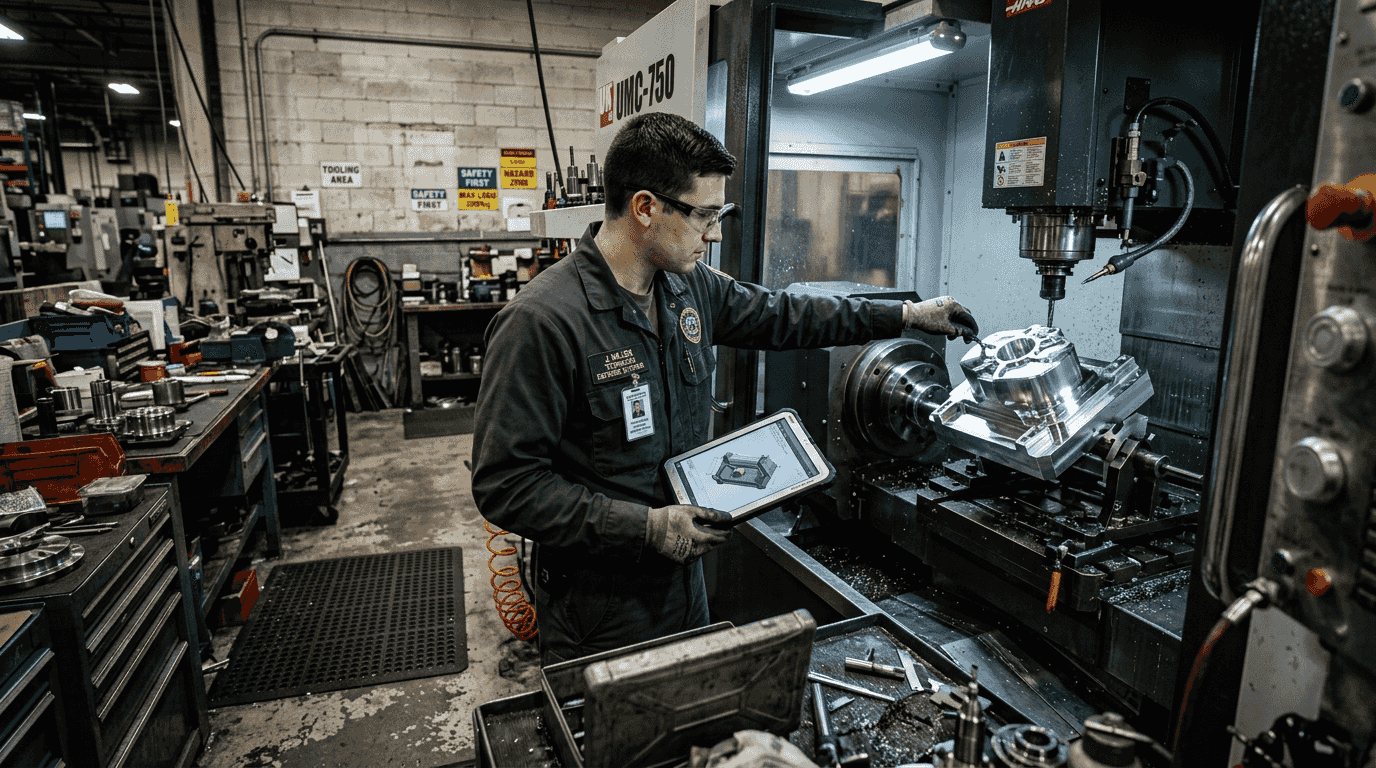
The defense industry provides compelling proof of five-axis effectiveness. Gilman Precision optimized F35 landing gear using a specialized five-axis machine module, meeting rigorous US military standards for dimensional accuracy and surface finish. The project demonstrated how advanced machining technology directly enables next-generation defense systems. Five-axis capability proved essential for producing the complex contours and tight tolerances required in landing gear spindles subject to extreme loads during carrier landings.
High-speed machining (HSM) represents another transformative technology. HSM enables complex aerospace components with material removal rates up to 10 times faster than conventional machining while maintaining or improving part quality. Spindle speeds exceeding 20,000 RPM combined with optimized toolpaths create surface finishes as fine as Ra 0.2 micrometers directly from the machining operation, often eliminating secondary finishing processes.
| Technology | Key Advantage | Typical Application | Performance Metric |
| — | — | — |
| Five-axis machining | Complex geometry access | Turbine blades, landing gear | Single-setup tolerance ±0.0002 in |
| High-speed machining | Rapid material removal | Structural components, housings | 10x faster removal rates |
| Wire EDM | Intricate internal features | Fuel system components, nozzles | Feature size down to 0.004 in |
| Adaptive machining | Real-time process adjustment | Large aerospace structures | 50% reduction in scrap rates |
The combination of HSM with advanced CAM software unlocks additional benefits. Toolpath optimization algorithms calculate cutting strategies that maintain consistent chip load, minimize tool deflection, and reduce thermal buildup. These factors directly impact surface finish, dimensional accuracy, and tool life. Defense manufacturers report tool life improvements of 30 to 50 percent when transitioning from conventional to high-speed machining approaches.
Pro Tip: Integrate process control and toolpath optimization software to maximize HSM benefits. Real-time monitoring of spindle load, vibration signatures, and cutting forces allows immediate adjustment of feed rates and speeds, preventing tool breakage and maintaining consistent quality across production runs.
Wire electrical discharge machining (EDM) complements traditional cutting methods for defense applications requiring intricate internal features or extremely hard materials. Wire EDM removes material through controlled electrical sparks rather than mechanical cutting, enabling feature sizes down to 0.004 inches and surface finishes comparable to grinding operations. This technology proves essential for fuel system components, hydraulic valve bodies, and other parts where conventional tooling cannot access internal geometries.
The evolution toward machining trends in 2026 emphasizes integration of these technologies with digital manufacturing systems. Machine tool builders now offer hybrid platforms combining multiple processes, such as five-axis milling with integrated turning or HSM with in-process measurement. These systems reduce non-cutting time, improve first-part accuracy, and provide the flexibility defense manufacturers need for complex part manufacturing across diverse component families.
Material considerations and process controls in defense machining
Defense aerospace components must withstand extreme operating conditions, driving material selection toward advanced alloys with exceptional strength-to-weight ratios and temperature resistance. Inconel 718 dominates high-temperature applications, retaining strength above 700°C and maintaining tensile strength exceeding 180 ksi at elevated temperatures. These properties make Inconel ideal for turbine components, exhaust systems, and other hot-section parts.
Machining Inconel and similar superalloys presents significant challenges. Work hardening occurs rapidly during cutting, creating a hardened surface layer that accelerates tool wear. Heat generation concentrates at the tool-workpiece interface, reaching temperatures above 1000°C that can cause premature tool failure. Chip formation is problematic, with chips tending to weld to the cutting edge rather than evacuating cleanly. These factors demand specialized machining strategies.
Successful Inconel machining requires:
- Ceramic or carbide tooling with advanced coatings to withstand cutting temperatures
- Reduced cutting speeds (50 to 150 surface feet per minute) compared to steel machining
- High feed rates to prevent work hardening and maintain chip thickness
- Flood coolant delivery or high-pressure coolant systems to manage thermal loads
- Rigid machine tool construction to resist cutting forces exceeding 2000 pounds
Titanium alloys present different but equally demanding machining requirements. Titanium’s low thermal conductivity causes heat to concentrate in the cutting zone rather than dissipating into the workpiece. The material’s chemical reactivity at elevated temperatures can cause galling and built-up edge formation on cutting tools. Despite these challenges, titanium’s strength-to-weight ratio makes it indispensable for aerospace structural components, landing gear, and fasteners.
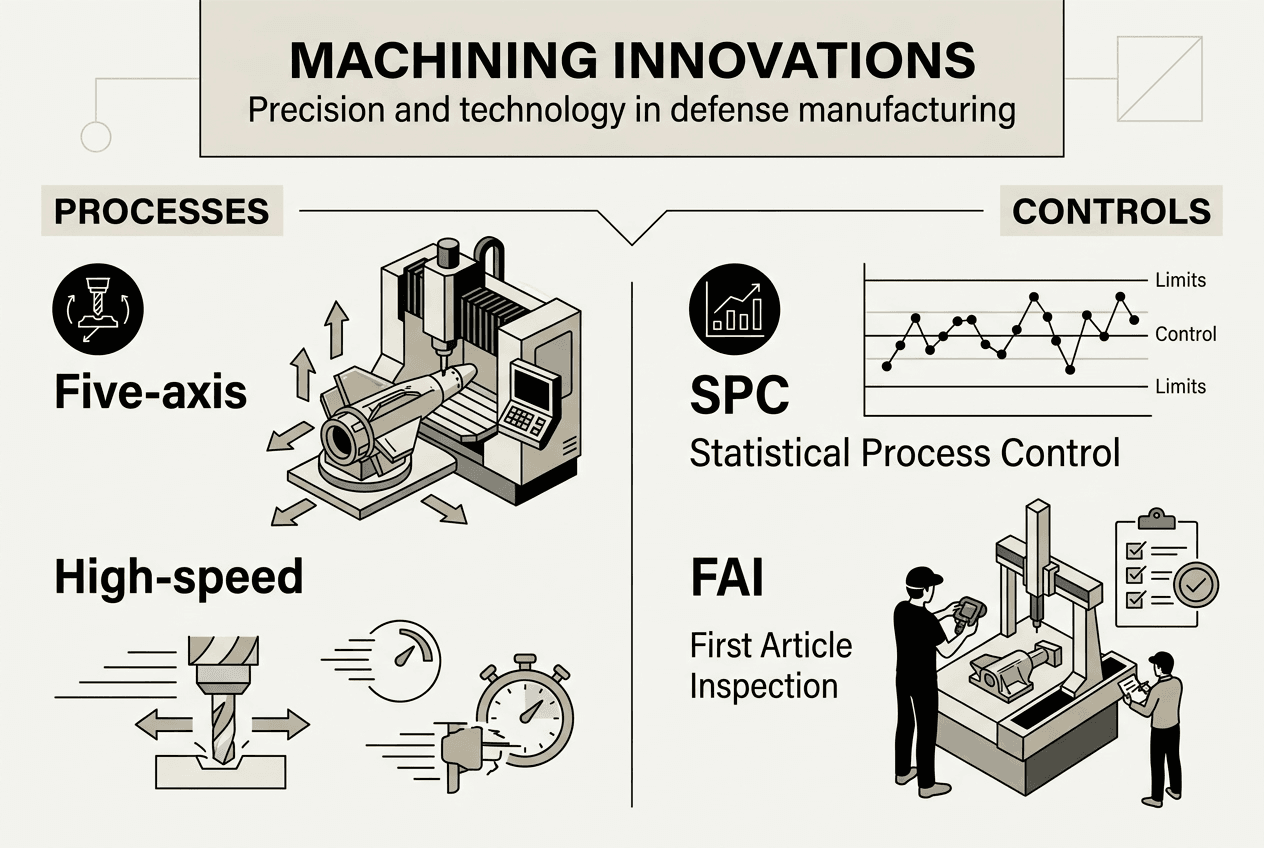
Process controls become critical when machining these advanced materials. Statistical process control (SPC) monitors key dimensions throughout production, using control charts to detect trends before parts drift out of specification. In-process measurement systems verify dimensions while parts remain fixtured on the machine, enabling immediate corrective action. Digital traceability systems record every process parameter, creating a complete manufacturing history for each component.
Pro Tip: Implement real-time metrology integration to detect and correct deviations instantly during machining. Probing systems measure critical features between operations, automatically adjusting tool offsets to compensate for thermal expansion, tool wear, or material variation. This closed-loop control maintains dimensional accuracy across extended production runs.
Certification standards like AS9100 mandate comprehensive process documentation for defense aerospace manufacturing. Every machining operation must have a documented process plan specifying tools, speeds, feeds, and inspection requirements. Machine capability studies prove equipment can consistently meet tolerances before production begins. First article inspections verify that initial production parts meet all specifications, with dimensional reports documenting every critical feature.
The integration of precision parts manufacturing quality systems with advanced machining technology creates a robust foundation for defense component production. Digital twins simulate machining operations before cutting metal, predicting tool loads, identifying potential collisions, and optimizing cycle times. Machine monitoring systems track spindle power, vibration, and acoustic signatures, using machine learning algorithms to predict tool wear and schedule replacements before quality degrades.
Material certification adds another layer of traceability. Defense contracts require material test reports documenting chemical composition, mechanical properties, and heat treatment for every lot of raw material. This documentation traces back to the original mill, creating an unbroken chain of custody from raw material to finished component. Automated machining processes integrate this documentation into digital manufacturing systems, automatically associating material certifications with specific production lots.
Ensuring quality and compliance: standards and traceability in defense machining
Traceability forms the backbone of defense aerospace quality systems. Every component must have a documented manufacturing history proving conformance to specifications. This extends beyond dimensional inspection to include material certifications, process parameters, operator qualifications, and environmental conditions during production. The goal is complete accountability: if a component fails in service, investigators can trace every factor that influenced its manufacture.
AS9100 certification demands traceability and documented process control throughout the manufacturing cycle. Defense contractors must demonstrate their quality management system addresses aerospace-specific requirements including configuration management, risk assessment, and continuous improvement. Machining strategies must integrate metrology, statistical process control, and digital records satisfying these standards.
Statistical process control (SPC) provides the analytical framework for maintaining consistency across production batches. Control charts plot key dimensions from sequential parts, revealing patterns that indicate process drift, tool wear, or environmental changes. X-bar and R charts track both average values and variation range, ensuring the process remains centered within tolerance bands with minimal spread. Capability studies calculate Cp and Cpk indices, quantifying how well the process meets specifications.
Achieving and maintaining compliance requires systematic implementation:
- Define processes with detailed work instructions specifying every operation, tool, and inspection requirement
- Implement metrology systems calibrated to standards traceable to NIST or equivalent national laboratories
- Monitor SPC data in real time, establishing control limits and reaction plans for out-of-control conditions
- Document records in digital quality management systems that link process data to specific components and production lots
- Audit continuously through internal reviews, customer assessments, and third-party registrar evaluations
Digital manufacturing execution systems (MES) automate much of this documentation burden. These systems capture data directly from machine tools, coordinate measuring machines, and inspection equipment. When an operator completes a machining operation, the MES automatically records cycle time, tool usage, and in-process measurements. This data feeds into SPC charts, triggers alerts for out-of-tolerance conditions, and populates quality records without manual transcription.
“Certification demands robust traceability and documented process control. Defense aerospace manufacturing transforms raw material into mission-critical components through a series of verified, validated, and documented steps. The manufacturing record becomes as important as the physical part.”
Configuration management ensures that engineering changes flow systematically through the manufacturing process. When a design revision occurs, the quality system must verify that all subsequent parts incorporate the change. This requires revision control of drawings, process plans, and inspection procedures. Digital systems link these documents, automatically updating work instructions when engineering releases a new revision.
Precision parts manufacturing quality systems extend beyond dimensional inspection to include non-destructive testing (NDT) for critical defense components. Fluorescent penetrant inspection reveals surface cracks invisible to the naked eye. Magnetic particle inspection detects subsurface defects in ferromagnetic materials. Ultrasonic testing verifies internal soundness of thick sections. Each NDT method has specific applications, limitations, and operator certification requirements defined by aerospace standards.
First article inspection (FAI) provides comprehensive verification before full-scale production begins. The FAI process measures and documents every dimension, feature, and characteristic on initial production parts. This includes not only dimensions called out on drawings but also general tolerances, surface finish, and material properties. The resulting FAI report demonstrates the manufacturing process can consistently produce conforming parts, giving customers confidence before committing to large production quantities.
Supplier quality management extends traceability through the supply chain. Defense prime contractors audit their machining suppliers, verifying quality systems, process capabilities, and traceability practices. Complex part manufacturing precision strategies must cascade from prime contractors through multiple tiers of suppliers, each maintaining the same rigorous standards. This creates a quality network where every participant shares responsibility for mission success.
Discover advanced machining solutions for defense manufacturing
Meeting defense aerospace machining requirements demands more than advanced equipment. It requires deep expertise in materials, processes, and quality systems combined with the capacity to deliver consistent results across high-volume production. Machining Technologies brings over 35 years of precision manufacturing experience to defense and aerospace applications, operating from a 70,000 square foot facility equipped with state-of-the-art CNC machining centers, automated production systems, and integrated quality control.
Our capabilities directly address the challenges defense engineers face daily. Multi-axis CNC machining produces complex geometries with single-setup accuracy. High-speed machining delivers rapid turnaround without compromising surface finish or dimensional control. Wire EDM creates intricate features in hardened materials. Every process integrates with our quality management system, providing the traceability and documentation defense contracts require.
Key service highlights include:
- Multi-axis CNC machining for complex defense components with tolerances to ±0.0002 inches
- High-speed machining capabilities delivering 10x faster material removal with superior surface finish
- Experience machining Inconel, titanium, and other advanced alloys used in aerospace applications
- AS9100 compliance support with comprehensive process documentation and traceability
- Rapid prototyping through full-scale production with capacity exceeding 20 million parts annually
Our complex part manufacturing strategies for 2026 combine advanced technology with proven processes. In-process measurement systems verify dimensions while parts remain fixtured, enabling real-time corrections. Statistical process control monitors every critical dimension, ensuring consistency across production batches. Digital quality records provide complete traceability from raw material through final inspection.
Explore our full range of machining services or learn how we maintain precision parts manufacturing quality across demanding defense aerospace applications. Contact our engineering team to discuss your specific requirements and discover how advanced machining technology can accelerate your next defense program.
Frequently asked questions
What materials are commonly machined in defense aerospace components?
Inconel 718 retains strength above 700°C and maintains tensile strength exceeding 180 ksi at elevated temperatures, making it the primary choice for turbine components and exhaust systems. Titanium alloys provide exceptional strength-to-weight ratios for structural components and landing gear. Aluminum alloys serve in airframe structures where weight reduction is critical, while composite materials increasingly appear in non-load-bearing applications. Each material requires specialized tooling and machining strategies to achieve defense-grade precision and surface finish.
How does five-axis machining benefit defense component manufacturing?
Five-axis machining allows simultaneous movement across three linear axes and two rotary axes, enabling the cutting tool to approach workpieces from virtually any angle. Gilman Precision optimized F35 landing gear using specialized five-axis equipment, demonstrating how this technology meets rigorous military standards. The primary benefits include eliminating multiple setups that introduce positional errors, reducing fixturing complexity, and machining complex contours in a single operation. This maintains tighter tolerances while reducing production time by 30 to 50 percent compared to conventional three-axis approaches.
What role does traceability play in defense machining certification?
Traceability demands robust documentation proving every manufacturing step meets specifications, creating accountability throughout the production cycle. AS9100 and military standards require complete records linking raw material certifications to process parameters, inspection results, and operator qualifications for each component. This documentation enables root cause analysis if components fail in service, identifying whether issues stem from material defects, process deviations, or other factors. Defense contracts mandate traceability as a contractual requirement, with manufacturers maintaining records for 10 years or longer depending on component criticality.
How does high-speed machining improve defense component production?
High-speed machining operates at spindle speeds exceeding 20,000 RPM with optimized toolpaths that maintain consistent chip loads and minimize cutting forces. This achieves material removal rates up to 10 times faster than conventional machining while producing surface finishes as fine as Ra 0.2 micrometers directly from the machining operation. The reduced cutting forces minimize tool deflection and workpiece distortion, improving dimensional accuracy on thin-walled aerospace structures. Heat generation per unit volume decreases due to rapid chip evacuation, reducing thermal distortion in temperature-sensitive materials like titanium and Inconel. These factors combine to reduce lead times by 40 percent while maintaining or improving part quality.
What inspection methods verify defense aerospace machining quality?
Coordinate measuring machines (CMMs) provide three-dimensional verification of complex geometries, measuring hundreds of points to verify form, position, and orientation tolerances. In-process probing systems check critical dimensions while parts remain fixtured on machine tools, enabling immediate corrective action. Non-destructive testing including fluorescent penetrant inspection, magnetic particle inspection, and ultrasonic testing reveals surface and subsurface defects without damaging components. Statistical process control charts monitor dimensional trends across production batches, detecting process drift before parts exceed tolerance bands. First article inspections comprehensively document every feature on initial production parts, verifying manufacturing processes can consistently meet specifications before full-scale production begins.