

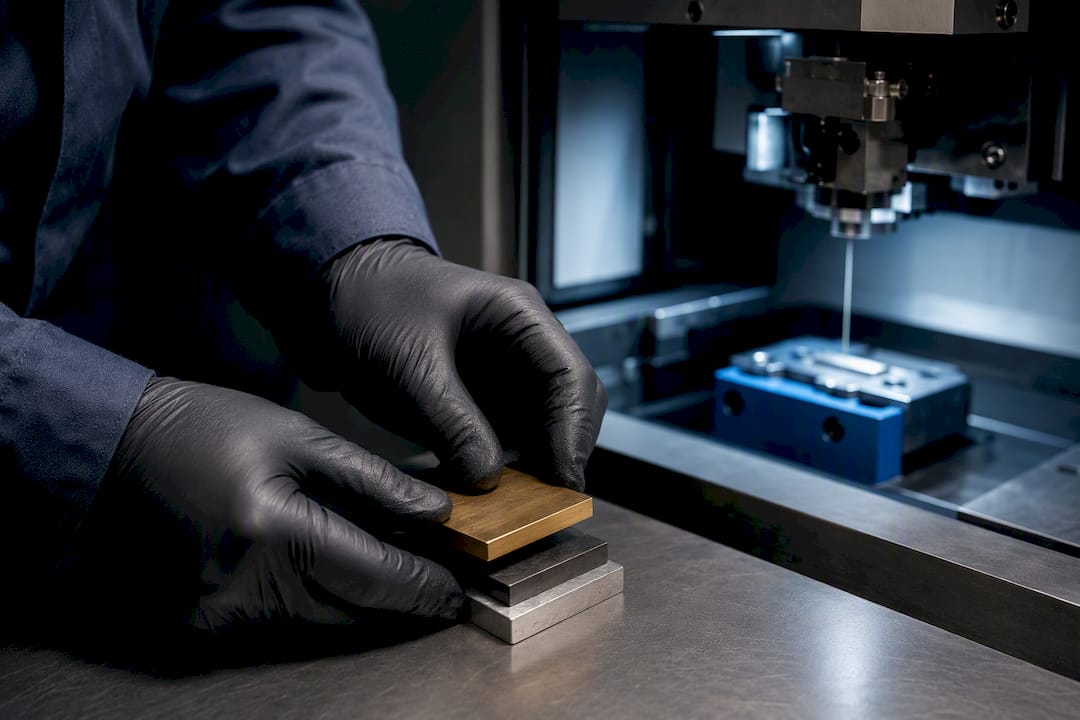
Wire EDM cuts any electrically conductive metal, from mild steel to hardened tool steel, titanium, and Inconel. Hardness doesn’t block the process; conductivity does. The wire electrode itself falls into three practical groups: plain brass for general work, coated or diffusion-annealed wire for speed and difficult flushing, and high-tensile specialty wires like molybdenum or steel-core composites for tall parts and tight corners. Pick the wire that matches your material’s conductivity, your geometry’s demands on tensile strength, and the tolerance you actually need to hit.
TL;DR:
- Using coated or high-tensile wires can improve efficiency by 10 to 30 percent on high-volume jobs, especially when flushing tough materials.
- The workpiece’s condition, not just the alloy, influences wire choice and cutting speed, requiring explicit specification on the drawing.
- Thinner wires offer tighter internal radii for complex profiles but reduce load capacity and increase risk of breakage, especially on hard or tall parts.
- Tolerance and surface finish depend heavily on the number of skim passes, with each pass improving accuracy and surface quality at the cost of cycle time.
- Wire diameter and spool quality, including diameter tolerance, significantly affect dimensional accuracy and breakage rates during long or high-precision cuts.
Table of Contents
- What Materials Can Wire EDM Cut?
- Common EDM Wire Types and Practical Trade-Offs
- How Does Wire Diameter Affect Accuracy and Kerf?
- How to Choose the Right Wire: A Decision Checklist for Engineers and RFQs
- Process Limits: Tolerances, Finish, and Cost Trade-Offs
- Practical Recommendations and Troubleshooting From a Contract Machining Perspective
- Where to Verify Wire EDM Specs and Data
- When to Choose Wire EDM Over Milling or Sinker EDM
- Sources
What Materials Can Wire EDM Cut?
Electrical discharge machining removes material through spark erosion, which means the workpiece has to conduct electricity. That single requirement rules out plastics, ceramics, and glass unless they’ve been specially doped with conductive fillers, which is rare enough in production work that most shops treat it as a non-option. Everything else on the metals side is fair game, and this is where wire EDM earns its reputation as the go-to process for parts that would chew up an end mill.
Hardness isn’t a barrier at all. A Frontiers review of wire EDM confirms conductivity, not hardness, determines whether a material qualifies, which is why hardened tool steel cuts just as readily as mild steel, only slower.
Here’s how the common workpiece materials behave on the wire:
- Carbon and stainless steels cut fast and predictably, with clean, repeatable finishes and minimal skim passes needed for standard tolerances.
- Tool steels (D2, A2, H13) run slower, especially after hardening, but wire EDM is often the only practical way to hold profile tolerance once heat treatment has locked in distortion.
- Titanium alloys cut at moderate speed with good surface quality, though heat sensitivity means flushing and power settings need more attention than on steel.
- Inconel and nickel-base superalloys are notoriously tough on cutting tools but behave reasonably on wire EDM, cutting slower than steel and demanding careful flushing to avoid wire breaks.
- Aluminum cuts quickly thanks to lower melting point, though its high thermal conductivity can cause tapering if power settings aren’t dialed in.
- Copper and brass cut fast and clean, largely because they share conductivity traits with the wire electrode itself.
Carbide and polycrystalline diamond (PCD) sit in a gray zone. Tungsten carbide is conductive enough to wire EDM, and shops do it routinely for die and punch work, but the cobalt binder phase erodes differently than the carbide grains, which can leave a rougher edge than you’d get on steel. PCD tooling gets wire EDM’d around its conductive substrate, but the diamond layer itself isn’t touched by the process, so it’s really cutting the carrier, not the cutting edge.
One detail that trips up a lot of RFQs: specify the material condition on the drawing, not just the alloy. A print that says “4140 steel” without noting whether it’s pre-heat-treat or post-heat-treat leaves the shop guessing at hardness, and hardness changes cut speed, wire selection, and quoted lead time. If dimensions are called out post-heat-treatment, say so explicitly.
Common EDM Wire Types and Practical Trade-Offs
Brass is the default wire for a reason. Most shops run something close to a 63/37 copper-zinc alloy, which the Sodick guide to EDM wire types confirms is the industry standard for general-purpose cutting. It balances conductivity, tensile strength, and cost well enough that it handles the bulk of jobs without any special justification needed.
Coated and diffusion-annealed wires step up from there. These combine a zinc-rich outer layer, which vaporizes efficiently and improves flushing, with a stronger core that resists breaking under tension. Sodick’s data shows coated and diffusion-annealed wires can deliver 10 to 30 percent efficiency gains in production runs, largely by cutting faster and breaking less often in tough flushing conditions. They cost more per spool, but on a high-volume job that premium usually pays for itself inside the first few parts.
Copper wire still shows up in older machines and certain niche applications. It has excellent conductivity, better than brass in raw terms, but its tensile strength is lower, which limits how much tension you can run and how tall a part you can reliably cut without wander. Most shops running modern generators have moved away from it in favor of brass and coated alternatives.
Specialty high-tensile wires earn their keep on the hardest jobs. Molybdenum and tungsten wire can handle tension levels brass can’t touch, which matters when you’re cutting a tall die section or a part with fine internal radii that would otherwise let the wire bow mid-cut. Steel-core composite wires split the difference, wrapping a high-strength core in a more conductive shell. The trade-off is speed: these wires cut slower than brass or coated wire, so you only reach for them when geometry demands it.
Quick summary of where each wire earns its place:
- Plain brass: default choice, lowest cost, fine for most jobs under moderate thickness.
- Coated/diffusion-annealed: production runs, poor flushing conditions, thicker sections.
- Copper: legacy machines, low-tension applications, largely phased out.
- Molybdenum/tungsten/steel-core: tall parts, fine radii, aerospace and medical micro-precision work.
How Does Wire Diameter Affect Accuracy and Kerf?
Wire diameter sets the floor on how tight a corner you can cut. Thinner wire buys you smaller internal radii, but it comes with less tensile capacity and a higher chance of breaking mid-cut on thick or hard material.
- Standard diameters run around 0.010 inch (0.25mm) for general work, cutting most tool steel and aluminum jobs without drama.
- Fine-detail wire in the 0.001 to 0.004 inch range handles small internal radii and intricate profiles, a range confirmed by the Frontiers review on wire EDM, though load capacity drops fast as diameter shrinks.
- Ultra-thin micro wires, down around 20 to 50 microns, serve micro-precision work like medical components, but they demand near-perfect machine tuning since they carry almost no margin for tension error.
- Kerf width always runs slightly wider than the wire diameter itself, since the spark gap adds material removal on both sides. A 0.010 inch wire typically leaves a kerf closer to 0.012 to 0.013 inch once you account for the discharge gap.
Higher tensile strength lets you run more tension, which keeps the wire straighter through the cut and reduces bow on tall parts. The trade-off is that stiffer, higher-tensile wires sometimes cut slightly slower or flush less efficiently than a softer brass wire, depending on coating. On the machine side, thinner wire wears guides faster and puts more demand on automatic threading systems, so a shop running fine wire regularly needs guides rated for that tolerance, not just whatever came stock on the machine.
How to Choose the Right Wire: A Decision Checklist for Engineers and RFQs
Before specifying a wire, engineers should run through a short set of questions that determine which family actually fits the job:
- What’s the workpiece material and its post-heat-treatment hardness? Hardened tool steel and superalloys favor coated or high-tensile wire over plain brass.
- Is the part tall, thin, or geometrically delicate? Tall sections need tensile strength to resist bow; thin fine-radius features need small diameter.
- What tolerance and finish does the print call out? Tighter tolerances usually mean more skim passes, and wire choice affects how many passes get you there.
- How’s the flushing environment? Deep cuts or poor coolant access favor coated wire’s better flush characteristics.
- What’s the production volume? One-off prototypes rarely justify premium wire cost; high-volume runs often do, given the efficiency gains coated wire delivers.
A few common mappings make this concrete. A hardened D2 tool steel insert needing tight profile tolerance typically calls for coated or diffusion-annealed wire paired with two or three skim passes. A thin aluminum bracket with generous tolerances runs fine on plain brass at standard diameter. A tall Inconel die section with fine internal corners often needs a high-tensile specialty wire even though it cuts slower, because breakage on a multi-hour cut costs more time than the slower feed rate does.
On procurement, spool quality matters more than most engineers assume. The P2InfoHouse technical reference on wire selection flags diameter tolerance and spooling consistency as direct drivers of breakage rate and dimensional repeatability. Uneven winding or diameter drift within a single spool shows up as inconsistent kerf partway through a long job.
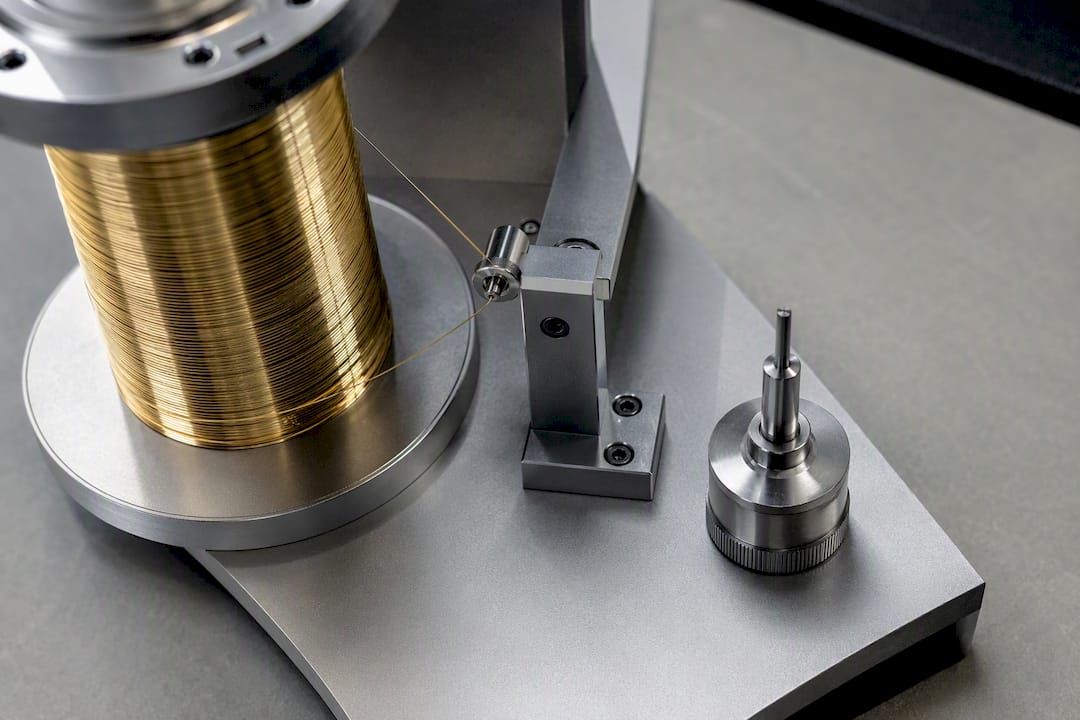
Pro Tip: Ask any new wire supplier for the diameter tolerance spec on the spool, not just the nominal size. A spool rated at plus or minus 0.0002 inch behaves very differently on a tight-tolerance job than one with looser, unstated tolerance bands.
Process Limits: Tolerances, Finish, and Cost Trade-Offs
Thickness and power settings work together to set your kerf and cycle time. Thicker sections need more aggressive power, which widens the kerf slightly and slows the cut, so a 4-inch-thick tool steel block takes meaningfully longer per inch than a half-inch plate.
- Rough cut tolerance typically lands in the ±0.001 inch range on a single pass.
- Skim passes tighten that considerably. With multiple finishing passes, well-tuned setups can approach ±0.0001 inch, though each added pass costs cycle time.
- Surface finish improves with each skim pass too, moving from a rough as-cut texture toward a near-mirror finish on the final pass.
- Post-processing is rarely needed on wire EDM parts unless a spec calls for finish finer than the machine can deliver economically.
Coated wire’s higher per-spool cost often nets out cheaper overall. Sodick’s efficiency data suggests the 10 to 30 percent throughput gain from coated wire on production runs outweighs the material premium once you factor in fewer breaks and faster cycles.
Practical Recommendations and Troubleshooting From a Contract Machining Perspective
Running high volumes of wire EDM work day after day teaches you where jobs actually go wrong, and it’s rarely the machine. When specifying a job, ask suppliers to confirm:
- Wire family and diameter they plan to run for your specific material and thickness.
- Number of skim passes included in the quote, and what tolerance that pass count achieves.
- Demonstrated tolerance history on comparable material and section thickness.
The most common failure modes are wire breakage, tapering on thick sections, and inconsistent finish between passes. Breakage usually traces back to tension set too high for the wire’s tensile rating or flushing that can’t keep pace with debris removal; tapering often means power settings weren’t adjusted for section thickness. Both are fixable by adjusting wire type, tension, or flush pressure rather than accepting the defect as a process limit.
For unfamiliar materials or unusually tall sections, ask for a test cut on a sample coupon before committing to the full run. Machiningtechllc runs high-volume wire EDM work across diverse materials daily, and that repetition is exactly what surfaces these failure patterns early enough to fix cheaply.
Pro Tip: If a supplier can’t tell you which skim pass count their quote assumes, ask before you sign. Tolerance claims without a pass count attached are close to meaningless.
Where to Verify Wire EDM Specs and Data
For exact tensile and diameter tolerances, go to manufacturer datasheets directly. The Sodick wire guide and P2InfoHouse wire selection reference both offer solid starting points for tensile and vaporization data beyond what generic guides cover.
When to Choose Wire EDM Over Milling or Sinker EDM
Wire EDM wins for complex profiles, tiny internal radii, and machining after heat treatment, when distortion rules out milling. Milling stays faster and cheaper for simple external geometry. Sinker EDM takes over for blind cavities and non-through features wire can’t reach. For part-specific wire and process selection, work through Machiningtechllc’s services or request a quote directly.
— Andrew
Sources
- EDM Wire Explained: Types of EDM Wire and How to Choose the Right One
- Wire Types And Their Selection
- What Is Wire EDM? Process, Materials & Tolerances Guide