

The strongest U.S. alternatives to americanmachinecompany.com are Machiningtechllc (high-volume Hydromat, CNC, wire EDM, Webster MA), Ultra Precision (tight-tolerance turning and milling), King Precision (mid-volume aerospace and defense), Venango Machine (complex multi-axis work), Jamcor Corporation (high-mix, low-to-mid volume), and Custom Engineering Co. (prototype-to-production transitions). If you need high-volume OEM production with AS9100-level QA and documented on-time delivery, contact Machiningtechllc first. For prototype-stage work with fast turnaround, Jamcor or Custom Engineering Co. are solid starting points.
| Supplier | Best For | Key Certifications | Typical Lead Time |
|---|---|---|---|
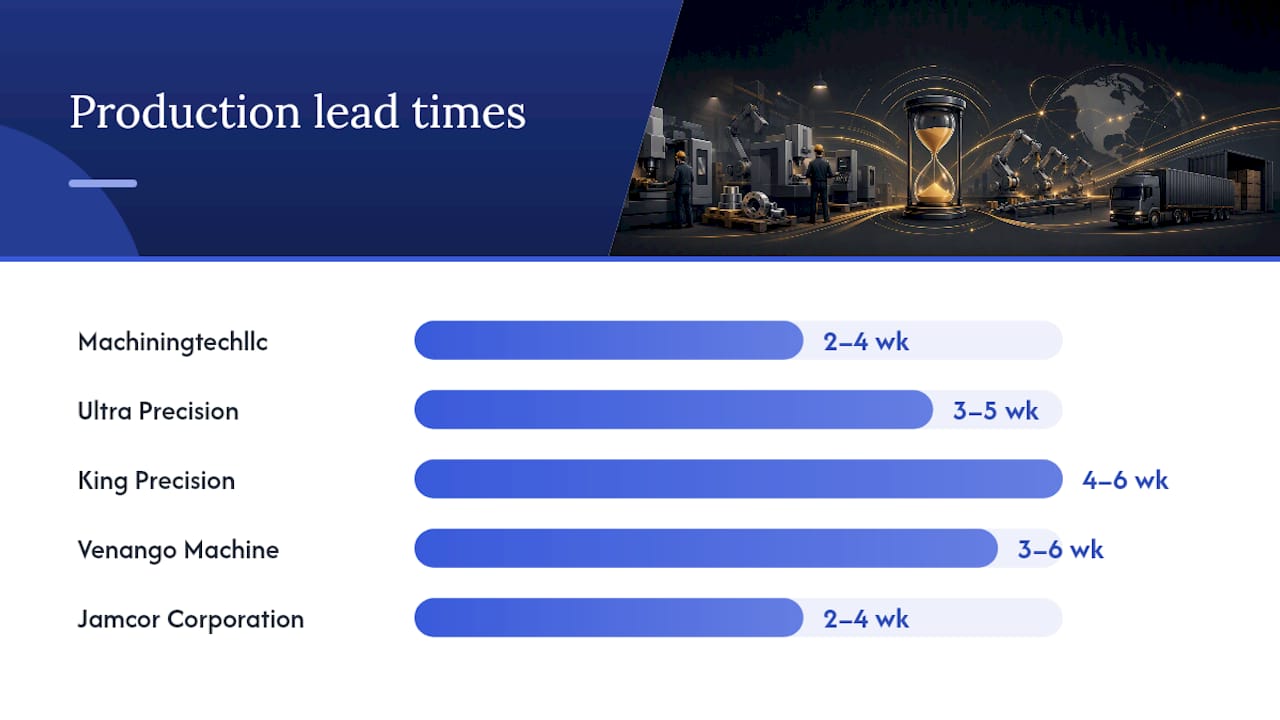
| Machiningtechllc | High-volume Hydromat, CNC, wire EDM | ISO 9001, ITAR-eligible | 2–4 weeks production |
| Ultra Precision | Tight-tolerance turning/milling | ISO 9001 | 3–5 weeks |
| King Precision | Aerospace/defense components | AS9100, ITAR | 4–6 weeks |
| Venango Machine | Complex multi-axis parts | ISO 9001 | 3–6 weeks |
| Jamcor Corporation | High-mix, low-volume | ISO 9001 | 2–4 weeks |
| Custom Engineering Co. | Prototype to production | ISO 9001 | 1–4 weeks |
Start your RFQ with: a 2D drawing (PDF) plus 3D model (STEP or IGES), material callout, tolerance stack, required certifications, and target annual volume. Send that package to two suppliers simultaneously to get comparable quotes within the same window.
Table of Contents
- What are the best americanmachinecompany.com alternatives?
- Supplier profiles: which shop actually fits your program?
- How do you choose the right American machine shop?
- What do AS9100, ITAR, and ISO 9001 actually mean for buyers?
- What do prototype and production machining actually cost in 2026?
- Why Machiningtechllc is a procurement-ready alternative
- Key Takeaways
- The case for domestic sourcing is stronger than the cost sheet shows
- Machiningtechllc: built for OEMs who need volume and precision together
- Useful sources for buyers
What are the best americanmachinecompany.com alternatives?
The U.S. contract manufacturing services market is projected at $214.7 billion in 2026, growing at a 6.8% CAGR through 2036, which means buyers have more vetted domestic options than ever before. The table below maps each shortlisted supplier across the eight dimensions procurement teams actually use when awarding RFQs.
| Supplier | Best For | Certifications | Core Capabilities | Industries | Order Size | Lead Time | Location | Quote Path |
|---|---|---|---|---|---|---|---|---|
| Machiningtechllc | High-volume OEM, Hydromat, wire EDM | ISO 9001, ITAR-eligible | Hydromat, CNC milling/turning, wire EDM | Aerospace, defense, firearms, industrial | Prototype to 20M+ parts/yr | 2–4 weeks (production) | Webster, MA | RFQ via website |
| Ultra Precision | Tight-tolerance turned/milled parts | ISO 9001 | CNC turning, milling, grinding | Aerospace, medical, industrial | Low-to-mid volume | 3–5 weeks | Midwest US | Quote form / email |
| King Precision | Aerospace and defense components | AS9100, ITAR | CNC milling, turning, inspection | Aerospace, defense | Mid-to-high volume | 4–6 weeks | Southeast US | RFQ via website |
| Venango Machine | Complex multi-axis, tight tolerances | ISO 9001 | Multi-axis CNC, turning, milling | Industrial, defense | Low-to-mid volume | 3–6 weeks | Pennsylvania | Email/phone RFQ |
| Jamcor Corporation | High-mix, low-to-mid volume | ISO 9001 | CNC milling, turning, secondary ops | Industrial, commercial | Low-to-mid volume | 2–4 weeks | Northeast US | Quote form |
| Custom Engineering Co. | Prototype to production ramp | ISO 9001 | CNC milling, turning, prototyping | Industrial, OEM | Prototype to mid-volume | 1–4 weeks | Midwest US | Email RFQ |
| American Valmark | Precision stamping and machined parts | ISO 9001 | Stamping, CNC machining | Industrial, automotive | Mid-to-high volume | 3–5 weeks | Ohio | Phone/email |
| Haas Automation | CNC machine brand (not a job shop) | N/A (OEM) | VMC, HMC, lathe platforms | All manufacturing sectors | Machine purchase | Varies | Oxnard, CA | Dealer network |
| Hurco | CNC machine brand, conversational control | N/A (OEM) | VMC, turning centers | Job shops, education | Machine purchase | Varies | Indianapolis, IN | Dealer network |
| Tormach | Accessible CNC machines, R&D/prototyping | N/A (OEM) | PCNC mills, lathes | R&D, small shops, education | Machine purchase | Varies | Waunakee, WI | Direct/dealer |
Reading the table: The sharpest gap is between job shops (Machiningtechllc, King Precision, Venango Machine) and CNC machine brands (Haas, Hurco, Tormach). Haas, Hurco, and Tormach sell equipment — they are not contract suppliers. If you need parts made, not machines to make parts yourself, those three are off the shortlist. Among contract shops, Machiningtechllc stands out for throughput: 20 million-plus parts annually from a 70,000 sq. ft. facility puts it in a different capacity tier than most regional shops.
Pro Tip: When comparing certifications versus throughput for an RFQ award, weight certifications first for aerospace and defense programs — an expired AS9100 or lapsed ITAR registration disqualifies a supplier regardless of price. For industrial or commercial OEM work, throughput and lead time can outweigh certification breadth.
The SOCMA Contract Manufacturing Outlook tracks capacity and labor trends year-over-year, and its 2026 data confirms that shops with documented automation (Hydromat, multi-pallet CNC) are absorbing volume faster than shops relying on manual setups — a useful benchmark when evaluating throughput claims.
Supplier profiles: which shop actually fits your program?
Matching shop type to part geometry and production volume is the single most effective filter in any sourcing decision, according to MakerStage’s supplier-selection guidance. Here is what each shortlisted supplier actually delivers.
Machiningtechllc
Best for: OEMs and defense primes needing high-volume, tight-tolerance parts across aerospace, firearms, and industrial categories.
Operating since 1985 out of Webster, Massachusetts, Machiningtechllc runs Hydromat rotary transfer systems alongside CNC milling and turning and wire EDM under one roof. That combination is rare: most shops do one or two of those processes; Machiningtechllc does all three at production scale. Annual throughput exceeds 20 million parts. CMM inspection and GD&T-compliant QA are standard. Typical production lead time runs 2–4 weeks depending on complexity and lot size.
RFQ note: Include your annual volume forecast, not just the first PO quantity. Hydromat economics favor high-volume runs, so the quote changes significantly between a 5,000-piece order and a 500,000-piece annual program.
Ultra Precision
Best for: Parts requiring extremely tight dimensional tolerances on turned or milled features, particularly for aerospace and medical applications.
Ultra Precision holds ISO 9001 certification and focuses on close-tolerance CNC turning and milling. Its strength is dimensional consistency across a production run, not raw throughput. Typical order sizes fall in the low-to-mid volume range, with lead times of 3–5 weeks.
RFQ note: Send a tolerance stack analysis with your drawing. Shops like this price tight-tolerance work based on process capability (Cpk targets), not just feature count.
King Precision
Best for: Aerospace and defense components requiring AS9100 certification and ITAR compliance.
King Precision carries AS9100 and ITAR registration, which makes it one of the shorter lists of shops cleared for controlled defense work. CNC milling and turning are its core processes, with in-house inspection capability. Lead times of 4–6 weeks reflect the additional documentation requirements for AS9100-compliant first-article inspection (FAI).
RFQ note: Specify your ITAR classification and whether you need a DD Form 2345 or export-control review as part of onboarding.
Venango Machine
Best for: Complex multi-axis parts with challenging geometry that simpler 3-axis shops cannot hold in tolerance.
Located in Pennsylvania, Venango Machine handles multi-axis CNC work for industrial and defense customers. Its value is geometric complexity, not volume. Order sizes tend toward low-to-mid volume, and lead times of 3–6 weeks reflect setup time on complex fixtures.
RFQ note: Include a 3D model (STEP preferred) and call out any datum reference frames or GD&T callouts that drive the fixturing strategy.
Jamcor Corporation
Best for: High-mix, lower-volume programs where you need a shop that can switch between part families without long setup delays.
Jamcor holds ISO 9001 and runs CNC milling, turning, and secondary operations. Its sweet spot is programs with 10–500 pieces per run across multiple part numbers. Lead times of 2–4 weeks are competitive for this tier.
RFQ note: Bundle your part family into a single RFQ package. High-mix shops price more favorably when they can see the full scope of work upfront.
Custom Engineering Co.
Best for: Programs moving from prototype to production ramp, where the shop needs to hold process knowledge across both phases.
Custom Engineering Co. handles CNC milling and turning from prototype quantities through mid-volume production. The advantage here is continuity: the same shop that cuts your first-article parts carries the process knowledge into production, reducing the risk of tolerance drift during scale-up. Lead times of 1–4 weeks for prototypes align with MakerStage’s benchmark of 1–7 business days for online-quoted prototype work at comparable shops.
RFQ note: Ask explicitly whether the shop retains fixturing and setup sheets between prototype and production phases — many do not, and that gap costs time and money at ramp.
American Valmark
Best for: Mid-to-high volume programs combining precision stamping with machined features, particularly for industrial and automotive OEMs.
American Valmark, based in Ohio, brings stamping capability alongside CNC machining, which is useful when a part design includes both formed and machined features. ISO 9001 certified. Lead times of 3–5 weeks.
RFQ note: If your part has both stamped and machined features, send the full assembly drawing, not just the machined-feature detail. Quoting the whole part at once avoids coordination gaps between processes.
Haas Automation, Hurco, and Tormach
These three are CNC machine manufacturers, not contract machining suppliers. Haas (Oxnard, CA) dominates the mid-range VMC and lathe market for job shops. Hurco (Indianapolis, IN) is known for conversational CNC control systems favored by smaller job shops. Tormach (Waunakee, WI) targets R&D labs, educational institutions, and small-batch prototype shops with accessible PCNC mills and lathes.
If you are evaluating these as equipment purchases for an in-house machining operation, they belong on your shortlist. If you need parts made under contract, they do not.
Procurement reality check: The competitive landscape for U.S. contract manufacturing shows that scale and certification together drive contract awards more than any single capability claim. A shop with AS9100, documented CMM capability, and 10+ years of aerospace delivery history will win an RFQ over a larger shop with no quality-system paper trail — even at a higher unit price.
How do you choose the right American machine shop?
The CNC factory evaluation framework most procurement teams use scores suppliers across six dimensions: technical fit, quality systems, traceability, capacity, location/lead time, and commercial terms. Here is how to apply that framework in practice.
Technical fit comes first. Does the shop’s primary process match your part’s dominant feature? A shop optimized for high-volume rotary transfer (Hydromat) will quote a 500,000-piece annual program at a fundamentally different cost structure than a job shop running 3-axis VMCs. Mismatching process to part is the most common sourcing mistake, and it shows up as inflated quotes or missed tolerances at production scale. Reviewing custom vs. standard machining options before you write the RFQ helps you frame the part requirements correctly.
Quality systems are non-negotiable for aerospace and defense. AS9100 Rev D is the current standard; ISO 9001:2015 is the baseline for industrial and commercial work. ITAR registration is required for any part that falls under the U.S. Munitions List. Always verify certifications independently through the issuing registrar’s database — expired or suspended certificates are more common than buyers expect, and a supplier’s website may not reflect the current status.
Concrete RFQ questions to ask every shop:
- What is your current Cpk on a representative feature at the tolerance I am calling out?
- Do you perform first-article inspection (FAI) per AS9100 or PPAP? Can you share a sample report?
- What is your material traceability process from raw stock to finished part?
- What is your change-control procedure if I revise the drawing after first article?
- What is your on-time delivery SLA, and how do you define “on time”?
- What is your corrective-action process when a nonconformance is found?
Scoring for prototypes vs. production: For prototype programs, weight technical fit (50%) and lead time (30%) over price (20%). A slow prototype phase delays your entire development schedule. For production programs, rebalance toward quality systems (35%), capacity/throughput (30%), commercial terms (20%), and technical fit (15%) — by production, you already know the part works; now you need it made reliably at volume.
Red flags that should trigger a deeper audit:
- Certifications listed on the website with no registration number or audit date
- No first-article inspection capability or no sample FAI report available
- Inability to provide material certifications (mill certs) traceable to the heat/lot
- No documented corrective-action or nonconformance process
- Lead time quotes that do not account for fixturing or first-article time
What do AS9100, ITAR, and ISO 9001 actually mean for buyers?
These three credentials appear on nearly every aerospace and defense RFQ, but they mean different things and carry different weight depending on your program.
ISO 9001:2015 is the foundation. It certifies that a shop has a documented quality management system covering process control, document management, and corrective action. For industrial and commercial OEM work, ISO 9001 is usually sufficient. It does not, by itself, address the aerospace-specific requirements around risk management, configuration control, or first-article inspection.
AS9100 Rev D builds on ISO 9001 and adds aerospace-specific requirements: product/process risk management, configuration management, first-article inspection, and stricter supplier control. If your part goes into an aircraft, a missile system, or a space vehicle, AS9100 is the minimum. Shops certified to AS9100 are audited by IAQG-approved registrars, and their certificates are searchable in the OASIS database.
ITAR registration is not a quality certification — it is a legal requirement under the International Traffic in Arms Regulations (22 CFR Parts 120–130). Any shop manufacturing parts that appear on the U.S. Munitions List must be registered with the Directorate of Defense Trade Controls (DDTC). Registration does not expire annually like a quality cert, but it must be maintained and renewed. For firearms components, defense hardware, and certain aerospace parts, ITAR registration is a hard gate.
ISO 13485 applies to medical devices. If your program touches implantable or life-critical components, this is the relevant standard, not AS9100.
By industry:
- Aerospace: AS9100 Rev D required; ITAR registration required for controlled parts
- Defense/firearms: ITAR registration required; AS9100 preferred for prime-contractor programs
- Industrial/commercial OEM: ISO 9001 sufficient in most cases
- Medical devices: ISO 13485 required; ISO 9001 alone is not adequate
What to request in your RFQ to verify compliance:
- Certificate scope (the scope statement must cover the processes you are sourcing)
- Certificate number and expiration date (verify against the registrar’s database)
- ITAR registration number (verify against DDTC’s public registrant list)
- Most recent external audit date and any open findings
Pro Tip: A certificate’s scope statement matters more than the headline certification. A shop certified to AS9100 for “CNC turning of aluminum components” is not automatically cleared to machine titanium structural parts under that same certificate. Always read the scope.
What do prototype and production machining actually cost in 2026?
Pricing in U.S. contract machining is driven by six variables: tolerance tightness, feature count, secondary operations, material availability, lot size, and fixturing/first-article costs. None of those factors move independently, which is why a quote that looks high on unit price often reflects a fixturing cost that amortizes over the full production run.
Automation adoption and persistent skilled-labor shortages are reshaping cost structures across the industry in 2026. Shops with automated cells (Hydromat, multi-pallet CNC) are absorbing volume with fewer operators, which compresses unit costs at high volumes but does not reduce setup and first-article costs at prototype scale.
| Production Tier | Typical Quantity | Lead Time Range | Primary Cost Drivers |
|---|---|---|---|
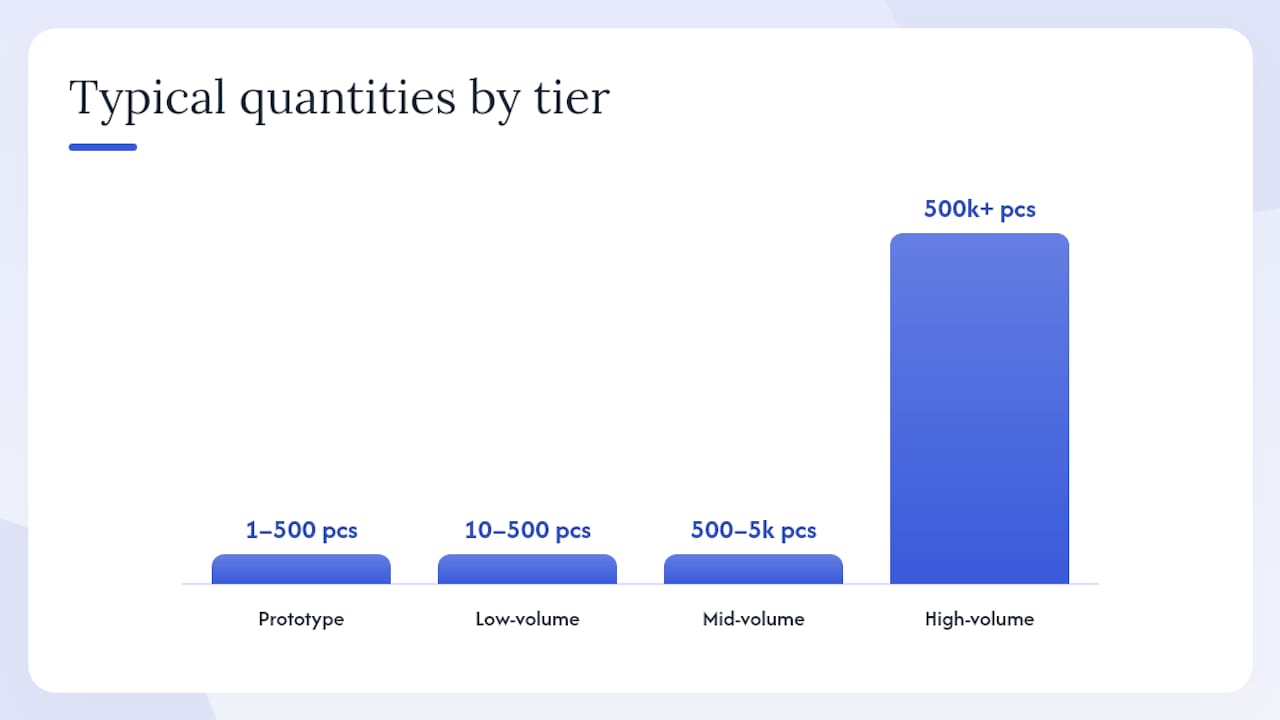
| Prototype | 1–500 pieces | 1–7 business days (online shops); 2–4 weeks (full-service shops) | Setup, fixturing, first-article inspection, engineering review |
| Low-volume production | 10–500 pieces | 2–5 weeks | Fixturing amortization, material procurement, secondary ops |
| Mid-volume production | 500–5000 pieces | 3–6 weeks | Process optimization, inspection frequency, scheduling |
| High-volume production | 500,000+ pieces | 4–6 weeks (initial ramp); ongoing per schedule | Automation fit, tooling life, inventory carrying, freight |
Online quoting platforms can compress prototype RFQ cycles to hours and deliver parts in 1–7 business days for simple geometries. For complex parts with tight tolerances or special materials, a full-service shop’s 2–4 week prototype window is more realistic, producing a more reliable first article.
Total-cost thinking beyond unit price: Inventory carrying costs, incoming inspection at your facility, and expedited freight on a missed delivery can easily exceed the unit-price difference between a cheaper and a more expensive supplier. A shop with a documented on-time delivery SLA and CMM-verified outgoing inspection reduces your total landed cost even when its unit price is higher. The IRA incentives reshaping domestic site economics also mean that shops investing in automation are better positioned to hold pricing stability through 2026 and beyond.
Why Machiningtechllc is a procurement-ready alternative
Machiningtechllc has operated since 1985 from its 70,000 sq. ft. facility in Webster, Massachusetts, producing over 20 million parts annually across aerospace, defense, firearms, and industrial programs. That throughput figure is not a marketing claim — it reflects the capacity of Hydromat rotary transfer systems running alongside multi-axis CNC milling, turning, and wire EDM precision machining, all under one roof.
For OEM procurement teams, the practical advantage is consolidation. Instead of splitting a program across a Hydromat shop, a wire EDM shop, and a secondary-ops vendor, Machiningtechllc handles all three processes with a single quality record, a single point of contact, and a single on-time delivery commitment. CMM inspection and GD&T-compliant QA are built into the production flow, not added as a separate inspection step.
What this means for your RFQ: A buyer sending a high-volume firearm component program to Machiningtechllc can expect Hydromat-optimized quoting, documented CMM capability, and ITAR-eligible production — with onboarding that typically moves from RFQ to first article faster than shops that need to outsource secondary operations.
The facility’s full capability profile covers the equipment list, process range, and industries served. For buyers evaluating precision machining services across multiple process types, Machiningtechllc’s breadth reduces program risk at production scale.
To start an RFQ: Send a 2D drawing (PDF), 3D model (STEP or IGES), material specification, tolerance callouts, required certifications (AS9100, ITAR, ISO 9001), and your target annual volume. The more complete the package, the faster and more accurate the quote.
Key Takeaways
Machiningtechllc is the strongest single alternative to americanmachinecompany.com for OEMs needing high-volume, multi-process precision machining with documented QA, ITAR eligibility, and 40-plus years of production history.
| Point | Details |
|---|---|
| Start with shop-type match | Match your part’s dominant process (Hydromat, multi-axis, wire EDM) to the shop’s primary capability before comparing price. |
| Verify certifications independently | Check AS9100 and ISO 9001 certificates against the registrar’s database; ITAR registration against the DDTC list. |
| U.S. market context | The U.S. contract manufacturing market is projected at $214.7 billion in 2026, with domestic shops absorbing reshored volume. |
| Prototype vs. production scoring | Weight lead time and technical fit heavily for prototypes; shift to quality systems and throughput for production awards. |
| Machiningtechllc | 70,000 sq. ft. facility, 20M+ parts/year, Hydromat plus CNC milling/turning plus wire EDM, serving aerospace, defense, and firearms OEMs. |
The case for domestic sourcing is stronger than the cost sheet shows
The conventional wisdom in procurement is that domestic machining costs more, full stop. That framing misses what has shifted in 2026. Reshoring pressure, IRA-driven capital investment in automated domestic facilities, and persistent overseas logistics delays have changed the total-cost calculation in ways that a unit-price comparison does not capture.
The shops that invested in automation — Hydromat systems, multi-pallet CNC cells, automated inspection — are now running at lower cost-per-part than they were five years ago, even as labor costs have risen. The shops that did not invest are struggling with lead times and capacity constraints. That divergence is the real story in domestic contract machining right now, and it means the gap between a well-automated domestic shop and an offshore alternative is narrower than most buyers assume when they look only at the quote sheet.
My practical rule: if your program has a 12-month or longer horizon and requires AS9100 or ITAR compliance, the total-cost case for a domestic, automated shop almost always closes within the first two quarters. The freight variability, the audit travel, the time-zone friction, and the rework costs on nonconforming offshore parts add up faster than the unit-price premium disappears.
One thing buyers consistently underestimate: the cost of a supplier change mid-program. Qualifying a new shop after production has started — new FAI, new material certs, new process validation — can run months and tens of thousands of dollars. Choosing the right shop at the RFQ stage, even at a slightly higher unit price, is almost always cheaper than switching later.
Machiningtechllc: built for OEMs who need volume and precision together
Most contract shops make you choose: high volume or tight tolerances or fast turnaround. Machiningtechllc’s 70,000 sq. ft. Webster, MA facility runs Hydromat, CNC milling and turning, and wire EDM under one roof, which means you get all three without splitting your program across vendors.
For OEM buyers, that consolidation translates directly to faster onboarding, a single quality record, and a delivery commitment backed by 40-plus years of production history and 20 million-plus parts per year. Whether your program is a firearm component, an aerospace subassembly, or an industrial precision part, Machiningtechllc quotes from prototype through full-scale production.
Start your RFQ by sending your 2D drawing, 3D model (STEP), material spec, tolerance callouts, required certifications, and annual volume target. The team responds with a detailed quote, not a generic price range.
Useful sources for buyers
These links let you verify market context, supplier certifications, and Machiningtechllc’s capabilities directly.
- Contract Manufacturing Outlook Report | SOCMA
- United States Contract Manufacturing Services Market — Mordor Intelligence
- How to Choose a Custom Machine Shop or CNC Supplier (2026) | MakerStage
- How to Qualify a CNC Shop or Supplier (2026) | MakerStage
- United States Contract Manufacturing Services Market Size, Share, and Industry Trends Forecast 2026-2036 | MarkWide Research
- Manufacturing Industry Trends: Data & Market Analysis 2026 | VantaInsights
- CNC Machining Factory Evaluation Guide
- Top 5 wirecuttechnologies.com Alternatives 2026 | Machining Technologies
Recommended
- Best mat-tekmfg.com Alternatives for US Precision Machining | Machining Technologies
- Top 5 Wireproedm.com Alternatives Providers 2026 | Machining Technologies
- Best advancededm.ca Alternatives for Contract EDM in 2026 | Machining Technologies
- Top 5 wirecuttechnologies.com Alternatives 2026 | Machining Technologies