

TL;DR:
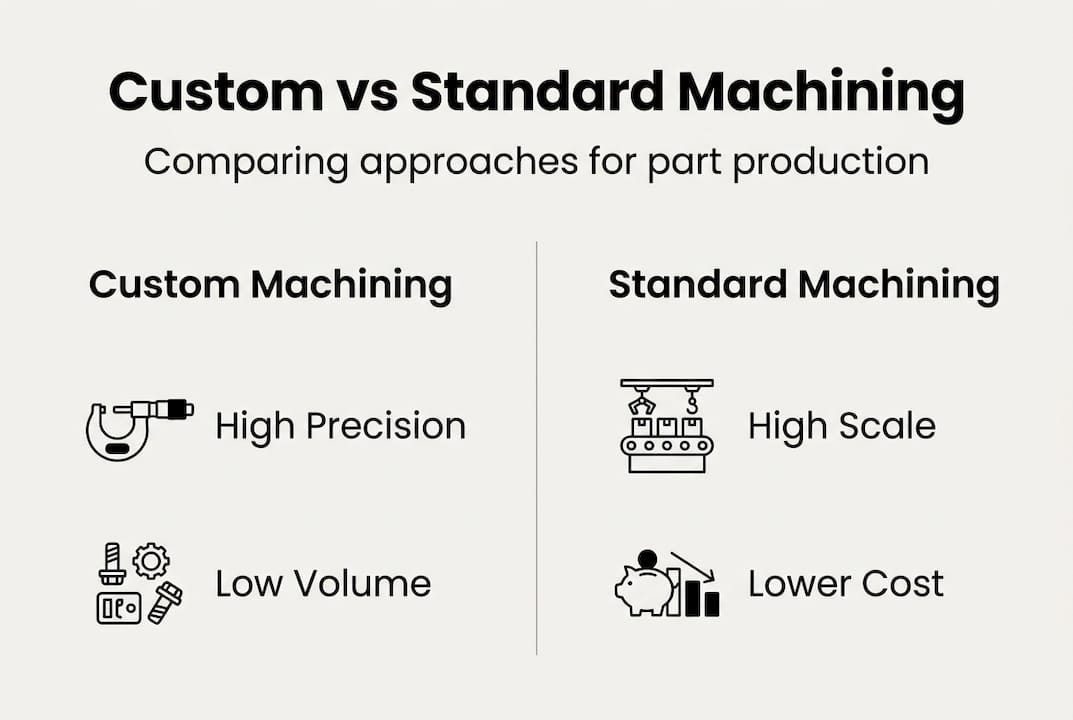
- Custom machining is ideal for low-volume, complex, or tight-tolerance parts; standard methods excel at high-volume production.
- Hybrid machining combines both approaches to optimize cost, quality, and scalability for critical components.
- OEMs should evaluate volume, complexity, timeline, and quality needs to choose the best machining strategy.
Choosing between custom and standard machining sounds straightforward until you’re staring at a failed delivery, a tolerance rejection, or a cost overrun that wasn’t in the budget. For OEMs in aerospace, defense, and firearms manufacturing, this decision shapes everything from prototype lead times to full-scale production costs. Most manufacturers default to one method out of habit rather than strategy, and that instinct can quietly erode margins and quality. This guide breaks down both approaches head-to-head, examines where hybrid strategies outperform single-method thinking, and gives you a practical framework to make the right call on your next project.
Table of Contents
- Understanding custom and standard machining
- Comparing performance: Quality, lead time, and scalability
- Cost and value analysis for high-volume manufacturing
- Making the right choice: OEM decision framework
- A fresh perspective: Why the best machining strategies blend both worlds
- How Machining Technologies accelerates your machining success
- Frequently asked questions
Key Takeaways
| Point | Details |
|---|---|
| Custom vs standard defined | Custom machining provides tailored solutions for complex or unique parts, while standard processes excel at high-volume production with consistent features. |
| Critical decision factors | Volume, part complexity, required tolerances, and production speed all play a role in selecting the best machining approach. |
| Hybrid strategies win | Mixing standard and custom techniques often provides the best balance of quality, speed, and scalability—especially in demanding industries. |
| Cost is nuanced | While standard machining lowers per-part cost at scale, custom approaches can deliver greater value for prototypes, pilot lots, or complex precision parts. |
| Consult early | Early engagement with machining specialists can clarify options and avoid costly mistakes when shifting from prototype to mass production. |
Understanding custom and standard machining
Let’s start by clarifying what sets custom and standard machining apart.
Custom machining refers to the production of parts built to specific, often unique engineering requirements. It typically involves CNC milling, turning, or wire EDM to achieve complex geometries, tight tolerances, and low-to-medium production volumes. Think of a one-off aerospace bracket or a firearm component with a proprietary geometry that no catalog part can replicate. The process is flexible, highly programmable, and suited to custom machining for aerospace and defense applications where no standard solution exists.
Standard machining covers repeatable, high-volume processes designed to produce consistent parts at scale with minimal per-unit cost. Metal Injection Molding (MIM), a process where fine metal powder is mixed with a binder, injected into a mold, and sintered to full density, is a prime example. MIM excels at producing thousands to millions of small, intricate parts with consistent geometry. Understanding the difference between MIM and CNC processes in firearms parts manufacturing reveals that each method has distinct strengths depending on volume and complexity requirements.
Here’s a quick comparison of typical scenarios for each:
| Factor | Custom machining | Standard machining (MIM) |
|---|---|---|
| Typical volume | 1 to 10,000 units | 10,000 to millions |
| Part complexity | High, unique geometries | Moderate, repeatable shapes |
| Tooling cost | Low to moderate | High upfront, low per-unit |
| Lead time (first article) | Short | Long (tooling required) |
| Tolerance capability | Extremely tight | Moderate, post-machining needed |
OEMs typically choose custom machining when:
- Part geometry is proprietary or cannot be molded
- Volumes are too low to justify tooling investment
- Tolerances exceed what standard processes can hold
- Material requirements are unusual or performance-critical
Standard methods dominate in defense and firearms production for fire control components, trigger housings, and other parts produced at scale. Understanding the full range of machining methods and precision value helps OEMs match the right process to the right application before committing to a production strategy.
Comparing performance: Quality, lead time, and scalability
With definitions clear, let’s compare how each method performs where it matters.
| Metric | Custom CNC | Standard MIM | Hybrid MIM + CNC |
|---|---|---|---|
| Surface finish | Excellent | Good | Excellent |
| Dimensional tolerance | ±0.001″ or tighter | ±0.003″ typical | ±0.001″ on critical surfaces |
| First-article lead time | Days to weeks | 8 to 16 weeks (tooling) | 10 to 18 weeks |
| Per-unit cost at 100K+ | High | Low | Moderate |
| Scalability | Limited | High | High |
| Design flexibility | Very high | Low after tooling | Moderate |
For quality-critical surfaces, custom CNC is hard to beat. It can hold tolerances that MIM simply cannot achieve without secondary operations. But at volumes above 50,000 units, the per-unit economics of MIM become compelling, provided the geometry fits within molding constraints.
Lead time is where the comparison gets interesting. Custom CNC can produce first articles in days, making it the go-to for prototyping and low-volume pilot runs. MIM requires significant upfront tooling, often stretching first-article delivery to several months. That delay can be a serious problem if your program timeline is tight.
Scalability favors standard methods, but not without limits. MIM locks you into a fixed geometry once tooling is cut. Design changes mean new tooling, new costs, and new delays. Precision manufacturing strategies that account for design evolution often favor keeping custom CNC in the mix longer than expected.
The most interesting performance story is the hybrid approach. Hybrid MIM plus CNC post-machining is often chosen for critical surfaces in firearm fire control parts precisely because it captures the cost benefits of MIM at scale while using CNC to achieve the surface finish and tolerance needed on bearing surfaces and engagement features.
Key performance takeaways for OEMs:
- Custom CNC wins on tolerance, finish, and flexibility
- MIM wins on per-unit cost and volume throughput
- Hybrid approaches win when both quality and scale are non-negotiable
- Prototyping always favors CNC regardless of eventual production method
Pro Tip: If you’re planning to eventually transition a part to MIM production, design it for moldability from day one. Using CNC for the prototype stage while designing with MIM constraints in mind saves expensive redesign cycles later. Balancing quality and throughput in machining from the start prevents costly rework.
Cost and value analysis for high-volume manufacturing
Once performance is understood, cost considerations often tip the scale.
The cost structure for each method is fundamentally different, and confusing them leads to poor sourcing decisions. Here are the primary cost drivers for each:
- Custom CNC cost drivers: Programming time, machine setup, cutting tool wear, operator skill level, and cycle time per part. These costs are relatively fixed per unit, meaning the per-unit price doesn’t drop dramatically with volume beyond a certain point.
- Standard MIM cost drivers: Tooling investment (often $20,000 to $100,000+), material powder cost, sintering energy, and finishing operations. Once tooling is amortized, per-unit costs drop sharply with volume.
- Hybrid approach cost drivers: Both of the above, plus the coordination cost of managing two production processes and the risk of tolerance stack-up between MIM and CNC operations.
- Hidden risk factors: Scrap rates, rework loops, tolerance escapes, and supplier qualification time all add to total cost of ownership in ways that don’t appear on the initial quote.
- Long-term value realization: A part that costs 30% more per unit but ships on time, holds tolerance, and requires zero rework often delivers better ROI than a cheaper part that generates field failures or production stoppages.
The key benefits of precision machining for manufacturers include reducing total cost of ownership, not just unit price. That distinction matters enormously in aerospace and defense, where a single tolerance escape can trigger a program-wide audit.
Firearms OEMs illustrate this tradeoff well. MIM enables more competitive costs at ultra-high volume, while custom CNC excels in low-volume or high-complexity OEM work. A manufacturer producing 500,000 trigger groups annually will find MIM economics compelling. A defense contractor producing 200 specialized components for a government pilot program will find custom CNC far more practical.
Understanding high-volume manufacturing strategies means recognizing that the right cost model depends on your program phase, not just your part design. Early-stage programs almost always benefit from custom CNC even if the eventual production method will be standard.
Making the right choice: OEM decision framework
Now, let’s make this actionable for your next RFQ or sourcing decision.
The decision between custom and standard machining comes down to four critical factors: volume, complexity, timeline, and quality requirements. Answering these honestly before you write your RFQ will save you weeks of back-and-forth with vendors.
Here’s a practical checklist to use when evaluating your next project:
- Volume: Is your annual quantity above 50,000 units? If yes, standard or hybrid methods deserve serious evaluation. Below that threshold, custom CNC is usually more practical.
- Complexity: Does the part have features that cannot be molded, such as undercuts, internal threads, or surfaces requiring sub-0.002″ tolerance? If yes, CNC is required at some stage.
- Timeline: Do you need first articles in less than eight weeks? Standard methods with tooling requirements will not meet that window. Custom prototype machining companies can often deliver first articles in days.
- Quality requirements: Are there critical surfaces, bearing interfaces, or engagement features that must hold tight tolerances? Plan for CNC finishing even if the bulk of the part is molded.
- Design stability: Is the design frozen, or is it still evolving? Invest in tooling only when the design is locked.
Pitfalls to avoid when talking to vendors:
- Asking for a quote without specifying production volume. The same part can have a 10x price difference between a 100-unit run and a 100,000-unit run.
- Assuming the cheapest per-unit quote represents the best value. Factor in lead time, scrap rate, and rework risk.
- Locking into a single production method before the design is stable.
Prototype, low volume, or highly specialized needs are better suited to custom CNC, while repeatable high-volume components favor standard methods. Knowing which phase your program is in determines which method serves you best right now. The contract machining benefits of working with an experienced partner include getting that guidance before you commit to a method.
Pro Tip: Re-evaluate your machining method at every major program milestone: prototype, pilot lot, and full-rate production. The right answer at prototype stage is rarely the right answer at full-rate production.
A fresh perspective: Why the best machining strategies blend both worlds
Let’s step back and see why real-world solutions are rarely black and white.
The industry debate around custom versus standard machining often gets framed as an either/or choice, as if picking one method means abandoning the other. That framing misses how leading OEMs actually operate. The most successful manufacturers treat machining methods as a toolkit, not a loyalty test.
Firearms manufacturing is the clearest example. Fire control components require both high-volume economics and precision surfaces. Hybrid machining combining MIM plus CNC is a proven solution in high-performance sectors precisely because it refuses to compromise on either dimension. The MIM process handles the bulk geometry at scale. The CNC step handles the surfaces that determine function and reliability.
The lesson for OEMs is this: the best firearms machining workflow and the best aerospace manufacturing workflow share the same underlying logic. Use the right tool for each job within the same part. Flexibility and open-mindedness about combining methods consistently outperform rigid adherence to a single process. The manufacturers who win on cost, quality, and schedule are the ones who stopped asking “which method” and started asking “which method for which feature.”
How Machining Technologies accelerates your machining success
If you’re ready to leverage the best of both custom and standard machining, here’s how Machining Technologies can help.
At Machining Technologies LLC, we’ve been producing complex, high-precision parts since 1985 from our 70,000 square foot facility in Webster, Massachusetts. We run Hydromat systems, CNC milling, turning, and wire EDM under one roof, which means you get the flexibility of custom approaches and the throughput of high-volume production without splitting your supply chain.
Whether you need a rapid prototype or a full-rate production run of millions of parts, our team helps you select the right method for each phase of your program. Explore the contract machining benefits we deliver for OEMs, or review our complex part manufacturing strategies to see how we approach precision at scale. Contact us today to discuss your next project.
Frequently asked questions
When should I choose custom machining over standard machining?
Opt for custom machining when you need low quantities, unique geometries, or ultra-tight tolerances that standard processes can’t reliably produce. Custom machining suits low-volume, high-complexity OEM needs where standard tooling cannot meet the design requirements.
Is hybrid machining a good option for high-volume parts?
Yes, combining standard processes like MIM with custom CNC post-machining can deliver both scale and critical surface precision for high-volume needs. Hybrid MIM plus CNC offers scalability plus the quality control that mission-critical applications demand.
How does part complexity influence machining choice?
Higher geometric complexity often favors custom techniques like CNC, while simple repeated features can be scaled with standard methods like MIM. CNC handles unique part shapes and complex tolerances better than any molding process can.
Do custom machining costs always outweigh standard methods?
Not necessarily. Custom machining can optimize value for high-complexity, low-volume, or mission-critical parts, while standard methods save money at high volumes. Costs depend on complexity, volume, and quality requirements rather than process type alone.
Recommended
- Why choose custom machining for aerospace and defense | Machining Technologies
- Optimize high-volume machining workflow: aerospace precision | Machining Technologies
- Aerospace machining best practices for precision | Machining Technologies
- How to specify machining tolerances for precision | Machining Technologies