

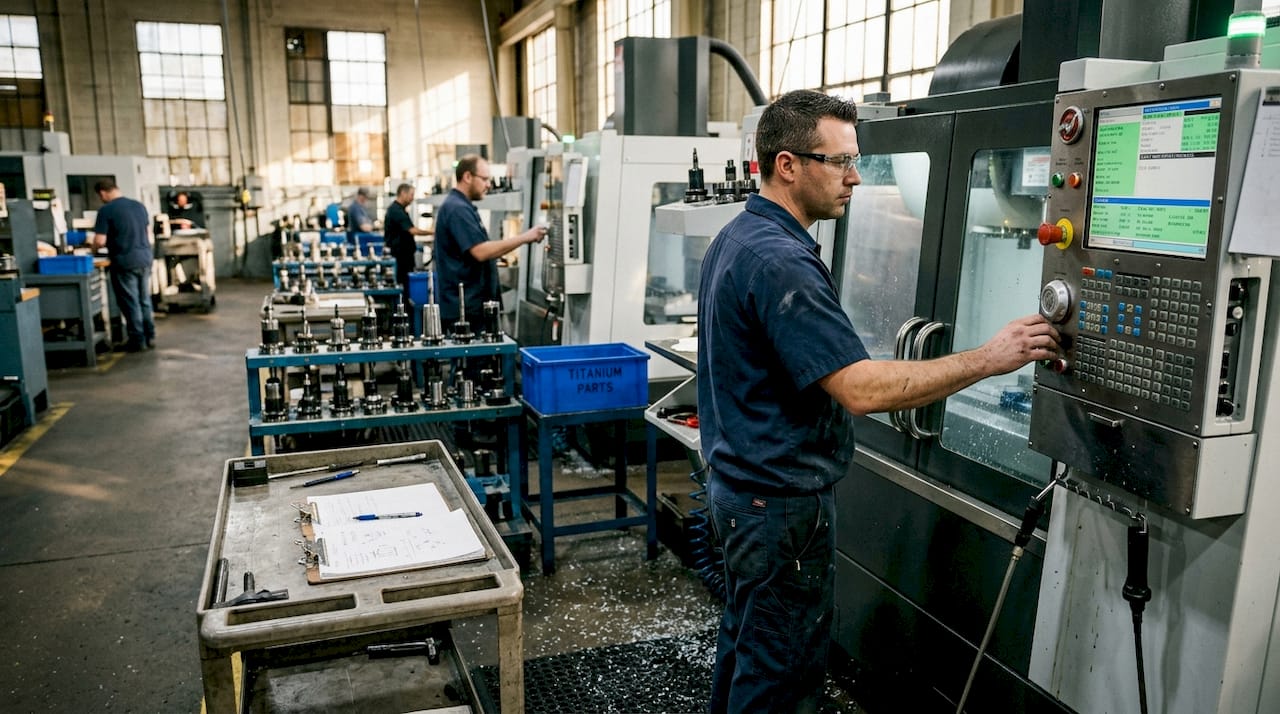
When a single missed tolerance on a titanium bracket grounds a fleet or delays a defense contract, the cost isn’t just financial. It’s reputational. Aerospace and defense machining at high volumes amplifies every process gap, every tool change delay, every inspection bottleneck into something that can derail a program. The difference between a shop that wins repeat contracts and one that struggles to keep pace often comes down to workflow discipline, not machine capability alone. This guide walks you through preparation, execution, quality assurance, and real-world strategies to help your team produce precision components at scale without sacrificing reliability.
Table of Contents
- Key requirements and preparation for high-volume machining
- Step-by-step workflow: Executing high-volume machining
- Tool life, quality control, and minimizing downtime
- Troubleshooting and operator best practices
- A fresh perspective on high-volume machining success
- Next steps: Partnering for high-volume precision
- Frequently asked questions
Key Takeaways
| Point | Details |
|---|---|
| Material mastery required | Efficient high-volume machining depends on tailored approaches for titanium, Inconel, and aerospace alloys. |
| Automation boosts throughput | Probing and workflow automation can slash cycle times and multiply productivity rates. |
| Tool life impacts uptime | Active monitoring and quality control prevent costly downtimes in continuous runs. |
| Whole-system thinking wins | Success is driven by tightly integrated process controls, supplier qualifications, and human expertise. |
Key requirements and preparation for high-volume machining
Before a single chip flies, your workflow has to be built on the right foundation. That means understanding your materials, your standards, and your process constraints before production starts.
Aerospace materials like titanium, Inconel, aluminum alloys, and stainless steel require specialized strategies because of heat generation, aggressive tool wear, and work-hardening behavior. Titanium’s low thermal conductivity traps heat at the cutting edge. Inconel resists deformation and eats carbide inserts. Aluminum cuts fast but demands precise chip evacuation to avoid built-up edge. Each material requires a tailored approach before you commit to a production run.
On the certification side, AS9100 and NADCAP are non-negotiable baselines for aerospace and defense work. When qualifying suppliers, look beyond the certificate. Ask for documented process controls, evidence of exotic material experience, and demonstrated automation capability. A supplier who can show you actual SPC data from a titanium run is worth far more than one who only hands you a certificate.
Use this table as a quick-reference guide during your preparation phase:
| Material | Required tooling | Cooling strategy | Workholding consideration |
|---|---|---|---|
| Titanium | Carbide, sharp edge geometry | High-pressure coolant | Rigid, minimal vibration |
| Inconel | Coated carbide or ceramic | Flood coolant, low speed | Secure, anti-chatter setup |
| Aluminum | High-helix end mills | Air blast or mist | Light clamping, no distortion |
| Stainless steel | TiAlN-coated carbide | Flood coolant | Stable fixturing |
Before any run, work through this preparation checklist:
- Validate drawings and specs against the latest revision
- Confirm tooling availability and condition
- Verify your metrology plan covers all critical dimensions
- Review workholding setup for each operation
- Confirm material certs and traceability documentation
For aerospace machining best practices and precision strategies for complex parts, front-loading this preparation work consistently reduces mid-run surprises.
Pro Tip: Engage suppliers who demonstrate automation and exotic material experience early in the quoting process. A partner who asks the right questions upfront will save you far more time than one who discovers problems after setup.
Step-by-step workflow: Executing high-volume machining
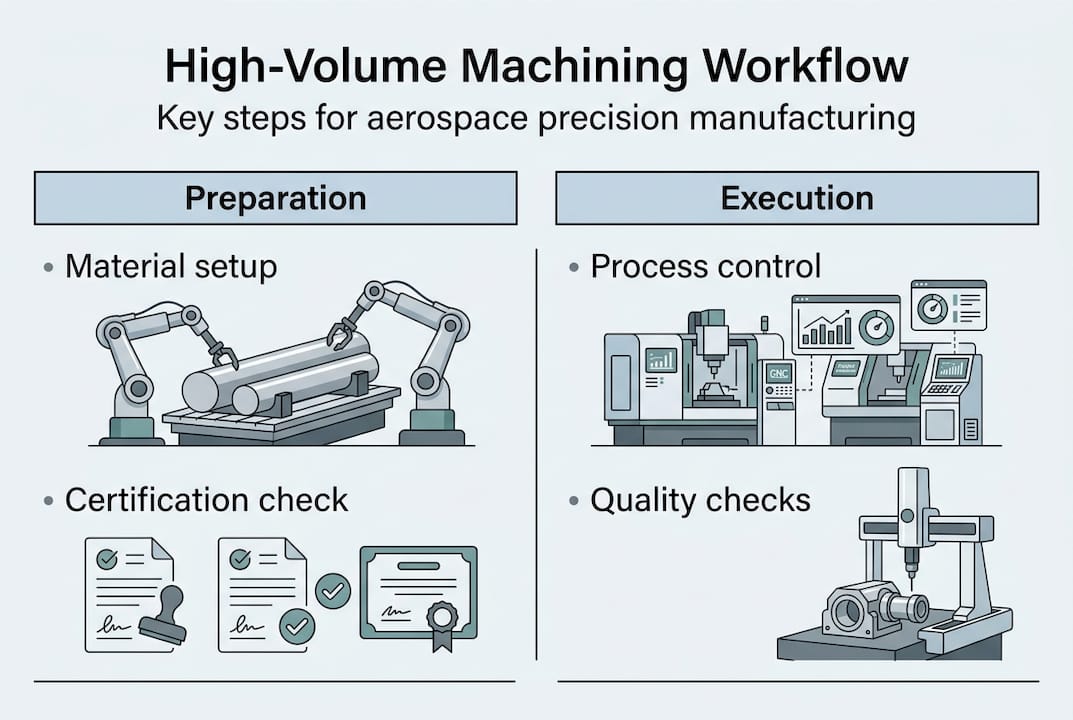
With preparation locked in, execution becomes a matter of process discipline. Here is a proven sequence for high-volume precision machining of aerospace and defense components:
- Setup and fixturing verification. Confirm workholding torque, datum alignment, and part seating before the first cycle. A 10-minute check here prevents hours of scrap.
- Tool path optimization. Use CAM-generated paths that account for material-specific feeds, speeds, and engagement angles. Avoid full-width cuts in tough alloys.
- In-process probing. Deploy on-machine probing after the first article and at defined intervals. This catches tool wear and part drift before they become scrap.
- Adaptive control. Use spindle load monitoring or adaptive feed control to respond to real-time cutting conditions, especially in variable-stock castings.
- Part ejection and handling. Automate part transfer where possible to reduce handling damage and keep cycle times consistent.
Cycle time reductions of 30 to 50% are achievable through parameter optimization alone, and production rates improve by 80% or more when probing automation is fully integrated into the workflow.
| Step | Manual approach | Automated approach |
|---|---|---|
| Setup verification | Operator visual check | Probing cycle with auto-report |
| In-process inspection | Periodic manual gauging | Continuous on-machine probing |
| Feed/speed adjustment | Operator judgment | Adaptive control system |
| Part transfer | Hand loading | Robotic or conveyor system |
| Error detection | Post-process CMM | In-cycle feedback loop |
For deeper context on high-volume manufacturing strategies, the shift from manual to automated steps is where the biggest throughput gains live. Explore automation in machining and lead time improvement trends to benchmark your current setup against what’s possible.
Pro Tip: Use on-machine probing to catch part drift and tool wear before it results in scrap. Even a single probing cycle after every 25th part can cut your scrap rate dramatically on long production runs.
Tool life, quality control, and minimizing downtime
With your workflow running, sustaining output and managing quality become the real challenge. Unplanned downtime is the single biggest throughput killer in high-volume aerospace machining, and most of it is preventable.
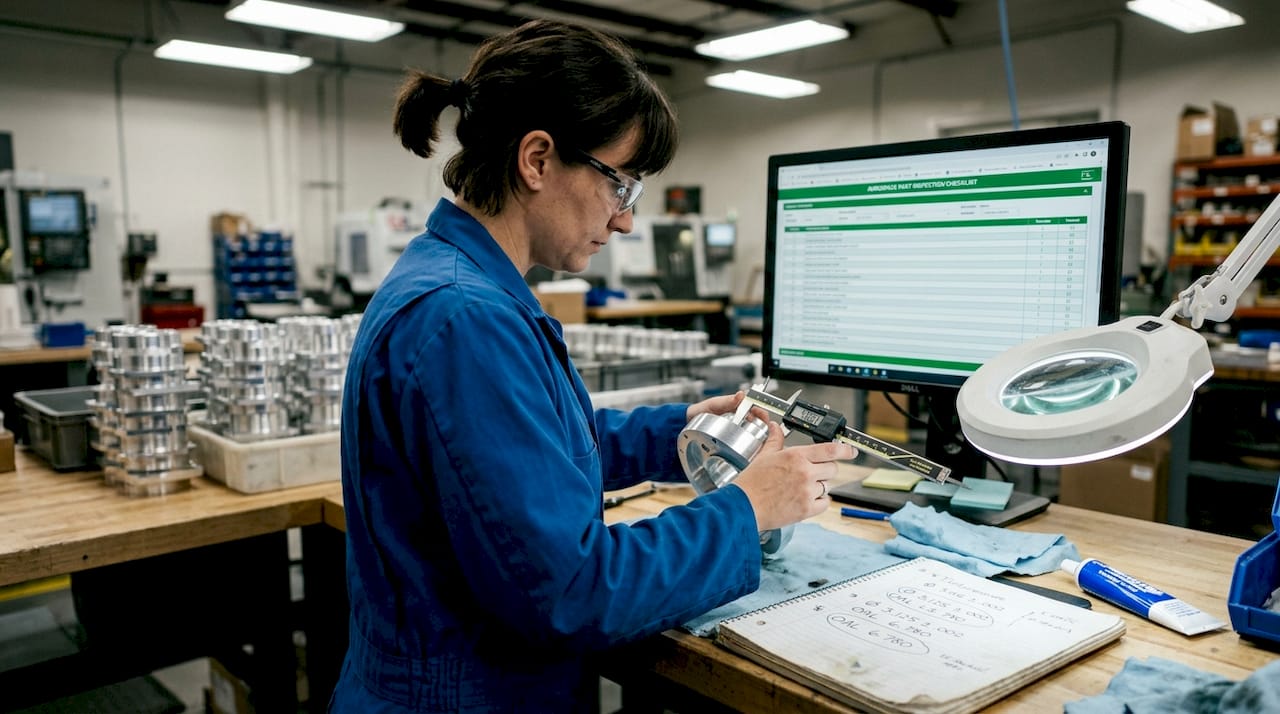
Tool life management reduces unplanned downtime, and probing combined with automation is essential for stability when running exotic alloys versus standard steels. The failure modes are different, the warning signs are subtler, and the consequences of missing them are more severe.
Here are leading practices for tool life and process stability:
- Set tool life limits based on empirical data from your specific material and operation, not the insert manufacturer’s generic spec
- Use spindle load sensors to detect tool wear in real time
- Implement adaptive feed control to compensate for stock variation in castings
- Schedule preventive tool changes at defined intervals rather than waiting for failure
- Track tool consumption per part to identify drift in process conditions over time
For quality control, statistical process control (SPC) gives you a live view of where your process is trending before it goes out of tolerance. Pair SPC with in-process metrology at critical features, and you create a feedback loop that catches problems in seconds rather than hours.
“When on-machine probing is integrated with adaptive control, shops can run lights-out high-volume production on aerospace exotics with confidence. The combination prevents the scrap cascades that come from undetected tool wear or part drift.”
For more on minimizing downtime and the full scope of CNC automation benefits, the data consistently shows that shops investing in probing and SPC outperform those relying on post-process inspection alone.
Troubleshooting and operator best practices
Even the best workflows face challenges. The key is recognizing failure modes early and having a response plan ready before production starts.
Common issues in high-volume aerospace machining and how to address them:
- Tool breakage: Usually caused by excessive chip load, poor chip evacuation, or worn inserts running past their limit. Review feeds and speeds, check coolant delivery, and enforce tool change intervals.
- Built-up edge (BUE): Common in aluminum and stainless. Address with sharper geometry, higher surface speeds, and proper lubrication.
- Thermal distortion: Critical in titanium and Inconel. High-pressure coolant and reduced depth of cut are your primary controls.
- Chip evacuation failures: Especially dangerous in deep-cavity milling. Use high-pressure through-spindle coolant and program chip-breaking moves into the tool path.
As one industry expert put it: “Humans and software are the limiters and unlockers of tool potential.” The balanced approach combining speed with stability, proper CAM, coatings, coolant, and skilled human oversight is what separates consistent performers from shops that fight fires every shift.
For operators, structured shift handovers are non-negotiable. Every handover should include tool life status, any in-process anomalies, and the current SPC trend for critical dimensions. A five-minute handover briefing prevents a two-hour troubleshooting session on the next shift.
For procurement managers, the vetting question isn’t just “can they hold the tolerance?” It’s “can they demonstrate ongoing process improvement and automation integration?” Ask for evidence of how a supplier responded to a production problem. Their answer tells you everything about their culture. Look at cross-industry workflow insights to see how process discipline translates across demanding applications.
A fresh perspective on high-volume machining success
Here’s something the industry doesn’t say enough: technology investments alone won’t fix a broken workflow. We’ve seen shops with the latest five-axis machining centers and adaptive control systems still struggling with scrap rates and missed deliveries because the human and organizational side of the process wasn’t aligned.
The real wins in high-volume aerospace machining come from integrating engineering judgment, supplier relationships, and operator talent into a single system. Over-specifying machine parameters without active feedback and control doesn’t make things more precise. It makes them more brittle. A tightly specified process with no room for real-time correction will fail faster than a slightly looser process with strong feedback loops.
Persistent communication between procurement, operators, and engineers is the most undervalued lever in this business. When a procurement manager understands why a supplier is requesting a material substitution, and when an operator can flag a process drift to engineering in real time, course corrections happen in minutes instead of days. That’s where real-world manufacturing examples consistently show the biggest gains: not in the machines, but in the people and processes surrounding them.
Next steps: Partnering for high-volume precision
If you’re ready to implement or further improve your high-volume machining workflow, the right manufacturing partner makes a measurable difference.
At Machining Technologies LLC, we’ve been producing precision aerospace and defense components since 1985, with over 20 million parts manufactured annually from our 70,000 square foot facility in Webster, Massachusetts. Our Hydromat systems, CNC turning, milling, and wire EDM capabilities are built for the kind of throughput and tolerance demands your programs require. See our case examples to understand how we approach complex, high-volume runs, and explore the contract machining benefits that help OEMs accelerate production. When quality and throughput both matter, our quality and throughput services are built around your program requirements.
Frequently asked questions
What are the top materials used in high-volume aerospace machining?
Titanium alloys, aluminum alloys, stainless steel, and Inconel are the most common due to their strength-to-weight performance, but each brings specific challenges around heat, tool wear, and work-hardening that require tailored strategies.
How much can automation and process control improve productivity?
Production rate improvements of 80% or more are well-documented with robust probing and automation integration, particularly for complex aluminum castings and other precision aerospace components.
Why is on-machine probing so important for aerospace components?
On-machine probing catches tool drift and wear before parts go out of tolerance, enabling lights-out automation runs and maintaining quality control on specialty alloys where manual inspection intervals are too slow to prevent scrap cascades.
What certifications are essential for aerospace and defense machining suppliers?
AS9100 and NADCAP certifications are the baseline requirements. Beyond the certificates, look for suppliers with proven exotics experience and demonstrated automation integration for consistent high-volume precision output.
Recommended
- Aerospace machining best practices for precision | Machining Technologies
- Aerospace machining: precision processes and standards | Machining Technologies
- Machining Trends 2026: 40% Faster Lead Times + 50% Tool Life | Machining Technologies
- Master Precision Machining Workflow for Firearms Components | Machining Technologies