

Aerospace machining represents one of the most demanding manufacturing disciplines, where tolerances measured in ten-thousandths of an inch determine whether a component flies or fails. Unlike conventional manufacturing, aerospace parts must withstand extreme temperatures, vibrations, and stresses while maintaining structural integrity across decades of service. This guide examines the specialized CNC processes, material requirements, residual stress challenges, and emerging technologies that define modern aerospace machining. You’ll discover how multi-axis machining achieves micron-level precision, why material selection directly impacts component longevity, and which innovations are reshaping manufacturing efficiency for critical aerospace applications.
Table of Contents
- Key takeaways
- Core aerospace machining processes and standards
- Advanced techniques and residual stress management
- Empirical machining benchmarks and material selection
- Innovations and hybrid manufacturing in aerospace machining
- Explore machining technologies for aerospace manufacturing
- Frequently asked questions about aerospace machining
Key Takeaways
| Point | Details |
|---|---|
| Tight tolerances | Aerospace components are machined to tolerances of roughly plus or minus 0.0002 to 0.001 inches with surface finishes as fine as Ra 16 microinches. |
| Material choices | Material selection drives machining strategy and tooling choices, with aluminum 7075 and 6061 used for airframes, titanium 6Al 4V for high temperature and fatigue resistance, and Inconel 718 for demanding engine components. |
| Multi axis milling | Five axis milling enables continuous tool orientation changes to tackle complex geometries, improving precision and surface finish. |
| Standards and certs | AS9100 certification and NADCAP accreditation provide quality management and process approvals for heat treatment, testing, and related processes. |
| Residual stress | Modern aerospace machining emphasizes managing residual stresses through optimized cooling and cutting parameters to prevent part distortion. |
Core aerospace machining processes and standards
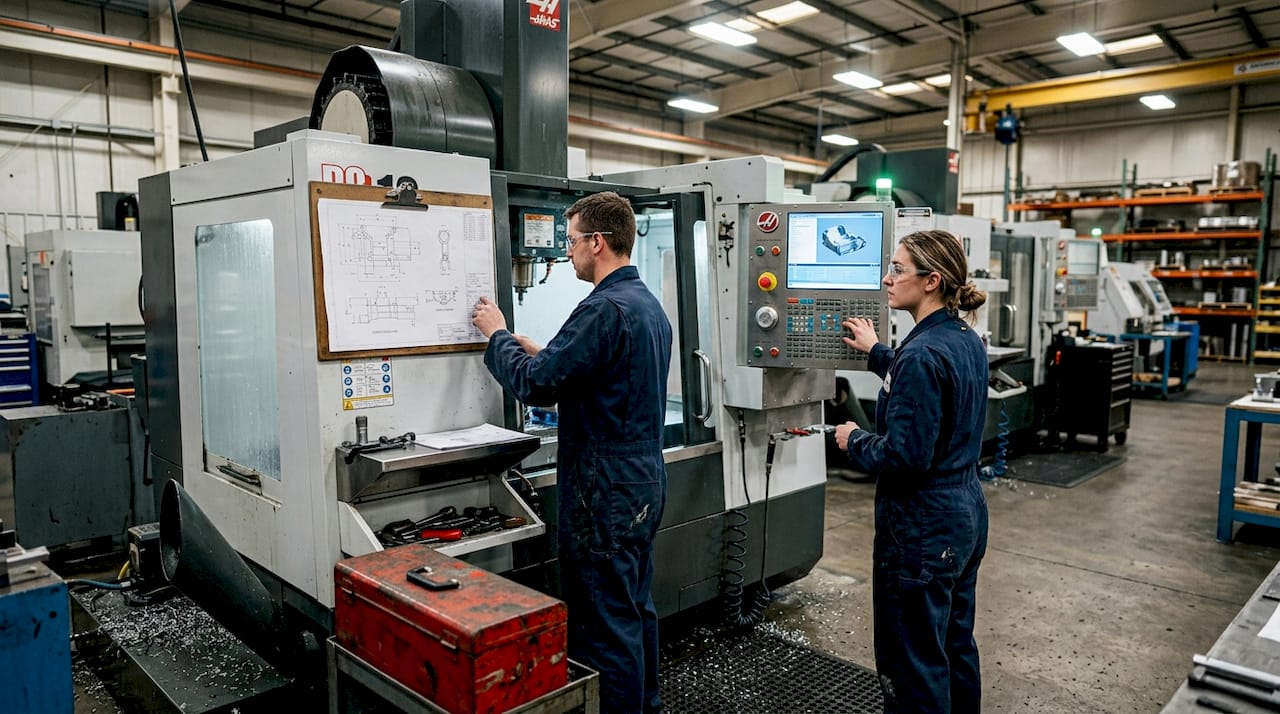
Aerospace machining focuses on precision CNC subtractive manufacturing using multi-axis milling, turning, and grinding to achieve tolerances between ±0.0002 and 0.001 inches with surface finishes reaching Ra ≤16 microinches. These exacting specifications exist because aerospace components operate under extreme conditions where even microscopic deviations can compromise safety and performance. The subtractive approach removes material from solid blocks or forgings of high-performance alloys, creating parts that meet stringent dimensional and metallurgical requirements.
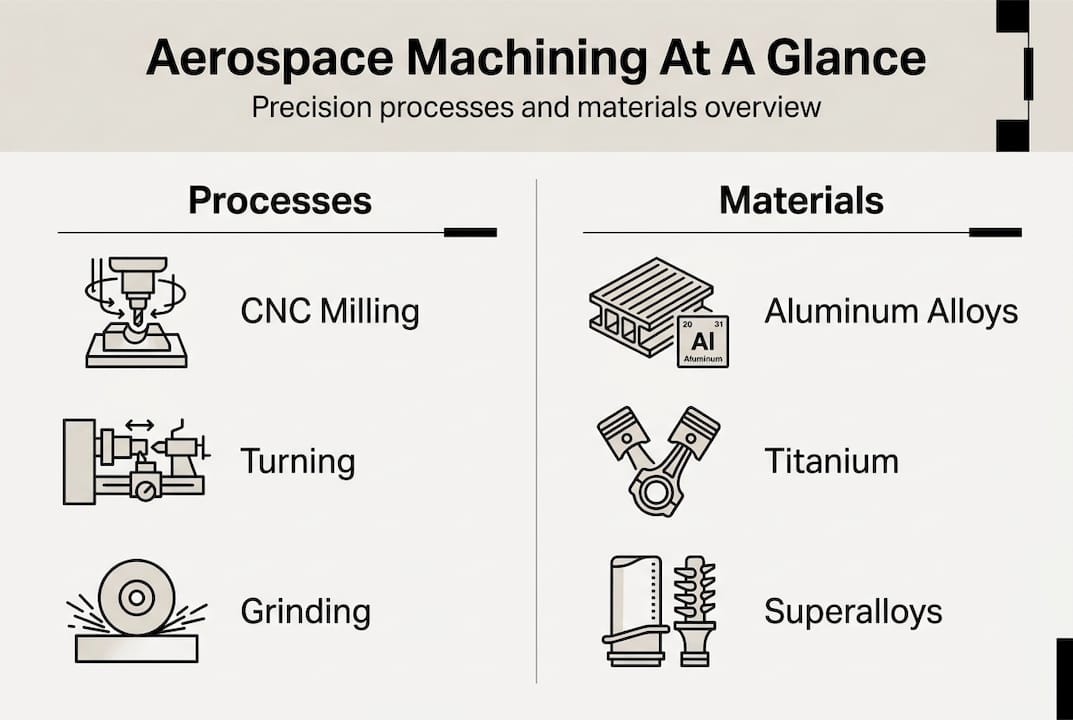
Material selection drives machining strategy and tooling choices. Aluminum alloys 7075 and 6061 dominate airframe construction due to their excellent strength-to-weight ratios and machinability. Titanium Ti-6Al-4V serves engine components and structural elements requiring superior heat resistance and fatigue properties. Inconel 718 and similar superalloys handle the most demanding applications like turbine blades and combustion chambers, though their toughness presents significant machining challenges. Each material requires specific cutting parameters, tool geometries, and coolant strategies to achieve required surface integrity without inducing harmful residual stresses.
Three primary processes form the foundation of aerospace machining. CNC milling uses rotating cutters to remove material and create complex contours, with 5-axis machines enabling continuous tool orientation changes for intricate geometries. Turning operations rotate the workpiece against stationary cutting tools to produce cylindrical features and threaded connections. Grinding delivers final surface finishes and holds tight tolerances aerospace machining demands, particularly for bearing surfaces and sealing interfaces.
AS9100 certification establishes the quality management framework for aerospace manufacturing, encompassing design controls, process validation, and traceability requirements. NADCAP accreditation adds specialized process approvals for heat treatment, non-destructive testing, and chemical processing. These standards ensure components maintain performance characteristics across temperature extremes, cyclic loading, and corrosive environments encountered during service life.
Key aerospace machining equipment includes:
- 5-axis CNC machining centers for turbine blades, impellers, and structural brackets requiring complex angular features
- Horizontal boring mills for large airframe components and landing gear assemblies with deep cavities
- Swiss-type turning centers producing small-diameter shafts, fasteners, and hydraulic fittings with high precision
- Cylindrical and surface grinders achieving final dimensional accuracy and surface finish specifications
- Wire EDM machines cutting intricate cooling passages and thin-wall features in hardened materials
Advanced techniques and residual stress management
Modern aerospace machining employs specialized techniques optimized for difficult-to-machine superalloys and thin-walled structures. Trochoidal milling uses circular tool paths with shallow radial engagement, distributing heat and wear across more cutting edge while enabling higher metal removal rates in Inconel and titanium. Peel milling takes light cuts across large surface areas, ideal for removing stock from monolithic airframe panels without inducing thermal damage. High-pressure coolant delivery systems flush chips from deep pockets and maintain cutting temperatures within acceptable ranges for tool life and surface integrity.
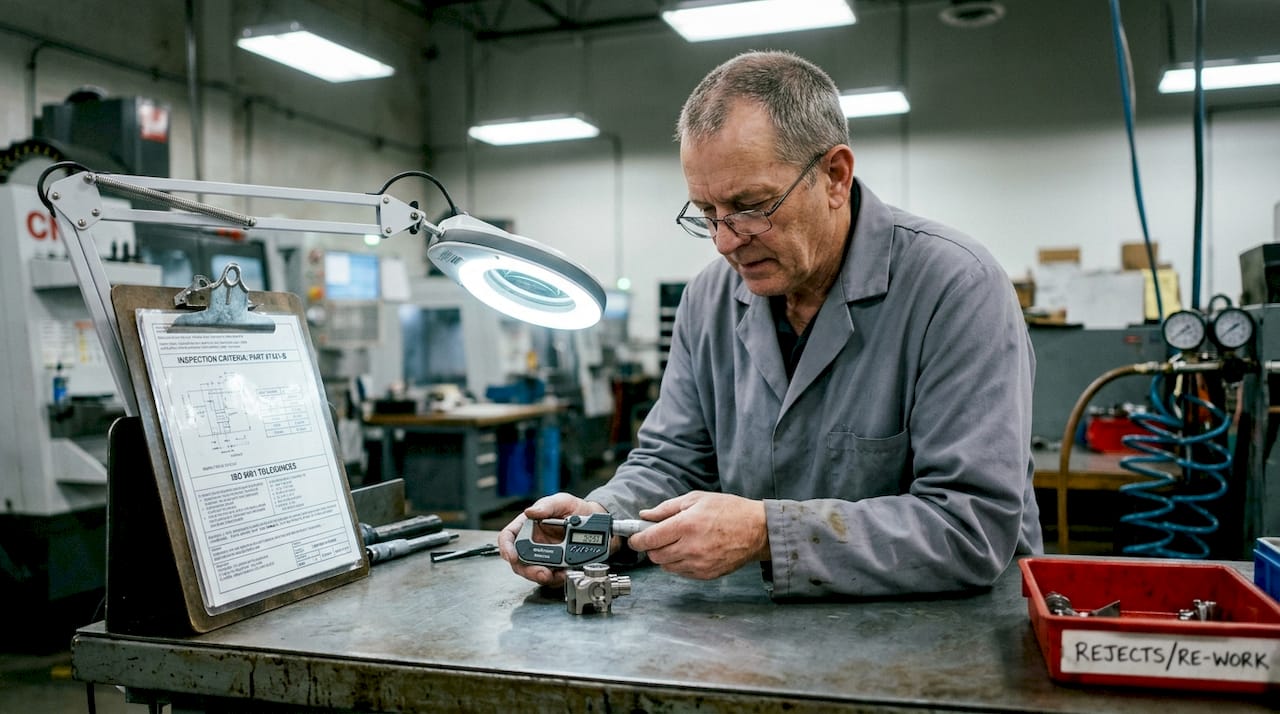
Residual stresses cause distortion leading to costly rework, with mitigation requiring both offline planning and online process control. These internal stresses originate from forging operations, heat treatments, and the machining process itself. When material removal unbalances stress distributions, parts warp unpredictably, sometimes rendering components scrap after hundreds of hours of machining investment. Boeing documented $290 million in rework costs attributed to distortion issues in a single aircraft program, highlighting the financial impact of inadequate stress management.
Residual stress mitigation strategies include:
- Offline machining sequence optimization using finite element analysis to predict and compensate for distortion through strategic material removal patterns and intermediate stress relief cycles
- Stress relief heat treatments performed at specific intervals during machining to relax accumulated stresses before they cause dimensional instability
- Online adaptive clamping systems that adjust fixture forces in real time based on measured part deflections and predicted stress states
- In-situ monitoring with strain gauges and laser displacement sensors providing feedback for process parameter adjustments
Distortion reduction directly impacts production economics and delivery schedules. Parts requiring extensive manual rework consume additional machine time and skilled labor while delaying downstream assembly operations. Effective stress management through precision strategies complex manufacturing enables first-time-right production, eliminating rework loops and improving on-time delivery performance.
Pro Tip: For thin-walled aerospace components like compressor casings, implement Christmas tree machining sequences that remove material symmetrically from opposite sides in alternating passes, or use hybrid sequences combining roughing operations with intermediate stress relief. This approach maintains balanced stress distributions throughout the process, reducing final distortion by 60-75% compared to conventional single-side machining.
Empirical machining benchmarks and material selection
Real-world machining data reveals the precision levels achievable with optimized processes and proper material selection. 7075 aluminum milling achieves Ra values between 0.25 and 0.40 micrometers using flow-optimized tool paths, significantly reducing machining time while maintaining surface quality. Compressor blade manufacturing studies document dimensional deviations under 0.0005 inches across complex airfoil geometries when combining proper fixturing with adaptive machining strategies. These benchmarks far exceed automotive and general industrial standards, where tolerances of ±0.005 inches are common.
| Material | Typical Ra Finish | Standard Tolerance | Primary Applications |
|---|---|---|---|
| Aluminum 7075 | 0.25-0.40 μm (10-16 μin) | ±0.0005 in | Airframe structures, wing ribs, fuselage frames |
| Titanium Ti-6Al-4V | 0.40-0.60 μm (16-24 μin) | ±0.0003 in | Engine mounts, landing gear, fasteners |
| Inconel 718 | 0.50-0.80 μm (20-32 μin) | ±0.0002 in | Turbine blades, combustion chambers, exhaust components |
Material selection best practices for aerospace components:
- Match alloy properties to service environment, selecting aluminum for ambient temperature airframe applications, titanium for moderate heat exposure up to 800°F, and superalloys for combustion section components exceeding 1200°F
- Consider machinability ratings when balancing performance requirements against production costs, as Inconel 718 requires 5-8 times longer machining cycles than aluminum 7075 for equivalent geometries
- Evaluate material availability and supply chain stability, particularly for specialized aerospace grades with limited production sources
- Account for heat treatment requirements in process planning, as some alloys need solution treating and aging after rough machining but before final operations
Surface roughness measurements provide critical quality indicators for aerospace components. Bearing surfaces typically require Ra values below 16 microinches to ensure proper lubrication film formation and prevent premature wear. Sealing interfaces demand even finer finishes, often Ra 8 microinches or better, to maintain pressure differentials without leakage. Aerodynamic surfaces on compressor blades and turbine vanes achieve Ra 10-12 microinches to minimize boundary layer disruption and maintain efficiency.
Machining flow strategies improve quality by optimizing tool engagement angles and maintaining consistent chip loads throughout cutting operations. Conventional zigzag patterns create entry and exit marks where the tool changes direction, while flow-optimized paths use smooth transitions and constant engagement. This approach reduces surface roughness variation by 30-40% and extends tool life through more predictable wear patterns. Implementation requires CAM software capable of advanced toolpath generation and machines with look-ahead control maintaining feedrates through direction changes.
Innovations and hybrid manufacturing in aerospace machining
Hybrid manufacturing combines additive manufacturing with conventional CNC machining to revolutionize aerospace component production. Hybrid AM+CNC cuts waste by 90% compared to traditional subtractive-only approaches while reducing costs 15-25% through optimized material usage. The process deposits metal using directed energy deposition or powder bed fusion to create near-net shapes, then applies precision machining for critical dimensions and surface finishes. This approach particularly benefits components with complex internal features like conformal cooling channels or weight-optimized lattice structures.
| Manufacturing Approach | Material Waste | Precision Level | Lead Time | Relative Cost |
|---|---|---|---|---|
| Traditional CNC only | High (70-90% waste) | Excellent (±0.0002 in) | Baseline | 100% |
| Hybrid AM+CNC | Low (5-10% waste) | Excellent (±0.0002 in) | 30-40% faster | 75-85% |
| AM only | Minimal waste | Good (±0.005 in) | 20-30% faster | 60-70% |
Laser-assisted machining improves cutting performance in difficult superalloys by preheating material immediately ahead of the cutting edge. A focused laser beam raises local temperature to 1500-2000°F, reducing yield strength and allowing higher material removal rates with lower cutting forces. This technology extends tool life by 200-300% when machining Inconel 718 and similar alloys, while improving surface integrity through reduced mechanical stresses. Applications include turbine disk machining and large structural forgings where conventional cutting struggles with work hardening and rapid tool wear.
Digital twin simulations predict residual stress behavior throughout the machining process, enabling proactive adjustments before distortion occurs. Engineers create virtual models incorporating material properties, fixture constraints, and cutting sequences, then run finite element analyses predicting stress distributions after each operation. Comparing predicted versus measured results validates models and builds confidence for production implementation. Advanced systems integrate real-time sensor data with digital twins, automatically adjusting parameters when deviations from predicted behavior indicate potential quality issues.
Pro Tip: Balance cutting speed and tool rake angle to minimize residual stress while maintaining surface quality. Increasing speed from 200 to 350 surface feet per minute in titanium machining reduces tensile residual stresses by 40-50% through higher temperatures that promote stress relief during cutting. However, pair speed increases with slightly negative rake angles (2-4 degrees) to prevent excessive heat generation that could alter surface metallurgy.
Emerging technologies reshaping aerospace machining include:
- Cryogenic cooling using liquid nitrogen or carbon dioxide to improve tool life 3-5x while achieving better surface finishes in titanium and superalloys
- Ultrasonic-assisted machining applying high-frequency vibrations to reduce cutting forces and enable machining of ceramics and ceramic matrix composites
- Artificial intelligence optimizing cutting parameters in real time based on tool wear monitoring, surface finish measurements, and power consumption data
- Automated inspection systems using blue light scanning and computed tomography to verify dimensional accuracy without removing parts from fixtures
Implementing machining trends 2026 requires investment in advanced equipment and operator training, but delivers measurable improvements in productivity and quality. Manufacturers adopting hybrid approaches report 25-35% reductions in lead times for complex aerospace components while maintaining or improving dimensional accuracy. The combination of additive near-net shaping with precision CNC finishing optimizes material utilization and manufacturing efficiency.
Explore machining technologies for aerospace manufacturing
Navigating the complexities of aerospace component manufacturing demands partners with proven expertise in precision machining, quality systems, and advanced process control. Machining Technologies brings decades of experience producing critical aerospace parts to exacting specifications, backed by comprehensive quality certifications and state-of-the-art equipment. Our 70,000 square foot facility houses advanced multi-axis CNC machines, automated inspection systems, and process monitoring technology ensuring every component meets dimensional and metallurgical requirements.
Whether you need precision parts manufacturing quality for prototype development or full-scale production runs, our team applies proven strategies for managing residual stress, optimizing machining sequences, and delivering components on schedule. Explore our complex part manufacturing precision strategies to understand how we tackle challenging geometries and difficult materials. Compare capabilities across top CNC machining providers 2026 to make informed sourcing decisions for your aerospace manufacturing requirements.
Frequently asked questions about aerospace machining
What is aerospace machining?
Aerospace machining uses precision CNC processes including multi-axis milling, turning, and grinding to manufacture aircraft and spacecraft components from high-performance alloys. It achieves tolerances between ±0.0002 and 0.001 inches with surface finishes reaching Ra 16 microinches or better, meeting AS9100 quality standards for safety-critical applications.
Why is 5-axis machining essential for aerospace components?
5-axis machining enables continuous tool orientation changes, allowing single-setup production of complex geometries like turbine blades and impellers. This eliminates repositioning errors, reduces setup time by 60-70%, and maintains tighter tolerances by keeping parts fixtured throughout the entire machining cycle.
How does residual stress impact aerospace parts manufacturing?
Residual stresses from forging, heat treatment, and machining cause unpredictable part distortion when material removal unbalances internal forces. Unmanaged stress leads to dimensional deviations requiring costly rework or scrap, with some programs documenting hundreds of millions in distortion-related losses. Mitigation strategies include optimized machining sequences, intermediate stress relief treatments, and adaptive fixturing.
What are the benefits of hybrid manufacturing for aerospace?
Hybrid AM+CNC manufacturing reduces material waste by 90% and costs by 15-25% while maintaining precision levels equivalent to conventional machining. It enables complex internal features like conformal cooling channels, shortens lead times by 30-40%, and optimizes buy-to-fly ratios for expensive aerospace alloys like titanium and Inconel.
What material considerations are unique to aerospace machining?
Aerospace materials must withstand extreme temperatures, cyclic loading, and corrosive environments while meeting strict traceability requirements. Aluminum 7075 serves airframe structures, titanium Ti-6Al-4V handles engine components to 800°F, and Inconel 718 survives combustion section temperatures exceeding 1200°F. Each requires specialized cutting parameters, tooling, and process controls to achieve required surface integrity without inducing harmful metallurgical changes.
Recommended
- Why tight tolerances matter for aerospace machining | Machining Technologies
- Machining in defense industry: precision and innovation | Machining Technologies
- Why choose custom machining for aerospace and defense | Machining Technologies
- Precision Parts Manufacturing: Maximizing Quality and Throughput | Machining Technologies