

TL;DR:
- Industrial component machining involves controlled processes to produce precise, reliable parts for demanding applications.
- Matching the appropriate machining method to part complexity, material, and tolerances ensures optimal performance and quality.
- Effective collaboration and communication with suppliers are crucial for achieving high-quality, high-reliability machined components.
Not all machined parts are created equal. A component that looks identical to a high-precision part can fail spectacularly in the field if the wrong process, material, or tolerance standard was applied. For purchasing agents and engineering managers sourcing critical parts, understanding what separates precision industrial component machining from commodity cutting is not academic. It directly affects product reliability, warranty costs, and your supply chain’s credibility. This guide walks through the core methods, quality standards, and practical decision criteria that matter most when you’re specifying or sourcing machined components for demanding industrial applications.
Table of Contents
- Defining industrial component machining
- Key machining methods and their applications
- Precision, tolerances, and quality control in machining
- Choosing a machining partner: What to look for
- Industrial component machining in action: Practical examples
- Our take: What most buyers miss about industrial component machining
- Ready to advance your industrial machining results?
- Frequently asked questions
Key Takeaways
| Point | Details |
|---|---|
| Precision drives quality | High-precision machining underpins reliability and lifespan in industrial assemblies. |
| Process selection matters | Matching machining methods to application needs can reduce cost and improve part performance. |
| Supplier choice is strategic | Carefully vetting machining partners ensures consistent outcomes and reduces operational risks. |
| Tolerances affect outcomes | Small differences in tolerance can have major impacts on assembly fit and lifecycle. |
Defining industrial component machining
Industrial component machining is a set of controlled material-removal processes used to produce parts for manufacturing equipment, vehicles, aerospace structures, defense systems, and more. It is not a single operation. It is a discipline that spans multiple technologies, materials, and tolerance classes, each chosen to match the specific demands of a given part.
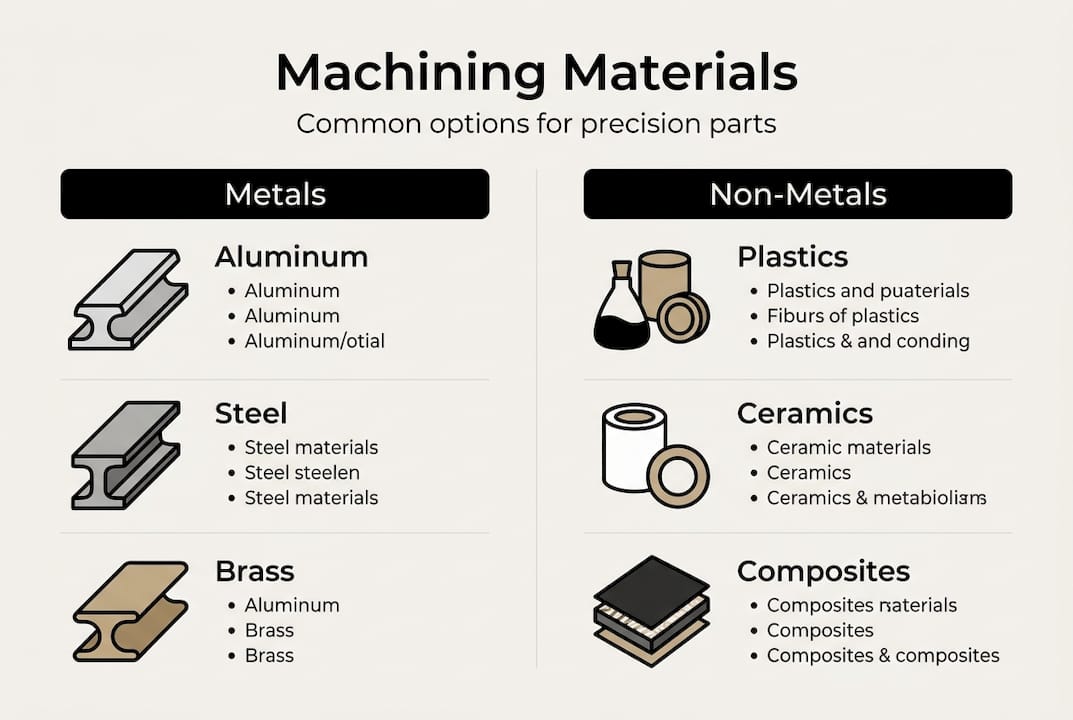
The range of materials handled is broad. Aluminum alloys, stainless steel, titanium, hardened tool steel, brass, and engineering plastics all fall within scope. So does the complexity range. A simple turned shaft and a five-axis milled aerospace bracket both qualify as industrial components, but they demand very different equipment, programming, and inspection protocols.
What separates high-precision machining from commodity work is the combination of process control, equipment capability, and quality verification. Commodity machining prioritizes speed and low unit cost, often at the expense of consistency. Precision machining, by contrast, treats every part as a functional artifact that must perform reliably under load, temperature, and wear.
Understanding the benefits of precision machining for your supply chain starts with recognizing this distinction. A part that passes a visual check but fails a functional gauge is not a good part. It is a liability.
Here is what industrial component machining typically encompasses:
- CNC milling: Complex 3D shapes, pockets, contours, and flat surfaces
- CNC turning: Cylindrical parts such as shafts, bushings, and fittings
- Drilling and boring: Precision holes with controlled diameter and position
- Grinding: Fine surface finishes and sub-thousandth tolerances
- EDM (electrical discharge machining): Hard materials and intricate geometries that resist conventional cutting
As precision machining methods show, core methodologies include CNC milling for complex 3D shapes and pockets, CNC turning for cylindrical parts like shafts, drilling for holes, grinding for fine finishes and tight tolerances, and EDM for hard materials and intricate geometries.
“The difference between a precision-machined part and a commodity part is not always visible to the naked eye. It shows up in field performance, assembly fit, and product lifespan.”
Key machining methods and their applications
Choosing the right process is one of the most consequential decisions in part development. Each method has a defined sweet spot, and using the wrong one adds cost, compromises quality, or both.
As precision machining references confirm, the core methodologies cover CNC milling for complex 3D shapes, CNC turning for cylindrical parts, drilling for holes, grinding for tight tolerances, and EDM for hard materials and intricate geometries. Here is how each plays out in practice:
- CNC milling handles multi-axis cutting for prismatic parts, housings, brackets, and complex contoured surfaces. It excels when geometry is irregular or when multiple features must be located precisely relative to each other.
- CNC turning is the go-to for round parts. Shafts, spindles, threaded fittings, and valve bodies are all prime candidates. High spindle speeds and tight diameter tolerances make turning ideal for high-volume cylindrical work.
- Drilling and boring produce holes with controlled size, position, and finish. Boring is used when hole diameter tolerance is tighter than a drill can reliably achieve.
- Grinding follows rough machining to achieve surface finishes and tolerances that cutting tools cannot match. It is common in bearing seats, sealing surfaces, and gauge-critical bores.
- Wire EDM cuts through hardened materials using an electrically charged wire, with no cutting force on the part. This makes it indispensable for thin-walled features, tight-radius slots, and materials like carbide or hardened D2 tool steel. Learn more about wire EDM advantages for precision manufacturing.
| Method | Best for | Typical tolerance | Limitation |
|---|---|---|---|
| CNC milling | Complex geometry, pockets | ±0.001″ | Slower on simple round parts |
| CNC turning | Cylindrical parts | ±0.0005″ | Limited to rotational geometry |
| Grinding | Finish and fine tolerance | ±0.0001″ | Material removal rate is low |
| Wire EDM | Hard materials, thin features | ±0.0001″ | Slower throughput |
| Drilling/boring | Precision holes | ±0.001″ | Depth-to-diameter limits |
For CNC milling and turning applications, combining operations in a single setup reduces fixturing error and speeds delivery.
Pro Tip: When a part requires both a turned diameter and a milled flat, consider a mill-turn center that handles both operations in one setup. This eliminates repositioning error and cuts lead time significantly.
Precision, tolerances, and quality control in machining
Tolerance is the permissible variation in a dimension. A shaft specified at 1.000″ with a tolerance of ±0.001″ can measure anywhere from 0.999″ to 1.001″ and still be acceptable. Tighter tolerances cost more to achieve and verify, so specifying them where they are not needed wastes money. Specifying them where they are needed and skipping verification is a reliability risk.
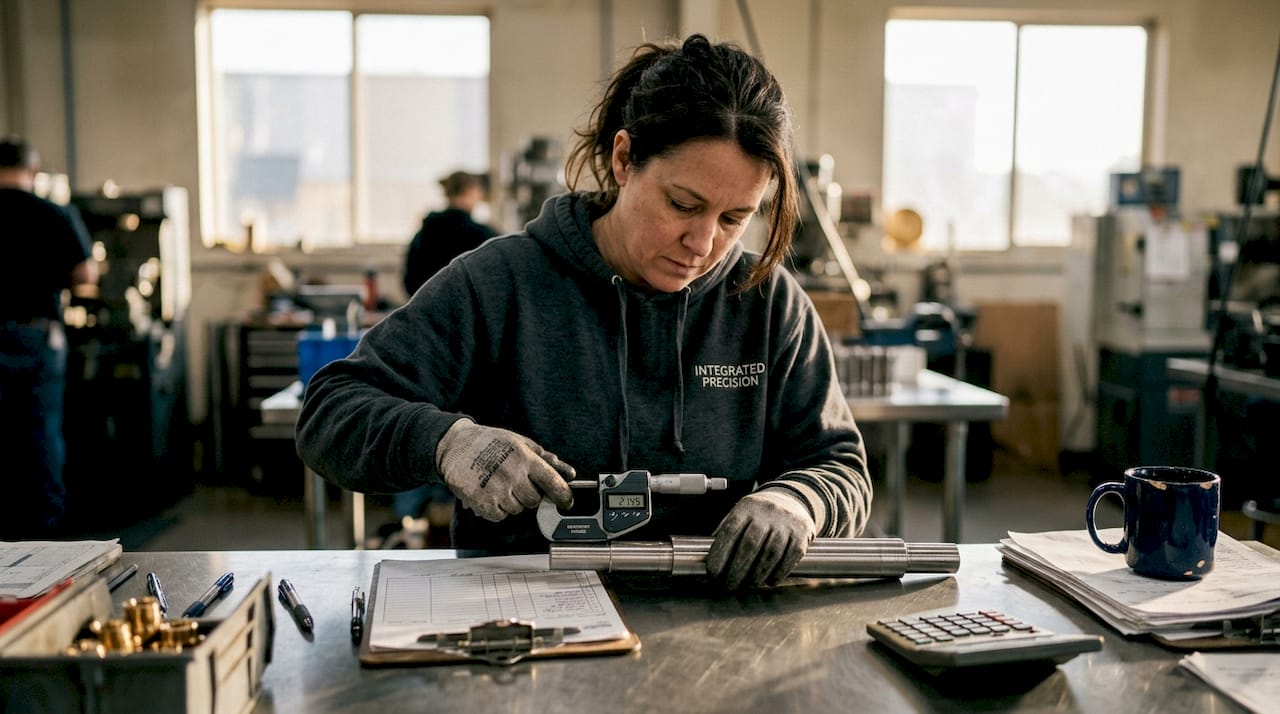
Sub-millimeter accuracy matters in critical components because small dimensional errors compound. A bearing bore that is 0.002″ oversized allows movement that causes wear, vibration, and eventual failure. In aerospace or defense assemblies, that failure has consequences far beyond a warranty claim.
Common tolerance classes in industrial machining:
| Application | Typical tolerance | Verification method |
|---|---|---|
| General industrial | ±0.005″ | Calipers, CMM |
| Precision assemblies | ±0.001″ | CMM, air gauging |
| Aerospace/defense | ±0.0005″ or tighter | CMM, optical comparator |
| Sealing surfaces | ±0.0001″ | Surface profilometer |
As precision machining standards note, EDM and grinding are specifically used where hard materials and intricate geometries demand the tightest control. Quality control in a modern machining facility goes beyond final inspection.
Key quality control steps include:
- First article inspection (FAI): Full dimensional verification of the first part off a new setup
- In-process gauging: Operators check critical features during production, not just at the end
- CMM (coordinate measuring machine) inspection: Automated 3D measurement against CAD model
- Statistical process control (SPC): Tracking measurement trends to catch drift before it causes rejects
- Material certification: Verifying raw material chemistry and mechanical properties before machining
For precision parts manufacturing quality, these steps are not optional extras. They are the baseline for any supplier serving aerospace, defense, or high-reliability industrial markets. Explore complex part manufacturing strategies to see how these quality layers apply to multi-feature components.
Choosing a machining partner: What to look for
Technical capability is table stakes. What separates a reliable machining partner from a risky one is the combination of process discipline, communication quality, and organizational maturity.
Start with these criteria when evaluating suppliers:
- Equipment breadth: Can they handle your full range of part geometries and materials in-house, or will they subcontract critical operations?
- Certifications: ISO 9001, AS9100 (aerospace), or ITAR registration signal process rigor and regulatory compliance
- Production volume experience: A shop that runs 20 million parts per year has solved problems that a low-volume job shop has never encountered
- Engineering collaboration: Do they review your drawings for manufacturability, or do they simply quote what you send?
- Responsiveness: Slow quoting often predicts slow problem resolution during production
- On-time delivery record: Ask for data, not promises
Red flags to watch for include inconsistent first-article results, reluctance to share inspection data, and vague answers about subcontracting. These patterns predict quality escapes and delivery failures.
For maximizing quality and throughput, the right partner treats your drawing as a starting point for a conversation, not a final document to be executed without feedback. The benefits for OEMs from a well-matched supplier extend well beyond unit price.
Pro Tip: Ask your shortlisted suppliers to walk you through a recent non-conformance and how they resolved it. A supplier who has never had a non-conformance is either not being honest or not running enough volume to have encountered real-world variation.
Industrial component machining in action: Practical examples
Abstract process descriptions become clearer when grounded in real manufacturing scenarios. Here is how different sectors apply these methods to solve specific challenges.
Aerospace structural brackets: A flight-critical bracket machined from 7075-T6 aluminum requires five-axis milling for complex contours, followed by CMM inspection to verify every hole position within ±0.001″. The aerospace machining workflow for this type of part integrates first article inspection and material traceability from raw stock to finished component.
Defense components: Hardened steel components for weapons systems often require wire EDM to produce tight-tolerance slots and profiles that cutting tools cannot achieve without distorting the part. Precision machining methods confirm that EDM is the correct choice for hard materials and intricate geometries where dimensional integrity cannot be compromised.
Firearm components: Receiver components and bolt carriers demand consistent tolerances across high production volumes. The workflow for firearms components relies on CNC turning and milling with in-process gauging to maintain spec across thousands of parts per run.
Industrial machinery: Pump housings and valve bodies require multi-operation setups combining milling, boring, and thread milling. The challenge is maintaining feature-to-feature relationships across multiple setups without accumulating positional error.
“In high-volume production, process consistency matters more than peak accuracy. A process that holds ±0.001” reliably across 10,000 parts outperforms one that hits ±0.0005″ on the first part and drifts on the hundredth.”
These examples illustrate a consistent pattern. The best outcomes come from matching the process to the part’s functional requirements, not defaulting to the most familiar or lowest-cost method.
Our take: What most buyers miss about industrial component machining
Most procurement failures in precision machining do not start with bad equipment. They start with incomplete communication. A supplier running state-of-the-art five-axis machines will still produce wrong parts if the drawing is ambiguous or the tolerance callouts are inconsistent with the assembly function.
The buyers who get the best results treat their machining partner as an engineering collaborator, not a vending machine. They share assembly context. They explain what the part actually does. They ask for manufacturability feedback before finalizing specs. This kind of transparency catches problems at the drawing stage, where they cost nothing to fix, rather than at the inspection stage, where they cost everything.
The precision machining benefits that matter most, such as reduced rework, faster qualification, and lower total cost, flow from this collaborative approach. Supplier capability is necessary. Supplier transparency and communication are what make that capability reliable over time.
Ready to advance your industrial machining results?
If the methods, tolerances, and supplier criteria covered here resonate with the challenges you’re managing, the next step is a direct conversation with a team that has been solving these problems since 1985.
At Machining Technologies LLC, we produce over 20 million parts annually from our 70,000 square foot facility in Webster, Massachusetts. Whether your project calls for CNC milling and turning services, wire EDM services, or full-scale premium parts manufacturing, our team brings the engineering depth and production capacity to deliver. Reach out to discuss your requirements and get a tailored solution that fits your specs, volume, and timeline.
Frequently asked questions
What are the most common types of industrial component machining?
The most common methods are CNC milling, CNC turning, drilling, grinding, and EDM, each suited to different shapes, materials, and tolerances. Precision machining references confirm these as the foundational processes for industrial part production.
How do tolerances impact the performance of machined components?
Tighter tolerances ensure parts fit and function as intended, reducing wear, failure, and rework in final assemblies. Even small dimensional deviations can compound into significant performance problems in precision equipment.
How do I choose the right machining supplier for high-precision parts?
Look for proven capabilities, relevant certifications, a track record with similar part geometries, and transparent communication throughout the project. Ask for inspection data and non-conformance history, not just a capability statement.
When should EDM be chosen over other machining methods?
EDM is ideal for intricate shapes or hard materials that resist conventional cutting, and it applies no cutting force to the part, making it safe for thin-walled or delicate features. EDM suits hard materials and intricate geometries that other processes cannot reliably achieve.
What types of industries rely most on precision component machining?
Aerospace, defense, automotive, medical device, and industrial equipment sectors all depend on high-precision machining for critical assemblies where dimensional consistency directly affects safety and performance.
Recommended
- Precision Parts Manufacturing: Maximizing Quality and Throughput | Machining Technologies
- Optimize high-volume machining workflow: aerospace precision | Machining Technologies
- Advanced machining equipment: efficiency gains and ROI | Machining Technologies
- Aerospace machining best practices for precision | Machining Technologies