

TL;DR:
- Advanced machining equipment offers an 18-month or faster payback period with significant quality and efficiency improvements.
- Investments should be validated with demand analysis, setup savings, and scrap reduction calculations.
- Smart manufacturing integration enhances ROI through increased utilization, reduced downtime, and sustainability benefits.
Most manufacturing executives assume that high-end machining equipment means a long, painful payback period. That assumption is costing them contracts. Advanced machining equipment delivers $477K in year-one benefits with an 18-month payback, and the best-performing 5-axis installations recover costs in under 9 months. This guide walks through the technology, the financial benchmarks, and the production outcomes that procurement managers and OEM leaders need to evaluate before their next capital expenditure decision. The evidence is clear, and the framework for applying it to your operation is straightforward.
Table of Contents
- Understanding advanced machining technology
- Measuring ROI: Real-world data and industry benchmarks
- Production efficiency and precision gains
- Smart manufacturing integration: next-level impact
- Editorial perspective: Hard truths and overlooked factors
- Work with experts: Enhance your advanced machining ROI
- Frequently asked questions
Key Takeaways
| Point | Details |
|---|---|
| Rapid ROI possible | Most advanced machining investments recoup costs within 8-18 months, with substantial annual revenue and savings benefits. |
| Efficiency and quality | Production cycle times drop by up to 80%, and part precision improves drastically with advanced systems. |
| Smart integration amplifies ROI | Connected automation solutions drive 47% utilization gains, 53% lower downtime, and yield both financial and environmental advantages. |
| Demand validation is critical | Rapid payback only occurs when complex, high-volume part demand justifies investment—analyze lost quotes and ecosystem needs first. |
Understanding advanced machining technology
Advanced machining is not simply a faster version of conventional CNC work. It refers to a category of equipment and methodologies that combine multi-axis movement, automation, and in-process verification to produce complex geometries with tolerances that older setups cannot reliably hold. The distinction matters because the ROI calculation changes significantly depending on which tier of technology you are evaluating.
The core systems in this category include:
- Multi-axis CNC machining centers (4-axis and 5-axis): These machines cut from multiple angles in a single setup, eliminating repositioning errors and reducing cycle time.
- Turn-mill centers: Combine turning and milling operations on one platform, compressing what used to require two machines and two operators into a single workflow.
- Automated pallet changers and robotic loading: Enable lights-out machining, extending productive hours without adding headcount.
- In-process probing and real-time verification: Catch dimensional errors mid-cycle rather than at final inspection, reducing scrap and rework.
Capabilities at this level include tolerances of ±0.001 to ±0.005mm and the ability to machine complex, contoured surfaces that are standard requirements in aerospace, defense, and firearm components. Understanding multi-axis machining is the starting point for any serious capital investment conversation.
Supporting methodologies matter just as much as the hardware. Coolant-through-spindle delivery maintains tool temperature and chip evacuation at high feed rates. High-rake tooling reduces cutting forces and extends tool life. Together, these practices protect the machine investment and sustain the precision output over production runs.
Pro Tip: Before evaluating specific equipment, map your current part portfolio against complexity tiers. If more than 30% of your parts require three or more setups today, a turn-mill or 5-axis platform will almost certainly justify its cost.
The precision machining market reached $127 billion in 2025, driven largely by multi-axis CNC demand across aerospace and defense supply chains. That scale reflects real purchasing decisions by organizations that have already run the numbers on complex part manufacturing and found the investment defensible.
Measuring ROI: Real-world data and industry benchmarks
The financial case for advanced machining is stronger than most internal budget presentations suggest. The gap between what executives expect and what the data shows is significant.
Here is a direct comparison of payback timelines and margin outcomes by machine type:
| Machine type | Typical payback period | Margin impact on complex parts |
|---|---|---|
| Vertical machining center (VMC) | 14 to 36 months | Moderate, depends on volume |
| 5-axis CNC center | 8.7 to 18 months | 18 to 25% higher on titanium/Inconel |
| Turn-mill center | 12 to 24 months | High, especially multi-op parts |
The VMC payback range of 14 to 36 months reflects a wide spread based on utilization and part mix. The 5-axis payback at 8.7 months represents a best-case scenario with strong demand and optimized programming, while 18 months is a realistic mid-range target for most contract shops entering this segment.
Mid-tier manufacturers consistently achieve 18 to 25% higher margins on complex titanium and Inconel parts after 5-axis investment. That margin improvement comes from three sources: fewer setups, shorter cycle times, and the ability to quote work that competitors without 5-axis capability cannot touch.
To build a credible ROI model before purchasing, follow this sequence:
- Run a lost-quote analysis. Identify contracts you declined or lost in the past 12 months because your current equipment could not meet complexity or tolerance requirements.
- Validate demand. Confirm that the work you want to win is repeatable and not a one-time project. Equipment ROI depends on sustained utilization, not spot jobs.
- Calculate setup savings. Estimate the labor and machine time currently consumed by repositioning and re-fixturing on multi-step parts.
- Model scrap reduction. Even a 2% reduction in scrap rate on high-value materials like titanium generates meaningful savings at volume.
- Factor in new revenue potential. The ability to machine complex geometries opens bidding opportunities that are currently off-limits.
Pro Tip: If your lost-quote analysis shows more than $500K in declined or lost work annually, a 5-axis investment will almost certainly reach payback within 18 months under conservative assumptions.
The precision machining benefits extend beyond direct savings. Winning complex, high-margin contracts changes your customer mix and reduces dependence on commodity work. Understanding contract machining ROI in full requires accounting for that strategic value, not just the line-item savings.
Production efficiency and precision gains
The ROI numbers become concrete when you look at what actually changes on the shop floor. Cycle time and setup reduction are the two biggest levers, and the documented outcomes are striking.
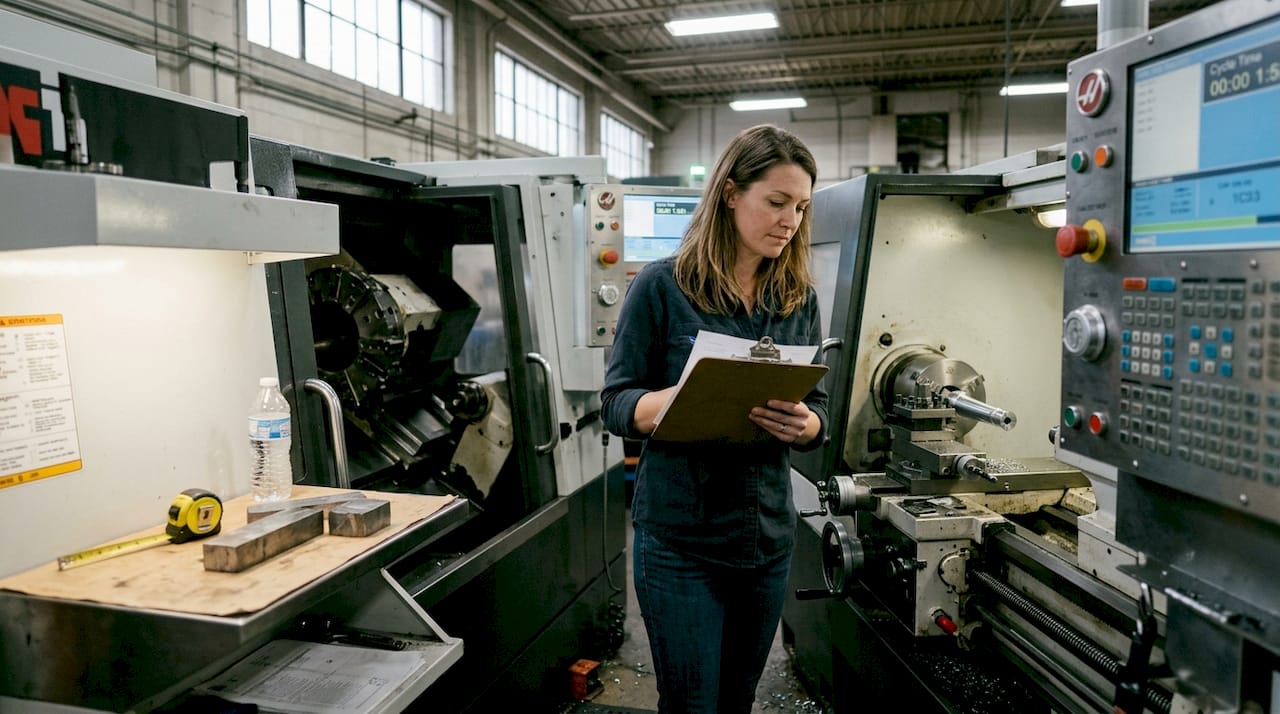
LeanWerks, a precision CNC shop, cut aluminum casting time from 10 hours to under 2 hours per part after implementing turn-mill centers with in-process probing. That is an 80% improvement in throughput on a single part family. The probing system caught dimensional drift mid-cycle, eliminating end-of-line scrap and rework that had been absorbing hours of operator time.
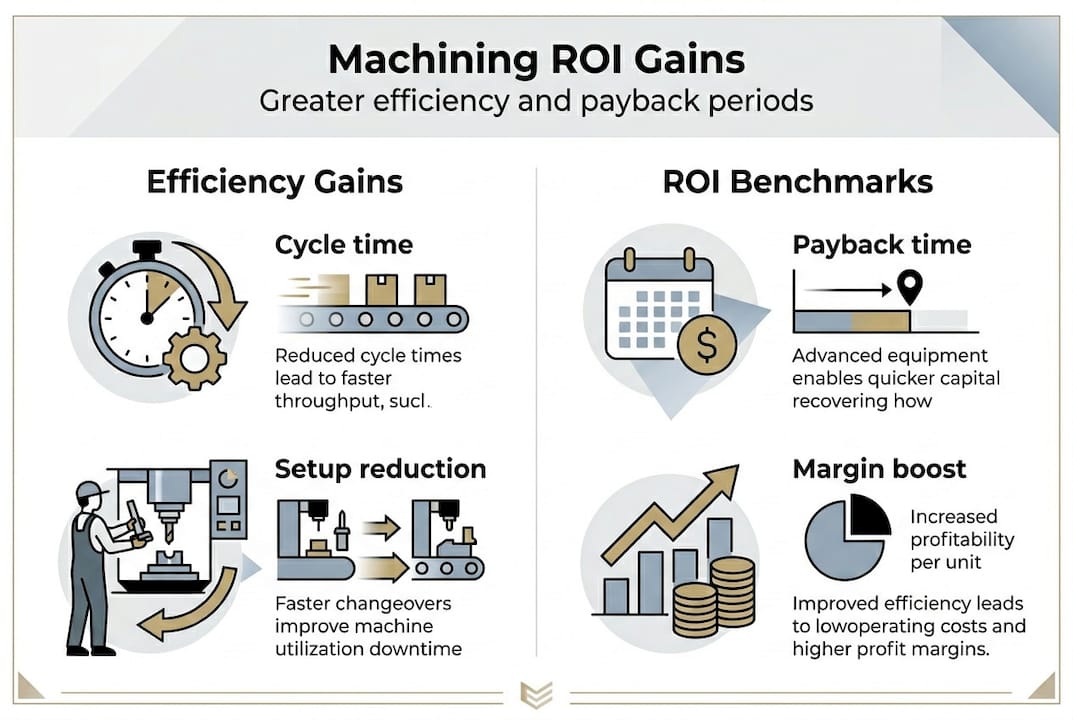
For aerospace brackets, a documented case study shows cycle time reduced from 95 minutes across 3 setups to 52 minutes in a single setup, generating $31,500 in annual savings on that part alone. Scale that across a part portfolio of 40 to 60 active part numbers and the aggregate savings become a primary driver of payback.
Here is how the before-and-after picture looks across key production metrics:
| Metric | Before advanced machining | After advanced machining |
|---|---|---|
| Setups per complex part | 3 to 5 | 1 to 2 |
| Cycle time (representative part) | 95 minutes | 52 minutes |
| Scrap rate | 4 to 6% | 1 to 2% |
| Operator interventions per shift | High | Reduced by automation |
Advanced fixturing plays a supporting role that is easy to underestimate. Zero-point clamping systems allow rapid changeover between part families without losing datum reference. Combined with real-time probing, this eliminates the tolerance stack-up that accumulates across multiple setups on conventional machines.
“The single-setup approach does not just save time. It removes the error accumulation that makes tight-tolerance parts unpredictable at scale.”
For organizations running aerospace manufacturing automation, the combination of reduced setups and automated verification is what makes high-volume precision work economically viable. Optimizing a high-volume machining workflow requires both the hardware and the process discipline to sustain these gains across production runs. CNC turning precision at this level also reduces final inspection time because parts arrive at inspection already verified.
Smart manufacturing integration: next-level impact
Efficiency gains are not just isolated to hardware. Smart manufacturing platforms amplify ROI further by connecting machines, data, and decisions in real time.
A published study on smart manufacturing in precision environments found that integration delivers a 47% improvement in equipment utilization, a 53% reduction in unplanned downtime, a 1-year ROI, a 40% internal rate of return, and a 42% reduction in emissions. These are not marginal improvements. They represent a fundamental shift in how a machining operation performs.
The mechanisms behind these outcomes include:
- Real-time machine monitoring: OEE (Overall Equipment Effectiveness) dashboards identify underperforming assets before they become bottlenecks.
- Predictive maintenance: Vibration and thermal sensors flag tool wear and spindle health before failure, preventing unplanned downtime.
- Connected scheduling: Production scheduling systems that pull live machine status data reduce queue time and improve on-time delivery rates.
- Data-driven process optimization: Cutting parameter libraries built from production data improve cycle times and tool life over time without manual experimentation.
Pro Tip: Start smart integration with machine monitoring before investing in full MES platforms. Utilization data alone will identify your highest-impact improvement opportunities within 60 days.
For OEMs and defense contractors evaluating automated machining benefits, the sustainability dimension is increasingly relevant. A 42% emissions reduction is not just an environmental outcome. It is a supply chain qualification factor for prime contractors with scope 3 emissions commitments. Connecting machining investment to sustainability reporting adds a dimension to the ROI case that pure financial models miss. Broader logistics optimization strategies can further extend these gains across the supply chain.
Editorial perspective: Hard truths and overlooked factors
Most ROI guides for advanced machining stop at the headline numbers. Here is what they leave out.
High capital expenditure is not feasible for every operation. A shop running primarily simple turned parts at moderate volume may never generate enough complex work to justify a 5-axis investment. Demand validation is not a step you can skip. If the complex work is not already in your pipeline or realistically winnable within 6 months, the payback math falls apart.
The learning curve is real. Ecosystem costs add 15 to 20% to the total investment when you account for CAM software, workholding, tooling, and operator training. Shops typically operate at around 60% efficiency for the first 3 months after installation. Simulation tools reduce collision risk during this period, but they do not eliminate the productivity gap.
The operations that extract the best returns from advanced machining are not necessarily the largest. They are the ones that align their equipment investment with a clear and validated market position. Tracking machining trends helps you time your investment to match demand, not chase it after the fact. Invest in the capability your customers are already asking for, not the capability you hope they will need.
Work with experts: Enhance your advanced machining ROI
If you are ready to achieve these ROI and efficiency milestones, Machining Technologies is positioned to support your next investment decision with direct, hands-on expertise.
Since 1985, we have operated a 70,000 square foot facility in Webster, Massachusetts, producing over 20 million parts annually for aerospace, defense, and industrial OEMs. We offer custom ROI assessments grounded in real production data, not generic benchmarks. Whether you need guidance on contract machining benefits, support for complex part manufacturing, or a partner to optimize your high-volume workflow for aerospace, our team brings the equipment, capacity, and process knowledge to deliver measurable results.
Frequently asked questions
How quickly can advanced machining equipment pay for itself?
Payback can occur in as little as 8.7 months for well-utilized 5-axis installations, with a realistic mid-range target of 18 months for most operations entering this segment.
What operational changes are required for optimal ROI from advanced machining?
Expect a 3-month learning curve at reduced efficiency, plus additional ecosystem costs of 15 to 20% for CAM software, tooling, and operator training, alongside validated demand for complex parts.
Does advanced machining equipment reduce production waste?
Yes. Single-setup machining combined with real-time probing reduces scrap rates from 4 to 6% down to 1 to 2% by eliminating repositioning errors and catching dimensional drift mid-cycle.
Is smart manufacturing integration necessary for maximizing ROI?
Smart integration is not required but significantly accelerates returns, delivering a 1-year ROI, 47% higher utilization, and 53% less unplanned downtime compared to hardware-only deployments.