


TL;DR:
- Automation significantly reduces cycle times and increases capacity for high-volume, precision OEM parts.
- Implementing phased automation minimizes risks and enhances process stability and data collection.
- Success relies on measuring operational value beyond costs, focusing on continuous improvement and process discipline.
Modern OEMs and industrial manufacturers face relentless pressure to cut lead times, tighten tolerances, and scale output without proportionally scaling headcount. Traditional machining methods, while reliable for low-volume work, consistently hit a ceiling when production demands surge. Automated machining breaks through that ceiling. Case studies show dramatic efficiency gains, including 51.5% cycle time reductions and 850% capacity increases, numbers that fundamentally change what’s possible for OEM production teams. This article walks through the criteria for evaluating automation, the measurable benefits, a direct comparison with traditional methods, and a practical rollout framework.
Table of Contents
- Key criteria for evaluating machining automation
- The top benefits of automated machining
- Comparing automated vs. traditional machining
- When and how to implement automated machining
- Why many OEMs underestimate the true value of automation
- Explore advanced automated machining solutions
- Frequently asked questions
Key Takeaways
| Point | Details |
|---|---|
| Cycle time reduction | Automated machining slashes production cycles by up to 51.5 percent for OEMs. |
| Massive capacity boost | Companies have achieved an 850 percent increase in machining output with automation. |
| Superior quality and finish | AI-powered systems deliver improved surface finish and consistent part quality compared to manual methods. |
| Strategic investment | Although setup is resource-intensive, the long-term ROI and operational gains are substantial. |
Key criteria for evaluating machining automation
Before committing to automation, you need a clear-eyed look at whether your production environment is actually suited for it. Not every job shop scenario benefits equally. The gains are real, but so are the prerequisites.
What qualifies as high-volume and precision in an OEM context? Generally, runs of 10,000 or more identical or near-identical parts per year are where automation starts to pay off. Precision means tolerances of ±0.001″ or tighter, often with complex geometries requiring multi-axis movement. If your components check both boxes, automation deserves serious evaluation.
Automation delivers most value in high-volume, precision OEM manufacturing and is less ideal for low-volume custom needs. That distinction matters when you’re building a business case.
The key machining automation drivers that signal automation readiness include:
- Batch size: Consistent runs of thousands of parts per cycle
- Tolerance requirements: ±0.001″ or tighter, with repeatable surface finish specs
- Part geometry complexity: Multi-feature parts requiring 4 or 5-axis movement
- Changeover frequency: Low changeover rates favor automation; high-mix, low-volume runs do not
- ROI threshold: Payback period under 24 months is the common benchmark for justifying capital investment
- Process stability: Upstream material consistency and downstream assembly requirements must be predictable
Technical enablers worth understanding include multi-axis CNC systems, robotic part loading and unloading, and real-time in-process monitoring. These aren’t just add-ons. They’re the infrastructure that makes automation sustainable at scale. Reviewing precision manufacturing strategies can help you map these enablers to your specific component requirements.
Pro Tip: When building your automation business case, don’t just model unit cost savings. Factor in scrap reduction, operator redeployment, and the compounding value of consistent on-time delivery to your customers.
The top benefits of automated machining
With your evaluation criteria defined, the performance data behind automation becomes much more compelling. These aren’t theoretical gains. They’re documented outcomes from real production environments.
Dramatic cycle time reduction. Cycle times drop by 51.5% in well-implemented automated machining programs. For a part that previously took 4 minutes to machine, that’s under 2 minutes per cycle. Multiply that across millions of annual parts and the impact on lead times is substantial.
Massive capacity growth with controlled floor space. The same Renishaw data shows capacity increases of 850% with only 80% more machines, meaning you’re not doubling your footprint to double output. You’re multiplying it.
AI-driven process optimization. AI-based optimization cut cycle time by 37% and enhanced surface finish to Ra 0.11 µm in documented studies. That level of surface quality opens doors to aerospace and defense applications that manual methods simply can’t reach.
Consistency and scrap reduction. Automated systems don’t fatigue. They don’t have bad days. Part-to-part consistency improves sharply, and scrap rates fall accordingly. For high-cost materials like titanium or Inconel, this matters enormously to your bottom line.
Operator role transformation. Rather than running individual machines, your skilled operators shift to process oversight, quality monitoring, and continuous improvement. That’s a better use of expensive human expertise. Strategies for boosting machining efficiency consistently point to this operator leverage as one of the most underappreciated gains.
“The shift from manual to automated machining isn’t just about speed. It’s about building a production system that improves itself over time through data, consistency, and disciplined process control.”
For OEMs focused on maximizing machining quality, automation isn’t optional at scale. It’s the foundation.
Comparing automated vs. traditional machining
Numbers tell part of the story. A direct comparison across key production metrics shows where each approach wins and where the tradeoffs live.
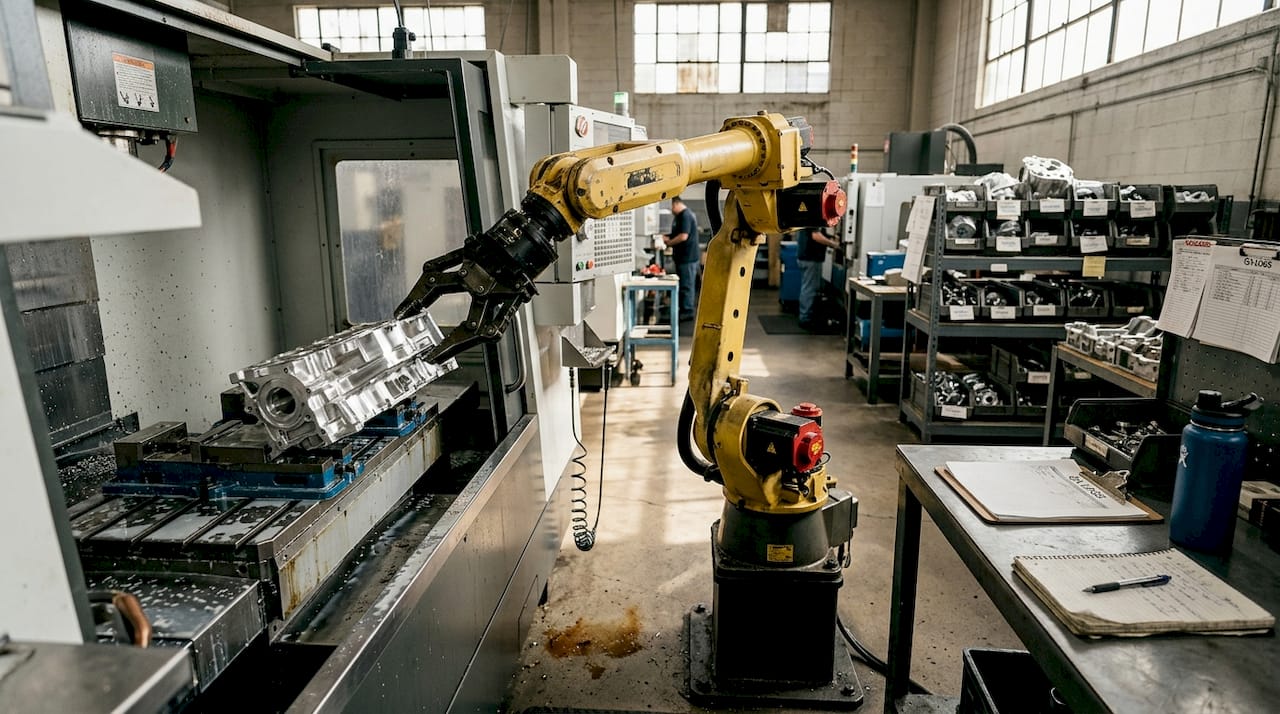
| Metric | Automated machining | Traditional machining |
|---|---|---|
| Cycle time | Up to 51.5% faster | Baseline |
| Output capacity | Up to 850% increase | Limited by operator hours |
| Part-to-part consistency | Very high | Operator-dependent |
| Setup time | Higher upfront | Lower for short runs |
| Changeover flexibility | Lower (best for stable runs) | Higher for varied jobs |
| Surface finish capability | Ra 0.11 µm achievable | Ra 0.4 µm typical |
| Floor space efficiency | High (more output per sq ft) | Moderate |
| ROI timeline | 12 to 24 months at volume | Immediate, lower ceiling |
Automated machining excels in throughput and precision but requires higher initial setup and process stability. That’s the honest tradeoff.
Where automation clearly leads:
- High-volume runs with stable part designs
- Tight tolerance components for aerospace, defense, or firearms
- Multi-shift operations where labor costs compound
- Programs requiring optimizing high-volume workflow across multiple part families
Where traditional machining still holds its own:
- Prototype runs of fewer than 500 parts
- Highly varied custom jobs with frequent geometry changes
- Emergency repairs or one-off replacement parts
Edge cases to watch: Full automation amplifies process instability. If your raw material has inconsistent hardness or your fixturing isn’t dialed in, automated systems will produce bad parts faster than manual ones. Maintenance downtime also hits harder when one cell feeds an entire line. Studying high-volume manufacturing examples from comparable industries can help you anticipate these failure modes before they cost you.
When and how to implement automated machining
Knowing automation is right for your operation is one thing. Rolling it out without disrupting current production is another challenge entirely.
Start with an automation-readiness checklist. Before you commit capital, confirm these conditions:
- You have at least one part family running 10,000 or more units annually
- Part designs are stable with no major engineering changes expected in the next 18 months
- Your current scrap rate or cycle time is measurably hurting delivery performance
- You have or can hire operators capable of CNC programming and process monitoring
- Your facility can support the power, coolant, and safety infrastructure required
Use a phased rollout. Don’t automate everything at once. Pilot one cell, one part family, one shift. Measure cycle time, scrap rate, and uptime. Fix what breaks. Then scale.
The multi-axis automation guide from Machining Technologies walks through how phased implementation works in practice for complex aerospace and defense components.
Manage the real risks. High initial setup and process instability are amplified with automation. Preventive maintenance schedules, operator training programs, and robust process documentation are not optional extras. They’re what separates a successful automation program from an expensive mistake.
Pro Tip: Build your AI surface finish optimization and safety interlocks into the initial cell design, not as afterthoughts. Retrofitting these systems costs two to three times more than designing them in from the start.
Why many OEMs underestimate the true value of automation
Here’s a perspective that most automation conversations skip: the biggest barrier to adoption isn’t budget. It’s measurement.
Most procurement and operations teams evaluate automation purely on cost-per-part or cycle time. Those are valid metrics, but they miss the larger picture. Automation creates process discipline. When you’re running a cell that produces 20 million parts a year, every variable must be controlled and documented. That discipline generates data. That data enables continuous improvement. And that improvement compounds over years in ways that a simple payback model never captures.
The companies that think beyond cost-per-part start seeing automation as an operational transformation, not a capital purchase. They gain agility. Their teams develop deeper process knowledge. Their quality systems get tighter because the data forces accountability.
Firms that focus only on the upfront number often stall at the pilot stage, never realizing that the real return shows up in year three and four, in fewer customer escapes, faster new program launches, and a workforce that’s genuinely skilled rather than just present.
The shift from treating machines as individual tools to running them as an integrated, data-connected system is where the strategic advantage lives. That’s not a cost conversation. It’s a competitive positioning conversation.
Explore advanced automated machining solutions
For OEM executives and procurement officers ready to move from evaluation to execution, the right partner makes the difference between a successful automation program and a costly detour.
At Machining Technologies LLC, we’ve been producing precision components since 1985 from our 70,000 square foot facility in Webster, Massachusetts. We run Hydromat systems, multi-axis CNC, and wire EDM at scale, producing over 20 million parts annually for aerospace, defense, firearms, and industrial machinery customers. If you’re evaluating contract machining benefits for your next high-volume program, or need a partner capable of complex part manufacturing with tight tolerances and reliable delivery, explore our precision parts manufacturing capabilities and connect with our team.
Frequently asked questions
What types of components benefit most from automated machining?
High-volume, precision OEM components with repeatable designs see the greatest gains, particularly multi-feature parts requiring tight tolerances across large production runs.
How quickly can OEMs expect ROI from automation?
Many programs achieve ROI in under two years when 51.5% cycle time reductions and labor reallocation are fully realized, though payback timelines vary by part complexity and volume.
What are the main risks of implementing machining automation?
Upfront investment and process instability are the top risks; both are manageable with preventive maintenance programs, operator upskilling, and a disciplined phased rollout.
Can automation improve part surface finish?
Yes. AI-optimized systems achieve Ra 0.11 µm surface finishes, which meets the requirements for demanding aerospace and defense applications that manual machining typically cannot reach.