


AS9100 Rev D requires you to maintain and retain “documented information” mapped to specific clauses, not a fixed binder of documents and records the way older revisions implied. AS9100 Rev D, built on ISO 9001:2015 with aerospace-specific additions, replaced the old “documents/records” split with one unified term, and IAQG guidance makes clear there’s no universal checklist that fits every organization. A contract manufacturer like Machiningtechllc, running high-volume Hydromat and CNC operations, needs a different documentation footprint than a two-person engineering shop, even though both answer to the same clauses.
Before you touch a single procedure template, confirm you have:
- Mandatory documented information you must maintain (clauses 4.3, 4.4.2, 5.2, 6.2, and others)
- Mandatory retained records proving processes ran as planned (clauses 7.2, 8.x, 9.x, 10.2)
- Clause 7.5 controls covering how information gets created, updated, distributed, and protected from unintended obsolete use
- An audit checklist cross-referencing each clause against physical or electronic evidence you can pull in under five minutes
Key Takeaways
AS9100 Rev D succeeds when documented information is sized to your organization’s actual complexity and mapped tightly to clause requirements rather than padded for appearances.
| Point | Details |
|---|---|
| Documented information replaces documents/records | AS9100 Rev D uses one term covering both maintained documents and retained records, controlled under clause 7.5. |
| Several specific mandatory documented information items exist | Scope, process interactions, quality policy, objectives, supplier control, nonconforming product, and corrective action procedures are required. |
| Records prove execution | Internal audit, management review, corrective action, competence, and calibration records carry the most audit weight. |
| Extent depends on context | IAQG guidance ties documentation volume to organization size, complexity, and competence, not a fixed template. |
| High-risk areas deserve priority | Nonconformity, supplier control, traceability, and FAI generate the most audit findings and need the clearest evidence. |
Table of Contents
- What Documents Does AS9100 Rev D Require?
- Which Records Does AS9100 Rev D Require You to Keep?
- What Counts as “Documented Information” Under Clause 7.5?
- What Documents Aren’t Required But Are Worth Keeping?
- How Do You Decide How Much to Document?
- Audit Checklist: Verifying Your AS9100 Documentation
- What I’ve Learned About What Actually Works
- Standards and Resources Worth Bookmarking
- Frequently Asked Questions About AS9100 Documentation Requirements
- Sources
What Documents Does AS9100 Rev D Require?
AS9100 Rev D mandates a shorter list of documented information than most quality managers expect. The standard doesn’t demand a quality manual, a set of numbered procedures, or a particular file format. It demands specific pieces of information exist, get maintained, and stay under control per clause 7.5.
Here’s the clause-mapped list of what you must maintain:
- Scope of the QMS — clause 4.3, including justification for any exclusions
- Description of QMS processes and their interactions, along with a general description of relevant interested parties — clause 4.4.2
- Quality policy — clause 5.2, communicated and understood across the organization
- Quality objectives and the planning to achieve them — clause 6.2
- Procedures for control of externally provided processes, products, and services — clause 8.4.1
- Criteria for nonconforming product control and the process for disposition — clause 8.7.1
- The nonconformity and corrective action process — clause 10.2.1
Several items are conditional. You only need design and development documentation under clause 8.3 if you actually design products. First Article Inspection documentation under 8.5.1 only applies if your contracts or customer specifications call for FAI. Calibration procedures under 7.1.5 apply if you use measuring equipment to verify conformity, which covers nearly every machining operation but not every administrative function. Traceability documentation under 8.5.2 kicks in when your customer, regulatory body, or your own risk assessment requires it, which is standard practice for aerospace and defense parts but not universal across every industry AS9100 touches.
Format flexibility is where a lot of quality managers waste time worrying. Advisera’s mandatory documents breakdown confirms the standard doesn’t care whether your QMS scope lives in a bound quality manual, a single-page PDF, an intranet page, or a folder inside your document management system. What matters is that the information exists, stays current, and is controlled the way clause 7.5 requires. A single-source QMS map that shows how your processes interact often satisfies clause 4.4.2 more efficiently than five separate flowcharts nobody updates.
Auditors reviewing a machining or contract manufacturing operation tend to look for one thing first: does the documentation match what’s actually happening on the shop floor? A quality manual describing a process your operators haven’t followed in two years is worse than no quality manual at all, because it signals your document control system isn’t catching drift. This is where AS9100 Rev D documentation guidance is blunt: a lean, accurate manual beats an exhaustive, outdated one every time.
Pro Tip: Auditors often ask to see your QMS scope and process interaction map within the first hour of a stage 2 audit. Keep both on a single page or single screen you can pull up instantly. If it takes you longer than a minute to locate your own scope statement, that’s a finding waiting to happen.
Machining organizations handling externally provided processes, such as outsourced heat treat or plating, need clause 8.4.1 documentation that specifies evaluation criteria for suppliers and the controls applied to purchased product. If your operation resembles Machiningtechllc’s model of high-volume production with tight tolerances across varied materials, this document tends to grow fast because supplier qualification and reevaluation criteria multiply with every new material or process you outsource. Structuring it as a living matrix rather than narrative text keeps it manageable as your supplier base changes.
Which Records Does AS9100 Rev D Require You to Keep?
Records are the retained half of documented information, the evidence that proves your processes actually happened the way your documents say they should. Auditors weight records heavily because a procedure describes intent, but a record proves execution.
The core mandatory records, per the complete mandatory documents list, include:
- Internal audit program results — clause 9.2.2
- Management review outputs — clause 9.3, typically meeting minutes with decisions and action items
- Records of corrective actions, including root cause analysis and effectiveness verification — clause 10.2
- Evidence of employee competence, including education, training, skills, and experience — clause 7.2
- Monitoring and measurement equipment calibration records — clause 7.1.5
Conditional records apply based on what your organization actually does. If you design products, clause 8.3.x requires design review, verification, and validation records. If your contracts require it, clause 8.5.2 traceability records must show the chain of custody for materials and components, which for aerospace and defense parts usually means lot-level or serial-level tracking through every operation. If First Article Inspection applies under clause 8.5.1, most organizations use SAE AS9102 format reports, and auditors expect that documentation to exist for every new part number, engineering change, or supplier transfer that triggers a new FAI, according to guidance on what AS9102 covers.
Acceptable evidence varies by record type but auditors generally want something dated, attributable to a specific person or role, and either signed or system-locked against alteration. Signed management review minutes work. A DMS audit trail showing who approved a procedure revision and when works. A calibration label on a gauge with a due date works, provided it ties back to a calibration record showing the actual measurement results, not just a pass/fail stamp.
| Clause | Record Type | Typical Location |
|---|---|---|
| 9.2.2 | Internal audit reports and findings | DMS audit folder or internal audit binder |
| 9.3 | Management review minutes and actions | DMS or quality department shared drive |
| 10.2 | Corrective action records with root cause | CAPA tracking system or DMS |
| 7.2 | Training and competence records | HR/training records system |
| 7.1.5 | Calibration certificates and schedules | Calibration management software or gauge log |
| 8.5.1 | FAI reports (AS9102 format where applicable) | Production quality file or DMS project folder |
| 8.5.2 | Traceability and lot/serial records | ERP system or traveler/router documentation |
If you want to see how this plays out on a production floor, methods aerospace OEMs use to verify machined part quality shows how inspection data and traceability records get captured at the point of manufacture rather than reconstructed after the fact, which is exactly what auditors want to see.

What Counts as “Documented Information” Under Clause 7.5?
“Documented information” is the term AS9100 Rev D uses in place of the old “documents” and “records” split, and it means information required by the standard or information your organization has decided is necessary to trust that a process ran as planned. AS9100 Rev D’s documentation guidance treats the two former categories as a single continuum: some documented information you maintain and keep current (like a procedure), and some you retain as evidence after the fact (like a record). Same term, different lifecycle.
Clause 7.5 sets the control requirements that apply regardless of which lifecycle stage the information is in:
- Identification and description — a title, date, author, or reference number so it can be located and distinguished
- Format and media — language, software version, graphics, paper or electronic, chosen to fit the use
- Review and approval — for suitability and adequacy before release
- Distribution and access — the right people can get to it, and unauthorized people can’t alter it
- Storage and preservation — legible and protected against damage or loss
- Control of changes — a defined revision process with version history
- Retention and disposition — how long you keep it and how you dispose of it
Electronic systems handle most of these controls automatically once configured correctly. A document management system with version locking, role-based access, and a built-in audit trail satisfies identification, distribution, and change control in one package. Paper-based control still works but demands more manual discipline: stamped “controlled copy” masters, a distribution log, and a physical process for pulling obsolete revisions before they reach the shop floor. Operations running CNC automation for aerospace manufacturing tend to lean electronic because automated data capture already generates timestamped records as a byproduct of production, reducing the manual burden of proving control.
Pro Tip: During an on-site audit, expect the auditor to pull a random procedure, ask who approved the current revision, and ask you to produce the previous revision to confirm it’s marked obsolete and inaccessible on the floor. If you can’t produce both in under two minutes, your clause 7.5 control has a gap.
What Documents Aren’t Required But Are Worth Keeping?
AS9100 Rev D dropped several mandatory procedures that older revisions required by name, but most aerospace organizations keep equivalent documents anyway because they reduce audit friction and training time. None of the following are mandatory, yet nearly every certified supplier maintains some version of them.
A quality manual tops the list. It’s optional under Rev D, but a lean, single-source reference for scope, process interaction, and assigned authorities makes life easier for auditors and new employees alike. Documented procedures for risk management, supplier control beyond the minimum clause 8.4.1 requirement, and configuration management also show up constantly, especially in organizations juggling engineering changes across multiple customer programs. Work instructions at the operator level and process flow diagrams round out the common set, giving shop floor personnel something more specific than a high-level procedure to follow at the machine.
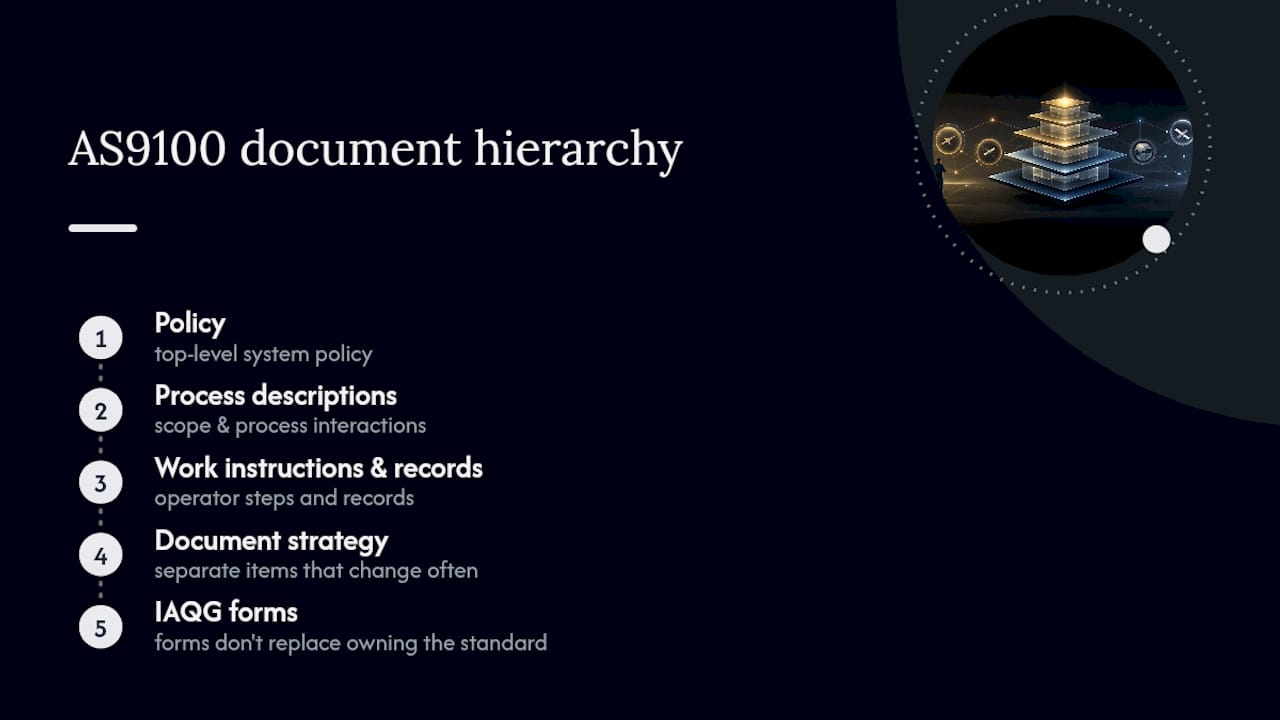
Why keep documents nobody requires? Consistency across shifts, faster onboarding for new hires, clearer expectations for suppliers you’re qualifying, and a smoother experience when a customer auditor shows up unannounced. Structuring AS9100 documentation around a hierarchy, policy at the top, process descriptions in the middle, work instructions and records at the bottom, keeps the relationship between documents clear even as the total volume grows.
Deciding when to merge versus split documents comes down to who uses them and how often they change. A work instruction that only one machine operator references daily should stay separate from a broader process description that a supervisor reviews quarterly, because merging them means every minor tweak to the specific instruction triggers a full review cycle for the whole document.
If you use IAQG-provided forms or templates to speed up implementation, know that convenience carries an obligation. IAQG’s forms management page is explicit that using its forms doesn’t substitute for owning the relevant standard, and auditors can flag a gap between form use and standard ownership as a nonconformance.
How Do You Decide How Much to Document?
IAQG’s own guidance rejects a one-size-fits-all document package. The extent of your documented information should track your organization’s context, size, process complexity, and personnel competence, according to the 9100:2016 overview. A five-person engineering firm subcontracting design work needs less documented information than a 70,000-square-foot facility running Hydromat systems across millions of parts annually, even though both answer to the identical clause numbers.
A practical six-step approach works for most organizations sizing their documentation for the first time or cleaning up an over-documented legacy system:
- Identify which clauses apply to your scope, including conditional ones like design, FAI, and traceability.
- Map your actual processes as they run today, not as a five-year-old procedure describes them.
- Capture the minimum documented information needed to prove each process runs as planned.
- Select your storage and control method, electronic DMS or controlled paper, based on your team’s size and technical capacity.
- Assign document owners and a review cadence so nothing goes stale without someone noticing.
- Sample your own evidence before an external audit finds the gaps for you.
A small supplier machining a handful of part numbers for one customer program might satisfy every mandatory clause with a ten-page manual, a supplier evaluation spreadsheet, and a shared drive of calibration records. An OEM or prime running dozens of programs across multiple facilities needs the same clauses covered but with configuration management, multi-site traceability, and a formal document hierarchy layered underneath. The clause numbers don’t change; the volume and structure supporting them does. Aerospace machining best practices illustrate how process validation and work instruction discipline scale with production volume without duplicating effort across similar part families.
Pro Tip: Prioritize documentation depth around your highest-risk processes first: nonconformity and corrective action, supplier control, traceability, and FAI. These four areas generate more audit findings than any other documentation category, so they deserve your first pass before you polish lower-risk procedures.
Compliance frameworks that intersect IT and quality systems are worth reviewing too, particularly as more documented information moves into electronic systems; a broader look at aerospace compliance covers how organizations are structuring governance around digital records.
Audit Checklist: Verifying Your AS9100 Documentation
Run this sequence during an internal audit or a pre-certification readiness review, before an external auditor runs it for you.
- Confirm each mandatory documented information item exists and maps to its clause (4.3, 4.4.2, 5.2, 6.2, 8.4.1, 8.7.1, 10.2.1).
- Verify every document shows evidence of review and approval, with a visible revision date and owner.
- Check your DMS or paper control system for version history and confirm obsolete revisions are inaccessible on the floor.
- Pull retained records for internal audits, management review, corrective actions, and competence, and confirm they’re legible and dated.
- Where design, FAI, or traceability clauses apply, confirm evidence exists and matches the AS9102 FAI format where required.
Have your quality manual or QMS map, your last three internal audit reports, your most recent management review minutes, and your calibration log ready in one folder before the auditor arrives. Retrieval speed matters as much as content accuracy; a document nobody can find in under a minute reads as a control failure even when the document itself is perfect.
What I’ve Learned About What Actually Works
The organizations that struggle most with AS9100 documentation aren’t the ones with too little. They’re the ones with too much, procedures nobody reads, forms nobody fills out consistently, and a quality manual that describes a process the shop floor abandoned two revisions ago. A centralized, accurate QMS description that operators and auditors can both navigate quickly beats an exhaustive library every time.
Scale changes the calculus, but not the principle. Machiningtechllc’s production volume, tight tolerances, and multi-material capability demand more traceability and calibration records than a small job shop, yet the same rule applies: documentation earns its place by matching what’s happening on the floor, not by existing for its own sake.
Precise documentation and precise machining depend on the same discipline: knowing exactly what evidence proves a part or a process met its requirement. If your supplier’s quality system can’t produce that evidence on demand, the parts underneath it are a bigger risk than the paperwork. Machiningtechllc’s services pair AS9100-aligned quality controls with high-volume Hydromat, CNC milling and turning, and Wire EDM capability, backed by traceability and inspection records built into production rather than reconstructed for an audit. Organizations weighing a supplier switch or a new production partner can review contract machining benefits for OEMs to see how documentation discipline translates into faster, more reliable turnaround.
Standards and Resources Worth Bookmarking
Keep the primary standard and its supporting forms within reach rather than relying on secondhand summaries when clause language gets disputed during an audit.
- The AS9100 Rev D standard text itself, for exact clause wording and numbering
- IAQG’s forms and templates for audit and reporting convenience
- SAE AS9102, referenced for First Article Inspection reporting
- A downloadable mandatory documents checklist to cross-check your own list
One caution worth repeating: using IAQG or AS9102-style forms without owning the underlying standard is a documented nonconformance risk, not a shortcut.
Frequently Asked Questions About AS9100 Documentation Requirements
Does AS9100 Rev D require a quality manual?
No. A quality manual isn’t mandatory under AS9100 Rev D, though most organizations keep a lean version because it centralizes scope, process interaction, and authority assignments in one place auditors can review quickly.
What’s the difference between AS9100 documentation requirements and ISO 9001?
AS9100 Rev D builds directly on ISO 9001:2015 but adds aerospace-specific requirements around configuration management, production transfer control, and stricter supplier and nonconformity controls, so your documented information needs to cover those additions where they apply.
How long do you need to retain AS9100 records?
The standard doesn’t set a universal retention period; your organization defines retention times for each record type under clause 7.5, often driven by customer contract requirements or program length for traceability and FAI records specifically.
What’s the most common documentation finding during AS9100 audits?
Auditors frequently flag documentation that doesn’t match actual shop floor practice, along with gaps in FAI evidence, supplier evaluation records, and corrective action effectiveness verification.
Can small suppliers use the same AS9100 documentation checklist as large OEMs?
Yes, the clause requirements are identical regardless of size, but a small supplier typically satisfies them with far less document volume than a large OEM running multiple programs and facilities.
Sources
- Mandatory Documents for AS9100 Rev D – The Complete List
- 9100:2016 overview (IAQG)
- AS9100 Rev D Documentation Requirements
- IAQG Forms Management – IAQG
- What is AS9102 (First Article Inspection)?
Recommended
- Manufacturing Quality Assurance Checklist for Pros | Machining Technologies
- How to verify machined part quality: methods for aerospace OEMs | Machining Technologies
- Achieve Consistent Quality Assurance in Firearms Parts | Machining Technologies
- A Quality Assurance Process Guide for Precision Machining | Machining Technologies