

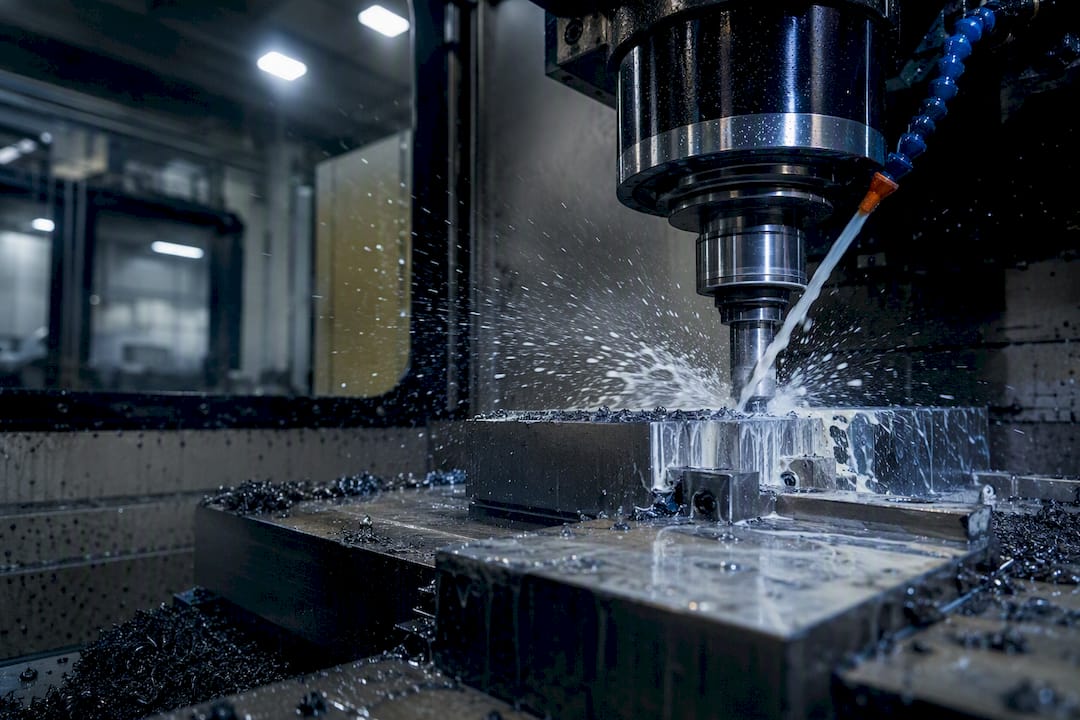
Machine D2 tool steel in the annealed condition whenever possible, then finish after hardening with CBN or ceramic tooling, or grinding, rather than trying to hog material out of an already-hardened blank. The single biggest failure mode is dwell: letting a tool ride against the surface instead of cutting cleanly, which work-hardens D2’s chromium carbides, and destroys inserts fast. Stay rigid, keep chip load constant, and flood the cut with coolant on carbide operations.
TL;DR:
- Machining D2 steel should be done in the annealed condition, using grinding or CBN tools after hardening to avoid work-hardening and tool failure.
- Cutting parameters must be conservative, with slower speeds and feeds than standard steels, and coolant flow is critical to prevent thermal damage.
- Use coated carbide, alumina, or PCBN tooling depending on the condition, and keep tool geometry conservative with modest corner radii and proper chip breakers.
- Follow a strict machining sequence: verify receipt condition, rough to near-net size, stress relieve, harden and temper, then finish to specification to maintain accuracy.
- Managing heat, chip load, and avoiding dwell is essential, as work-hardening occurs rapidly when cutting edges rub instead of shear, leading to unexpected tool failure.
Table of Contents
- D2 Tool Steel Machining Speeds and Feeds by Operation
- What Tooling Works Best for D2 Steel
- How to Sequence a D2 Machining Job
- Turning, Milling, Drilling, and Grinding Strategy
- Why D2 Work-Hardens and How to Stop It
- Hard Turning vs Grinding for Finished D2 Parts
- Shop Notes From the Machining Technologies Floor
- Get D2 Parts Machined Right the First Time
- Sources
D2 Tool Steel Machining Speeds and Feeds by Operation
D2’s chromium carbide structure gives it a lower machinability rating than standard alloy steels, which is why the recommended machining parameters are slower than those used for steels like 4140 or 1018. These are starting points for rigid setups with sharp tooling and good coolant flow, not ceiling values to push toward.
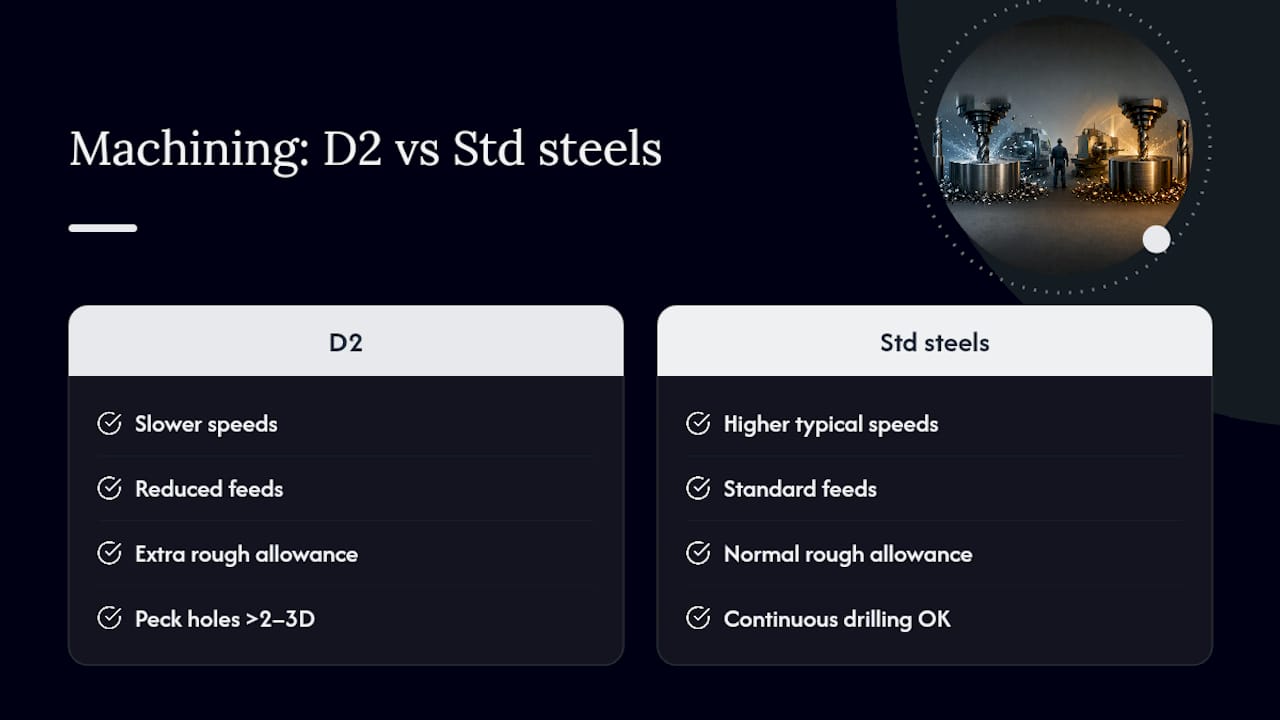
The machining data sheet for D2 lists reduced machinability across the board in the annealed state, which is the entire reason for building rough allowance into your process before anyone touches a heat-treat oven. Drilling sits closer to the turning roughing numbers, but expect to peck rather than run continuous feed on holes deeper than two or three diameters.
What Tooling Works Best for D2 Steel
Substrate choice matters more on D2 than on almost any other tool steel because the chromium carbides in its microstructure are harder than most carbide binders at cutting temperature. Once the cut zone climbs past roughly 600°C, the carbide matrix starts to soften and flank wear accelerates, sometimes three to five times faster than on a plain carbon steel under the same conditions.
- Annealed D2: submicron-grain carbide with a TiAlN or AlCrN PVD coating handles the abrasive carbides without chipping on interruption.
- Hardened D2 (58 to 62 HRC): PCBN grades built for high-chromium tool steels hold an edge through hard turning; alumina-based ceramic inserts work for light finishing passes but struggle in interrupted cuts.
- Geometry: keep corner radii modest, match flute count to the chip you’re trying to form, and use chip breakers designed for long, stringy chips on ductile annealed stock.
Pro Tip: Run a slightly worn insert edge test before committing a full production batch to a new coating. D2’s abrasiveness shows up in flank wear within the first few parts, long before it would on a mild steel job, so you’ll know fast whether that grade earns its keep.
How to Sequence a D2 Machining Job
D2 punishes shops that skip steps. The sequence below keeps distortion low and gives you a real shot at hitting final tolerance after hardening.
- Verify condition on receipt. Confirm annealed hardness is within a typical range consistent with D2’s annealed condition before committing a fixture design or program to the material.
- Rough to near-net shape. Machine to within 0.050 to 0.100 inch of final dimension in the annealed state, where D2 cuts far more predictably.
- Leave finishing allowance. Depending on how critical the feature is, hold back 0.020 to 0.050 inch of stock before hardening, per ArcelorMittal’s D2 datasheet.
- Stress relieve. Run a stress-relief cycle between roughing and hardening to pull out machining stresses that would otherwise show up as warpage in the furnace.
- Harden and temper. Vacuum or air harden, then double temper to knock down retained austenite, following the cycles outlined in West Yorkshire Steel’s D2 technical bulletin.
- Finish to size. Hard-turn or grind after hardening, using the allowance you left in step 3.
Turning, Milling, Drilling, and Grinding Strategy
Every operation on D2 comes down to managing heat and abrasion, but the tactics differ enough by process that treating them identically wastes tool life.
- Turning: Stay inside the annealed ranges above for roughing; for hardened finishing, CBN inserts running 100 to 200 SFM with a DOC of 0.005 to 0.025 inch give you a controllable hard-turning process without the setup time grinding demands.
- Milling: Trochoidal toolpaths reduce the amount of time a flute stays buried in the cut, which controls heat buildup on high-carbide steels and is why research on trochoidal milling and tool geometry flags it as a meaningful lever on hardened material. Down-milling generally produces a cleaner shear than up-milling on D2; start feed-per-tooth conservative and increase once you confirm chip color and form look right.
- Drilling: Peck drilling clears chips before they pack and re-cut, and a stub-length drill with a strong point geometry resists walking better than a long, slender one. Keep coolant pressure high at the point.
- Grinding: Match wheel hardness to hardness of the part, dress more often than you would on a mild steel job, and stick to wet grinding. Dry grinding on D2 raises the risk of glazing the wheel or, worse, thermal cracking the surface you just spent an entire heat-treat cycle producing.
Carbide wear on D2 is not gradual the way it is on lower-alloy steels. It tends to hold steady, then fall off a cliff once the coating burns through, so watch part-to-part consistency rather than waiting for visible chipping.
Why D2 Work-Hardens and How to Stop It
D2’s abrasion resistance comes from the same chromium carbides that make it dangerous to your tooling. The moment a cutting edge dwells against the surface instead of shearing through it, that contact zone work-hardens and turns into a harder skin than the rest of the part, which is a documented cause of sudden, unexpected tool failure on D2 and similar tool steels.
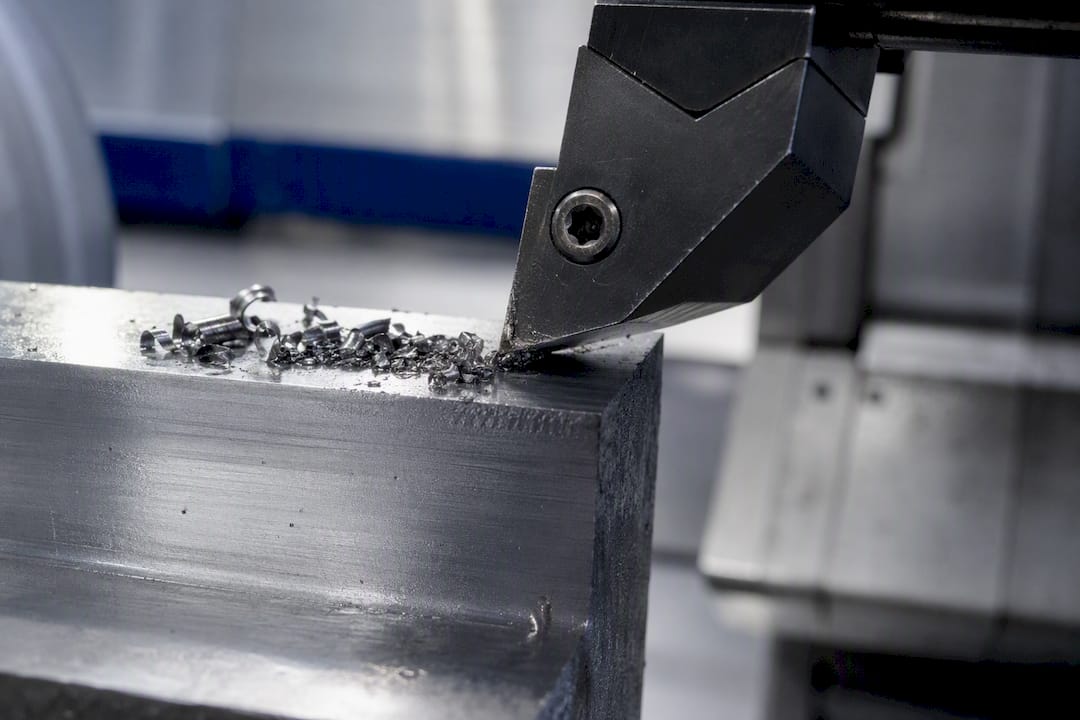
Keep chip load constant across the entire cut. A tool that’s engaged one moment and rubbing the next is building that hardened layer with every pass. Climb milling where geometry allows, run high-flow coolant to clear chips before they re-cut, and pick a flute count that matches your chip evacuation capacity rather than maximizing metal removal rate on paper.
Pro Tip: Burrs on D2 often come from a final pass that’s too light rather than too aggressive. A light climb pass at consistent engagement, followed by a dedicated deburring operation, beats trying to dial burrs out with feed rate alone.
Hard Turning vs Grinding for Finished D2 Parts
Hard turning earns its place on simple rotational geometries where you need to hold a tolerance without tying up a grinder for an hour. Grinding still wins on complex profiles, tight perpendicularity requirements, and anywhere the surface finish spec drops below what a CBN insert can reliably deliver.
- Hard turning with CBN handles straightforward ODs and faces well, typically holding tolerances in the 0.0005 to 0.001 inch range with a workable surface finish.
- CBN inserts generally run dry or with minimal coolant. Flooding a hot CBN edge with coolant risks thermal shock that chips the edge rather than extending its life.
- Grinding wheels for hardened D2 should be dressed on a fixed interval rather than by feel. A dull wheel glazes before it visibly dulls, and glazing is what drives thermal cracking.
- For finishes tighter than a few microinches, or for profiles with internal corners a turning tool can’t reach, grinding remains the more reliable route even though it costs more setup time.
Shop Notes From the Machining Technologies Floor
Production runs on D2 expose problems a single prototype never will. Fixture deflection under roughing loads shows up as dimensional drift only after hardening reveals it, when the fix costs far more than it would have upfront. Building in-house heat treatment into the same high-volume machining workflow that rough-machines the part cuts handling time and keeps dimensional control tighter than shipping parts out between operations. That single change, in Machining Technologies’ experience, is usually what separates a batch that finishes clean from one that comes back for rework.
— Andrew
Get D2 Parts Machined Right the First Time
Machining Technologies is the direct route to production D2 parts without juggling separate vendors for rough machining, heat treatment, and hard finishing. Our shop runs CNC milling and turning alongside CBN grinding capacity and coordinates heat treat directly into the workflow, so a part doesn’t leave the building between stress relief and final finish.

That in-house coordination is what shows up on your delivery schedule. Instead of stacking lead times across three suppliers, your D2 components move through rough machining, stress relief, hardening, and CBN finishing under one roof, backed by high-volume production capabilities built for OEM order sizes. If you have a D2 part that needs to hold tolerance after hardening, request a quote through our contract machining services page and get a straight answer on lead time and cost.
Sources
- Trochoidal milling and tool geometry effects on machining hardened steels
- Machining tool steels (D2, H13, S7): Challenges and approaches | UTEC Industrial
- D2 tool steel datasheet — ArcelorMittal / Industeel
- Steel D2: Machining data sheet (MachiningDoctor)
- D2 tool steel technical bulletin — West Yorkshire Steel
Recommended
- Optimize high-volume machining workflow: aerospace precision | Machining Technologies
- Master Precision Machining Workflow for Firearms Components | Machining Technologies
- What Is DFM in Machining? A Guide for Engineers | Machining Technologies
- Why Part Geometry Impacts Machining: 2026 Guide | Machining Technologies