

TL;DR:
- Machining Technologies LLC offers high-volume, traceable precision machining in a single U.S. facility since 1985. Their full-spectrum services support aerospace, defense, and industrial needs, providing proven process continuity from prototypes to mass production. Verifying current certifications and onsite validation remains essential to ensure reliable supplier performance.
If you need a direct U.S. alternative to mat-tekmfg.com, Machining Technologies LLC is the recommended option for high-volume, traceable precision machining. Operating from a 70,000 sq ft facility in Webster, Massachusetts, with over 20 million parts produced annually since 1985, it covers the full spectrum from prototypes to mass production under ISO 9001-aligned quality systems.
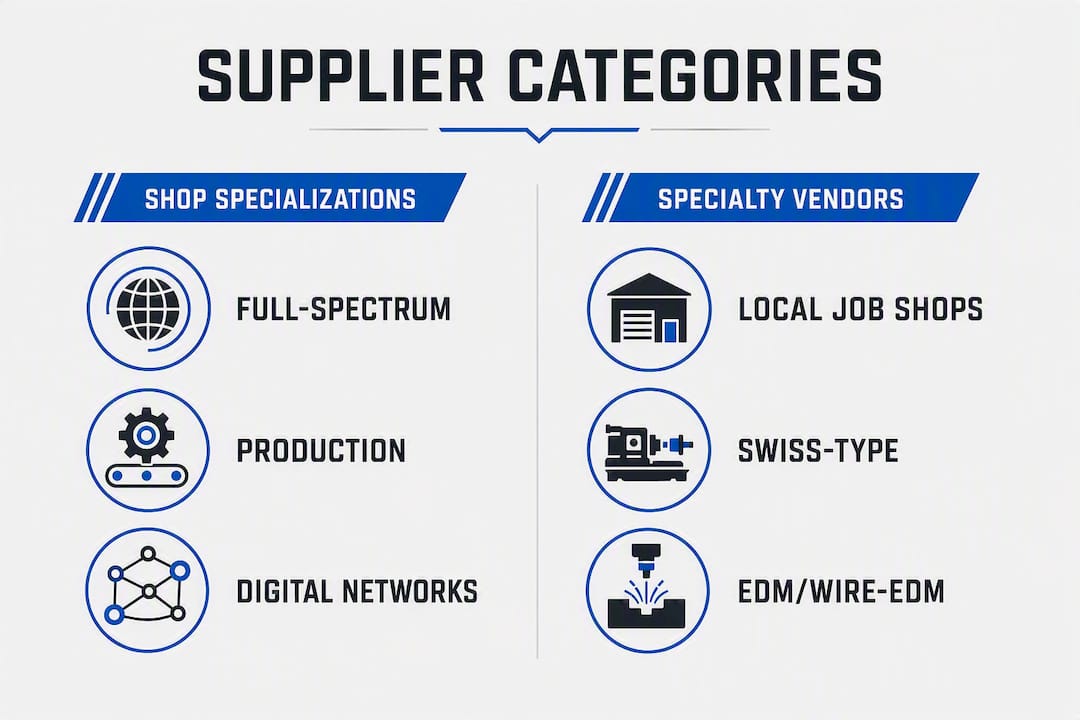
Here is a quick shortlist of supplier categories to match your program:
- Full-spectrum production contract manufacturer (Machining Technologies LLC): Best for OEMs needing Hydromat, CNC milling/turning, and Wire EDM under one roof at high volume. Pick this when traceability and throughput both matter.
- Digital on-demand quoting networks (e.g., Protolabs, Xometry): Fast quotes in 1–7 business days, broad geometry coverage. Best for speed-sensitive prototype or mid-volume work where on-site audit is not required.
- Local job shops for complex NPI: Strong on engineering collaboration and first-article iteration. Pick this when geometry is unusual and you need a project engineer in the room.
- Swiss-type/small-parts specialists: Optimized for high-volume turned parts under 1.25" diameter. Pick this when cycle economics on small-diameter bar stock matter more than mixed-process flexibility.
- EDM/Wire-EDM specialty vendors: Right for exotic alloys, tight-tolerance features, or hardened tool steel where conventional cutting is not viable.
Table of Contents
- How do mat-tekmfg.com alternatives compare across key buying criteria?
- What does each supplier category actually offer?
- How do you vet a precision machining supplier before committing?
- Why Machining Technologies LLC stands out as a recommended U.S. alternative
- Key Takeaways
- What the precision machining market tells us about supplier selection
- Get a production-ready quote from Machining Technologies LLC
- Useful standards and sources for supplier qualification
How do mat-tekmfg.com alternatives compare across key buying criteria?
The table below maps supplier categories against the dimensions procurement teams actually use when switching from Mat-Tek or evaluating similar websites to mat-tekmfg.com.
| Dimension | Full-Spectrum Production CM (Machining Technologies LLC) | Digital On-Demand Network | Local Job Shop | Swiss-Type Specialist | EDM/Wire-EDM Specialist |
|---|---|---|---|---|---|
| Primary capabilities | Hydromat, CNC milling/turning, Wire EDM, secondary ops | CNC milling/turning, sheet metal, injection molding | CNC milling/turning, manual ops, fixturing | Swiss-type turning, small-diameter bar stock | Wire EDM, sinker EDM, hard metals |
| Industries served | Aerospace, defense, firearms, industrial, data center | General industrial, consumer, medical (low-risk) | Mixed; strong in medical NPI, defense prototypes | Medical, electronics, watchmaking, firearms | Aerospace, medical, tooling, mold & die |
| Typical order volume | Prototype → 10,000,000+ | Prototype → ~50,000 | Prototype → ~5,000 | 1,000 → 10,000,000+ | Prototype → ~10,000 |
| Lead time / quoting | Production-scale quoting; rapid turnaround | 1–7 business days online quote | 3–10 days; manual RFQ | 5–14 days; process-dependent | 5–21 days; geometry-dependent |
| Quality systems | ISO 9001, ITAR-capable, full traceability | Varies by network node; ISO 9001 common | ISO 9001 varies; AS9100 rare | ISO 9001; AS9100 in medical-focused shops | ISO 9001; AS9100 in aerospace-focused shops |
| Engineering support / DFM | Full DfM, NPI, process validation on production equipment | Automated DfM feedback; limited human review | High-touch engineering collaboration | Limited DfM; strong process knowledge | Geometry-specific DfM; limited NPI support |
| US presence | Webster, MA (single facility) | Distributed U.S. network | Local/regional | Regional clusters (CA, IL, CT) | Regional; often co-located with tooling shops |
| Pricing model | Per-part contract pricing; volume breaks | Instant per-part quote; marketplace | Per-part RFQ; negotiated | Per-part RFQ; volume-tiered | Per-part RFQ; setup-heavy |
Three use-cases that map cleanly to the table above:
- Prototype fast-turn: A digital on-demand network gets you parts in days with no tooling investment, which suits early design validation before committing to fixtures.
- Mixed-volume NPI: A local job shop with a dedicated project engineer handles geometry iteration well, but verify they hold ISO 9001 before submitting regulated-industry drawings.
- Production-scale high-throughput: Machining Technologies LLC’s Hydromat systems and precision machining services are built for exactly this scenario, where per-part cost, traceability, and on-time delivery at volume are non-negotiable.
What does each supplier category actually offer?
Shop specialization directly impacts lead time and quality. Matching part geometry to shop type is the single fastest way to eliminate misfit suppliers before you spend time on RFQs.
Machining Technologies LLC: full-spectrum production partner
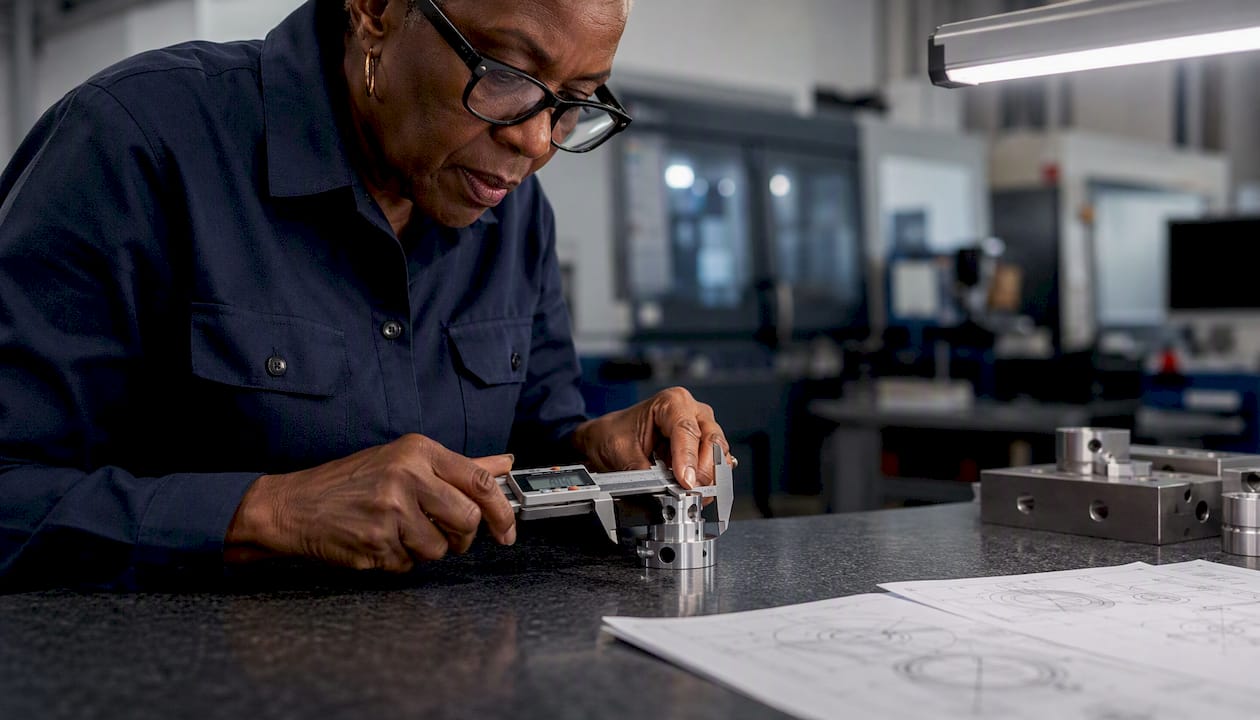
In business since 1985, Machining Technologies LLC runs a 70,000 sq ft facility producing millions of parts per year. Hydromat rotary transfer machining, CNC milling and turning, and Wire EDM operate under one QMS, which means a prototype can be validated on the same equipment that will run production. That matters enormously for aerospace, defense, and firearms programs where first-article inspection (FAI) must reflect actual production conditions.
Pick this when:
- Your program needs prototype-to-volume continuity on identical equipment and fixtures
- You serve aerospace, defense, or firearms and need documented traceability
- Annual volumes exceed tens of thousands of pieces and per-part cost efficiency is a hard requirement
Production-focused contract manufacturers
Larger contract manufacturers serve regulated end markets — medical devices, defense electronics, data center hardware — with validated processes and multi-shift capacity. The U.S. contract manufacturing market favors these providers for high-volume, regulatory-capable programs. They typically carry ISO 9001 and often AS9100 or FDA registration.
Pick this when:
- Your program is regulated (FDA, ITAR) and requires a supplier with an audited QMS
- You need multi-process capability beyond pure machining (assembly, coating, testing)
- Volume justifies a long-term supply agreement
Digital on-demand quoting networks
Platforms like Protolabs, Xometry, and Fictiv quote online in 1–7 business days and route work to a distributed supplier network. Speed is the advantage. The trade-off: buyers sacrificing on-site process validation may face higher audit requirements during qualification for regulated industries. These platforms work well for design-iteration prototypes and mid-volume commercial parts.
Pick this when:
- You need parts in days, not weeks, for design validation
- The program is not regulated and on-site audit is not required
- Geometry is standard (3-axis milling, turning) and tolerances are moderate
Local job shops for complex NPI
A local job shop with a dedicated project engineer is hard to beat during new product introduction when geometry changes frequently. The engineer-to-engineer relationship accelerates DfM feedback. The risk: many job shops lack AS9100 or ITAR registration, so verify certifications before submitting controlled drawings.
Pick this when:
- Design is still evolving and you need rapid iteration cycles
- Part complexity requires hands-on fixturing collaboration
- Volume is low (under 1,000 pieces) and speed of iteration beats per-part cost
Swiss-type and small-parts specialists
Swiss-type turning shops run high-volume, small-diameter bar stock with cycle economics that no general job shop can match. Medical, electronics, and firearms components under 1.25" diameter are natural fits. Tooling investment is front-loaded, so these shops make sense only when volumes justify the setup.
Pick this when:
- Parts are small-diameter turned components in high volumes
- Tight concentricity and surface finish are critical
- You need a supplier with dedicated small-parts inspection capability
EDM and Wire-EDM specialty vendors
Wire EDM cuts hardened steel, exotic alloys, and complex 2D profiles that conventional tooling cannot reach. For wire EDM precision work, Machining Technologies LLC also offers this capability in-house, which eliminates the coordination overhead of a separate specialty vendor. Standalone EDM shops are useful when the entire program is EDM-dominant.
Pick this when:
- Material is hardened tool steel, titanium, or a nickel superalloy
- Feature geometry requires contour cutting without cutting forces
- Tolerances are under ±0.0005"
Pro Tip: Ask any EDM vendor whether they perform in-process CMM checks on wire-cut features. Shops that rely solely on final inspection miss drift that accumulates across a long production run.
How do you vet a precision machining supplier before committing?
The single most important principle: prototype and production must run on the same equipment, fixtures, and QMS. A prototype validated on a different machine than the production run does not prove the production process works. That gap is where most NPI delays originate.
Sequential vetting checklist
- Initial screening: Confirm the shop’s primary process matches your part geometry. Request a capability statement listing machine types, axis count, and material certifications.
- Sample/prototype validation: Submit a first-article request. Specify that the prototype must run on the same equipment and fixtures as the intended production run.
- Production validation (FAI/CMM): Require a First Article Inspection report and CMM dimensional report before approving production release. A DfM review, fixture lock-down, and process-validation run of 50–1,000 pieces should precede full-scale production.
- Contractual terms and IP controls: Confirm ownership of CAM programs, fixtures, and tooling. Verify NDA coverage for controlled drawings.
- Supply continuity checks: Ask about machine redundancy, lead times for raw material, and domestic sourcing. Reshoring incentives and domestic-content thresholds are shifting supplier economics — a shop with U.S.-sourced bar stock is more resilient than one dependent on offshore supply.
Supplier questionnaire (send with your RFQ)
- Do you run prototypes and production on identical equipment and under the same QMS?
- Can you provide FAI and CMM reports for first articles?
- What is your typical quoting turnaround for a turned/milled part at [your geometry]?
- What certifications do you hold: ISO 9001, AS9100, ITAR?
- Who is the named project engineer assigned to our program?
- How do you manage engineering change orders and document traceability?
- What is your machine-tool vintage, and do you run automated inspection in-process?
Red flags to watch for
- Prototype and production run at different facilities or on different equipment
- No named project engineer; account managed only by sales
- Vague traceability answers or no documented FAI practice
- Certifications listed on the website but not available as current certificates on request
- Treating a contract manufacturer as a strategic partner means demanding change-control documentation — a shop that cannot describe its ECO process is a risk
Pro Tip: When validating scale readiness, ask the supplier to walk you through their process-validation run procedure: how fixtures are locked down, how CAM programs are version-controlled, and how they document the transition from prototype to production. A shop that cannot answer this in detail has not done it consistently.
Why Machining Technologies LLC stands out as a recommended U.S. alternative
Machining Technologies LLC is a recommended alternative for buyers who need U.S.-based, high-throughput, traceable precision machining from prototypes through mass production. The evidence is specific: in business since 1985, 70,000 sq ft facility, over 20 million parts produced annually, with Hydromat rotary transfer, CNC milling and turning, and Wire EDM all operating under one roof in Webster, Massachusetts.
Facility throughput: Machining Technologies LLC produces over 20 million precision parts per year from a single 70,000 sq ft facility — a throughput level that supports OEM programs requiring consistent per-part cost, tight tolerances, and documented traceability at scale.
That scale translates into three practical buyer benefits. First, you reduce supplier count: one facility covers prototyping, process validation, and full production without handoffs between shops. Second, NPI-to-volume transition is faster because the same equipment, fixtures, and QMS handle both phases. Third, traceability is consolidated — one audit, one quality contact, one certificate of conformance chain.
Machining Technologies LLC serves aerospace, defense, firearms, and industrial machinery customers. For firearms programs specifically, the shop’s precision machining workflow covers the tight-tolerance and compliance requirements that general job shops often cannot meet.
For buyers evaluating top contract machining providers, Machining Technologies LLC’s combination of throughput, process continuity, and multi-process capability under one QMS is a strong argument for consolidating your supply base here.
Key Takeaways
For industrial buyers evaluating mat-tekmfg.com alternatives, the fastest path to a reliable U.S. supplier is matching shop specialization to part geometry, then demanding FAI and CMM documentation before production release.
| Point | Details |
|---|---|
| Match specialization first | Align part geometry and volume to shop type before issuing an RFQ — mismatched shops waste weeks. |
| Prototype on production equipment | Require that first articles run on the same machine, fixtures, and QMS as the production run. |
| Demand FAI and CMM reports | No production release without a documented First Article Inspection and CMM dimensional report. |
| Verify certifications in writing | Request current ISO 9001, AS9100, or ITAR certificates — not just website claims. |
| Machining Technologies LLC | Recommended for high-volume, traceable U.S. precision machining with Hydromat, CNC, and Wire EDM under one roof since 1985. |
What the precision machining market tells us about supplier selection
The precision manufacturing market is bifurcating: shops aligned to resilient end markets — medical, aerospace, data centers — and those with deep technical capability are pulling away from generalist competitors on both valuation and reliability. That trend has a direct implication for procurement teams. Choosing a supplier purely on quoted price, without verifying technical depth and market focus, increasingly means choosing a shop that is under margin pressure and cutting corners on inspection or process validation.
From our experience, matching shop specialization to part geometry prevents the majority of NPI delays. The shops that struggle with scale-up are almost always the ones that ran prototypes on a different machine than production, or that lacked a named project engineer to own the transition. Quality systems and process validation are not paperwork exercises — they are the mechanism by which a supplier proves it can repeat what it demonstrated in the first article.
Get a production-ready quote from Machining Technologies LLC
Machining Technologies LLC delivers what most mat manufacturing site options cannot: a single U.S. facility that takes your program from prototype through 20 million parts per year, with Hydromat, CNC milling and turning, and Wire EDM all under one traceable QMS. For OEMs that have outgrown job-shop capacity or need a supplier that can hold tolerances at volume, that consolidation cuts lead time, reduces supplier management overhead, and gives you one certificate of conformance chain from first article to production.
Three ways to start: submit drawings for a DfM review and process-validation prototype, request a production-capable quote for your current program, or schedule a plant tour of the Webster, Massachusetts facility. Contact Machining Technologies LLC directly through machiningtechllc.com to get your program evaluated.
Useful standards and sources for supplier qualification
When qualifying any precision machining supplier, these are the standards and documents to verify:
- ISO 9001:2015: The baseline quality management system standard. Request the current certificate with scope statement and expiration date. A certificate more than three years old without a surveillance audit record is a flag.
- AS9100 Rev D: Required for aerospace and defense supply chains. Covers configuration management, risk management, and FOD controls beyond ISO 9001. Verify the certificate scope includes your part type.
- ITAR registration: Mandatory for suppliers handling defense articles under the U.S. Munitions List. Request the DDTC registration number and verify it at the State Department’s online registry.
- First Article Inspection (FAI) per AS9102: Defines what a compliant first-article package must contain, including dimensional reports, material certifications, and functional test results. Ask suppliers which revision they follow.
- CMM dimensional reports: Coordinate Measuring Machine reports provide objective dimensional evidence. Request a sample report from a previous program to assess measurement rigor and GD&T interpretation.
- Machine Shop Services industry analysis: IBISWorld’s U.S. machine shop industry report provides market-size context and competitive landscape data useful for benchmarking supplier scale.
- Precision manufacturing market update: Capstone Partners’ analysis on market bifurcation and which shop types are gaining stability.
- How to select a CNC manufacturing partner: Practical vetting guide covering equipment match, process validation, and DfM staging.
- Choosing a CNC machining partner: Guidance on project management rigor, change control, and traceability requirements.
For each standard, the proof to request is: current certificate (ISO/AS9100), DDTC registration number (ITAR), a completed FAI package from a recent program (AS9102), and in-process CMM reports showing measurement frequency and out-of-tolerance response procedures.
Recommended
- Top 5 Wireproedm.com Alternatives Providers 2026 | Machining Technologies
- Top 5 wirecuttechnologies.com Alternatives 2026 | Machining Technologies
- Best advancededm.ca Alternatives for Contract EDM in 2026 | Machining Technologies
- List of Precision Machining Services for Manufacturers | Machining Technologies