

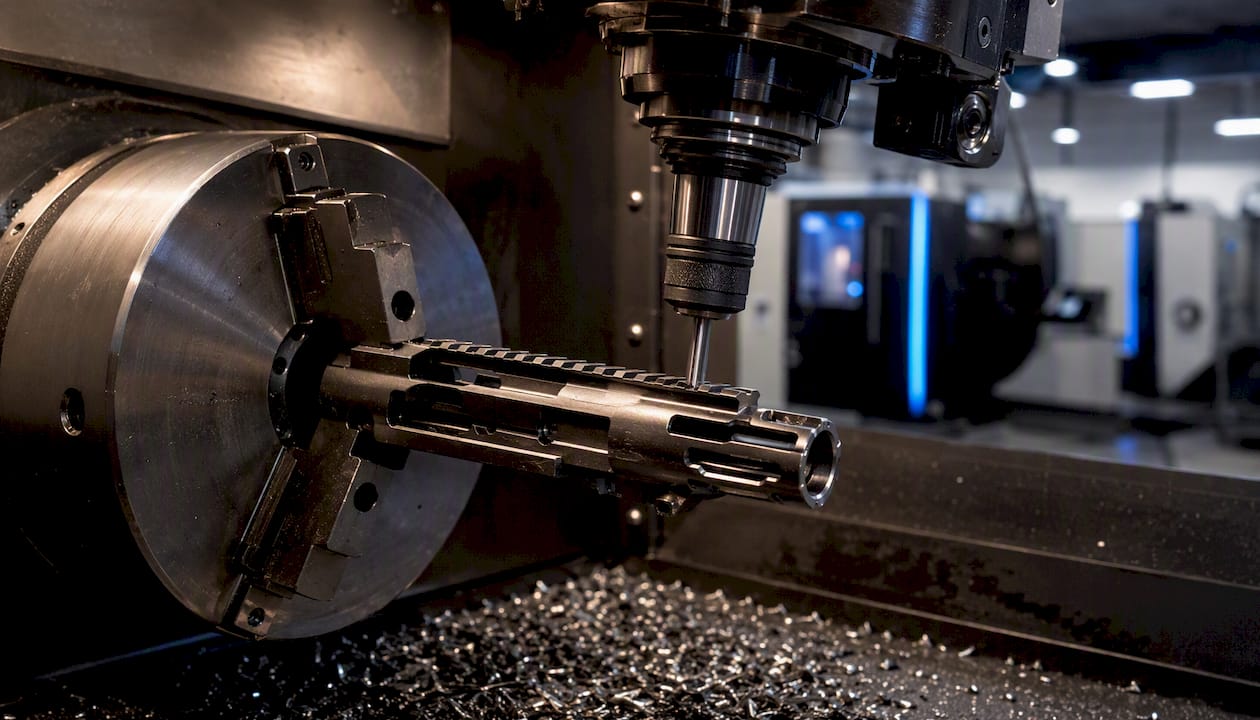
For most firearm components, the short answer on metal selection for gun parts is this: use AISI 4140 or 4340 for barrels, bolts, and high-stress structural parts; AISI 8620 or 9310 for case-hardened cyclic components like bolt carriers and small pins; 6061-T6 or 7075-T6 aluminum for receivers and lowers; and 17-4 PH or 416 stainless where corrosion resistance or sliding wear dominates. Every safety-critical lot should ship with a Mill Test Report (MTR) and reference an applicable AMS or MIL specification.
Quick part-by-part map:
- Barrel: AISI 4140 (general production) or 4150/4340 (higher-pressure, high-cycle); consider nitriding for bore surface hardness
- Bolt and bolt carrier: AISI 8620 or 9310 for case hardening; 4340 for through-hardened high-stress bolts
- Receiver/lower: 7075-T6 aluminum (mil-spec durability) or 6061-T6 (prototype and cost-sensitive builds)
- Firing pin: AISI 4340 or 17-4 PH stainless; quench-and-temper to target hardness
- Extractors and ejectors: 4340 or 17-4 PH; sliding wear and spring-back fatigue are the design drivers
- Springs: High-carbon 1060 or music wire (ASTM A228); fatigue life is the only metric that matters
- Small pins (trigger, hammer, roll pins): 8620 case-hardened or 4140 through-hardened; 1018 for non-load-bearing pins
- Require MTR documentation on every batch; call out AMS 6415 (4340 aircraft-quality bar) or Mil-S-5000 for government and defense programs
Key Takeaways
Choosing the right metal for firearm parts comes down to matching alloy toughness and hardenability to the stress environment of each specific component, then backing every lot with documented traceability.
| Point | Details |
|---|---|
| Match alloy to stress environment | Use 4140/4340 for high-stress structural parts; 8620/9310 for case-hardened cyclic components. |
| Mandate MTRs on every safety-critical lot | Mill Test Reports documenting chemistry, mechanical properties, and heat number are non-negotiable for defense and high-cycle parts. |
| Choose aluminum by application, not cost alone | 6061-T6 suits prototypes and cost-sensitive builds; 7075-T6 is the correct specification for mil-spec receivers and high-round-count use. |
| Specify surface treatment by environment | Hardcoat anodize (Type III, MIL-A-8625) for aluminum wear surfaces; nitriding with controlled white-layer depth for steel sliding surfaces. |
| Machiningtechllc for traceable production | Machiningtechllc handles MTR review, AMS/MIL-spec sourcing, and high-volume firearm component machining from its Webster, Massachusetts facility. |
Table of Contents
- What metal selection for gun parts actually demands from an alloy
- Common alloy steels used in firearm manufacturing
- Stainless steels and aluminum alloys: when corrosion resistance or light weight wins
- Heat treatment and surface processes: what to specify and what to inspect
- Starting forms and manufacturing methods: how they constrain alloy choice
- Part-by-part selection: recommended grades, heat treatments, and specifications
- What to require from your metal supplier: MTRs, AMS/MIL specs, and traceability
- Production notes from a high-volume precision shop
- Why traceability is the real differentiator in firearm production
- Precision firearm component machining at production volume
- Sources
What metal selection for gun parts actually demands from an alloy
Firearm components operate across a wider range of mechanical conditions than most consumer hardware. A barrel sees peak chamber pressures exceeding 60,000 psi on every shot, sustained heat, and abrasive gas flow. A bolt carrier cycles thousands of times under impact loading. An extractor flexes and snaps back with every round. Each condition maps to a different set of material properties, and conflating them is how engineers end up with parts that are either over-engineered and expensive or under-spec and dangerous.
The core properties to evaluate for any firearm component:
- Toughness and impact resistance: Measured by Charpy impact values; critical for bolts, carriers, and any part that absorbs cyclic shock. A high-hardness, low-toughness part will crack rather than deform.
- Hardenability: How deeply a steel responds to quench-and-temper. Thick cross-sections (bolt bodies, barrel blanks) need alloys with sufficient hardenability to reach target hardness at the core, not just the surface.
- Fatigue and wear resistance: Cyclic loading causes fatigue cracks at stress concentrations. Surface hardness (via nitriding or case hardening) extends wear life on sliding surfaces.
- Corrosion resistance: Carbon steels corrode readily without surface treatment. Stainless grades and anodized aluminum resist moisture and salt, which matters for duty weapons and marine environments.
- Machinability: Harder, tougher alloys cost more to machine. For high-volume production, firearm parts machining tolerances and tool life are real cost drivers.
- Density and weight: Aluminum is roughly one-third the density of steel. For receivers and furniture, that difference is felt in every carry.
- Thermal stability: Barrels and suppressors cycle through significant temperature ranges. Alloys that lose hardness at elevated temperatures (low tempering resistance) are a poor fit.
Pro Tip: For any safety-critical part, prioritize validated toughness and hardness over cost savings. A $0.30 savings per part on a cheaper alloy is irrelevant if a single field failure triggers a recall or liability event.
Common alloy steels used in firearm manufacturing
The firearm industry draws from a consistent set of alloys supplied as hot-rolled bar, cold-drawn bar, and forged blanks. Here is the working list, with the engineering rationale for each.
| Alloy | Typical Firearm Use | Key Properties | Heat Treatment Notes | Common Forms |
|---|---|---|---|---|
| AISI 4140 | Barrels, receivers, bolts, structural parts | Balanced toughness, hardenability, machinability | Q&T to 26–34 HRC typical; nitriding compatible | HR bar, CD bar, forgings |
| AISI 4150 | Military-spec barrels | Higher carbon than 4140; better wear at bore | Q&T; commonly nitrided or chrome-lined | HR bar, forgings |
| AISI 4340 | High-stress bolts, firing pins, structural | High toughness + hardenability; AMS 6415 grade available | Q&T to 38–46 HRC for bolts; Charpy tested | HR bar, CD bar, forgings |
| AISI 8620 | Bolt carriers, small cyclic parts, pins | Excellent case-hardening response; tough core | Carburize + Q&T; case depth 0.020–0.040" typical | HR bar, CD bar |
| AISI 9310 | High-cycle carriers, gears, cyclic parts | Higher alloy content than 8620; superior case toughness | Carburize + Q&T; used where 8620 core toughness is marginal | HR bar, forgings |
| — | Lighter structural parts, prototype frames | Lower alloy than 4140; easier to weld | Normalize or Q&T; lower hardness ceiling | HR bar, tube |
| Carbon Steel 1060 | Springs, flat springs, leaf springs | High carbon for spring temper; fatigue-focused | Spring temper; not for structural load | CD bar, strip |
| Carbon Steel 1018 | Non-load-bearing pins, spacers, fixtures | Excellent machinability; low strength | As-machined or case-hardened lightly | CD bar |
AISI 4140 is the industry’s default alloy for good reason. Its combination of fatigue strength, hardness potential, and machinability makes it a flexible choice across barrels, bolts, and receivers. Brinell hardness runs around 197 in the annealed condition before secondary heat treatment, which means it machines cleanly before hardening. AZoM’s materials reference documents its predictable hardenability and cost-effectiveness as the primary reasons it dominates commercial firearm production.
AISI 4340 steps up when toughness and fatigue life are non-negotiable. AMS 6415 defines aircraft-quality requirements for 4340 bar, with tighter limits on non-metallic inclusions and grain size than commercial grades. Defense programs and high-cycle ordnance components commonly call for AMS 6415 material precisely because inclusion-initiated fatigue failures are a real failure mode at high round counts.
AISI 8620 and 9310 are the go-to grades for case-hardened cyclic parts. Both respond well to carburizing, producing a hard, wear-resistant case over a tough, impact-absorbing core. 9310 carries more alloy content and is preferred where the core toughness of 8620 is marginal under sustained impact.
For next-generation barrel applications, Carpenter Technology’s GNB200 alloy family documents higher Charpy impact values at low temperature, improved tempering stability, and targeted yield/tensile strengths intended to outperform legacy chrome-moly steels in barrel life and wear resistance. Engineers specifying premium or high-performance barrels should be aware of it.
Every lot of these alloys should ship with a Mill Test Report documenting chemistry, mechanical properties, and heat number. Purchasing to a nominal grade alone is insufficient for defense or high-cycle parts.
Stainless steels and aluminum alloys: when corrosion resistance or light weight wins
17-4 PH, 416, and 420 stainless
Stainless grades trade some machinability and toughness for corrosion resistance and, in the case of 17-4 PH, a remarkable combination of strength and surface finish retention.
- 17-4 PH (UNS S17400): Precipitation-hardened stainless; can be heat-treated to H900 condition (approximately 190 ksi tensile) or softer H1150 for better toughness. Used for firing pins, extractors, slides, and components in corrosive-duty or marine environments. Machines well in the annealed condition; passivation is standard finishing.
- AISI 416: Free-machining stainless (sulfur addition improves chip breaking); the most machinable stainless grade. Used for bolt bodies, small parts, and components where corrosion resistance matters but extreme toughness does not. Not ideal for high-impact applications.
- AISI 420: Higher carbon than 416; can be hardened to approximately 50–55 HRC. Used for barrels and slides in stainless pistol builds. Corrosion resistance is good but not equal to austenitic grades; passivation or polishing is required.
The tradeoff is cost and machinability. Stainless grades run harder on tooling than 4140, and 17-4 PH in particular requires careful heat-treatment control to hit the right condition. For firearm components exposed to salt, moisture, or outdoor duty, the corrosion resistance justifies the added machining cost.
6061-T6 vs. 7075-T6 for receivers and lowers
This is the most common aluminum decision in firearm manufacturing, and the answer depends on what you are optimizing for.
- 6061-T6: Tensile strength around 45 ksi; excellent machinability, lower tooling wear, and more forgiving for prototype or first-article builds. Anodizes well. The right choice when cost and ease of machining matter more than ultimate strength.
- 7075-T6: Tensile strength roughly 30% higher than 6061-T6 in many references, closer to forged mil-spec receiver performance. Harder on tooling and more notch-sensitive (more brittle at stress concentrations). The standard for production mil-spec lowers and any receiver that will see sustained high-round-count use.
For a prototype or a cost-sensitive commercial lower, 6061-T6 is entirely adequate. For a production mil-spec receiver or any application where the receiver is a structural load path under sustained fire, 7075-T6 is the correct specification.
Pro Tip: Always hardcoat anodize (Type III per MIL-A-8625) aluminum receivers rather than standard Type II anodize. The hardcoat layer adds meaningful wear resistance at wear points like the buffer tube threads and takedown pin holes, where bare aluminum degrades quickly under cycling.
Heat treatment and surface processes: what to specify and what to inspect
Heat treatment is where alloy potential becomes actual part performance. Specifying the alloy without specifying the heat treatment is like ordering steel without a hardness requirement.
Quench and temper
The standard process for martensitic steels (4140, 4150, 4340). The part is austenitized, quenched in oil or polymer, then tempered to the target hardness range. Typical targets:
- Barrels (4140/4150): 26–34 HRC after Q&T, depending on wall thickness and pressure class
- Bolts (4340): 38–46 HRC; Charpy impact testing at the low end of this range is good practice for high-cycle applications
- Firing pins (4340 or 17-4 PH): 40–48 HRC; surface finish and dimensional stability after heat treatment are critical
Nitriding
Nitriding produces a hard, wear-resistant case at low process temperatures (typically 950–1050°F), which minimizes distortion compared to carburizing. The intermetallic compound layer (white layer) depth is commonly specified between 4 and 25 microns, with the diffusion zone beneath providing additional hardness support. Surface hardness can reach very high Vickers values on carbon steels and compatible stainless grades.
Key considerations when specifying nitriding:
- Specify maximum white-layer (compound zone) depth to control brittleness; a thick white layer can spall under impact
- Porosity in the compound zone can be beneficial for oil retention on sliding surfaces (bolt carrier, extractor groove)
- Gas nitriding and plasma (ion) nitriding produce slightly different compound-zone characteristics; confirm which process your supplier uses
- Nitriding is not a substitute for through-hardening on high-stress parts; it is a surface enhancement applied after Q&T
Case hardening (carburizing)
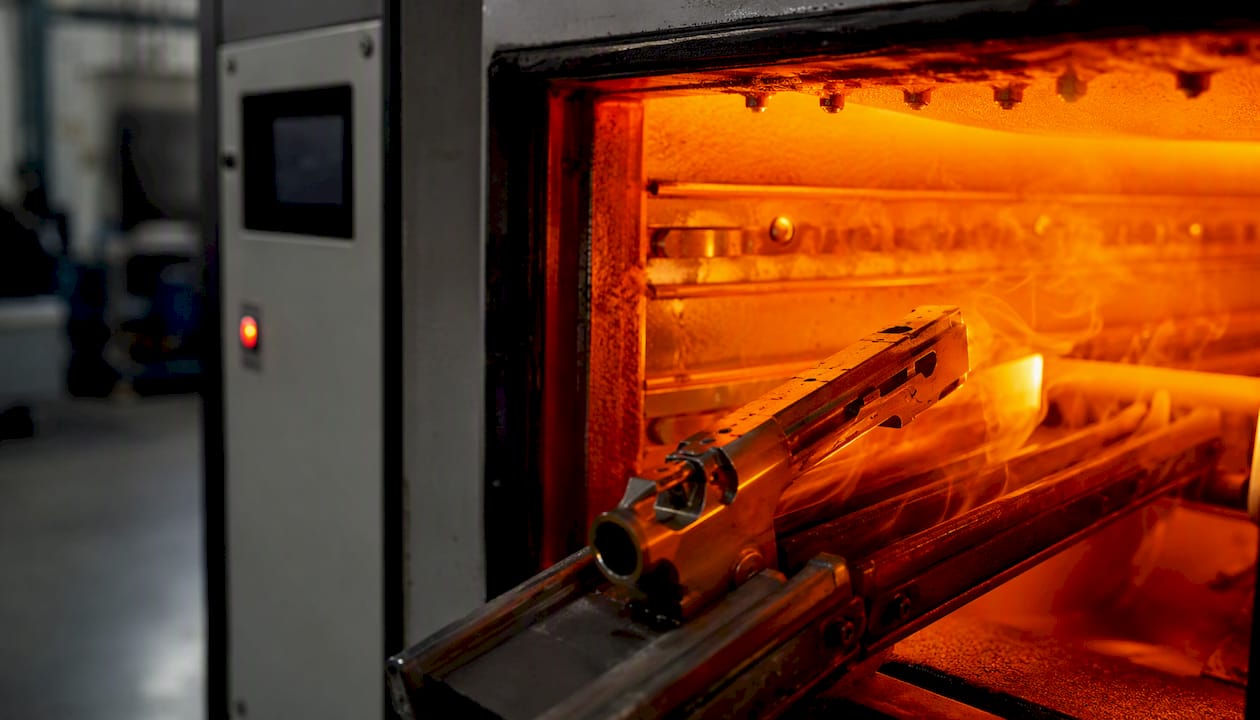
Used for 8620 and 9310 cyclic parts. The part is carburized at elevated temperature to enrich the surface carbon, then quenched and tempered. Typical case depths for firearm cyclic parts run 0.020–0.040 inches. The core remains tough and impact-resistant while the case resists wear.
Black oxide and anodizing
Black oxide (per MIL-DTL-13924) provides minimal corrosion protection on steel parts but is widely used for its appearance and light lubricity. It does not add meaningful dimensional change. Anodizing (Type II or Type III per MIL-A-8625) is the standard finish for aluminum; Type III hardcoat is preferred for wear surfaces.
Starting forms and manufacturing methods: how they constrain alloy choice
The form you start with shapes every downstream machining decision, and it affects which alloys are practical at volume.
- Hot-rolled bar (HR): The most common and lowest-cost starting form. Surface scale requires a cleanup pass; dimensional tolerance is looser than cold-drawn. Works well for most firearm blanks where the first operation is a facing or turning cut.
- Cold-drawn bar (CD): Tighter dimensional tolerance and better surface finish than HR; slight work-hardening at the surface. Preferred for Hydromat and turn-mill operations where bar feed accuracy directly affects part consistency. Commercial firearm-grade steels are available in both forms from major distributors.
- Forged blanks: Near-net shape with refined grain flow aligned to the part geometry. Forgings typically deliver better fatigue life than bar-stock equivalents because the grain flow follows the stress path. The tradeoff is tooling cost and minimum order quantity.
- Billet: Fully machined from a solid block; maximum design flexibility, highest material waste. Used for prototype receivers and low-volume specialty parts.
- Metal Injection Molding (MIM): Used for small, complex shapes (trigger components, small pins, sears) at high volume. Porosity is a concern; parts for safety-critical applications should be specified with density requirements. Not appropriate for high-stress structural parts without HIP.
- Additive manufacturing (AM): Growing use for prototype and low-volume complex geometries. Porosity and anisotropic properties require post-processing (HIP is often specified) before AM parts are used in load-bearing applications.
- Hot Isostatic Pressing (HIP): Applied to MIM and AM parts to close internal porosity and improve mechanical property consistency. Required for any MIM or AM part in a safety-critical load path.
Pro Tip: For high-volume barrel and bolt production, near-net-forged blanks reduce both material waste and distortion during heat treatment compared to machining from full bar stock. The upfront tooling investment pays back quickly above roughly 5,000 pieces per year.
For prototype firearm parts, billet and bar stock give the fastest turnaround and the most flexibility to iterate on geometry before committing to forging tooling.
Part-by-part selection: recommended grades, heat treatments, and specifications
For suppressed firearms, barrel erosion and temperature are higher than standard configurations. Specify 4150 or 4340 over 4140, and consider nitriding with a tighter white-layer specification. High-round-count service rifles benefit from AMS 6415 bolt material and documented Charpy testing at the lower hardness bound.
Where government or defense contracts are involved, mandate AMS 6415 for 4340 components, AMS 2300 for premium cleanliness requirements, and Mil-S-5000 for barrel steel. These specifications are not optional on defense programs; they are the difference between a compliant lot and a rejected shipment.
What to require from your metal supplier: MTRs, AMS/MIL specs, and traceability
Material traceability is where good engineering drawings become safe, manufacturable parts. Purchasing to a nominal grade without documentation is a liability in firearm production.
What to inspect on delivery
- Mill Test Report (MTR): Documents chemistry (heat analysis), mechanical properties (tensile, yield, elongation, reduction of area), and heat number. Every safety-critical lot needs one. Cross-check the chemistry against the specification limits on your drawing before releasing material to production.
- Heat number: Ties the physical material to the MTR. Confirm the heat number on the bar tag or bundle label matches the MTR. Any discrepancy is grounds for rejection.
- Certificate of Conformance (CoC): Supplier’s written statement that the material meets the specified standard. Required in addition to, not instead of, the MTR.
- Hardness verification: For pre-hardened or annealed stock, incoming hardness checks (Rockwell or Brinell) confirm the material is in the expected condition before machining.
- Charpy impact testing: Specify when ordering 4340 for bolts or other high-impact parts. Not standard on commercial MTRs; must be called out explicitly in the purchase order.
Specifications to reference in RFQs and drawings
- AMS 6415: Aircraft-quality 4340 bar; tighter inclusion and grain-size limits than commercial 4340. Mandatory for defense and high-fatigue applications.
- AMS 2300: Premium aircraft-quality cleanliness standard; applied when AMS 6415 alone is insufficient for the fatigue environment.
- Mil-S-5000: Military specification for carbon and alloy steel bars for ordnance use; covers 4140 and related grades for barrel and structural applications.
- ASTM A29: General requirements for carbon and alloy steel bar; the baseline commercial reference.
- ASTM A228: Music wire for springs; the standard fatigue-life reference for small coil springs.
Procurement checklist
- Specify alloy, condition (annealed, normalized, Q&T), and hardness range on the drawing
- Call out the applicable AMS or MIL specification by number
- Require MTR and CoC with every shipment
- Specify Charpy testing when ordering 4340 for impact-critical parts
- Define acceptance sampling plan for incoming hardness checks
- Require lot traceability through production (heat number on travelers)
For supplier qualification and RFQ language, the same traceability discipline that defense programs require is worth applying to commercial production. A single non-conforming lot that makes it into finished parts is far more expensive than the cost of proper incoming inspection.
Quality assurance practices for firearm parts should include documented incoming material review as a formal step, not an informal check.
Production notes from a high-volume precision shop
Running firearm components through Hydromat and turn-mill equipment at production volumes surfaces material issues that are invisible on a spec sheet.
Stock allowances and bar form selection: For Hydromat bar-feed operations, cold-drawn bar is strongly preferred over hot-rolled. The tighter diameter tolerance and better surface condition reduce setup variation and improve part-to-part consistency on the first cut. For 4140 and 4340, allow a minimum of 0.030–0.060 inches of stock on finish-machined surfaces to clear decarburization from the bar surface, which is present on hot-rolled material and can cause soft spots after heat treatment.
Tool wear differences between 7075 and 6061: 7075-T6 is harder on carbide tooling than 6061-T6, particularly on interrupted cuts and thin-wall features. In high-volume receiver machining, the difference in insert life between the two grades is real and should be factored into cycle time and tooling cost estimates. 6061-T6 runs faster with longer tool life; 7075-T6 requires more conservative feeds and speeds, especially on small-diameter end mills.
Incoming material flags to watch for:
- Seams or laps on bar surface (visible as linear marks after a light cleanup pass); reject any bar with seams in a critical diameter zone
- Inconsistent hardness across a lot (more than 3 HRC variation within a single heat); indicates poor mill practice or mixed material
- MTR chemistry that is at the edge of specification limits (e.g., carbon at the high end of 4140 range); flag for the heat-treatment supplier before processing
- MIM parts with visible surface porosity or density below specification; do not release to assembly without HIP documentation
Structuring RFQs for compliant lots: State the alloy, condition, applicable specification (AMS 6415, Mil-S-5000, or ASTM A29), required MTR, and any supplemental testing (Charpy, inclusion rating) directly in the purchase order line item. Vague orders (“4140 steel bar, 1.5” diameter") invite substitution with non-compliant material. Specific orders get specific material.
For precision machining workflow guidance on firearm components, the combination of correct alloy specification and rigorous incoming inspection is what separates a reliable production run from a rework problem.
Why traceability is the real differentiator in firearm production
The engineering community spends considerable energy debating 4140 versus 4340, or 6061 versus 7075, and those decisions matter. But in production, the more common failure mode is not a wrong alloy choice. It is an undocumented substitution, a mixed lot, or a heat-treated part that was never verified against the drawing requirement.
From a manufacturing standpoint, the MTR is the first thing worth reviewing when a new material lot arrives. Chemistry at the edge of specification limits, missing Charpy data on a bolt-grade order, or a CoC that references a different specification than the drawing calls out are all flags that cost far less to catch at receiving than after machining. The alloy choice is the engineering decision. The traceability is what makes that decision real in the finished part.
Machiningtechllc has operated since 1985 with the discipline that defense and OEM customers require: documented incoming material review, heat-number traceability through production, and hardness verification before parts move to finish operations. That is not a differentiator in the marketing sense. It is simply what high-cycle firearm production requires.
Precision firearm component machining at production volume
Machiningtechllc delivers precision firearm parts machining from its 70,000 sq. ft. Webster, Massachusetts facility, with Hydromat high-volume systems, CNC milling and turning, and wire EDM under one roof. The shop handles full MTR review and AMS/MIL-spec sourcing as part of the production process, not as an add-on. Whether the project is a prototype receiver in 7075-T6 or a high-volume run of 4340 bolt bodies to AMS 6415, the capability and traceability infrastructure are already in place.
For engineers and procurement managers specifying firearm components, the practical next step is an RFQ review. Machiningtechllc’s team can evaluate your drawing package for DFMA fit, confirm material specification language, and provide a production-ready quote. Contact Machiningtechllc directly to request a material consultation or submit your RFQ for review.
Sources
These are the primary documents to consult when writing drawings, RFQs, or process specifications for firearm components:
- AZoM — general materials information (AISI 4140 reference)
- Eaton Steel — Firearm-grade steel bar
- Jade Sterling — Steel for firearms: alloys and key characteristics
- Paulo — Thermal processing for firearms: the essential guide
- Carpenter Technology — Introducing GNB200 (white paper)
Recommended
- Firearm parts machining: methods, materials & quality | Machining Technologies
- Prototype Firearm Parts: A Guide for Engineers | Machining Technologies
- Firearm parts machining: ±0.001" tolerance ensures reliability | Machining Technologies
- Firearm Component Production: Step-by-Step Guide | Machining Technologies