

Selecting the wrong machining process or material for a firearm component is not just a quality problem. It can mean a catastrophic field failure, a regulatory violation, or a costly recall. Tight tolerances are critical for safety and regulatory compliance in every part you produce, from lower receivers to trigger pins. This guide walks OEMs and firearms manufacturers through the key criteria, process options, material choices, and quality strategies that separate reliable, compliant production from costly mistakes.
Table of Contents
- Key criteria for machining firearm parts
- Essential machining methods for firearm parts
- Top materials for firearm components
- Critical tolerances and quality control methods
- CNC machining vs MIM: How to choose for durability and cost
- Situational tolerances and field-fit considerations
- Partner with a machining team that knows firearms
- Frequently asked questions
Key Takeaways
| Point | Details |
|---|---|
| Mil-Spec as a baseline | Start all machining projects with Mil-Spec or TDP standards for part fit and interchangeability. |
| Method matters | Choose the machining method that matches each part’s complexity, volume, and tolerance needs. |
| Material selection is crucial | Use only traceable, certified alloys with known properties for any load-bearing firearm component. |
| QC drives compliance | In-process inspection and automated gauging enforce consistent accuracy and regulatory requirements. |
| Don’t over-tighten tolerances | Balance between accuracy and field reliability; sometimes a slightly looser fit ensures long-term function. |
Key criteria for machining firearm parts
Before you select a machining method or material, you need a clear picture of what the job actually demands. Not every firearm part carries the same risk profile, and treating them all the same is where many manufacturers run into trouble.
Mil-Spec and TDP adherence is the foundation of part interchangeability and function. If your components deviate from the Technical Data Package, you risk fit failures across assemblies, especially in high-volume OEM runs. Regulatory compliance adds another layer: ITAR controls, ATF marking requirements, and FFL obligations are non-negotiable, and violations carry serious legal consequences.
Tolerance requirements vary by part. Pin holes and bore diameters demand micron-level precision, while some external surfaces allow more latitude. Understanding the interplay between tight and loose fits is essential for both performance and reliability. Material traceability through certified Material Test Reports (MTRs) is equally important. Every lot of material used in a critical load-bearing part must be documented and traceable.
Production volume and part complexity also shape your approach. High-mix, low-volume custom work calls for flexible CNC setups, while high-volume, low-mix production benefits from dedicated automation. Review your machining workflow for firearms before committing to a process path.
- Mil-Spec and TDP compliance for interchangeability
- ITAR, ATF, and FFL regulatory adherence
- Micron-level tolerances on critical features
- Certified MTRs for every material lot
- Volume and complexity matched to process type
Pro Tip: Always request updated MTRs with each material batch used for critical load-bearing parts. A single undocumented substitution can invalidate your entire quality record.
Essential machining methods for firearm parts
Once your criteria are defined, the next step is matching those requirements to the right process. Primary machining methods for firearm parts include CNC Swiss machining, multi-axis CNC turning and milling, and screw machining, each suited to specific part geometries and production volumes.
Here is how the main methods stack up:
- CNC Swiss machining: Best for small, high-precision parts like pins, triggers, and small-diameter components. Delivers exceptional concentricity and surface finish with minimal setup variation.
- Multi-axis CNC turning and milling: The go-to for complex receivers, bolts, and barrels. Five-axis capability allows you to machine complex contours in a single setup, reducing fixturing error.
- Screw machining: Ideal for high-volume, simple geometries. Fast cycle times and low per-unit cost, but limited to less complex profiles.
- 4-axis and 5-axis vertical milling: Essential for AR-15 and AR-10 receivers, where complex pocket geometry and tight positional tolerances demand full multi-axis control.
Each method has trade-offs. Swiss machining excels at precision but is limited to smaller diameters. Multi-axis milling handles complexity but requires longer setup times. Screw machining wins on volume but cannot hold the same tolerances as CNC Swiss on intricate features.
- Explore firearm parts methods for a full breakdown by component type
- CNC turning for firearms covers turning-specific applications in detail
- Multi-axis machining explains when five-axis capability is worth the investment
Top materials for firearm components
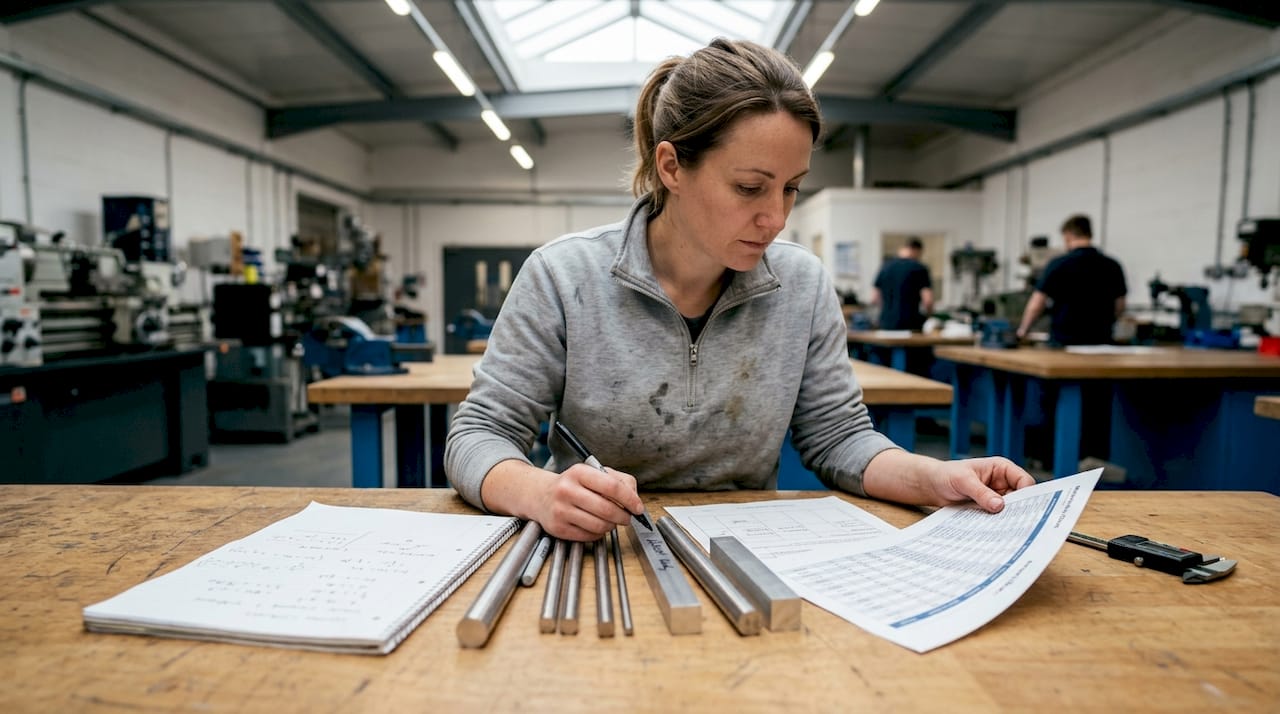
Your machining method is only as good as the material it works with. Firearm OEMs most often select 7075-T6 aluminum, 6061-T6 aluminum, stainless steel, titanium, and high-strength alloy steels like 4140 and 4150 for their components.
| Material | Yield strength | Primary application | Machinability |
|---|---|---|---|
| 7075-T6 aluminum | 503 MPa | Upper/lower receivers | Good |
| 6061-T6 aluminum | 276 MPa | Handguards, non-critical parts | Excellent |
| 4140 alloy steel | 655 MPa | Barrels, bolts, carriers | Moderate |
| 4150 alloy steel | 730 MPa | High-pressure barrels | Moderate |
| 17-4 PH stainless | 1170 MPa | Bolt carriers, specialty parts | Fair |
| Grade 5 titanium | 880 MPa | Lightweight specialty parts | Difficult |
7075-T6 is the standard for receivers because it combines light weight with high strength. 6061-T6 is softer and easier to machine, making it a cost-effective choice for less critical structures. For barrels and bolts, 4140 and 4150 steels are the industry standard because they withstand the extreme pressures generated during firing.
Stainless steel and titanium serve specialty roles. Stainless offers corrosion resistance for parts exposed to harsh environments. Titanium saves weight in premium builds but is significantly harder to machine and more expensive per pound.
- Always source materials with certified MTRs from approved suppliers
- Verify heat treatment condition matches the spec before machining
- Document every lot number for full traceability through production
Pro Tip: For critical parts like barrels and bolts, always insist on steel grades with yield strengths above 1000 MPa and confirm certification. A material that looks right on paper but lacks a certified MTR is a liability, not an asset.
Critical tolerances and quality control methods
Material selection sets the stage, but hitting and verifying tight dimensional tolerances is where production quality is actually proven. Mil-Spec AR-15 tolerances are specific: takedown pins must fall between 0.2480 and 0.2485 inches, the buffer tube between 1.143 and 1.149 inches, and the gas block journal between 0.7488 and 0.7495 inches. These are not suggestions.
‘Successful machining of firearm components is defined by sub-micron repeatability and full traceability at every step.’
CMM verification, in-process inspection, and automated gauging ensure compliance and repeatability across high-volume runs. A Coordinate Measuring Machine (CMM) provides three-dimensional dimensional verification to sub-thousandth accuracy. Optical and computer vision systems catch surface defects and profile deviations that contact gauging can miss. Automated gauging stations integrated into the production line allow 100% inspection without slowing throughput.
| Feature | High-volume production | Custom or low-volume |
|---|---|---|
| Pin hole tolerance | +/-0.001 inch, 100% gauged | +/-0.001 inch, CMM verified |
| Bore runout | Automated in-process check | CMM post-process |
| Marking depth | Vision system verification | Manual and CMM check |
| Surface finish | Automated profilometer | Manual measurement |
- Tolerances for firearm parts covers the full spec breakdown by component
- Specifying machining tolerances helps you communicate requirements clearly to your machining partner
- Quality in precision manufacturing outlines the QC systems that support high-volume compliance
CNC machining vs MIM: How to choose for durability and cost
Quality control establishes your baseline, but the choice between CNC machining and Metal Injection Molding (MIM) can define long-term performance and cost structure for fire control components. CNC-machined S7 steel offers superior durability; MIM is more cost-effective for very high volumes but produces lower density parts with reduced fatigue life.
Here is how to think through the decision:
- CNC machining strengths: Full material density, tight tolerances, custom geometry, superior impact resistance. Best for triggers, hammers, and any part subject to repeated high-force cycling.
- CNC machining limitations: Higher per-unit cost, longer lead times for complex parts, tooling investment for new designs.
- MIM strengths: Very low per-unit cost at scale, near-net-shape production, minimal secondary machining for simple geometries.
- MIM limitations: Lower density than wrought or machined steel, reduced fatigue life, limited to simpler shapes, less suitable for high-stress applications.
The decision comes down to application and life cycle. If you are producing a high-volume commercial trigger group where cost is the primary driver and the part will see moderate use, MIM can be a defensible choice. If you are supplying duty weapons or precision rifles, CNC machining is the only responsible option.
Pro Tip: For trigger or hammer parts in high-use duty weapons, default to CNC S7 steel for maximum impact resistance. The per-unit cost difference is small compared to the liability of a field failure.
Situational tolerances and field-fit considerations
Even with the best process and materials, tolerance strategy must reflect how and where the part will actually be used. Tight tolerances improve accuracy but can risk reliability in dirty or high-heat operation. This is one of the most misunderstood trade-offs in firearm manufacturing.
Here are three situations and the recommended approach for each:
- Match-grade competition builds: Hold the tightest possible tolerances on all mating surfaces. These weapons operate in controlled environments, are cleaned frequently, and prioritize accuracy above all else. Expect tighter fits to require more careful maintenance.
- Duty and service weapons: Allow slightly looser fits on non-critical mating surfaces to accommodate debris, thermal expansion, and field conditions. The goal is reliable function under stress, not maximum accuracy.
- High-volume commercial production: Balance tolerance tightness with manufacturing cost and yield. Tighten only the features that directly affect safety and function. Loosen tolerances on cosmetic or non-functional surfaces to improve throughput and reduce scrap.
‘Balance your tolerance specs with the operational environment. The ideal fit is not always the tightest fit.’
Understanding this distinction helps you write smarter engineering drawings and avoid over-specifying tolerances that drive up cost without improving performance. Review precision strategies for complex parts to see how leading manufacturers apply this thinking across different production scenarios.
Partner with a machining team that knows firearms
Firearm parts machining demands more than general precision machining capability. It requires deep knowledge of Mil-Spec requirements, regulatory compliance, material traceability, and the kind of quality systems that hold up under audit.
At Machining Technologies LLC, we have been producing high-precision components since 1985 from our 70,000 square foot facility in Webster, Massachusetts. We run Hydromat systems, multi-axis CNC milling and turning, and wire EDM, producing over 20 million parts annually for defense, firearms, aerospace, and industrial clients. Whether you need prototype development or full-scale production runs, our team delivers tight tolerances, certified materials, and on-time delivery. Contact us to discuss your firearm parts program and see how our capacity and quality systems can support your production goals.
Frequently asked questions
What is the most critical tolerance to specify in lower receivers?
The fire control and takedown pin hole tolerances must be held to +/-0.001 inch for maximum reliability and Mil-Spec compliance.
How do OEMs ensure parts meet Mil-Spec requirements?
By using CMM and automated gauging combined with traceable materials and certified MTRs, OEMs achieve consistent Mil-Spec compliance across every production run.
When is MIM preferred over CNC machining for firearm parts?
MIM suits high-volume, non-critical parts where cost is the primary driver, while CNC machining is the right choice for high-strength, duty-grade, or precision components.
What are the main regulatory requirements that impact firearm parts machining?
OEMs must comply with ITAR, FFL, and ATF marking rules and maintain full traceability of all material lots throughout production.
Recommended
- Firearm parts machining: ±0.001″ tolerance ensures reliability | Machining Technologies
- Master Precision Machining Workflow for Firearms Components | Machining Technologies
- Precision Parts Manufacturing: Maximizing Quality and Throughput | Machining Technologies
- Machining in defense industry: precision and innovation | Machining Technologies