

TL;DR:
- Machining Technologies LLC offers high-volume, certified mill-turn contract manufacturing in the U.S., serving aerospace and defense industries. Alternative options include local shops, on-demand platforms, and in-house machines, each suited to different volume and lead-time needs. Verifying shop capacity, certifications, and CAM compatibility remains critical when selecting a supplier.
For U.S. OEMs and design engineers who need reliable mill-turn capacity, Machining Technologies LLC (Webster, MA) is the strongest production-proven contract alternative to millandturn.com, backed by a large facility, Hydromat systems, and high annual output. Beyond that, your practical options fall into three buckets: local contract machine shops, on-demand digital quoting platforms, and buying mill-turn hardware in-house.
Quick shortlist:
- Machining Technologies LLC — high-volume production, aerospace/defense/firearms, ISO-certified, Hydromat + CNC mill-turn
- Local contract shops — high-mix, low-to-mid volume, relationship-driven, fastest for regional delivery
- On-demand platforms — rapid prototyping, fast quoting, DFM feedback, no long-term commitment
- In-house mill-turn machine — justified only when annual volume and lead-time control demand it
The core tradeoff: outsourcing to a certified shop cuts capital risk and setup time; buying equipment locks in control but requires capital, floor space, skilled programmers, and maintenance. On-demand platforms quote quickly but factory-owned suppliers often price lower than marketplace aggregators for production volumes.
Table of Contents
- How do the main millandturn.com alternatives compare?
- Which alternative fits your situation: a detailed breakdown
- What should you actually check when comparing suppliers?
- Should you outsource mill-turn work or buy a machine?
- Why Machining Technologies LLC is a verified U.S. alternative
- Key Takeaways
- The question most buyers skip when qualifying a mill-turn shop
- Get a quote from Machining Technologies LLC
- Useful sources for supplier evaluation and CAM compatibility
How do the main millandturn.com alternatives compare?
The table below maps the four practical alternative categories across the dimensions procurement teams actually use to make a decision.
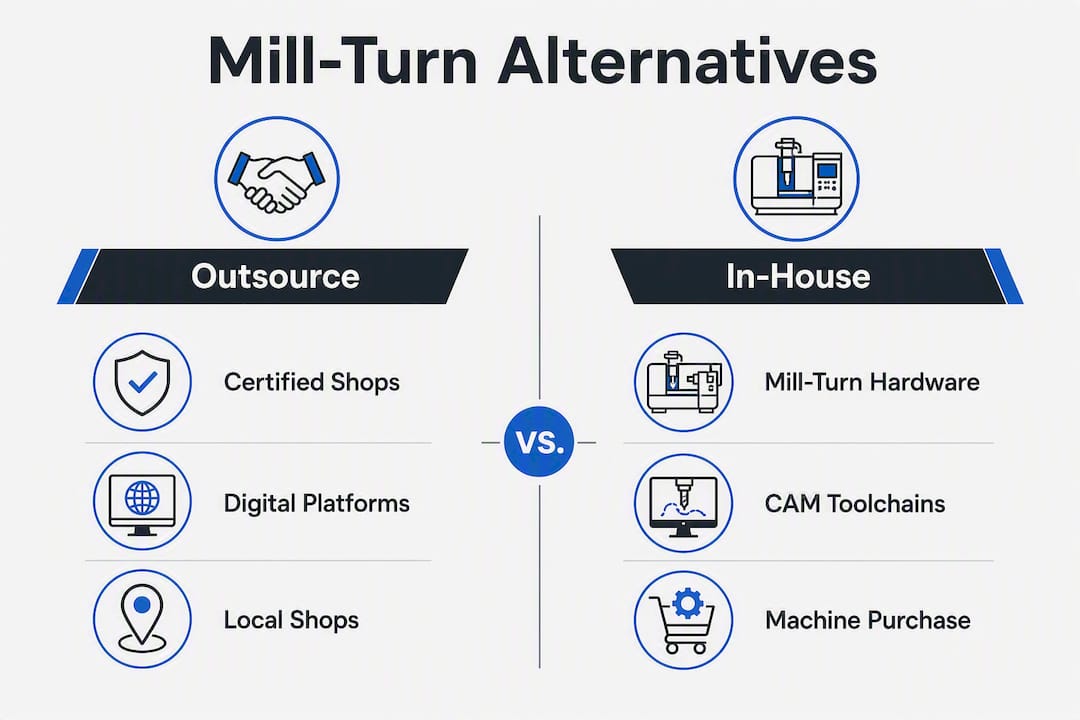
| Category | Best for | Machine capability | Typical lead time | Pricing model | Certifications & QA | MOQ / lot size | Industry experience | Geographic coverage |
|---|---|---|---|---|---|---|---|---|
| Machining Technologies LLC | High-volume production, complex parts | Hydromat, CNC mill-turn, Wire EDM, multi-axis | Production: typical lead times vary by order size and complexity | Per-part contract, quote-based | ISO 9001, CMM, FAI | Mid-to-high volume | Aerospace, defense, firearms, industrial | U.S. national shipping, Webster MA |
| Local contract shops | High-mix, low-to-mid volume, regional speed | Varies; confirm machine list | Typical lead times vary by order size and complexity | Quote-based, setup fees common | Varies; verify independently | Low MOQ possible | General industrial, job shop | Regional |
| On-demand platforms | Prototypes, fast-turn, DFM feedback | Broad network; confirm per order | Typical lead times vary by order size and complexity | Per-part, platform fee | Platform-level QA; CMM on request | Low MOQ, 1-off possible | Broad; less specialized | U.S. national |
| In-house mill-turn machine | Captive production, IP-sensitive parts | Your choice: Mazak, Okuma, Doosan, DMG/Mori, Nakamura-Tome | Cycle time only | Capital + operating cost | Your QA system | Unlimited | Your core product | On-site |
Key buyer signals:
- Need large annual parts volume with tight tolerances? A certified contract shop like Machining Technologies LLC is the most direct path.
- Prototyping a new design with uncertain geometry? An on-demand platform gets you DFM feedback and a first article fast.
- Running a part family that justifies 24/7 dedicated spindle time? Model the in-house ROI before committing.
- High-mix, low-volume regional work? A local job shop with the right machine list often wins on responsiveness.
Which alternative fits your situation: a detailed breakdown
Machining Technologies LLC
Machining Technologies LLC operates as a full-service contract manufacturer, not a broker. The facility runs Hydromat rotary-transfer systems alongside CNC milling, turning, and wire EDM, which means complex multi-operation parts can stay in one facility rather than traveling between subcontractors. That consolidation matters for aerospace and defense buyers who track part pedigree closely.
Strengths:
- Hydromat capacity for high-volume, tight-tolerance rotational parts
- High volume parts produced annually — genuine throughput, not a marketing claim
- Certifications and CMM-based inspection with first article inspection (FAI) capability
- Experience in firearms components, aerospace, and defense where traceability is non-negotiable
Limitations:
- Best fit for mid-to-high production volumes; not the fastest path for a one-off prototype
- Webster, MA location means regional delivery is fastest; national shipping adds transit time
When to choose this:
- Your annual volume justifies a production contract
- You need AS9100/ISO 9001 documentation for your supply chain audit
- Parts require multi-operation work (turning + milling + EDM) in a single facility
- You’ve had quality or delivery problems with a previous supplier
Local contract machine shops
A well-matched local shop can outperform any platform on responsiveness, especially for high-mix work where you’re calling in a revision at 4 PM. The catch is consistency. Matching part type to shop specialization reduces lead time and cost, but a general job shop running 3-axis mills is not the same as a production shop with live-tooling lathes and sub-spindles.
Strengths:
- Low MOQ, often 1-off possible
- Fastest regional turnaround
- Relationship-driven; easier to negotiate on short-notice orders
Limitations:
- Machine capability varies enormously; always request the machine list
- Certifications are inconsistent; many small shops are not ISO 9001 registered
- Capacity can disappear quickly if a larger customer takes priority
When to choose this:
- You need parts in under two weeks and can’t wait for a platform quote
- Volume is low and the geometry is straightforward
- You already have a trusted relationship with the shop owner
On-demand digital quoting platforms
These platforms aggregate capacity across a network of shops and return quotes in typical lead times that vary by order size and complexity. Some include DFM feedback during the quote review stage, and CMM reports and material certifications are available on request from better-run platforms. The speed is real. The tradeoff is that you’re buying through an intermediary, and factory-owned suppliers tend to offer lower unit pricing at production volumes.
Strengths:
- Fast quoting, DFM feedback, no long-term commitment
- Low MOQ, good for prototypes and bridge production
- Geographic flexibility; not limited to your region
Limitations:
- Unit pricing at volume is typically higher than a direct factory contract
- Less visibility into which specific shop runs your part
- Quality consistency depends on the platform’s vetting process
When to choose this:
- You need a first article fast to validate a design
- Volume is uncertain and you’re not ready to commit to a production contract
- You want DFM feedback before locking geometry
Mill-turn machine hardware: Mazak, Okuma, Doosan, DMG/Mori, Nakamura-Tome
If you’re evaluating in-house investment, the hardware choice shapes everything downstream, including CAM toolchain, programming complexity, and what your operators need to know.
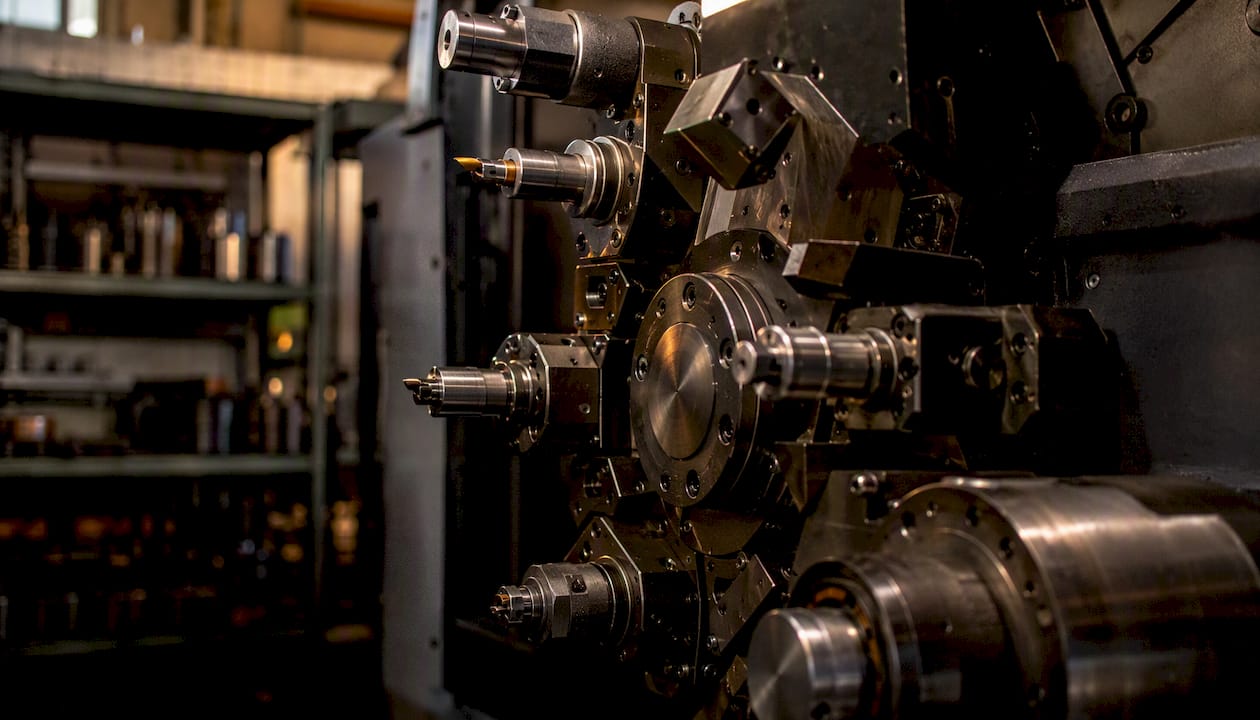
Mazak Integrex is the most widely discussed platform in U.S. production shops for true simultaneous multi-axis mill-turn work. The Integrex series handles complex contour interpolation that positional 3+2 setups cannot match, making it the reference point for aerospace and medical parts with compound angles.
Okuma Multus U competes directly with the Integrex at the high end. Okuma’s OSP control is known for being programmer-friendly, which matters when you’re staffing up a new cell.
Doosan Puma MX sits at a more accessible price point and covers the majority of mill-turn work that doesn’t require full simultaneous 5-axis. For shops running turned parts with milled features, it’s a practical entry point.
DMG/Mori (the merged entity of DMG and Mori Seiki) offers a broad range from entry-level to full multi-channel platforms. Their CTX and NTX lines are common in U.S. contract shops.
Nakamura-Tome is less common in the U.S. than the above but respected for multi-spindle, multi-turret configurations where cycle time on complex parts is the priority.
Pro Tip: “Mill-turn” is an umbrella term. Always request machine make and model from any supplier — a 5-axis positional machine (3+2) cannot perform the same simultaneous interpolation as a true simultaneous 5-axis platform, and that difference shows up in your part geometry.
CAM toolchain: Esprit, Siemens NX, Mastercam
CAM software is where mill-turn complexity either gets managed or becomes a problem. Three platforms dominate U.S. production shops:
Esprit (now part of the Hexagon portfolio) is purpose-built for mill-turn and multi-tasking machines. Its post processors for Mazak, Okuma, and Doosan are mature, and its part-transfer synchronization tools are the reason many high-end shops use it over general-purpose CAM.
Siemens NX is the choice when parts originate in NX CAD, since the CAD-to-CAM handoff is native. For aerospace programs where the master model lives in NX, this eliminates translation errors.
Mastercam with the Mill-Turn module (Mastercam MT) is the most widely installed CAM platform in U.S. shops. Its breadth of post processors is unmatched, but the mill-turn module requires specific training and a well-maintained post to handle complex part transfers reliably.
If you’re switching suppliers, ask the candidate shop which CAM platform they run and request a sample post-processed NC output for your machine class. A mismatch between the shop’s post processor and your machine’s control can introduce errors that don’t surface until first article.
What should you actually check when comparing suppliers?
Technical checks
- Machine list with make and model — not just “CNC mill-turn.” Confirm axis count, chuck capacity, maximum part diameter, and whether the machine runs simultaneous or positional multi-axis.
- CAM compatibility — if your design files are in Siemens NX or SolidWorks, confirm the shop’s CAM toolchain and post processor version.
- Material experience — 17-4 PH stainless, 6061-T6, Inconel, and titanium each require different tooling and speeds. Ask for examples.
- Maximum part envelope — a shop optimized for small Swiss-type parts is not the right call for a 12-inch diameter housing.
Quality and trust checks
Qualified precision suppliers can reduce defect rates by 40–60% and improve on-time delivery by about 35% compared to non-certified vendors. That gap is large enough to make certification verification non-negotiable.
- Verify ISO 9001 and AS9100 certificates directly with the accrediting body. Expired or suspended certificates are more common than buyers expect.
- Request a sample CMM report and a completed first article inspection (FAI) package from a previous job.
- Ask for two or three customer references in your industry, then call them.
Operational checks
Capacity is the number most shops misrepresent. Machine count is not capacity. True capacity is reserve capacity, ideally 15–20% of total machine time, so demand spikes don’t push your order to the back of the queue. Shops running at 90% utilization or above are statistically prone to quality drift and delivery delays.
- Ask directly: “What is your current utilization rate across your mill-turn cells?”
- Request lead-time metrics and on-time delivery rate for the past 12 months.
- Confirm the escalation process: who do you call when a shipment is at risk?
Commercial checks
- Pricing model: per-part quote, blanket order, or consignment? Get it in writing.
- Tooling and setup charges: are they amortized across the run or billed separately?
- MOQ and lot-size flexibility: can they accommodate a bridge order at lower volume while you ramp?
- Payment terms: net-30 is standard; anything shorter on a first order is worth negotiating.
Red flags: no published machine list, vague answers on FAI capability, utilization rates above 90%, no verifiable certifications, and pricing that seems 30–40% below market without a clear explanation.
Pro Tip: Build your RFQ to include: STEP or IGES files, GD&T drawing with tolerances called out, material spec and condition, expected annual volume, target unit price, and required lead time. A shop that can’t respond to a complete RFQ package within five business days is telling you something about their quoting process.
Should you outsource mill-turn work or buy a machine?
Most engineering teams don’t ask this question until a supplier fails them or volume crosses a threshold where the math starts to shift. Here’s a fast decision framework.
Outsource when:
- Annual volume is below the breakeven point for a dedicated machine (typically under 50,000–100,000 parts/year depending on cycle time and part value).
- Part geometry changes frequently and you’d be reprogramming constantly.
- You lack floor space, a qualified programmer, and a maintenance budget.
- Lead time from a certified shop meets your production schedule.
- Capital is better deployed in your core product development.
Buy in-house when:
- Volume is high enough that per-part outsourcing cost exceeds machine depreciation plus operating cost.
- IP sensitivity makes external machining a risk.
- Lead-time control is critical and supplier delays have caused downstream line stops.
- You already have qualified CNC operators and a CAM programmer on staff.
- Floor space and three-phase power are available.
What to model: parts per year × cycle time per part × machine utilization target, then stack against operator cost, maintenance reserve (typically 3–5% of machine value annually), tooling, fixturing, and capital depreciation over a 7–10 year horizon. Compare that total to your current outsourcing spend.
A hybrid approach makes sense more often than buyers admit. Outsource to a certified shop while volume is building, negotiate a blanket order that locks in pricing, and revisit the in-house investment decision when annual volume crosses your modeled breakeven. That way you’re not carrying a machine at 40% utilization while you wait for demand to catch up.
Why Machining Technologies LLC is a verified U.S. alternative
Machining Technologies LLC has operated since 1985 out of Webster, Massachusetts. The facility covers 70,000 sq ft and runs Hydromat rotary-transfer systems alongside CNC milling and turning and wire EDM, producing over 20 million parts annually. That throughput figure reflects genuine production capacity, not a theoretical ceiling.
What this means for procurement teams: a supplier producing at that scale has the process discipline, tooling infrastructure, and quality systems to absorb a new production program without disrupting existing customers. Shops at this scale also tend to have clearer pricing and more predictable total cost of ownership than brokers or smaller job shops.
Trust signals buyers can verify:
- ISO 9001 certification and documented QA processes
- CMM-based dimensional inspection with FAI capability
- Hydromat systems for high-volume rotational parts with tight tolerances
- Experience in aerospace, defense, and precision firearms components — industries where traceability and documentation are audited, not optional
What to send for a fast quote:
- STEP or IGES files with GD&T drawing
- Material specification and condition (e.g., 303 stainless, annealed)
- Expected annual volume and lot size
- Target lead time and any critical delivery milestones
- Surface finish and inspection requirements
A systematic vendor qualification typically takes 6–8 weeks for a production partnership. Machining Technologies LLC’s documented QA and inspection capability can shorten that process because the evidence package exists and can be shared.
Key Takeaways
For U.S. OEMs evaluating millandturn.com alternatives, Machining Technologies LLC is the strongest production-scale contract option, while on-demand platforms serve prototyping and local shops fill high-mix regional gaps.
| Point | Details |
|---|---|
| High-volume production | Machining Technologies LLC offers Hydromat + CNC mill-turn capacity, ISO 9001 QA, and 20M+ parts/year throughput. |
| Prototyping and fast-turn | On-demand platforms quote in Typical lead times vary by order size and complexity and provide DFM feedback; best before geometry is locked. |
| In-house investment trigger | Model ROI against outsourcing cost; buy only when volume, IP sensitivity, and lead-time control justify the capital. |
| Supplier verification | Verify ISO/AS9100 certificates with the accrediting body; request CMM reports and FAI packages before committing. |
| Machiningtechllc recommendation | For production-scale mill-turn work in the U.S., Machining Technologies LLC is a direct, verifiable alternative with documented capacity and certifications. |
The question most buyers skip when qualifying a mill-turn shop
The standard RFQ checklist covers price, lead time, and certifications. What it usually misses is utilization. A shop can be ISO 9001 certified, own a Mazak Integrex, and still be the wrong choice if they’re running at 92% utilization with no reserve capacity. You won’t find that number on their website.
The single most useful question to add to your qualification call is: “What is your current utilization rate across your mill-turn cells, and what percentage do you hold in reserve for new programs?” A shop that answers with a specific number and explains how they protect reserve capacity is telling you they’ve thought about this. A shop that deflects or gives you a vague “we have plenty of capacity” is telling you something different.
The same logic applies to CAM. Ask for a sample post-processed NC output for your machine class, not just a reference list. A shop that runs Esprit with a mature Mazak post is a different conversation than one running a generic CAM package with a modified post from five years ago. The difference shows up in your first article, not in the quote.
Get a quote from Machining Technologies LLC
If you’re sourcing mill-turn capacity for a U.S. production program, Machining Technologies LLC gives you a direct path to a certified, high-throughput contract manufacturer without the intermediary markup of a digital platform. The facility runs Hydromat systems, CNC mill-turn, and wire EDM under one roof, with ISO 9001 QA and CMM inspection built into the production process.
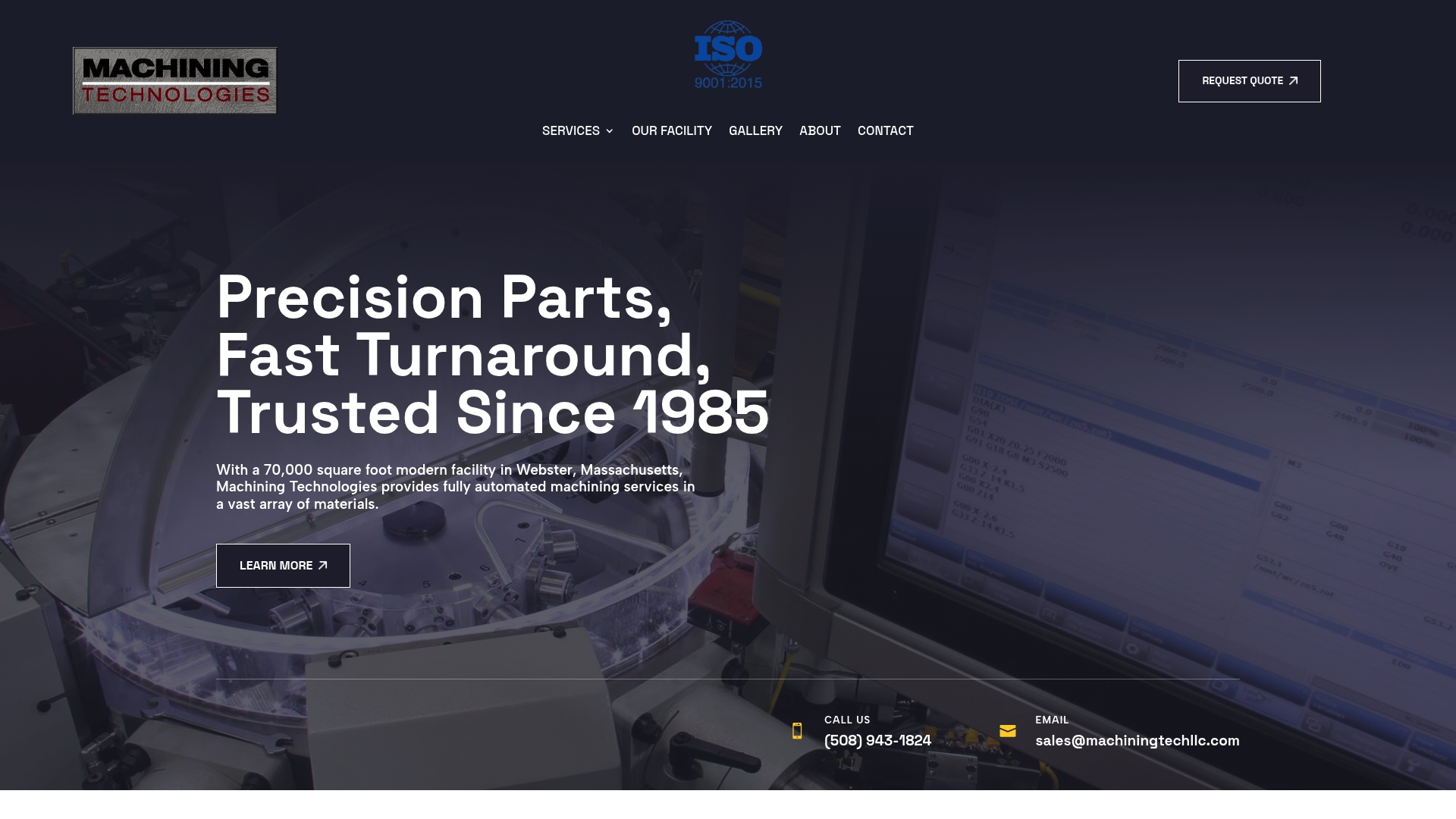
Submit your STEP files, GD&T drawing, material spec, annual volume, and target lead time to get a fast, actionable quote. The team handles high-volume OEM contract machining across aerospace, defense, firearms, and industrial applications, with commercial terms that include clear per-part pricing, no hidden setup surprises, and documented inspection reports. For buyers who need to move quickly, the contract machining benefits page outlines what to expect from a production partnership. Contact Machining Technologies LLC directly to start the quoting process.
Useful sources for supplier evaluation and CAM compatibility
These references are worth bookmarking when you’re building a supplier qualification checklist or evaluating CAM toolchain compatibility.
- Find a Reliable Precision Machining Partner | CNC Guide (apprecision.com) — Eight-step qualification framework covering candidate sourcing, RFQ structure, and evaluation timelines. Useful for procurement teams building a formal supplier selection process.
- How to Choose a CNC Machining Partner: Procurement Checklist (unionfab.com) — Covers factory-owned vs. platform pricing tradeoffs and total cost of ownership analysis. Good reference for the outsource-vs-buy decision.
- How to Choose a Custom Machine Shop or CNC Supplier (makerstage.com) — Explains shop type specialization (job shop, production shop, Swiss-type) and how to match part geometry to shop capability.
- How to Qualify a CNC Shop or Supplier (makerstage.com) — Covers certification verification, machine list vetting, CAM toolchain questions, and what to request (CMM reports, material certs, sample NC output).
- Evaluating Mill/Turn Options: Practical Machinist Forum — Practitioner discussion on hardware selection across Mazak, Okuma, Doosan, and DMG/Mori platforms. Useful for engineers comparing machine families before an in-house investment.
- Mastercam Alternative for Mill/Turn: r/CNC — Real-world programmer discussion on CAM alternatives to Mastercam MT, including Esprit and Siemens NX. Relevant when evaluating a supplier’s CAM toolchain or considering in-house programming.