
TL;DR:
- OEM contract machining is a collaborative process focusing on process engineering, quality control, and scalability.
- Maintaining process stability at high volumes requires automation, precise fixturing, and in-process measurement.
- Effective quality assurance involves SPC, digital traceability, and joint quality planning with the OEM.
Many OEMs assume contract machining is simply handing off a drawing and waiting for parts. That assumption costs time, money, and quality. OEM contract machining is a technical partnership built around process engineering, repeatability, and scale. In regulated sectors like aerospace, defense, and firearms, the tolerance for error is essentially zero. Understanding what separates a true OEM contract machining relationship from generic outsourcing helps you make smarter sourcing decisions, protect your production schedules, and consistently deliver components that meet your most demanding specifications.
Table of Contents
- Understanding OEM contract machining
- Why process stability is paramount for high-volume OEMs
- Maximizing efficiency: Automation, tooling, and measurement
- Quality assurance in OEM contract machining
- Why true OEM contract machining isn’t just outsourcing
- Partner with leaders in OEM contract machining
- Frequently asked questions
Key Takeaways
| Point | Details |
|---|---|
| OEM contract machining defined | It’s a partnership-driven manufacturing service designed for high-volume, precision-critical OEM components. |
| Process stability is key | Consistent process control and automation reduce risk and drive quality at scale. |
| Quality assurance is collaborative | The best results come from OEMs and machine shops co-developing rigorous, sector-specific QA protocols. |
| Efficiency gains are quantifiable | Leading contract shops achieve dramatic cycle time reductions and throughput boosts through advanced methods. |
Understanding OEM contract machining
OEM contract machining is a specialized manufacturing arrangement where a contract shop becomes a deeply integrated production partner for an original equipment manufacturer. This is not a transactional relationship. It requires shared investment in tooling strategy, process design, quality planning, and documentation from day one.
The OEM brings the part design, material specifications, and performance requirements. The contract machining partner brings manufacturing expertise, equipment capacity, and process control knowledge. Together, they develop a production system capable of delivering thousands or millions of identical, high-precision parts within tight tolerances. As high-volume machining research confirms, OEM contract machining involves partnership-level collaboration for process design and control, not just machine time.
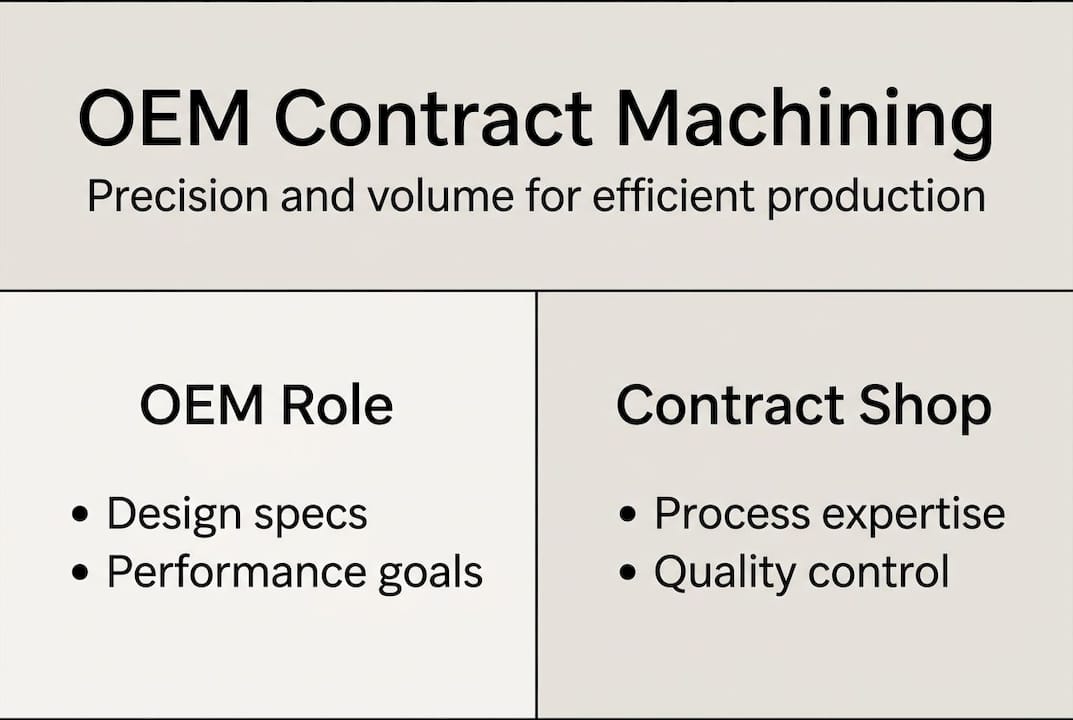
What separates OEM contract machining from general machining services comes down to depth and accountability. A general machine shop takes a job, runs it, and ships it. An OEM contract partner co-develops the entire production process, including fixturing, tooling standards, inspection protocols, and traceability systems.
Here is what makes OEM contract machining fundamentally different:
- Engineering for manufacturability: The shop actively contributes to refining part geometry and tolerances for efficient, repeatable production.
- Tooling and fixturing strategy: Custom fixtures and standardized tooling setups reduce variability between runs and operators.
- Process control documentation: Every step is documented, from setup sheets to in-process inspection records, supporting regulatory compliance.
- Quality system integration: The contract partner aligns its QA practices with the OEM’s internal standards and industry certifications.
- Scalable throughput: Production systems are designed from the start to handle volume ramp-ups without sacrificing precision.
Understanding the contract machining benefits available to OEMs is the first step toward building a production model that scales without breaking. When you engage a partner through OEM machining services structured around your specific requirements, you gain more than capacity. You gain a co-manufacturer invested in your success.
Why process stability is paramount for high-volume OEMs
Once you understand what OEM contract machining involves, the next challenge becomes clear: keeping that process stable at scale. This is where many outsourcing relationships fail, and where true OEM partnerships prove their value.
At low volumes, a small amount of variability is manageable. A skilled operator can compensate, and a rejected part here or there barely registers. At high volumes, that same variability becomes a serious problem. As volumes rise, variability caused by tool wear, manual intervention, or inconsistent fixturing can jeopardize both cost and quality simultaneously.
The strategies that keep high-volume processes stable are specific and non-negotiable. Off-line tool presetting eliminates the guesswork of on-machine tool measurement, reducing setup variation. Gage repeatability and reproducibility studies confirm that your measurement systems are actually measuring what you think they are. Standardized fixturing ensures every part is held identically, run after run. Layered automation removes human variability from repetitive tasks where consistency matters most.
| Factor | Low-volume requirements | High-volume requirements |
|---|---|---|
| Tool management | Manual tool changes, visual checks | Off-line presetting, scheduled replacement intervals |
| Fixturing precision | General-purpose fixtures acceptable | Custom, repeatable fixtures with positional verification |
| Automation level | Mostly manual operation | Robotic tending, automated part transfer |
| Inspection frequency | Final inspection per batch | In-process inspection at defined intervals |
The table above illustrates why you cannot simply scale a low-volume process and expect it to hold. The entire system must be engineered for volume from the start. Exploring machining process automation options early in your program planning prevents expensive retrofits later.
Pro Tip: Lock in your process control strategy before production begins, not after the first quality escape. Mistakes at volume multiply faster than you can correct them, and the cost of a field failure in aerospace or defense far exceeds the investment in upfront process engineering.
The automated machining benefits for OEMs are most visible in scrap reduction and throughput consistency. Pairing automation with a structured high-volume workflow creates a production environment where quality is built in, not inspected in.
Maximizing efficiency: Automation, tooling, and measurement
Process stability creates the foundation. Automation and advanced measurement build the performance layer on top of it. The best OEM contract shops do not treat these as optional upgrades. They treat them as core production infrastructure.
Robotic part tending eliminates the single biggest source of cycle-to-cycle variability in high-volume machining: human handling. When a robot loads and unloads every part with the same force, position, and timing, the process becomes genuinely repeatable. Software-driven tool life management ensures cutting tools are replaced before they drift out of tolerance, not after they cause a scrap event.
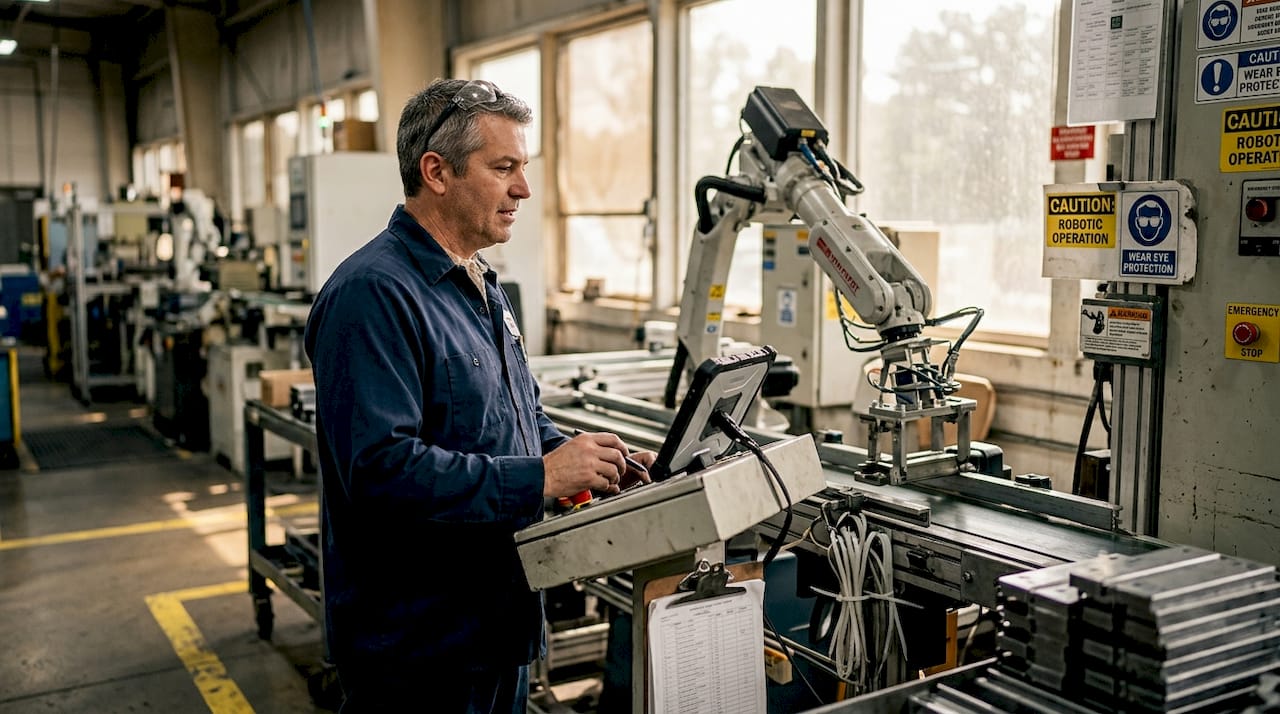
The results speak clearly. A production rate improvement of over 80% was achieved by integrating in-process measurement with turn-mill machining, demonstrating what is possible when measurement is embedded in the process rather than performed after the fact.
| Metric | Before automation | After automation |
|---|---|---|
| Cycle time per part | 4.2 minutes | 1.8 minutes |
| Scrap rate | 3.1% | 0.4% |
| Labor hours per 1,000 parts | 18 hours | 6 hours |
| In-process inspection rate | 10% of parts | 100% of parts |
Implementing this level of automation and measurement in a contract machining partnership follows a clear sequence:
- Define critical dimensions early. Work with your contract partner to identify the features that most affect part performance and focus measurement resources there.
- Integrate measurement into the process. In-process gauging catches drift before it produces scrap, rather than discovering problems at final inspection.
- Automate material handling first. Robotic tending delivers the fastest return on investment and immediately reduces operator-induced variability.
- Establish tool life protocols. Set tool replacement intervals based on data, not feel. This stabilizes surface finish and dimensional consistency across long production runs.
- Review and refine continuously. Use production data to tighten control limits and identify the next improvement opportunity.
Applying precision part strategies from the program launch stage, combined with rigorous machined part quality verification, gives OEMs the confidence to commit to aggressive delivery schedules without sacrificing quality.
Quality assurance in OEM contract machining
Efficient processes and fast cycle times mean nothing if the parts fail inspection or, worse, fail in service. For aerospace, defense, and firearms OEMs, quality assurance is not a checkbox. It is a system that must be built, validated, and maintained jointly between the OEM and the contract machining partner.
The must-have QA practices for high-volume OEM contract machining include:
- Statistical Process Control (SPC): Continuous monitoring of key dimensions against control limits, catching process drift before it produces nonconforming parts.
- Hard-gaging: Dedicated gages for critical features provide fast, reliable go/no-go verification at production speed.
- Digital traceability: Every part lot is linked to its process data, material certifications, and inspection records, supporting full traceability for regulated industries.
- Production Part Approval Process (PPAP): Formal submission of process capability data and sample parts before full production launch, confirming the process can consistently meet requirements.
- First Article Inspection (FAI): Detailed dimensional and material verification of the first production parts, establishing a baseline for ongoing control.
Meticulous measurement and documentation are central to contract machining for aerospace and defense OEMs. Without them, regulatory compliance and liability protection are impossible to maintain at scale.
The collaborative approach matters as much as the tools themselves. OEMs and contract shops should co-develop the quality plan during the quoting phase, not after problems emerge. This means agreeing on inspection frequency, defining critical characteristics together, and establishing clear escalation procedures for nonconformances.
Using structured OEM quality verification methods ensures your contract partner’s outputs align with your internal acceptance criteria. Understanding the difference between custom and standard machining approaches also helps OEMs set realistic expectations for what a quality system needs to include for their specific application.
Why true OEM contract machining isn’t just outsourcing
Here is the uncomfortable reality: most failed contract machining relationships fail because the OEM treated the engagement like a commodity purchase. They sent a drawing, accepted a price, and assumed the shop would figure out the rest. That model works for simple, low-stakes parts. It does not work for complex, high-volume components in regulated industries.
We have seen OEMs switch to a lower-cost shop to save 8% per part, only to absorb a 22% total program cost increase from scrap, rework, and schedule delays. The math is not complicated, but it requires looking beyond the unit price.
The shops that consistently deliver for OEMs in aerospace, defense, and firearms invest heavily in customer-specific process development. They assign engineering resources to your program. They build fixtures designed around your part, not a general-purpose alternative. They track your process data over time and bring you improvement recommendations proactively.
Pro Tip: When evaluating contract machining partners, ask specifically how they develop processes for new programs. A shop that describes a structured co-engineering approach is a fundamentally different partner than one that simply quotes from a drawing.
The higher output from contract machining that OEMs need at scale comes from this kind of embedded partnership, not from transactional outsourcing. Choose partners who treat your program as their own.
Partner with leaders in OEM contract machining
Choosing the right OEM contract machining partner directly determines whether your program scales smoothly or struggles with quality and delivery problems. The principles covered in this guide, from process stability to automation to quality systems, are exactly what separates capable partners from the rest.
At Machining Technologies LLC, we have been building these kinds of partnerships since 1985, producing over 20 million parts annually for aerospace, defense, and firearms OEMs from our 70,000 square foot facility in Webster, Massachusetts. Our high-volume aerospace machining capabilities and defense machining expertise are built for programs where precision and reliability are non-negotiable. Contact us to discuss your next program.
Frequently asked questions
How does OEM contract machining differ from regular machining services?
OEM contract machining involves a deeper partnership focused on engineering support, process control, and meeting strict industry standards for volume and complexity, as confirmed by high-volume machining research. Regular machining services typically handle lower-stakes, transactional work without the same level of process integration.
What quality assurance methods are used in OEM contract machining for aerospace or defense?
Common methods include Statistical Process Control, rigorous digital documentation, and hard-gaging validated in collaboration with the OEM, as measurement standards for these sectors require. PPAP and First Article Inspection are also standard practice for regulated programs.
How does automation improve high-volume contract machining?
Automation reduces variability, increases throughput, and enables faster, more reliable production of complex OEM parts. A production rate increase of over 80% is achievable when integrated measurement and turn-mill processes replace manual operations.
What sectors benefit most from OEM contract machining?
Aerospace, defense, and firearms manufacturing gain the most because these industries demand high-precision components, strict traceability, and consistent quality at scale. Any sector where part failure has serious safety or regulatory consequences benefits from the structured approach OEM contract machining provides.