


Component traceability is the documented ability to track every part’s complete history, from raw material and supplier origin through every production step, test result, and delivery destination. The immediate payoff: when a defective lot surfaces, you can isolate exactly which assemblies are affected within hours instead of days, limiting both recall scope and customer exposure. A circuit board manufacturer, for example, can pull a single batch number, identify every board built with that lot of capacitors, and notify only those customers rather than issuing a blanket field action.
Key Takeaways
Component traceability requires linking material batch IDs, process parameters, test results, and delivery records into a queryable chain that supports recalls, root-cause analysis, and compliance audits.
| Point | Details |
|---|---|
| Definition | Traceability documents a part’s full history from supplier origin through every process step to delivery destination. |
| Unit vs. batch | Use batch traceability for commercial parts; apply unit-level serialization for safety-critical, aerospace, or medical components. |
| Top technologies | Direct part marking, MES integration, and GS1-compliant identifiers form the practical core of most programs. |
| First three steps | Define scope, design the minimum data model, then pilot on your highest-risk SKUs before expanding. |
| Measure what matters | Track time-to-trace, supplier data completeness, and recall containment time as your primary program KPIs. |
Table of Contents
- What is component traceability and how does it work?
- Why component traceability matters for your operation
- What data do you actually need to record?
- Which capture and storage technologies should you use?
- How to implement a traceability program: a step-by-step checklist
- Which standards apply to your traceability program?
- Common challenges and how to avoid them
- Four use cases where traceability delivers measurable value
- An editorial perspective on traceability in contract machining
- Sources
What is component traceability and how does it work?
Traceability in manufacturing splits into two distinct architectures, and choosing the wrong one wastes both money and audit credibility.
Internal traceability covers everything that happens inside your four walls: which machine ran the part, which operator performed the inspection, which tool was in the spindle, and what the process parameters were at the moment of cut. It answers the question “how was this part made?” without involving anyone outside your facility.
Chain traceability (sometimes called chain-of-custody traceability) extends that record upstream to your suppliers and downstream to your customers. It answers “where did this material come from, and where did the finished part go?” The two types are complementary, not interchangeable. A robust program needs both.
Forward vs. backward traceability
Backward traceability starts with a finished product or field failure and traces back to the source: which supplier lot, which process run, which shift. Forward traceability starts with a raw material or component and follows it downstream to find every assembly or customer that received it. Backward traceability drives root-cause analysis; forward traceability drives recall containment. You need both directions to close the loop.
Unit vs. batch/lot traceability
| Dimension | Batch/lot traceability | Unit (serial) traceability |
|---|---|---|
| Scope | Group of parts sharing one production run | Individual serialized part |
| Data volume | Lower — one record per lot | Higher — one record per unit |
| Typical industries | General manufacturing, consumer goods | Aerospace, medical devices, defense, automotive |
| Recall granularity | All parts in the affected lot | Only the specific units confirmed defective |
Batch traceability is sufficient for many commercial applications. Unit-level serialization becomes necessary when regulations or customer contracts demand it, and in regulated or safety-critical sectors, serial-number traceability is frequently mandated: automotive IATF 16949 and medical-device MDR/510(k) rules both require higher granularity than general manufacturing.
Why component traceability matters for your operation
The business case is not abstract. Here is what traceability actually delivers:
- Faster recall containment. A targeted recall covering only the affected lot costs a fraction of a blanket recall. Time-to-containment drops from weeks to hours when batch or serial records are clean and queryable.
- Root-cause isolation. Linking a field failure back to a specific machine, tool, operator, or supplier lot turns a guessing game into a structured investigation.
- Counterfeit detection. Certificate-of-conformity records and supplier lot data let incoming inspection flag parts that don’t match declared provenance, a growing concern in electronics and defense supply chains.
- Warranty and service efficiency. A technician who can pull the full build record for a returned unit resolves the issue faster and with less back-and-forth with engineering.
- Supplier accountability. When your purchase order requires documented lot data and COAs, suppliers know their records will be audited. Non-conformance rates tend to drop.
- Compliance readiness. Regulatory frameworks from ISO 9001 to AS9100 to the EU RoHS directive require demonstrable material provenance and certificates of conformity; traceability supports meeting those obligations without scrambling at audit time.
Consider a concrete scenario: a precision machined aerospace bracket fails a fatigue test in the field. Without traceability, the investigation involves pulling paper travelers, interviewing operators, and potentially quarantining an entire production month. With a linked MES record, you know the exact bar stock lot, the CNC program revision, the tool life at time of cut, and the inspection result, all in one query. That difference in component quality assurance is what separates a contained corrective action from a full production stop.
What data do you actually need to record?
Traceability requires linking four levels of data: material batch IDs, process parameters, test results, and delivery records. If any level is missing, the audit trail breaks and recall or root-cause analysis suffers.
At minimum, every traceable record should capture:
- Part identification: part number, revision, and unique lot or serial number
- Supplier data: supplier ID, supplier lot number, purchase order reference, and date received
- Material certificates: certificate of conformity (COC), material test report (MTR), and RoHS/REACH declarations where applicable
- Process parameters: machine ID, program/revision, tool ID, cycle time, and key process variables (temperature, feed, speed)
- Operator and shift: operator ID or badge number, shift, and date/time stamp
- Inspection and test results: dimensional report, functional test pass/fail, gauge ID, and calibration status
- Shipment and delivery: customer PO, ship date, carrier, and destination
For electronic component traceability, add part marking method (laser, ink, label), date code, country of origin, and any chain-of-custody documentation from the authorized distributor.
Every record needs a time-stamp and a unique ID that links it to the physical part. The simplest reliable strategy: assign a unique identifier at the point of first operation and carry it through every downstream record. For batch parts, that identifier is the lot number. For serialized parts, it is the serial number, ideally encoded in a 2D barcode or direct part mark applied at the first machining station.
Pro Tip: Set a minimum retention period before you build the system, not after. Aerospace and defense contracts often require 10–20 years of record retention. Design your database schema and archive strategy around that requirement from day one, or you will be migrating records under pressure later.
A minimal audit-ready record for a serialized part looks like this: serial number → linked to supplier lot → linked to process run (machine, program, operator, timestamp) → linked to inspection record (gauge, result, date) → linked to shipment record (customer, PO, date). For a batch part, replace the serial number with the lot number and accept that recall granularity covers the whole lot rather than individual units.
Which capture and storage technologies should you use?
Modern traceability systems pair data capture with process monitoring and analytics to give real-time production visibility from raw material entry to finished product shipment. The capture layer and the storage layer are separate decisions.
Capture technologies
- Barcode and QR code: Low cost, widely supported, and readable by any smartphone or fixed scanner. Best for parts where direct marking is impractical. Vulnerable to label damage and separation from the part.
- RFID and NFC: Readable without line-of-sight, faster for high-volume scanning, and embeddable in pallets or containers. Higher unit cost than labels; not suitable for small metal parts without careful antenna design.
- Direct part marking (DPM): Laser engraving or dot-peen marking applies a 2D Data Matrix code directly to the part surface. Permanent, tamper-resistant, and required by many aerospace and defense contracts. Adds a marking operation to the process flow.
- Serialization: The practice of assigning a unique identifier to every unit. Serialization is a data strategy, not a capture technology; it works with any of the above marking methods.
Storage and integration
The canonical trace record should live in a system of record, typically a Manufacturing Execution System (MES) or an ERP with production-order tracking. PLM systems hold the design and revision history; the MES holds the as-built record. Integration between the two closes the gap between “what was designed” and “what was actually made,” which is exactly what auditors check.
NIST recommendations on manufacturing data trustworthiness describe three data-transaction models worth understanding:
- File-only transactions: Records are stored as signed files (PDF, XML, JSON) in a repository. Practical for most shops today; the limitation is that legacy formats like G-code and STL carry little provenance metadata natively.
- Distributed-ledger-registered transactions: A cryptographic hash of the record is written to a shared ledger, making the record tamper-evident and queryable by multiple parties without sharing the underlying data. Useful when multiple untrusted organizations exchange traceability data.
- Streaming-data packages: Continuous sensor and machine data streams are packaged and linked to part records in near-real time. Suited to high-volume, automated lines where manual record entry is impractical.
Industry guidance recommends mixing approaches: file-based signatures remain practical for many workflows, but distributed ledgers add tamper-resistant, queryable transaction records when multiple untrusted parties exchange data. ASTM D8558 formalizes this with its recommendation for time-stamped, tamper-evident ledgers and Certificates of Authentication as patterns to increase supply-chain verification and reduce fraud.
How to implement a traceability program: a step-by-step checklist
A phased approach prevents the most common failure mode: trying to trace everything at once and ending up with incomplete records everywhere.
- Define scope and objectives. Identify which product families, part numbers, and supply tiers are in scope. State the business driver: compliance, customer contract, recall risk, or counterfeit prevention. Set a go/no-go criterion before you spend anything on tooling.
- Design the data model. Map the minimum fields listed in the data requirements section above to your existing systems. Identify gaps: which fields are not currently captured, and where in the process flow they need to be added.
- Select capture and storage tooling. Match the capture technology to the part (label for low-cost commercial parts, DPM for safety-critical components). Confirm your MES or ERP can store and query the required fields. If not, evaluate middleware or a dedicated traceability module.
- Run a pilot. Choose a single product line or a small set of high-risk SKUs. Practical pilots should prioritize high-risk SKUs, such as safety-critical, high-cost, or high-volume parts, to prove ROI quickly before expanding to long-tail parts. Define success criteria: 100% of pilot parts traceable end-to-end, time-to-trace under a defined threshold, zero missing records at audit.
- Onboard suppliers. Issue a supplier data requirements document specifying minimum fields, acceptable formats (GS1 labels, COC templates), and submission timelines. Build data-exchange requirements into new purchase agreements. For existing suppliers, phase in requirements with a compliance deadline.
- Roll out and measure. Expand to additional product lines using the pilot’s data model and tooling. Track KPIs weekly during rollout: percent of serialized critical parts, supplier data completeness rate, time-to-trace for a sample query, and recall containment time in tabletop exercises.
- Continuous improvement. Review KPIs quarterly. Audit a random sample of records for completeness and accuracy. Close gaps before the next customer or regulatory audit.
Pro Tip: Run a tabletop recall exercise before your first real audit. Pick a lot number from six months ago and time how long it takes to identify every affected assembly and customer. The gaps that exercise reveals are exactly what an auditor will find, and fixing them proactively is far cheaper than a corrective action request.
For complex part manufacturing workflows, traceability integration at each process handoff point is where most programs break down. Build the record-capture step into the work instruction, not as a separate administrative task.
Sample pilot KPIs:
- Time-to-trace: target under 30 minutes for a full part history query
- Percent of critical parts with complete records: target 100% within pilot scope
- Supplier data completeness: percent of incoming lots with COC and lot data on receipt
- Recall containment time: hours from defect identification to affected-unit list
Which standards apply to your traceability program?
Standards set the floor for what “good” looks like, and auditors use them as their checklist. The relevant ones depend on your industry.
- NIST IR 8536 (Meta-Framework to Enhance Supply Chain Traceability): Organizes traceability records and links into verifiable chains across ecosystems, supporting provenance verification and external stakeholder obligations. Governance and architecture layer, not a technical schema.
- IPC-1782B: The electronics industry’s traceability standard. Defines expectations for recording component provenance and supply-chain traceability for electronic products. Required reading for any team supplying or qualifying electronic assemblies.
- ASTM D8558: Technology-neutral guide for supply chain traceability using emerging technologies including distributed ledger approaches. Covers COA patterns and tamper-evident record strategies.
- GS1 standards: Global identifier schemas (GTIN, SSCC, GLN) and data carriers (GS1-128, GS1 DataMatrix) that enable interoperable identification across supply chains. Use GS1 identifiers when your customers or regulators require cross-ecosystem data exchange.
- ISO 9001 / IATF 16949 / AS9100: Quality management system standards that include traceability requirements as a subset of product realization controls. IATF 16949 applies to automotive; AS9100 applies to aerospace and defense; ISO 9001 is the baseline for general manufacturing.
A practical note: NIST documents provide technical schemas and cryptographic guidance. GS1 provides identifier and data-carrier standards. ISO/IATF/AS standards provide the quality-management governance framework that auditors assess. You need all three layers for a complete program.
Common challenges and how to avoid them
Most traceability programs fail at the same predictable points.
- Heterogeneous file formats. Suppliers send COCs as scanned PDFs, spreadsheets, and proprietary ERP exports. Mitigation: specify an accepted format in your supplier data requirements document. GS1-compliant labels and structured XML or JSON COC templates are a reasonable baseline.
- Missing or inconsistent unique IDs. Parts arrive without lot numbers, or the same lot gets two different numbers at different process steps. Mitigation: assign your own internal lot or serial number at receiving and use that as the canonical ID throughout. Never rely solely on the supplier’s numbering.
- Supplier unwillingness or incapacity. Smaller suppliers may lack the systems to generate structured traceability data. Mitigation: start with your top-tier, highest-risk suppliers and phase in requirements. Provide a simple COC template they can fill manually if needed.
- Data volume and storage cost. Unit-level serialization for high-volume parts generates large record sets. Mitigation: tier your traceability requirements. Apply unit-level traceability only to safety-critical or high-value parts; use batch traceability for commercial-grade components.
- Legacy systems without integration. Older ERP or MES systems may not support the required data fields or APIs. Mitigation: use bridging middleware to extract and normalize records into a central repository, even if the source system is not updated.
Pro Tip: Handling and storage conditions affect part integrity and can invalidate a traceability record if the physical part degrades between receipt and use. Ambient contamination control in your facility protects both the parts and the credibility of the records tied to them.
A quick risk prioritization: data silos and missing IDs are high-likelihood, high-impact problems that should be addressed in the data model design phase. Supplier unwillingness is medium-likelihood and manageable through contract requirements. Legacy system gaps are high-impact but often addressable with middleware before a full system replacement is justified.
Four use cases where traceability delivers measurable value
Targeted recall containment
A manufacturer discovers a dimensional nonconformance in a machined valve body after shipment. With batch traceability, the quality team queries the lot number, identifies the affected assemblies built from that lot, and issues a targeted field notification promptly. Without traceability, the same investigation takes days and likely results in a broader quarantine covering weeks of production. Key data elements: lot number, ship records, customer PO. KPI direction: time-to-containment drops sharply; recall scope narrows to the affected lot.

Counterfeit detection and supplier verification
An electronics contract manufacturer receives a shipment of microcontrollers. COC records don’t match the date codes on the parts, and the lot number doesn’t appear in the authorized distributor’s records. The traceability system flags the discrepancy at receiving inspection before the parts enter production. Key data elements: supplier lot number, COC, date code, authorized distributor records. KPI direction: counterfeit detection rate improves; supplier non-conformance rate becomes measurable and auditable.
Warranty and service-support efficiency
A field technician returns a failed hydraulic actuator. The service team pulls the serial number, retrieves the full build record, and identifies that the part was assembled during a shift where a specific lubricant batch was used. Engineering confirms the lubricant batch as the root cause and closes the corrective action in two days rather than two weeks. Key data elements: serial number, process parameters, material lot. KPI direction: mean time to resolution decreases; repeat failures from the same root cause drop.
Production optimization through process-parameter linkage
A precision machining operation links dimensional inspection results back to specific machine IDs, tool life counts, and cutting parameters. The team adjusts the tool-change interval and scrap rate falls. Key data elements: machine ID, tool ID, tool life counter, inspection result. KPI direction: scrap rate decreases; first-pass yield improves.
An editorial perspective on traceability in contract machining
The conversation about traceability in contract manufacturing often gets stuck at the compliance level: “we need it for AS9100” or “the customer requires lot traceability.” That framing is fine for getting a program started, but it undersells what traceability actually does for a high-volume precision machining operation.
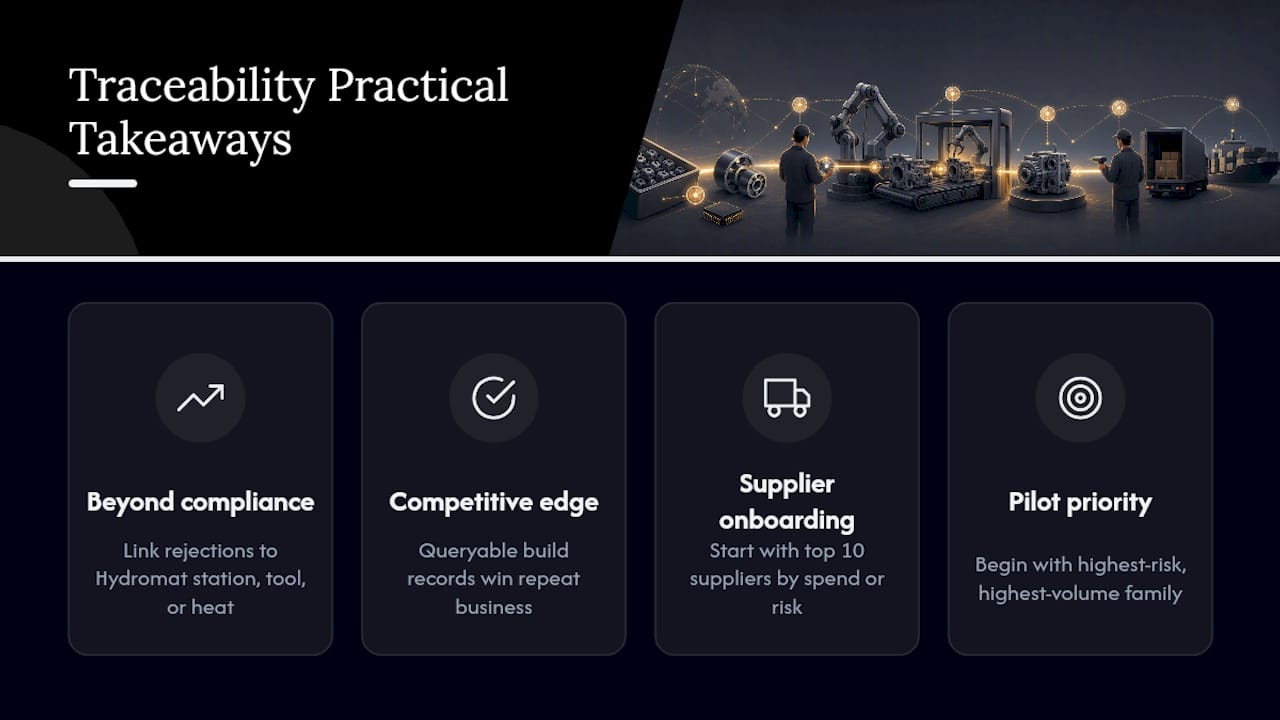
The real value shows up in the data you generate after the first six months. When you can link a dimensional rejection back to a specific Hydromat station, a specific tool change interval, or a specific bar stock heat, you stop guessing about process capability and start making decisions with evidence. That is a different kind of operation.
For contract manufacturers specifically, traceability is also a competitive differentiator. OEM customers in aerospace and defense are increasingly requiring documented traceability as a qualification criterion, not just an audit checkbox. A shop that can hand over a complete, queryable build record with every shipment is a shop that wins repeat business and survives supplier rationalization exercises.
The hardest part is not the technology. Barcodes, RFID, and MES integration are solved problems. The hard part is supplier onboarding for the long tail of smaller material and component suppliers who don’t have structured data systems. The practical answer: start with your top 10 suppliers by spend or risk, get them compliant, and use that experience to build a supplier onboarding playbook before you tackle the rest.
Pilot on your highest-risk, highest-volume part family first. Not because it’s the easiest, but because it generates the most useful data fastest and makes the ROI case to leadership before the program loses momentum.
Machiningtechllc produces over 20 million parts annually from its 70,000 square foot facility in Webster, Massachusetts, with traceability-ready processes across Hydromat, CNC milling and turning, and Wire EDM lines. If you are sourcing precision-machined components and need a contract manufacturer that can meet your traceability and documentation requirements, explore Machiningtechllc’s precision parts manufacturing capabilities or review the full list of precision machining services to find the right fit for your program.
Sources
The sources below cover the technical, standards, and practical dimensions of component traceability for U.S. manufacturers and electronics teams.
- Meta-Framework to Enhance Supply Chain Traceability (NIST IR 8536)
- D8558 Standard Guide for Supply Chain Traceability, Authentication, Verification, Validation, and Oversight Using Emerging Technologies Including Blockchain
Recommended
- Workflow for Complex Part Manufacturing: Engineer’s Guide | Machining Technologies
- Quality Control Best Practices for Manufacturing Pros | Machining Technologies
- Step-by-step precision part design for high-volume manufacturing | Machining Technologies
- Complex part manufacturing: precision strategies 2026 | Machining Technologies