


Selecting the correct castle nut for aerospace and defense applications can prevent catastrophic fastener failures in landing gear and engine assemblies. Castle nuts are essential fastening components designed for high vibration and dynamic stress environments in aerospace, making precise specification a critical engineering decision. This guide provides aerospace engineers with the technical knowledge to specify castle nuts that meet strict MIL-SPEC standards while balancing material performance, weight optimization, and rapid production requirements for complex defense projects.
Table of Contents
- Castle Nut Standards And Specifications
- Locking Mechanisms And Performance Under Stress
- Material Choices And Weight Considerations
- Precision Machining And Manufacturing Processes
- Customization Options And Production Lead Times
- Common Misconceptions About Castle Nuts
- Conclusion And Application Guidance
Key takeaways
| Point | Details |
|---|---|
| Castle nuts must meet strict MIL-SPEC standards for aerospace use | Primary standards MS17826 and MS17825 define dimensional, material, and insert requirements |
| Self-locking inserts prevent loosening under heavy vibration | Non-metallic materials like nylon deform elastically to resist rotation |
| Material choice balances strength, corrosion resistance, and weight | Options include alloy steel, stainless steel, and lightweight aluminum 7075-T6 |
| Precision CNC machining ensures critical dimensional tolerances | Tolerances of ±0.0001 inch with CMM inspection guarantee proper fastener fit |
| Customization and rapid production meet complex project demands | Tailored alloys, dimensions, and finishes support aerospace project timelines |
Introduction to castle nuts in aerospace and defense
Castle nuts are specialized hexagonal fasteners featuring castellated slots that allow a cotter pin or safety wire to lock the nut in place. These components serve as critical hardware in aerospace assemblies where fastener loosening could result in catastrophic failure. Typical applications include securing landing gear components, engine mount bolts, control linkages, and rotor assemblies where dynamic stress and continuous vibration challenge conventional threaded fasteners.
The unique design features of castle nuts address the fundamental engineering challenge of preventing rotation under vibration. Without proper locking mechanisms, standard nuts can gradually loosen during flight operations, maintenance cycles, or ground handling. Castle nuts solve this problem through two primary methods: castellated slots that accept a cotter pin passing through both the nut and bolt, or self-locking inserts that provide continuous resistance to rotation.
Aerospace environments impose severe demands on fastening hardware. Temperature extremes, corrosive conditions, and repeated stress cycles require fasteners that maintain preload integrity over thousands of operating hours. Castle nuts must resist loosening while accommodating thermal expansion, maintaining torque specifications, and providing visual inspection access for maintenance crews. The castellated design offers the additional benefit of allowing technicians to quickly verify proper installation by checking for the presence and condition of locking pins.
Key characteristics that make castle nuts indispensable in aerospace include:
- Positive locking through mechanical interference or insert friction
- Visual inspection capability for maintenance verification
- Compatibility with safety wire or cotter pin retention
- Proven reliability in high vibration environments
- Standardized dimensions for interchangeability
Engineers specifying castle nuts for aerospace applications must understand how these fasteners integrate into broader precision parts manufacturing processes. Material selection, dimensional tolerances, and locking mechanism choices directly impact assembly reliability and maintenance intervals. The following sections detail the standards, materials, and manufacturing processes that enable castle nuts to meet aerospace performance requirements.
Castle nut standards and specifications
Military specifications govern the design, materials, and performance requirements for aerospace castle nuts. The MS17826 military standard specifies a thin-profile, hexagonal, castellated nut with a non-metallic insert for self-locking in aerospace applications. These standards ensure interchangeability, reliability, and documented performance across defense contractors and aerospace manufacturers.
The two primary standards for aerospace castle nuts are MS17826 and MS17825. MS17826 defines thin-profile castle nuts with self-locking inserts suitable for applications with limited clearance. MS17825 covers standard-height castle nuts with similar locking features but greater thread engagement for higher load applications. Both standards specify exact dimensions, thread tolerances, slot geometry, and insert material requirements.
Key design features mandated by these standards include:
- Precise slot width and depth for cotter pin compatibility
- Thread class 2B tolerance for proper bolt fit
- Hexagonal wrench flats with specific across-flats dimensions
- Insert material specifications for temperature and chemical resistance
- Surface finish requirements to prevent galling and corrosion
The following table compares critical specifications between MS17826 and MS17825 standards:
| Feature | MS17826 | MS17825 |
|---|---|---|
| Profile height | Thin (reduced height) | Standard height |
| Thread sizes | #6-32 through 1-1/8-12 | #10-32 through 1-1/4-12 |
| Insert type | Non-metallic self-locking | Non-metallic self-locking |
| Typical applications | Space-constrained assemblies | High-load primary structures |
| Dimension tolerance | ±0.005 inch nominal | ±0.005 inch nominal |
Material requirements under MIL-SPEC standards typically specify alloy steel with minimum tensile strength ratings. Stainless steel versions are available for corrosive environments, though at reduced strength compared to alloy steel. Surface treatments such as cadmium plating or passivation are often specified to enhance corrosion resistance while maintaining dimensional accuracy.

Strict adherence to these standards is non-negotiable in aerospace manufacturing. Substituting non-conforming fasteners can void certifications, fail safety audits, and introduce liability risks. Engineers must verify that supplied castle nuts include complete traceability documentation, material certifications, and dimensional inspection reports. Working with manufacturers experienced in precision parts manufacturing ensures compliance with these demanding specifications.
Understanding the nuances between MS17826 and related standards enables engineers to select the optimal castle nut configuration for specific assembly requirements. Thread size, clearance constraints, and load conditions guide the selection process while maintaining full compliance with aerospace quality standards.
Locking mechanisms and performance under stress
Self-locking inserts such as nylon or non-metallic materials prevent loosening of castle nuts under vibration, critical for aerospace safety. These inserts function by creating controlled interference between the nut threads and bolt threads. The insert material deforms elastically during installation, generating a continuous clamping force that resists rotation even under dynamic loading conditions.
Non-metallic inserts offer significant advantages over mechanical locking methods in aerospace applications. Unlike split lock washers or toothed washers that can fatigue or embed into mating surfaces, polymer inserts maintain consistent locking torque throughout the fastener’s service life. The insert material’s elastic properties allow repeated installation and removal cycles without degrading locking performance, essential for components requiring periodic maintenance inspection.
Two primary insert materials dominate aerospace castle nut applications: nylon and specialized non-metallic polymers. Nylon inserts provide excellent locking performance at moderate temperatures and resist most common aerospace fluids. Specialized polymers offer enhanced temperature resistance and maintain locking torque in extreme environments where nylon would degrade.
| Insert Type | Locking Reliability | Temperature Range | Chemical Resistance |
|---|---|---|---|
| Nylon | Excellent up to 250°F | -65°F to 250°F | Good for most fluids |
| High-temp polymer | Excellent up to 450°F | -65°F to 450°F | Superior resistance |
| Standard polymer | Good up to 300°F | -40°F to 300°F | Moderate resistance |
Engineers must consider the operating environment when selecting insert materials. Engine compartment applications require high-temperature polymers due to heat exposure from exhaust systems and turbine components. Landing gear assemblies operate at lower temperatures but face hydraulic fluid exposure, requiring inserts with superior chemical resistance. Avionics bay fasteners typically use standard nylon inserts since temperature and chemical exposure remain moderate.
The locking torque generated by self-locking inserts follows predictable patterns based on thread size and insert material. Prevailing torque, the resistance felt when threading the nut onto a bolt before contact with the bearing surface, typically ranges from 3 to 15 inch-pounds for common thread sizes. This torque provides the anti-rotation force that prevents loosening under vibration. Manufacturers specify minimum prevailing torque values to ensure adequate locking performance throughout the fastener’s life.
Pro Tip: Always verify insert material compatibility with specific application temperatures and chemical exposures before finalizing specifications. Request test data showing prevailing torque retention after thermal cycling and fluid exposure to ensure long-term reliability in your aerospace assembly.
Understanding how locking mechanisms interact with precision machining workflow requirements helps engineers specify castle nuts that balance manufacturing feasibility with performance demands. Insert installation timing during manufacturing, quality control procedures, and final inspection criteria all influence the delivered product’s reliability in service.
Material choices and weight considerations
Materials like AISI 4130, 8740 alloy steel, stainless steel, and 7075-T6 aluminum are common for aerospace castle nuts due to their strength and corrosion resistance. Each material offers distinct advantages in mechanical properties, environmental durability, and weight characteristics that influence component selection for specific aerospace applications.
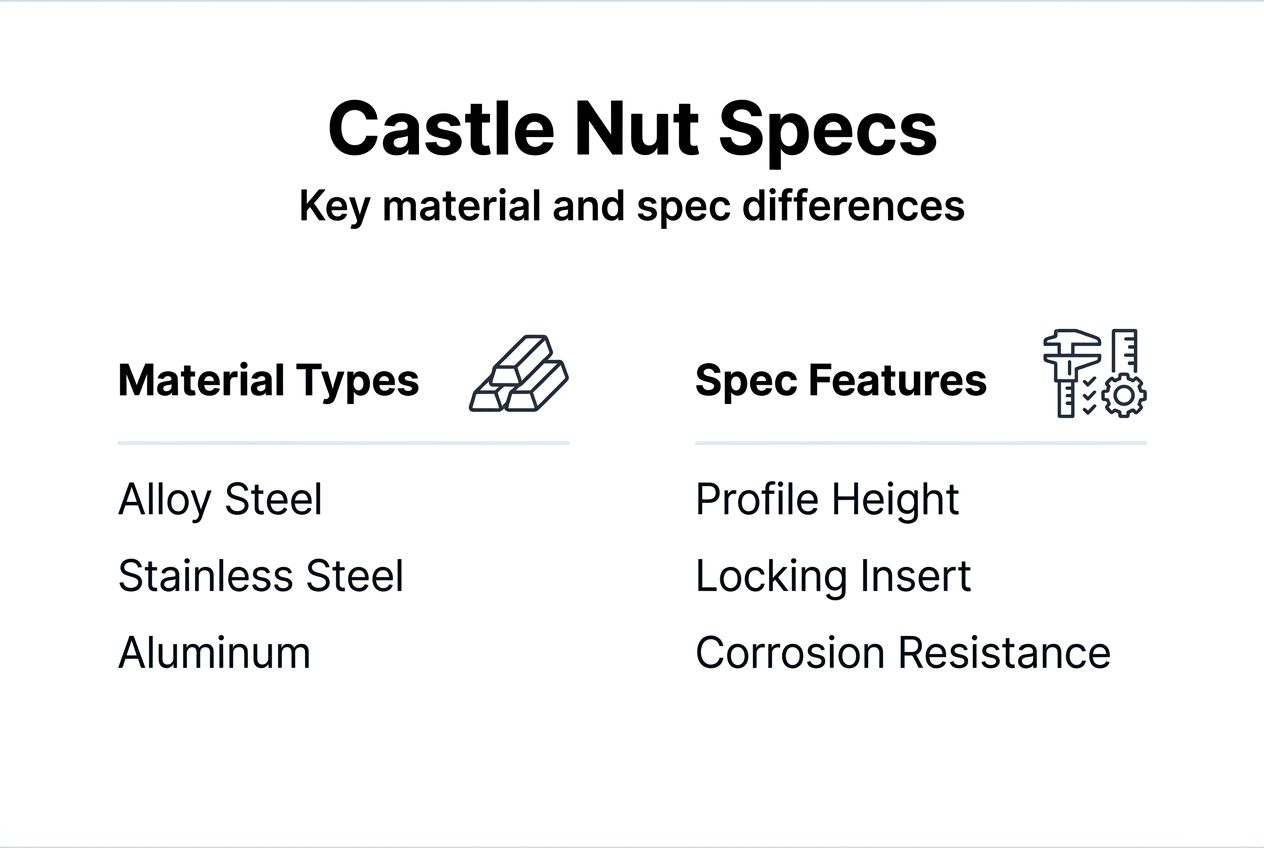
Alloy steels dominate high-strength aerospace fastener applications. AISI 4130 chromium-molybdenum steel provides excellent strength-to-weight ratios with good weldability and machinability. Grade 8740 nickel-chromium-molybdenum steel offers higher tensile strength, making it suitable for primary structural fasteners in landing gear and engine mounts. Both materials accept heat treatment to achieve required hardness levels while maintaining ductility for impact resistance.
Stainless steel castle nuts serve applications requiring superior corrosion resistance. Types 304 and 316 stainless provide excellent performance in marine environments and areas exposed to de-icing fluids. The trade-off comes in reduced tensile strength compared to alloy steels, requiring larger fastener sizes for equivalent load capacity. Stainless options work well for secondary structures and non-critical assemblies where corrosion resistance outweighs strength requirements.
7075-T6 aluminum nuts significantly reduce weight while maintaining aerospace durability with proper anodizing. This aluminum alloy contains zinc as the primary alloying element, achieving strengths comparable to mild steel at one-third the density. Weight reduction becomes critical in aerospace applications where every ounce impacts fuel efficiency and payload capacity. A typical 1/2-inch aluminum castle nut weighs approximately 0.15 ounces compared to 0.45 ounces for the steel equivalent.
Advanced surface treatments such as cadmium plating, passivation, and hardcoat anodizing improve corrosion resistance and durability. Cadmium plating provides excellent corrosion protection for steel fasteners, though environmental regulations increasingly restrict its use. Zinc-nickel plating serves as an environmentally preferred alternative with comparable performance. Passivation removes free iron from stainless steel surfaces, enhancing natural corrosion resistance. Hardcoat anodizing creates a thick, hard oxide layer on aluminum that resists wear and corrosion while maintaining the base material’s light weight.
Surface treatment selection impacts both performance and cost. Consider these factors:
- Operating environment exposure to moisture, salt, and chemicals
- Required service life and maintenance intervals
- Regulatory compliance for hazardous materials
- Compatibility with mating component finishes
- Budget constraints for treatment processes
Engineers optimizing weight in aerospace assemblies must balance material strength, corrosion resistance, and manufacturing considerations. Understanding how material choices integrate with precision machining benefits enables specification of castle nuts that meet performance requirements without unnecessary weight penalties. The additional cost of aluminum alloys and specialized coatings often justifies itself through lifecycle cost reductions in fuel consumption and maintenance.
Precision machining and manufacturing processes
Precision CNC machining with ±0.0001 inch tolerances and inspection methods like CMM and GD&T measurement are essential for aerospace castle nuts. Manufacturing processes must deliver consistent dimensional accuracy across high-volume production runs while maintaining full traceability and quality documentation for aerospace certification requirements.
The manufacturing sequence for aerospace-grade castle nuts follows a carefully controlled process:
- Raw material verification and certification review to confirm alloy composition and mechanical properties meet specifications
- CNC turning operations to establish basic hexagonal profile and thread dimensions with automatic tool compensation for wear
- Slot milling using precision indexing to create castellated features at exact angular positions for cotter pin alignment
- Thread rolling or cutting to final dimensional tolerances with proper thread class fit
- Insert installation using automated equipment to ensure proper positioning and retention
- Surface treatment application according to specified finish requirements
- Final dimensional inspection using CMM equipment with documented measurement reports
- Functional testing of prevailing torque to verify locking insert performance
Advanced machining equipment enables the tight tolerances required for aerospace fasteners. Hydromat rotary transfer machines produce high volumes of identical parts with minimal setup time between production runs. These systems combine multiple operations including turning, drilling, threading, and milling in a single automated sequence. Five-axis CNC machining centers handle complex geometries and provide the flexibility to accommodate custom specifications for specialized applications.
Tolerance control directly impacts fastener performance and assembly reliability. Thread tolerances of ±0.0005 inch ensure proper fit with mating bolts, preventing both excessive looseness that allows vibration and excessive tightness that causes galling. Hexagonal flat dimensions maintained within ±0.003 inch guarantee proper wrench engagement and torque application during installation. Slot positioning accuracy within ±2 degrees ensures cotter pins align correctly without forcing or binding.
Inspection methods validate that manufactured parts meet specifications. Coordinate measuring machines provide three-dimensional verification of critical features, generating documented reports for quality records. Geometric dimensioning and tolerancing principles define functional relationships between features, ensuring parts assemble correctly in final applications. Optical comparators verify slot profiles and castellated feature geometry against master templates.
Pro Tip: Require suppliers to provide complete inspection reports with CMM measurement data, material certifications, and functional test results. Verify that manufacturing facilities maintain AS9100 or ISO 9001 certifications to ensure consistent quality management throughout production.
Understanding the precision tolerance importance in castle nut manufacturing helps engineers write specifications that balance performance requirements with manufacturing feasibility. Overly tight tolerances increase costs without proportional benefits, while loose tolerances risk assembly problems and field failures. The expertise of precision manufacturers using CNC turning precision equipment ensures optimal balance between specification requirements and production efficiency.
Customization options and production lead times
Custom alloys, dimensions, and volume productions are available for aerospace castle nuts to meet specific defense contractor requirements. Modern precision manufacturing capabilities support tailored specifications that address unique engineering challenges while maintaining quality standards and certification compliance.
Customization extends across multiple design parameters. Material selection goes beyond standard alloys to include exotic materials like Inconel for extreme temperature applications or titanium for maximum strength-to-weight optimization. Thread specifications can accommodate non-standard pitches, special fits, or proprietary thread forms developed for specific assemblies. Castellated slot configurations adapt to different cotter pin sizes or safety wire retention methods. Locking insert materials and designs customize for operating temperature ranges, chemical exposures, and required prevailing torque levels.
Surface treatments and coatings offer additional customization possibilities. Beyond standard cadmium plating and anodizing, options include dry film lubricants that reduce installation torque, special color anodizing for visual identification of different specifications, and proprietary coatings that enhance specific performance characteristics. These custom finishes integrate into overall assembly requirements while maintaining dimensional accuracy.
Rapid prototyping capabilities accelerate development cycles for new aerospace programs. CNC machining technology produces initial prototype quantities in days rather than weeks, enabling design verification testing and assembly trials early in the development process. This speed allows engineers to validate specifications, identify potential issues, and refine designs before committing to full production tooling.
Production volume flexibility accommodates both small-batch specialty runs and high-volume manufacturing. Aerospace programs often require initial low quantities for prototyping and testing, followed by medium production volumes during platform rollout, then sustained high volumes for ongoing manufacturing and aftermarket support. Capable manufacturers scale production efficiently across this range without sacrificing quality or delivery performance.
Typical lead times vary based on specification complexity and order quantities:
- Standard catalog items with stock material: 2-3 weeks
- Custom specifications with standard materials: 4-6 weeks
- Custom alloys requiring special material procurement: 8-12 weeks
- High-volume production runs with dedicated tooling: 6-8 weeks after initial setup
Effective communication with precision manufacturers streamlines the specification and ordering process. Detailed drawings with complete GD&T callouts eliminate ambiguity about critical features. Material certifications, surface treatment requirements, and quality documentation expectations defined upfront prevent delays and misunderstandings. Regular production status updates maintain visibility into order progress and allow proactive management of schedule changes.
Engineers benefit from understanding machining trends and lead times that influence production schedules. Advanced planning and early supplier engagement minimize schedule risks for time-sensitive aerospace programs. The balance between certified quality manufacturing and rapid production cycles supports on-time delivery for critical defense and aerospace contracts.
Common misconceptions about castle nuts
Not all castle nuts are interchangeable; each MIL-SPEC defines unique thread sizes, locking types, and materials. Misunderstandings about castle nut specifications and performance capabilities lead to specification errors that compromise assembly safety and increase project costs.
The most dangerous misconception assumes all castle nuts meeting a general description can substitute for one another in aerospace applications. Military specifications exist precisely because different applications demand specific combinations of dimensions, materials, and performance characteristics. Substituting an MS17826 thin-profile nut for an MS17825 standard-height specification changes thread engagement length, potentially reducing joint strength below design requirements. Using non-specified materials alters mechanical properties and environmental resistance in ways that may not manifest until components experience service conditions.
Another widespread misunderstanding suggests that aluminum castle nuts lack the strength and durability for demanding aerospace applications. Aircraft-grade 7075-T6 aluminum with hardcoat anodizing meets aerospace durability, contrary to belief that aluminum is too weak. Properly specified and treated aluminum fasteners serve successfully in countless aerospace assemblies where weight reduction provides tangible performance benefits. The key lies in matching material selection to actual loading conditions rather than defaulting to steel based on unfounded assumptions.
A third misconception treats all self-locking inserts as functionally equivalent. Insert materials demonstrate dramatically different performance characteristics across temperature ranges and chemical exposures. Standard nylon inserts lose locking torque rapidly above 250°F, while specialized high-temperature polymers maintain performance to 450°F. Chemical resistance varies significantly, with some insert materials degrading quickly in hydraulic fluids or jet fuel while others remain stable. Assuming interchangeability without verifying environmental compatibility risks field failures.
Correct these common misconceptions:
- Castle nuts conforming to different MIL-SPEC standards are not interchangeable substitutes
- Aluminum alloys like 7075-T6 provide adequate strength for many aerospace applications when properly specified
- Self-locking insert materials have distinct temperature and chemical resistance profiles requiring careful selection
- Surface treatments significantly impact corrosion resistance and cannot be omitted or substituted arbitrarily
- Dimensional tolerances matter critically for proper assembly function and cannot be relaxed without engineering analysis
Exact MIL-SPEC compliance is non-negotiable in aerospace fastener specifications. Substitutions, even seemingly minor ones, introduce risks that can lead to assembly failures, safety incidents, and program delays. Engineers must verify complete conformance to specified standards and resist pressure to accept non-conforming alternatives.
Understanding these misconceptions helps engineers avoid specification pitfalls that compromise safety and increase costs. Proper education about castle nut specifications and performance requirements ensures aerospace assemblies receive fasteners that truly meet design intent and regulatory requirements.
Conclusion and application guidance
This guide has covered the essential technical knowledge aerospace engineers need to specify castle nuts that meet demanding MIL-SPEC standards. Key standards MS17826 and MS17825 define dimensional requirements, material specifications, and locking insert characteristics that ensure reliable performance in high-vibration aerospace environments. Self-locking inserts using nylon or specialized polymers provide continuous resistance to rotation, preventing fastener loosening during flight operations and maintenance cycles.
Material selection balances multiple competing requirements. Alloy steels like AISI 4130 and 8740 provide maximum strength for primary structures, while 7075-T6 aluminum offers significant weight savings for applications where strength requirements permit. Stainless steel serves corrosive environments where environmental durability outweighs strength considerations. Surface treatments including cadmium plating, passivation, and hardcoat anodizing enhance corrosion resistance and extend service life across diverse operating conditions.
Precision CNC machining with tolerances of ±0.0001 inch ensures dimensional accuracy essential for proper fastener function. Manufacturing processes incorporating automated equipment, rigorous inspection using CMM and GD&T principles, and complete traceability documentation deliver consistent quality across production volumes. Customization capabilities accommodate specialized requirements for materials, dimensions, threads, and coatings tailored to unique aerospace applications.
Critical decision criteria for castle nut selection include:
- Operating environment temperature range and chemical exposure
- Required tensile strength and shear load capacity
- Weight optimization opportunities and constraints
- Corrosion resistance and expected service life
- Installation and maintenance accessibility
- Certification and traceability documentation requirements
Pro Tip: Engage precision manufacturing partners early in the design process to align specifications with production capabilities and schedule requirements. Early collaboration identifies potential manufacturing challenges, optimizes designs for producibility, and establishes realistic delivery timelines that support program schedules.
Actionable steps for specifying and ordering castle nuts:
- Verify exact MIL-SPEC standard applicable to your application
- Confirm material and surface treatment compatibility with operating environment
- Define complete dimensional requirements using GD&T principles
- Specify inspection and documentation requirements for quality assurance
- Establish production volumes and delivery schedule expectations
- Request material certifications and inspection reports with deliveries
Successful aerospace programs depend on fasteners that perform reliably throughout demanding service lives. Working with manufacturers experienced in precision aerospace components ensures castle nuts meet exacting specifications while supporting aggressive development and production schedules. The expertise available from Machining Technologies LLC and similar precision manufacturers provides the technical support engineers need to specify optimal fastening solutions for critical aerospace assemblies.
Explore precision manufacturing solutions at Machining Technologies LLC
Machining Technologies LLC delivers aerospace-certified precision CNC machining services with the exacting tolerances and quality standards castle nut applications demand. With over 20 million parts produced annually in a 70,000 square foot facility, the company combines advanced Hydromat systems, five-axis CNC equipment, and comprehensive inspection capabilities to manufacture complex fasteners meeting MIL-SPEC requirements.
Customization capabilities span the full range of aerospace castle nut specifications including exotic alloys, specialized locking inserts, and certified surface treatments. Rapid prototyping through high-volume production supports aerospace programs from initial development through sustained manufacturing phases. Quality certifications and documented inspection processes ensure complete traceability for defense and aerospace applications requiring rigorous compliance.
Fast turnaround times and flexible production scheduling accommodate urgent program needs without compromising quality standards. Whether you need prototype quantities for design verification or high-volume production runs for ongoing platform manufacturing, the company’s capacity and expertise deliver on-time results. Precision parts manufacturing services cover every aspect from raw material procurement through final inspection and delivery.
Engineers benefit from collaborating with experienced precision manufacturers who understand aerospace fastener requirements and manufacturing challenges. Technical support assists with specification optimization, material selection guidance, and production planning that aligns with program schedules. Custom prototype machining capabilities accelerate development cycles while master precision machining workflow processes ensure consistent quality across production volumes. Contact Machining Technologies LLC to discuss your castle nut requirements and discover how precision manufacturing expertise supports aerospace program success.
FAQ
What are the key MIL-SPEC standards for aerospace castle nuts?
The primary standards are MS17826 covering thin-profile castle nuts and MS17825 for standard-height versions, both specifying dimensional tolerances, material requirements, and locking insert characteristics. Selection depends on application clearance constraints, required thread engagement length, and load conditions specific to your aerospace assembly.
How do locking inserts prevent castle nut loosening under vibration?
Non-metallic inserts such as nylon or specialized polymers deform elastically during installation, creating continuous friction between nut and bolt threads that resists rotation. This prevailing torque maintains joint integrity under dynamic loading and vibration without requiring additional locking hardware like cotter pins or safety wire.
Can aluminum castle nuts meet aerospace durability requirements?
Aircraft-grade 7075-T6 aluminum with hardcoat anodizing provides tensile strength comparable to mild steel while reducing weight by approximately 65 percent. When properly heat-treated and surface-finished, aluminum castle nuts serve successfully in many aerospace applications where corrosion resistance and weight optimization are priorities.
What inspection methods ensure castle nut precision in aerospace manufacturing?
Coordinate measuring machines verify critical dimensions in three-dimensional space, while geometric dimensioning and tolerancing principles define functional feature relationships. Complete inspection reports documenting thread tolerances, hexagonal flat dimensions, and slot positioning accuracy provide quality assurance and traceability for aerospace certification requirements.
Recommended
- Precision Parts Manufacturing: Maximizing Quality and Throughput | Machining Technologies
- Machining Trends 2026: 40% Faster Lead Times + 50% Tool Life | Machining Technologies
- Master Precision Machining Workflow for Firearms Components | Machining Technologies
- Firearm parts machining: ±0.001" tolerance ensures reliability | Machining Technologies