
A digital twin is a real-time virtual replica of a physical system that continuously updates from live equipment data, giving manufacturers the predictive insight to cut downtime, tighten quality, and compress ramp-to-volume timelines. For U.S. OEMs and contract manufacturers, that translates directly to fewer unplanned stoppages, faster new-product launches, and tighter traceability across regulated supply chains.
NIST estimates that U.S. discrete manufacturers lose roughly $245 billion annually to unplanned downtime alone, with defects adding another $32–$58.6 billion on top. Digital-twin adoption targets both numbers simultaneously.
Where the technology pays off immediately:
- Predictive maintenance on high-cycle assets such as Hydromat and CNC lines
- Virtual commissioning of new fixtures or pilot lines before physical build
- In-process quality monitoring to catch tolerance drift before parts go out of spec
- Production scheduling with what-if scenario testing across capacity constraints
The rest of this guide walks through the definition, technical architecture, use cases, a pilot checklist, and a concrete contract-manufacturer example so you can evaluate or scope a program with confidence.
Table of Contents
- What is a digital twin in manufacturing, and how does it differ from simulation?
- What are the core technical components of an industrial digital twin?
- How do digital twins improve manufacturing for OEMs and contract manufacturers?
- How do you plan and execute a digital twin pilot?
- What technical and data challenges should you plan for?
- Which KPIs prove digital twin ROI in manufacturing?
- What are the most common digital twin pitfalls?
- How Machining Technologies LLC supports a digital twin program
- Key Takeaways
- Why the digital twin conversation matters more than the technology
- Machining Technologies LLC: precision machining built for twin-ready OEM programs
- Useful sources for further research
What is a digital twin in manufacturing, and how does it differ from simulation?
The term gets misused constantly. A simulation is a one-time, offline model you run to validate a design or test a scenario. A digital twin is a living system. The key differentiator is a continuous, automated update cycle driven by IoT and PLC feeds, not just a high-fidelity 3D model.
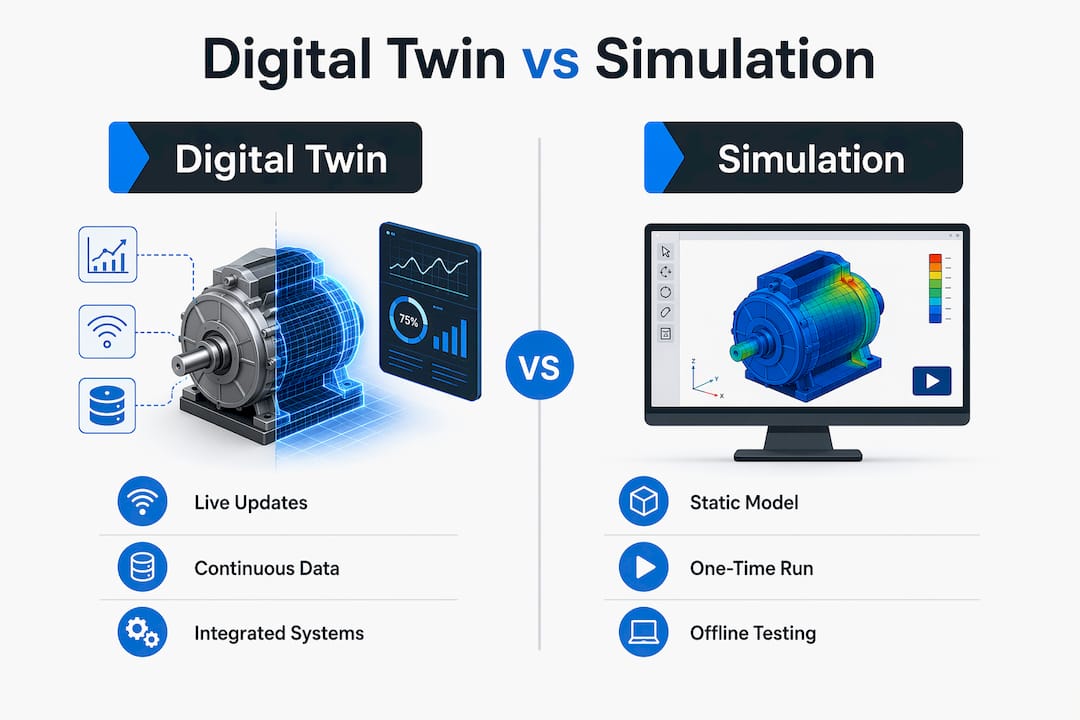
NIST defines digital twins as computer models of physical systems that forecast states and support monitoring, optimization, and decision support across the full lifecycle. The critical addition: bi-directional data exchange. The twin reads from the physical asset and can write back to control systems, closing the loop on process corrections.
Signals you are looking at a real digital twin:
- Real-time or near-real-time data sync from sensors, PLCs, or HMIs
- Closed-loop capability (model outputs can influence control parameters)
- Predictive models that update as the physical system changes
- Multi-domain scope covering mechanical, electrical, software, and process parameters
Signals you are looking at a simulation:
- Single-run or batch-run model, not continuously updated
- Offline, no live data feed
- Output is a report or visualization, not a control signal
- Scope limited to one discipline (e.g., FEA stress analysis only)
Siemens describes the “comprehensive digital twin” as an integrated network spanning mechanical behavior, drives, sensors, and safety topics across the entire product lifecycle, enabling parallel engineering phases that compress lead times from concept to production.
Pro Tip: When evaluating a vendor’s “digital twin” claim, ask three questions: What is the update frequency? Which industrial protocols does it support (OPC UA, MTConnect, Modbus)? Can the model write back to control systems? If the answers are “batch,” “proprietary only,” and “no,” you are buying a simulation dashboard.
What are the core technical components of an industrial digital twin?
Think of the architecture in three layers: physical, data/edge, and cyber/model.
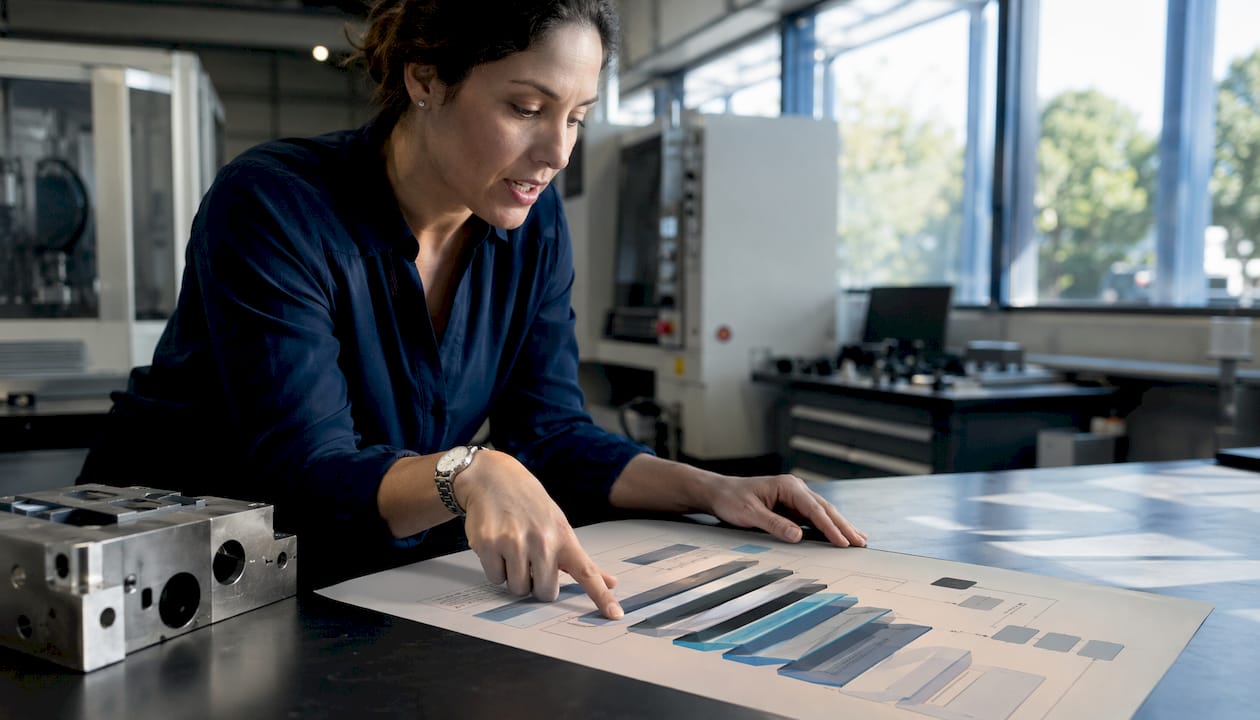
Physical layer: Sensors, PLCs, HMIs, and CNC controllers capturing spindle load, temperature, cycle time, tool-life telemetry, and dimensional feedback. For precision machining, sample rates matter; a Hydromat running 20 million parts annually needs sub-second cycle data to catch drift before it becomes scrap.
Data/edge layer: Edge gateways and protocol translators (OPC UA, MTConnect, MQTT, Modbus) normalize data from disparate equipment. A historian or time-series database stores the stream. This layer is where most legacy-equipment projects stall, because older PLCs speak proprietary dialects.
Cyber/model layer: The modeling and simulation engine, ML/analytics stack, and integration connectors to MES, ERP, PLM, and SCADA. McKinsey highlights the need for a modular, scalable tech stack and a single source of truth, meaning one common data model that all systems read from rather than parallel siloed databases.
A common data governance framework sits across all three layers: defining data ownership, retention policies, access controls, and model-validation cadence. Without it, the twin drifts from reality within months.
ScienceDirect research on aerospace component assembly shows that digital-twin-based tolerance allocation and real-time assembly control can materially reduce out-of-tolerance occurrences, a direct payoff for precision machining operations where rework is expensive.
How do digital twins improve manufacturing for OEMs and contract manufacturers?
McKinsey reports that factory twins enable simulation of production schedules, capacity constraints, and what-if scenarios, giving contract manufacturers a concrete tool for winning OEM business through superior traceability and agility.
Prioritized use cases by impact and implementation ease:
| Use Case | Primary Benefit | Pilot Complexity |
|---|---|---|
| Predictive maintenance (CNC/Hydromat) | Reduced unplanned downtime | Low — single asset |
| In-process quality monitoring | Improved first-pass yield, fewer rejects | Medium |
| Virtual commissioning | Faster fixture/line ramp | Medium |
| Production scheduling / what-if | Throughput and changeover optimization | Medium–High |
| Regulated-industry traceability | Audit-ready part genealogy | High |
Predictive maintenance on a single high-cycle asset is the easiest entry point. You instrument one machine, build a baseline, and measure MTBF improvement within 90 days. Virtual commissioning, by contrast, requires a full multi-domain model of the new line before it is built, which demands CAD/CAM/PLM alignment and more upfront investment.
For OEMs requiring traceability in aerospace or defense supply chains, a twin that logs every process parameter against every part serial number is no longer a differentiator. It is increasingly a qualification requirement.
How do you plan and execute a digital twin pilot?
McKinsey’s recommended adoption path is a phased sequence: proof of concept, then minimum viable twin (MVT), then live data connection, then optimization layer. Siemens echoes the same philosophy: “Think big. Start small.”
- Define objectives and KPIs — pick one measurable outcome (e.g., reduce unplanned downtime on Line 3 by 15%).
- Select the pilot asset — choose a high-impact bottleneck, not the easiest machine to instrument.
- Audit data availability — inventory existing sensors, PLC outputs, data rates, and historian coverage.
- Build the MVT — a minimum model validated against historical ground truth before any live connection.
- Validate against ground truth — compare model predictions to actual outcomes for 4–6 weeks.
- Integrate with MES/ERP — connect the twin’s outputs to scheduling and quality systems.
- Add analytics and optimization — layer ML-based predictive models once the data pipeline is stable.
- Scale and govern — replicate to additional assets with a formal data-governance charter.
Timeline guidance: A machine-level pilot typically runs 3–6 months from kickoff to validated MVT. Scaling to a cell or full line adds another 6–12 months depending on integration complexity and legacy-equipment gaps.
RFP checklist items to include when sourcing a twin partner:
- Supported industrial protocols (OPC UA, MTConnect, Modbus)
- Data update cadence and minimum sample rates
- Data ownership and portability terms
- Cybersecurity posture and OT/IT segmentation approach
- SLA for model maintenance and drift correction
- Integration responsibilities for MES/ERP/PLM connectors
Pro Tip: Run a 4–6 week data audit before committing to a vendor. Map every data source, its format, its update rate, and who owns it. Projects that skip this step routinely discover mid-pilot that 40% of the sensors they planned to use are either offline or writing to an inaccessible proprietary historian.
What technical and data challenges should you plan for?
Legacy equipment is the most common friction point. Older PLCs use proprietary communication protocols that require edge gateways or protocol translators before any data reaches the twin. Budget for this retrofit work explicitly; it is rarely included in platform vendor quotes.
Cybersecurity checklist for OT/IT boundaries:
- Network segmentation between OT (shop floor) and IT (enterprise) zones
- Secure, authenticated gateways for all data crossing the boundary
- Vendor remote-access controls with time-limited, audited sessions
- Patch management policy for edge devices and historian servers
- Data encryption in transit and at rest
Standards alignment matters too. OPC UA is the dominant protocol for machine-level data in precision machining environments; MTConnect covers CNC-specific telemetry. Requiring both in your RFP covers most modern equipment and many retrofittable legacy assets.
Automation of machining processes and digital-twin readiness go hand in hand: the same sensor infrastructure that enables automated process control feeds the twin’s data pipeline.
Which KPIs prove digital twin ROI in manufacturing?
| KPI | What It Measures | Typical Twin Lever |
|---|---|---|
| Equipment availability (uptime %) | Unplanned downtime frequency | Predictive maintenance |
| MTBF | Mean time between failures | Early fault detection |
| MTTR | Mean time to repair | Faster diagnosis via twin |
| First-pass yield (FPY) | Parts passing inspection first time | In-process quality monitoring |
| OEE | Combined availability, performance, quality | Full-line twin |
| Changeover time | Time lost switching products | Scheduling optimization |
| Scrap rate | Material wasted per run | Tolerance drift detection |
For high-volume production, even a 5% uptime improvement on a Hydromat line running millions of cycles annually translates to a significant reduction in cost per part. A 3% drop in scrap rate on tight-tolerance aerospace components can recover the cost of a machine-level pilot within a single production quarter.
Assign KPI ownership explicitly: shop-floor engineers own MTBF and MTTR; operations managers own OEE and throughput; procurement owns cost-per-part trends. Without named owners and a reporting cadence, KPI data goes stale and the twin loses executive support.
What are the most common digital twin pitfalls?
Over-engineering and data siloing are the two failure modes that kill more programs than any technology gap. Modeling every component of a 50-machine line before proving value on one asset burns budget and goodwill simultaneously.
Pitfalls and mitigations:
- Over-engineering: Start with the single highest-impact bottleneck asset; expand only after the MVT proves ROI.
- Data siloing: Mandate a single source of truth from day one; no parallel historians or shadow spreadsheets.
- Unclear KPIs: Define success metrics before selecting technology, not after.
- Insufficient OT/IT collaboration: Assign a joint OT/IT lead from project kickoff; decisions made by one team without the other create integration debt.
- No governance owner: Name a data steward responsible for model drift, access controls, and version history.
For regulated sectors (aerospace, defense, firearms), traceability and data-retention requirements must be built into the twin’s data model from the start, not retrofitted after audit findings.
How Machining Technologies LLC supports a digital twin program
Machining Technologies LLC operates a 70,000 sq. ft. facility in Webster, Massachusetts, producing over 20 million parts annually across Hydromat high-volume lines, CNC milling and turning, and Wire EDM. That asset base, running since 1985, represents exactly the kind of high-cycle, tight-tolerance environment where a machine-level digital twin delivers measurable ROI fastest.
A typical engagement with an OEM digital-twin program follows this workflow:
- Pilot selection: Identify the highest-volume, highest-scrap-risk asset (often a Hydromat cell) as the twin candidate.
- Sensor retrofit and data integration: Instrument the asset with spindle load, temperature, and cycle-time sensors; connect via OPC UA or MTConnect to the data pipeline.
- MVT validation: Run the minimum viable twin against 4–6 weeks of historical production data before connecting live.
- Production integration: Link twin outputs to the MES for scheduling feedback and quality alerts.
- Continuous improvement loop: Use predictive maintenance alerts and tolerance-drift signals to drive weekly process reviews.
What to ask any contract manufacturer about digital-twin readiness:
- Do you have existing sensor infrastructure on your primary assets?
- Which industrial protocols do your PLCs and controllers support?
- Can you provide part-level process data for traceability requirements?
- What is your SLA for data access and reporting during production runs?
- Have you participated in a customer-led twin pilot before?
Key Takeaways
Digital twins deliver measurable manufacturing ROI only when built on continuous IoT data feeds, a single source of truth, and clearly owned KPIs, not on high-fidelity models alone.
| Point | Details |
|---|---|
| Twin vs. simulation | A real twin updates continuously from live IoT/PLC data; a simulation is a static, single-run model. |
| Start with one bottleneck | Pilot on the highest-impact asset first; scale only after the MVT proves ROI in 3–6 months. |
| Data audit before vendor | Run a 4–6 week data audit to map sources, formats, and ownership before committing to a platform. |
| KPI ownership is mandatory | Assign named owners for MTBF, FPY, OEE, and scrap rate; unowned KPIs go stale and lose executive support. |
| Machiningtechllc as twin partner | Machining Technologies LLC’s Hydromat, CNC, and Wire EDM assets and 20M+ annual parts make it a concrete pilot candidate for OEM digital-twin programs. |
Why the digital twin conversation matters more than the technology
The most underestimated risk in a digital twin program is not the technology. It is the organizational assumption that buying a platform solves the problem. Every failed twin program I have analyzed shares the same root cause: data that was never clean, KPIs that were never agreed on, and an IT team that learned about the OT integration requirements six months too late.
The manufacturers who get real value from twins are the ones who treat it as a data architecture project first and a software purchase second. They audit their data before they write a check. They pick one bottleneck asset, prove the number, and then use that proof to fund the next phase. They involve shop-floor operators from week one, because the operators know where the data gaps are before any consultant does.
For OEMs sourcing contract manufacturers, the right question is not “do you have a digital twin?” It is “can you give me part-level process data, and what does your sensor infrastructure look like today?” A partner who can answer that question specifically is already most of the way there.
Machining Technologies LLC: precision machining built for twin-ready OEM programs
OEMs running digital-twin programs need a contract manufacturer who can deliver part-level process data, not just finished parts. Machining Technologies LLC brings 35+ years of high-volume precision machining experience, a 70,000 sq. ft. facility equipped with Hydromat systems, CNC milling and turning, and Wire EDM, and the throughput capacity to support both pilot-scale validation and full-production ramp.
Whether you are scoping a machine-level predictive maintenance pilot or need a manufacturing partner who can feed traceability data into your existing MES, Machining Technologies LLC is built for that conversation. The facility’s OEM contract machining capabilities cover the full range from prototype validation through 20 million parts annually, with the process control and documentation to support regulated-industry requirements.
Ready to discuss how your digital-twin program maps to a contract manufacturing partner? Request a production quote and start the technical conversation today.
Useful sources for further research
- NIST Digital Twins — The authoritative U.S. government definition, lifecycle framework, and quantified manufacturing loss estimates; use this when building RFP acceptance criteria.
- McKinsey: Digital Twins — The Next Frontier of Factory Optimization — Business-case framing, what-if scenario use cases, and the phased adoption roadmap (POC → MVT → optimizer).
- Siemens: What Is the Comprehensive Digital Twin? — Multi-domain integration guidance and parallel engineering benefits for industrial machinery manufacturers.
- MDCplus: Manufacturing Digital Twin Guide — Practitioner-level explanation of the simulation-vs-twin distinction and common failure modes.
- ScienceDirect: Digital Twin Technology for Precision Assembly — Peer-reviewed research on tolerance allocation and out-of-tolerance reduction in complex assemblies; useful for aerospace and defense RFP language.
- PMC: AI-Driven Digital Twins for Manufacturing — Comprehensive literature review covering machine-level through enterprise-level AI-integrated twin applications, including CNC machining and robotics deployments.
- AWS: Digital Twins and CPG Manufacturing Transformation — Practical architecture breakdown (physical, connectivity, model layers) and a real-world implementation case study with measurable outcomes.
Recommended
- How to optimize part prototyping for OEMs | Machining Technologies
- Unlock Customization for Precision Manufacturing Success | Machining Technologies
- Why Automate Machining Processes: Boosting OEM Efficiency | Machining Technologies
- OEM contract machining: Streamline precision for high-volume production | Machining Technologies