

TL;DR:
- Certifications alone do not guarantee a supplier’s ability to produce parts within specific tolerances or quality standards.
- Verification of scope, accreditation, process capability data, and trial orders are essential to ensure true capability before large production.
A certification tells you a supplier has an audited quality management system. It does not tell you whether that supplier can hold a ±0.0002" bore diameter on your specific aerospace housing. That distinction is what separates a smart procurement decision from an expensive rework cycle.
For U.S. contract machining, the credentials that matter most are ISO 9001, AS9100, NADCAP, ISO 13485, ISO/IEC 17025, and ITAR registration (with NIST SP 800-171 compliance for defense supply chains). Machiningtechllc works with buyers across aerospace, defense, and industrial manufacturing who need more than a certificate on file.
What to do immediately:
- Verify the certificate lists the exact manufacturing site and scope, not just the parent company
- Confirm the accreditation body (ANAB, IAF member) and check the most recent surveillance date
- Require a First Article Inspection (FAI) or PPAP before committing to production volume
- For defense programs, confirm ITAR registration and NIST SP 800-171 compliance documentation
Table of Contents
- Which certifications actually matter for U.S. contract machining?
- What certifications do NOT guarantee
- How do you verify a supplier’s actual capability?
- What documents and questions should you request?
- How certification checks play out in real qualification scenarios
- When should a certification be mandatory vs. desirable?
- Key Takeaways
- Why capability evidence matters as much as the certificate
- Machiningtechllc: qualified, verified contract machining for OEM buyers
- Authoritative verification resources for U.S. buyers
Which certifications actually matter for U.S. contract machining?
Explaining machinist certifications starts with separating two categories: quality management system (QMS) certifications and process-specific approvals. A QMS certificate proves a supplier documents, audits, and corrects its processes. A process approval proves a specific process meets a defined technical standard.

| Certification | What It Covers | Industry Relevance | How to Verify |
|---|---|---|---|
| ISO 9001 | QMS baseline: documentation, corrective action, management review | General manufacturing, industrial | IAF CertSearch database; check site, scope, expiry |
| AS9100 | Aerospace QMS + APQP/PPAP expectations, risk management, FOD controls | Aerospace, defense | OASIS database (IAQG); confirm revision level and site |
| NADCAP | Special process accreditation: heat treat, plating, welding, NDT | Aerospace, defense | PRI/NADCAP accreditation listings; confirm commodity scope |
| ISO 13485 | Medical device QMS: design controls, traceability, sterile process documentation | Medical devices | IAF CertSearch; confirm scope includes your device class |
| ISO/IEC 17025 | Calibration and testing lab competence | Any regulated industry requiring traceable measurement | ANAB or A2LA accreditation database |
| ITAR / NIST SP 800-171 | Export controls (ITAR) and defense data security (DFARS/NIST SP 800-171) | Defense, government contracts | DDTC registration lookup; SPRS score for NIST 800-171 |
| NIMS credentials | Individual operator competency: CNC milling, turning, EDM, measurement | Workforce qualification signal | NIMS credential verification; stackable, portable credentials |
A few things worth knowing about each tier:
- ISO 9001 is the floor, not the ceiling. Every serious contract shop should hold it, but it says nothing about tolerances, fixturing, or machine capability.
- AS9100 adds APQP and PPAP requirements on top of ISO 9001. If you’re sourcing aerospace structure or flight-critical hardware, this is non-negotiable.
- NADCAP is the only credential that validates a special process for aerospace — heat treat, anodize, Nadcap-approved NDT. A shop can be AS9100-certified and still send parts to an unaccredited plating house.
- ISO 13485 requires design-history file controls and traceability that ISO 9001 does not. Medical buyers should confirm the scope explicitly names their device category.
- NIMS credentials are operator-level signals. Over 130,000 NIMS credentials have been issued, earned through both performance assessments and theory exams. They tell you a machinist passed a competency test — they do not substitute for supplier-level process validation on a regulated production program.
What certifications do NOT guarantee
A certificate is evidence of a system, not a promise about your part. The gap between those two things is where quality escapes happen.
Concrete gaps certificates leave open:
- Fixture and toolpath design for your specific geometry — no QMS audit tests this
- Machine-type experience — a shop certified to AS9100 may have never run a Hydromat or a 5-axis simultaneous cut
- Program stability on tight tolerances — Cpk data on a similar feature is the only real proof
- Material traceability to your mill cert — ISO 9001 requires a traceability procedure, not that the procedure works for your alloy and heat number
- Validated special processes — NADCAP scope must explicitly name the commodity (e.g., “Chemical Processing — Anodize”) or the approval does not cover it
The downstream cost of assuming a certificate is enough shows up in schedule slips, incoming inspection rejections, and supplier changeover expenses. As industry experts note, the real cost of an unqualified supplier is downstream — quality escapes, missed ship dates, and rework — and certifications are a foundation rather than a guarantee.
Pro Tip: Treat any certification as a baseline trust signal, then layer on targeted verification: Cpk data on comparable features, a recent FAI or PPAP report, and a 3–5 piece trial order before releasing production quantities.
How do you verify a supplier’s actual capability?
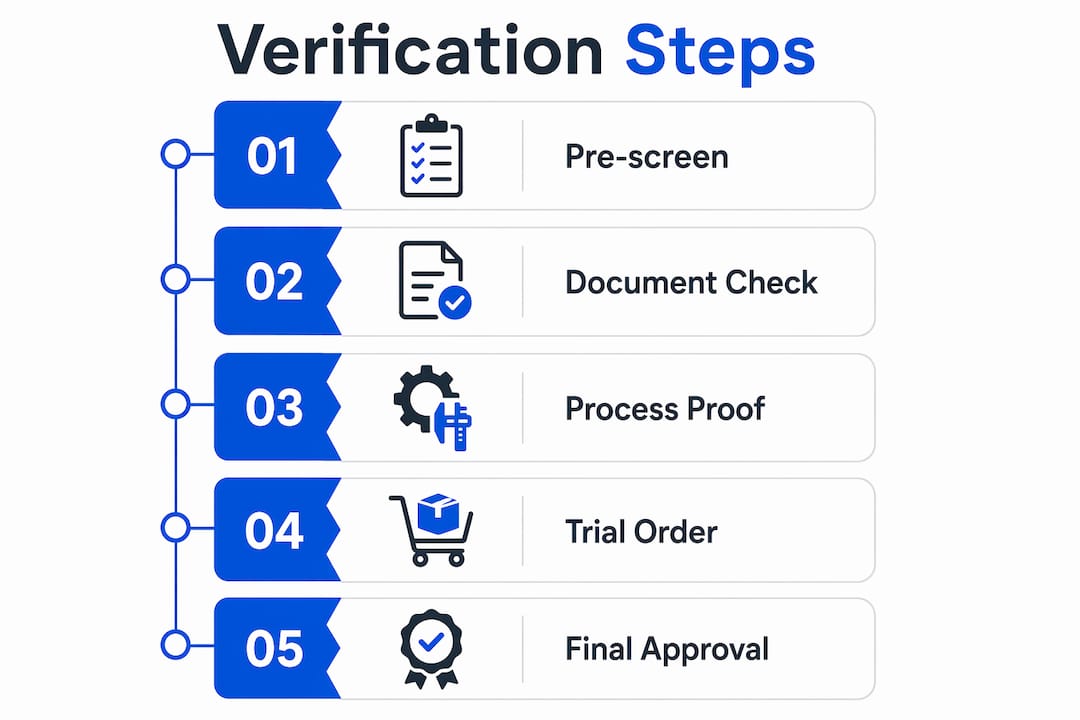
A 30-minute screening call and a capability questionnaire eliminate 60–70% of mismatched suppliers before you spend time on a full RFQ. Structure the rest of your verification in four steps.
Step 1: Pre-screen
Send a one-page capability questionnaire covering machine types (CNC turning, milling, Hydromat, wire EDM), material families, tolerance range, and any required special processes. Follow up with a 30-minute call to confirm the shop has run comparable features.
Step 2: Document verification
| Verification Step | Who Performs It | Expected Evidence |
|---|---|---|
| Certificate copy review | Procurement | Site name, scope language, expiry date, accreditation body |
| Database lookup | Procurement | IAF CertSearch (ISO 9001/13485), OASIS (AS9100), NADCAP listings, ANAB |
| Surveillance/audit date check | Procurement | Last audit date, open nonconformances (NCs) |
| ITAR/NIST SP 800-171 | Procurement / Legal | DDTC registration, SPRS score or System Security Plan |
Expired or suspended certifications are a common red flag — always verify on the independent database, never from a PDF the supplier emails you.
Step 3: Process evidence
Request Cpk/Cp values for features comparable to your critical dimensions. A qualified shop should demonstrate Cpk ≥ 1.33 on production-critical features. Also request calibration certificates, CMM capability statements, and mill certs with heat numbers for any structural alloy.
Step 4: Trial order
Define pass criteria before the order ships: 100% of critical dimensions in tolerance, ≥95% of non-critical. Place a 3–5 piece run, perform independent incoming inspection, and review on-time delivery and PPM data before releasing volume. This is the step most buyers skip — and the one that catches the most problems.
What documents and questions should you request?
Use this list verbatim during RFQ and supplier audits.
Document request list:
- Certificate copy with explicit site address and scope language
- Accreditation body name and most recent surveillance date
- Any open nonconformances from the last audit cycle
- Current FAI or PPAP package for a comparable part
- Recent SPC/Cpk reports on critical features
- Calibration records and CMM capability statement
- Mill certifications with heat numbers for all structural materials
- NADCAP approval certificates listing specific commodity scopes
- ITAR registration confirmation and NIST SP 800-171 compliance documentation (defense programs)
Scripted screening questions:
- “Can you demonstrate Cpk ≥ 1.33 on critical features from a recent production run?”
- “Do you supply mill certs with heat numbers for every structural material shipment?”
- “What was your most recent surveillance or audit date, and were any nonconformances raised?”
- “Is your NADCAP approval current, and does it explicitly cover the commodity we need?”
- “What is your current ITAR registration status and SPRS score?”
Pro Tip: Tie PO acceptance and payment milestones to FAI/PPAP signoff and material traceability documents. A supplier who resists this condition is telling you something important about how they manage production records.
How certification checks play out in real qualification scenarios
Two anonymized examples from procurement qualification work illustrate why the verification steps above matter.
Scenario A — Aerospace structural bracket:
A buyer qualified a supplier on AS9100 registration alone. During a pre-production audit, the team discovered the supplier’s NADCAP approval covered chemical processing but not the specific anodize process required by the drawing note. The supplier was not disqualified — but qualification was paused until a process audit confirmed the subcontractor performing the anodize held the correct NADCAP commodity scope. The delay was two weeks. Without the scope check, it would have been a first-article rejection.
Scenario B — Medical device housing:
An ISO 13485 certificate was on file, but when the buyer requested a validation package for the sterilization-compatible surface finish, the supplier could not produce one. The traceability records for the implant-grade titanium did not include the required heat numbers. A trial run was placed, a supplier corrective action was issued, and the supplier updated its material receiving procedure before production was released.
Catching a NADCAP scope mismatch or a traceability gap at the qualification stage costs hours. Catching it after first article costs weeks and a production slot. The document checklist is not bureaucracy — it is the cheapest inspection you will ever run.
When should a certification be mandatory vs. desirable?
1. Mandatory (regulatory or contractual requirement applies)
- AS9100 for flight-critical or aerospace structural hardware
- ISO 13485 for medical device components subject to FDA oversight
- ITAR registration and NIST SP 800-171 compliance for defense programs
- NADCAP for any special process called out on an aerospace drawing
Minimum documents: Certificate copy with site/scope, accreditation database confirmation, current FAI/PPAP, NADCAP commodity listing where applicable.
2. Conditional (high-volume or tight-tolerance production)
- ISO 9001 with documented Cpk ≥ 1.33 on critical features
- FAI/PPAP required before production release
- SPC data and calibration records on file
Minimum documents: Certificate copy, Cpk reports, trial-order inspection results, mill certs.
3. Desirable (low-risk, commodity parts)
- ISO 9001 preferred but not contractually required
- Spot-check incoming inspection acceptable
Minimum documents: Certificate copy, supplier self-declaration, periodic incoming inspection.
For contractual language, require the certificate copy and FAI signoff as explicit PO conditions. Tie final payment to receipt of the complete FAI/PPAP package and material traceability documents.
Key Takeaways
Certifications are necessary but not sufficient. Verify scope and accreditation, require process evidence, and run a trial order before committing to production volume.
| Point | Details |
|---|---|
| Certificates prove systems, not parts | ISO 9001 and AS9100 confirm an audited QMS — not that a supplier can hold your specific tolerance. |
| Always verify on independent databases | Use IAF CertSearch, OASIS, or NADCAP listings; never rely solely on a supplier-provided PDF. |
| Require Cpk ≥ 1.33 for critical features | Request SPC data on comparable features before releasing any production quantity. |
| Tie PO milestones to FAI/PPAP | Make FAI signoff and material traceability documents a contractual condition, not a courtesy request. |
| Machiningtechllc supports full qualification | Machiningtechllc provides FAI/PPAP documentation, Cpk data, and material traceability for OEM buyers. |
Why capability evidence matters as much as the certificate
Certifications are the starting point, not the finish line. A supplier can hold ISO 9001 and still lack the fixturing depth, machine-type experience, or process stability your program requires. The verification workflow described here — scope check, database lookup, Cpk data, trial order — is how procurement teams close that gap before it becomes a production problem.
Machiningtechllc operates from a 70,000 sq ft facility in Webster, Massachusetts, running Hydromat high-volume systems, CNC milling and turning, and wire EDM. The team supports buyers who need more than a certificate on file: FAI/PPAP packages, process capability data, and material traceability are part of the standard qualification conversation. If you want to discuss your program’s qualification requirements, the team is ready to provide capability data and walk through the verification steps with you.
Machiningtechllc: qualified, verified contract machining for OEM buyers
Buyers who complete the verification workflow above need a supplier who can meet every checkpoint without friction.
Machiningtechllc delivers high-volume Hydromat machining, CNC milling and turning, and wire EDM from a single 70,000 sq ft facility, with FAI/PPAP expertise, full material traceability, and on-time delivery performance built into every production program. The team has served aerospace, defense, firearms, and industrial OEMs since 1985, producing over 20 million parts annually. For buyers who need a precision parts manufacturing partner that can back its capability claims with data, Machiningtechllc offers a qualification packet and a free screening call to start the process. Contact the team to request capability data, review your FAI requirements, or discuss your program’s certification and traceability needs.
Authoritative verification resources for U.S. buyers
Use these databases and standards bodies to confirm certificates independently.
- IAF CertSearch — verify ISO 9001 and ISO 13485 certificates; check site address, scope, expiry, and accreditation body
- OASIS (IAQG) — verify AS9100 certificates; confirm revision level and site
- PRI/NADCAP listings — confirm NADCAP accreditation by supplier and commodity scope
- ANAB and A2LA — verify ISO/IEC 17025 calibration and testing lab accreditations
- DDTC registration lookup — confirm ITAR registration status for defense suppliers
- SPRS (Supplier Performance Risk System) — review NIST SP 800-171 compliance scores for defense supply chain
- NIMS credential resources — verify individual operator credentials across machining, metalforming, and quality portfolios
For each lookup, save a dated screenshot or PDF to the supplier file. Document the verification date, the accreditation body confirmed, and any open nonconformances noted. A supplier whose certificate cannot be found on the relevant database — regardless of what their paperwork says — is not certified for your purposes.
Recommended
- How to Select the Right Machining Partner for OEM Success | Machining Technologies
- How to select reliable firearm machining partners | Machining Technologies
- OEM contract machining: Streamline precision for high-volume production | Machining Technologies
- Subcontract Machining: Boost OEM Precision & Efficiency | Machining Technologies