


TL;DR:
- Manufacturing efficiency optimization relies on accurate OEE measurement, bottleneck elimination, and human-supervised digital tools. Consistent progress depends on precise data, systematic application of VSM and TOC, and disciplined daily management practices. Avoid measurement errors and over-automation, focusing instead on validated metrics and experienced judgment to sustain improvements over time.
Manufacturing efficiency optimization is the process of maximizing production output while minimizing waste, downtime, and defects through targeted measurement and systematic improvement. The industry standard metric for this work is Overall Equipment Effectiveness (OEE), which combines Availability, Performance, and Quality into a single score that exposes exactly where a facility loses capacity. Beyond OEE, methodologies like Value Stream Mapping (VSM), the Theory of Constraints (TOC), and human-supervised automation give operations managers a layered toolkit to improve manufacturing processes at every level. Facilities that apply these methods together consistently report reduced lead times, fewer defects, and higher throughput without proportional increases in capital spending.
How to optimize manufacturing efficiency with OEE as your foundation
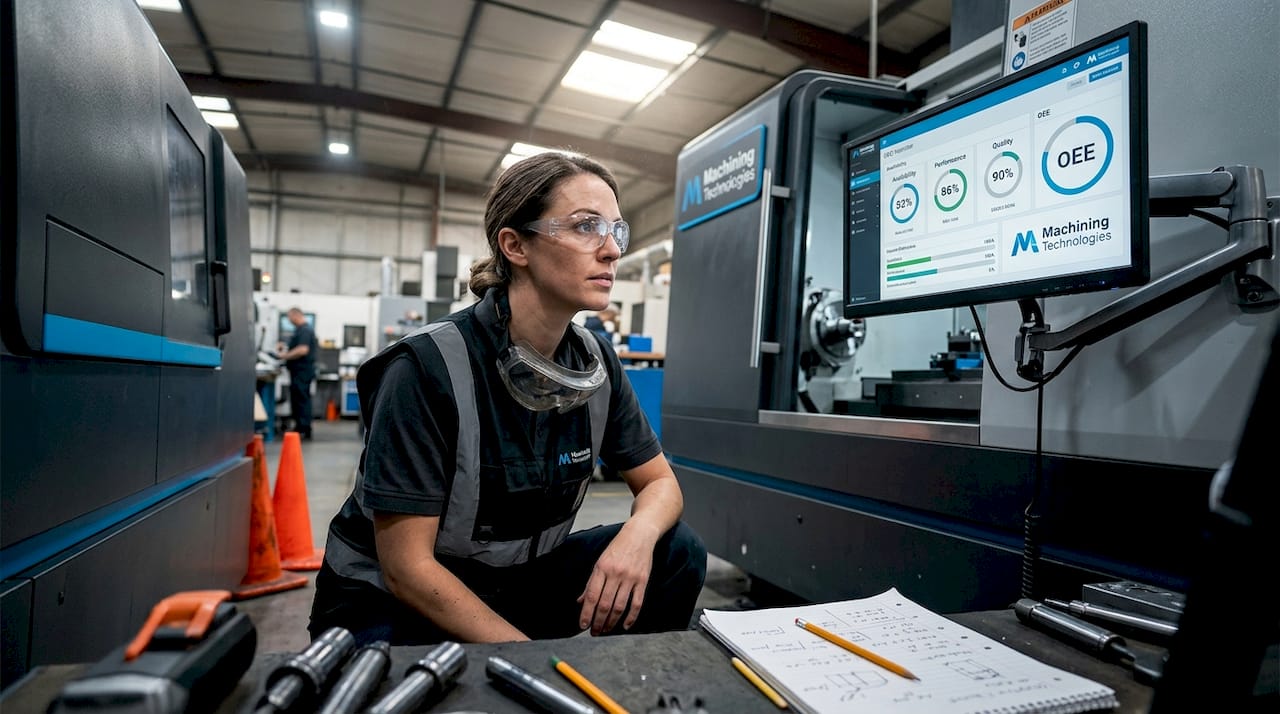
Overall Equipment Effectiveness is the most widely used metric for measuring and improving production efficiency, and it is the right place to start any optimization effort. OEE is calculated as the product of three independent components per ISO 22400-2:2014: Availability (Actual Production Time divided by Planned Busy Time), Performance (Planned Run Time per Item multiplied by Produced Quantity, divided by Actual Production Time), and Quality (Good Quantity divided by Produced Quantity). Each component maps directly to a category of loss, which means a low score in any one of them tells you precisely where to focus.
The multiplicative structure of OEE is what makes it so revealing. A line running at 90% availability, 85% performance, and 95% quality produces an OEE of roughly 72.7%, not the 90% a manager might assume from looking at uptime alone. That gap between perceived and actual efficiency is where most improvement opportunities hide. Improving the weakest component first always yields the highest return per unit of effort.
Each OEE component corresponds to a set of losses known as the Six Big Losses:
- Availability losses: Unplanned breakdowns and planned stops (changeovers, maintenance)
- Performance losses: Minor stoppages and reduced speed
- Quality losses: Startup rejects and production defects
Prioritizing improvement starts by identifying which of these three categories is dragging your OEE score down the most. If availability is the floor, focus on preventive maintenance and changeover reduction before touching anything else. If quality is the constraint, defect root cause analysis and process standardization take priority.
Pro Tip: Decompose OEE into its three components before any improvement meeting. Presenting a single OEE number without the breakdown almost always misdirects the team toward the wrong problem.
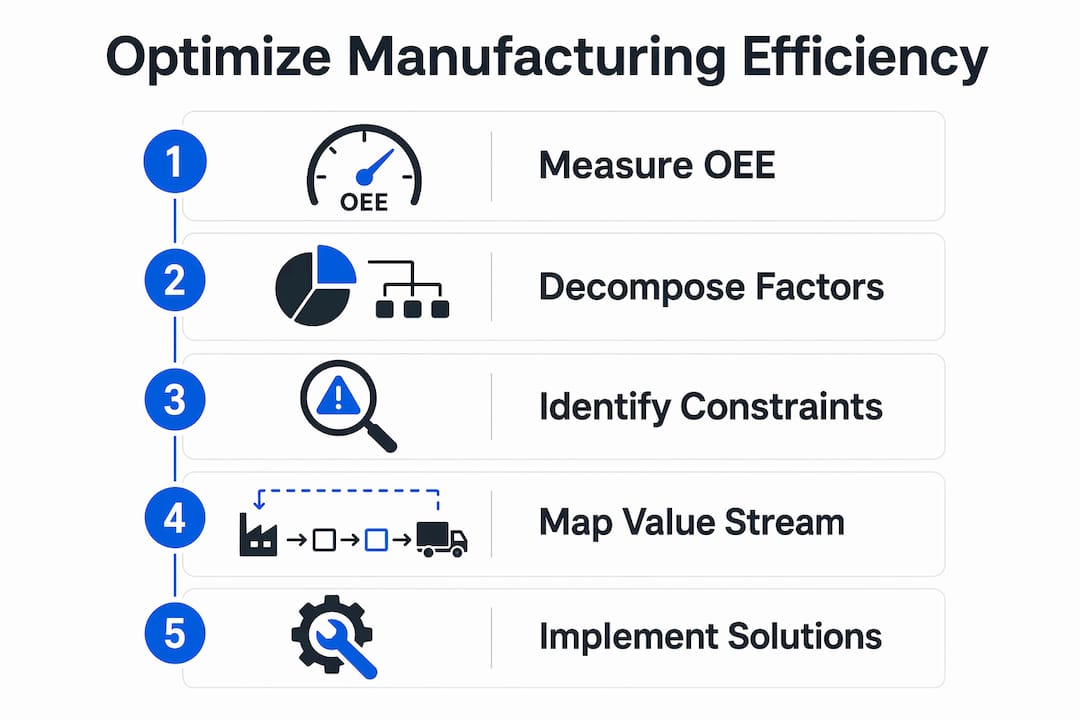
How does Value Stream Mapping identify bottlenecks and reduce waste?
Value Stream Mapping is a Lean manufacturing tool that creates a visual representation of every step in a production flow, from raw material to finished part, with the explicit goal of making waiting time visible. Most operations managers are surprised to learn that most lead time in manufacturing is waiting time, sometimes exceeding 90% of total lead time. A facility with a 12-day lead time might have only 4 hours of actual value-added processing, putting flow efficiency below 2%. Speed improvements on individual machines do almost nothing to fix that ratio.
Building a VSM follows a clear sequence:
- Map the current state. Walk the floor and document every process step, inventory point, and information flow. Record cycle times, changeover times, and queue sizes at each step.
- Build the lead time ladder. Alternate processing time and waiting time beneath the map to calculate total lead time and flow efficiency.
- Identify the bottleneck. Compare cycle time to takt time at each step. The step where cycle time exceeds takt time, or where upstream work-in-process (WIP) accumulates, is your constraint.
- Design the future state. Eliminate or reduce the largest waiting segments. Introduce pull systems, supermarkets, or FIFO lanes to control WIP between steps.
- Implement and measure. Execute the future state plan in phases and track lead time and flow efficiency weekly.
The transition from traditional paper VSM to Digital VSM is one of the most significant shifts in Lean practice right now. Digital VSM using real-time data and AI-driven feature selection reduced total lead time by over 26% and increased line efficiency to 91.7% in a discrete manufacturing case study, compared to static VSM analysis alone. The difference is that digital tools allow continuous monitoring rather than periodic snapshots, which means constraints are caught before they compound.
| Approach | Data source | Update frequency | Best use case |
|---|---|---|---|
| Traditional VSM | Manual observation | Periodic (weeks/months) | Initial baseline mapping |
| Digital VSM | IoT sensors, MES | Real-time or near-real-time | Continuous improvement programs |
Pro Tip: When building your lead time ladder, record waiting time in the same units as processing time. Teams that mix hours and days consistently underestimate the scale of flow waste.
Applying lean machining principles alongside VSM analysis accelerates the identification of non-value-added activities in high-mix production environments.
How does the Theory of Constraints improve manufacturing throughput?
The Theory of Constraints (TOC), developed by Eliyahu Goldratt, treats any production system as a chain where one link limits total output. Improving any link other than the weakest one does not increase throughput. It only builds inventory. TOC gives operations managers a five-step cycle to find and fix that weakest link systematically.
The five focusing steps work as follows:
- Identify the constraint. Find the single resource, process, or policy that limits system throughput. High WIP upstream and idle time downstream are the clearest signals.
- Exploit the constraint. Get maximum output from the constraint without additional spending. Eliminate stoppages at that station, reduce changeover time, and dedicate the best operators to it.
- Subordinate everything else. Adjust all non-constraint processes to support the constraint’s pace. Running non-constraints at full speed only creates excess WIP.
- Elevate the constraint. If exploitation is not enough, invest in additional capacity at the constraint through equipment, shifts, or outsourcing.
- Repeat. Once the constraint is resolved, a new one will emerge. The cycle never ends.
“Exploitation at the constraint can recover 8 to 15% throughput before any capital investment. The full five-step approach may unlock 15 to 25% more capacity system-wide.” (iFactory)
The most common mistake operations managers make with TOC is optimizing local machine utilization instead of system throughput. A press running at 95% utilization looks efficient on paper. If it is not the constraint, that utilization is producing inventory, not output. TOC forces the discipline to let non-constraints run below capacity when the system requires it.
What tools and best practices sustain long-term efficiency gains?
Methodologies like OEE, VSM, and TOC identify where to improve. The tools and practices below are what lock those improvements in place and prevent regression.
Digital monitoring and scheduling are the backbone of modern factory performance management. Real-time production scheduling with AI can generate and re-plan discrete manufacturing schedules in under one second and every 15 minutes, which means disruptions from machine downtime or material shortages are absorbed before they cascade. IoT sensor data feeds OEE dashboards continuously, replacing the end-of-shift manual data entry that historically introduced errors and delays.
Human-supervised cyber-physical systems represent the right balance between automation and operator authority. Lean manufacturing plus selective automation under human supervision, structured around PDCA cycles, delivers sustained improvements across operational, economic, sustainability, and safety dimensions. The key word is supervised. Fully automated systems without operator override authority tend to optimize locally and miss systemic issues that experienced floor personnel would catch immediately.
Core best practices that complement these tools include:
- Preventive maintenance schedules tied directly to OEE availability data, not calendar intervals
- Standardized work instructions at every station to reduce variation and training time
- Operator-led daily management with short-interval control meetings at shift start
- ERP and MES integration to give schedulers real-time inventory visibility and reduce material-related stoppages
- Continuous operator training focused on the Six Big Losses so floor teams can self-diagnose problems
Factory of the future approaches combine automation, integrated planning, and variability management to compound efficiency gains end-to-end, significantly reducing operating costs. The compounding effect is the point: no single tool produces sustainable results in isolation.
Pro Tip: Connect your preventive maintenance trigger to OEE availability data rather than a fixed calendar. A machine running clean at 98% availability does not need a scheduled stop. One trending toward 85% does.
| Tool | Primary OEE component addressed | Key benefit |
|---|---|---|
| IoT sensor monitoring | Availability | Real-time downtime detection |
| AI scheduling | Performance | Reduced planning bottlenecks |
| ERP/MES integration | Quality | Fewer material-related defects |
| PDCA cycles | All three | Sustained, measurable improvement |
What mistakes should you avoid when optimizing production efficiency?
Measurement errors are the most damaging mistakes in any efficiency program because they create false confidence. Common OEE calculation mistakes inflate metrics by 10 to 18 percentage points, most often by excluding changeover time from availability loss or ignoring micro-stoppages under two minutes. Those micro-stoppages are invisible individually but collectively represent hours of lost production per shift.
The most frequent pitfalls operations managers encounter include:
- Excluding planned stops from availability. Changeovers are availability losses. Including them gives an accurate picture of total productive time.
- Ignoring micro-stoppages. Stoppages under two minutes rarely get logged manually. Automated data capture is the only reliable fix.
- Misreading utilization as efficiency. A machine at 95% utilization producing scrap or feeding a non-constraint is not efficient. It is busy.
- Optimizing one station in isolation. Improving a non-constraint’s cycle time without addressing the system constraint adds WIP, not output.
- Treating VSM as a one-time exercise. A current-state map that is six months old is not a current-state map. Flow conditions change with product mix, staffing, and equipment age.
Sustaining gains requires standard work and daily management discipline. Without documented standards, improvements erode within weeks as operators revert to previous habits. Short-interval control, where supervisors review OEE data at the start of each shift and assign corrective actions before problems compound, is the single most effective practice for holding gains.
Pro Tip: Run a shadow OEE calculation for one week using automated data capture alongside your existing manual system. The gap between the two numbers tells you exactly how much your current measurement is understating losses.
Key takeaways
Optimizing manufacturing efficiency requires accurate OEE measurement, systematic bottleneck elimination through VSM and TOC, and human-supervised digital tools to sustain gains over time.
| Point | Details |
|---|---|
| Start with OEE decomposition | Separate Availability, Performance, and Quality before targeting any improvement effort. |
| Make waiting time visible | VSM exposes flow waste that machine speed improvements alone will never fix. |
| Apply TOC before capital spending | Exploit the constraint fully before investing in new equipment or capacity. |
| Supervise automation with operators | Human-supervised PDCA cycles prevent over-automation and sustain measurable gains. |
| Fix measurement errors first | Correcting OEE calculation mistakes reveals the true scale of losses and directs effort accurately. |
What I’ve learned about efficiency programs that actually stick
Most efficiency initiatives I have seen fail not because the methodology was wrong but because the measurement was. Teams adopt OEE, run a VSM workshop, and then present results based on numbers that exclude changeovers and ignore micro-stoppages. The improvement looks real on the dashboard. The floor tells a different story.
The facilities that consistently improve are the ones that treat accurate measurement as non-negotiable before they touch a single process. They automate data capture at the machine level, reconcile OEE numbers against actual output daily, and refuse to celebrate a metric that has not been validated against physical reality. That discipline is harder to maintain than any methodology, and it is the actual differentiator between programs that compound over years and programs that plateau after the first workshop.
The integration of AI scheduling and digital VSM is genuinely changing what is possible in 2026. But the operations managers I respect most are the ones who insist on human authority over automated recommendations. A system that re-plans every 15 minutes is powerful. A system that re-plans every 15 minutes without an operator who understands why is a liability. The combination of proven methodologies, accurate data, and experienced human judgment is what produces results that hold.
— Andrew
How Machiningtechllc supports your efficiency goals
Machiningtechllc has operated from its 70,000 square foot Webster, Massachusetts facility since 1985, producing over 20 million precision parts annually for aerospace, defense, and industrial OEMs. The facility runs Hydromat systems, CNC milling, turning, and wire EDM under automated, high-volume workflows designed around the same OEE and throughput principles covered in this guide.
If your operation needs a contract machining partner that treats cycle time, quality yield, and on-time delivery as measurable commitments rather than aspirations, explore Machiningtechllc’s precision parts manufacturing services or review how contract machining can compress your production lead times by up to 80%. Both pages outline specific capabilities, tolerances, and turnaround benchmarks relevant to OEM procurement decisions.
FAQ
What is OEE and why does it matter for factory performance?
OEE (Overall Equipment Effectiveness) measures the percentage of planned production time that is truly productive, calculated as Availability multiplied by Performance multiplied by Quality. It is the standard starting point for any effort to enhance factory performance because it pinpoints exactly which loss category is limiting output.
How do you identify a bottleneck using Value Stream Mapping?
Compare cycle time to takt time at each process step on your current-state VSM. The step where cycle time exceeds takt time, or where upstream WIP consistently accumulates, is your bottleneck and the highest-priority target for improvement.
What is the difference between TOC and Lean manufacturing?
TOC focuses on maximizing system throughput by targeting the single binding constraint, while Lean focuses on eliminating waste across all processes. The two methods complement each other: Lean reduces waste everywhere, and TOC directs where to apply the most concentrated effort first.
How much throughput can TOC recover without capital investment?
Exploiting the constraint through scheduling, reduced changeovers, and dedicated staffing can recover 8 to 15% throughput before any capital spending. The full five-step TOC cycle applied continuously may unlock 15 to 25% more capacity system-wide.
What is the most common mistake in OEE calculation?
Excluding changeover time from availability loss and ignoring micro-stoppages are the two most common errors, and together they inflate OEE scores by 10 to 18 percentage points. Automated data capture at the machine level is the most reliable correction.