

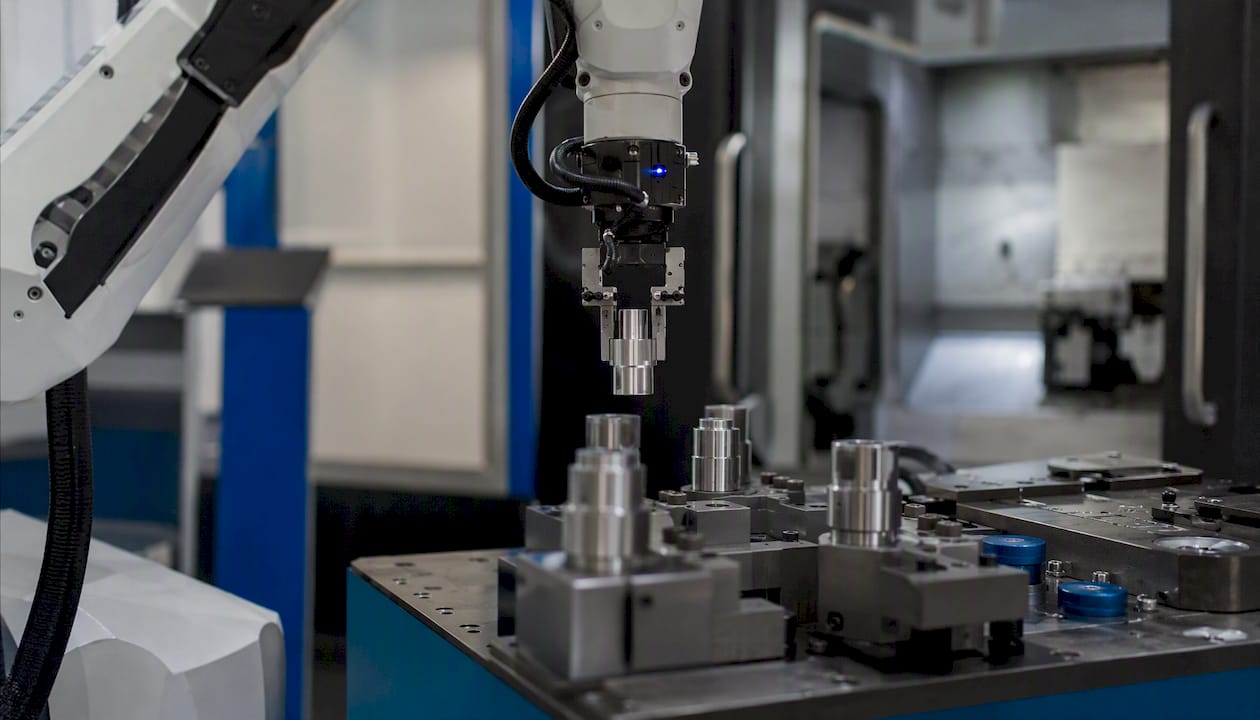
Lights out machining delivers extended spindle hours, lower per-part labor cost, and genuine 24/7 manufacturing capacity, but only when the process is already stable and the shop has installed the right controls. The minimum stack: deterministic G-code with safe-start and safe-restart blocks, in-machine probing, automated tool management with sister-tool logic, robotic or bar-feed material handling, chip evacuation, and centralized IIoT monitoring. Before you run a single unattended shift, work through this short checklist:
- Select a candidate part with proven, repeatable cycle times and mature tooling.
- Instrument the machine with probing, load monitoring, and tool-life counters.
- Confirm chip evacuation handles your worst-case chip load without packing.
- Set up centralized alarm notifications to a remote operator’s phone or dashboard.
- Review your equipment breakdown and business interruption insurance coverage.
Pro Tip: Start with your most repeatable part on your best-maintained machine. Trying to automate a difficult job first is the fastest way to lose confidence in the whole program.
Key Takeaways
Lights out machining delivers reliable unattended spindle hours only when process stability, deterministic programming, and a complete monitoring and safety stack are in place before the first overnight run.
| Point | Details |
|---|---|
| Start with stable, proven parts | Select jobs with Cpk above 1.33, mature tooling, and at least one full attended production run completed. |
| Build the full technology stack | Probing, sister-tool logic, chip evacuation, IIoT monitoring, and robotic or bar-feed material handling are all required, not optional. |
| Stage the rollout in phases | Pilot on one machine, validate KPIs over 20 unattended cycles, then scale. Advanced shops achieve extended unattended machining per cycle for predictable parts. |
| Address safety and insurance before scaling | Review equipment breakdown coverage and confirm fire detection inside enclosures before extending to overnight or weekend runs. |
| Machiningtechllc as a production partner | Machiningtechllc’s Hydromat-equipped, 70,000 sq. ft. facility produces over 20 million parts annually and supports pilot scoping for unattended production. |
Table of Contents
- What lights out machining actually means, and where it applies
- Core hardware and software you need before running unattended CNC
- How to implement lights-out machining in stages: pilot to scale
- Safety, risk controls, and insurance considerations for unattended production
- Which parts and operations are genuinely suited for lights-out production
- Monitoring architecture, maintenance, and the KPIs that matter
- Capital costs, ROI framing, and how staffing shifts
- How Machining Technologies LLC scaled unattended high-volume machining
- A shop-floor perspective on what lights-out machining actually demands
- Machining Technologies LLC: turnkey support for lights-out conversion
- Sources
What lights out machining actually means, and where it applies
The industry term is “lights out” or “lights-out manufacturing,” and it refers specifically to unattended CNC operation windows, not necessarily a fully dark factory. A single turning cell running overnight with no operator present qualifies. A 50-machine plant running autonomously around the clock is the extreme end of the same spectrum.
The practical boundary: lights out machining is not about eliminating people. It is about removing the requirement for a human to be physically present during a defined production window. The machine must be capable of detecting its own problems and stopping safely before a minor issue becomes a catastrophic one.
The scope has real limits. Prototype programs, first-article runs on new materials, unstable material lots, and safety-critical assemblies that require human inspection each cycle are poor candidates. So are jobs where tool life is unpredictable, fixturing is sensitive to operator touch-up, or the CAM program has not been proven through at least a full attended production run.
The useful middle ground is what practitioners call “lights-dim” operation: a skeleton crew monitors multiple cells remotely, intervening only when an alarm fires. Full unattended runs, where no one is on-site for hours, require a higher bar of process discipline. Modern Machine Shop’s lights-out machining resource frames this well: success depends on systemized processes, machine monitoring, and a genuine mindset shift, not just hardware.
| Readiness factor | Lights-dim (partial) | Full unattended |
|---|---|---|
| Program maturity | Proven in production | Fully deterministic, validated |
| Probing | Recommended | Mandatory with hard stop on failure |
| Tool-life management | Manual tracking acceptable | Sister-tool logic required |
| Remote monitoring | Periodic check-ins | Real-time alarm escalation |
Core hardware and software you need before running unattended CNC
No single component makes lights out machining reliable. It is a stack, and a gap in any layer creates the failure mode that shuts down your shift or damages your machine.
Machine-level requirements:
- In-machine probing (Renishaw RMP or equivalent) that validates workpiece offsets before cutting begins and parks the program if the result is out of tolerance.
- Tool-break detection, either through spindle load monitoring or a dedicated optical/contact sensor.
- Reliable automatic tool changers with confirmed pocket-to-pocket repeatability.
- High-pressure through-spindle coolant or directed mist to prevent chip recutting.
- Chip conveyors sized for your worst-case chip load, with automatic drain and level monitoring.
Material handling:
Robotic loaders such as Fanuc robotic loaders or Universal Robots cobots handle part tending for prismatic work. Bar feeders cover turned parts. Pallet pools let horizontal machining centers queue multiple fixtures and cycle through them without human intervention. Each of these removes the single biggest reason a machine sits idle overnight: no one to load the next part.
Software and connectivity:
MTConnect is the open standard that lets machine monitoring platforms pull spindle utilization, alarm history, and OEE data from controllers without proprietary middleware. OPC UA serves the same role for newer equipment. Platforms like DataXchange aggregate this data into dashboards that send SMS or email alerts when a machine stops unexpectedly. The goal is a remote operator who can see every cell’s status from a phone.
MES and ERP integration matters more than most shops expect. When a machine parks on a tool-life alarm at 2 AM, the system needs to log the event, flag the work order, and update inventory. Without that connection, the daytime team walks in blind.
Facility and services:
Compressed air filtration and automatic drains are unglamorous but critical. A single pressure drop from a clogged filter can halt a pneumatic tool changer mid-cycle. Coolant maintenance, including concentration monitoring and automatic top-off, prevents the corrosion and bacterial growth that degrades surface finish over long unattended runs. A UPS or robust power protection prevents a brief grid fluctuation from leaving a spindle mid-cut. Fire detection inside machine enclosures, and ideally local suppression, is not optional once you remove the human who would otherwise smell smoke.
Pro Tip: Instrument your highest-volume machine first. The data it generates in the first 30 days of monitoring will reveal the real failure modes, not the ones you assumed.
How to implement lights-out machining in stages: pilot to scale
Advanced shops that can achieve extended unattended machining per cycle for predictable parts do not get there in one step. Cnccode are the programming disciplines that separate a stable pilot from a liability.
Phase 3: Scale
Add cells only after Phase 2 acceptance criteria are met. Automate material handling with robotic loaders or pallet pools. Integrate automated inspection, using CMM or in-machine gauging, to close the quality loop without a daytime inspector reviewing every part. Connect the cell to MES/ERP so work orders update automatically. For guidance on automating machining processes at the cell level, the rationale for each investment becomes clearer when you model it against actual pilot data.
Safety, risk controls, and insurance considerations for unattended production
The dominant failure pattern in unattended manufacturing is not a dramatic crash. It is escalation: a slightly dull tool generates more friction, friction generates heat, heat ignites accumulated chips, and a small fire damages a machine worth hundreds of thousands of dollars. The Fabricator’s analysis of unattended manufacturing risks makes this point directly: small anomalies that a present operator would catch in seconds can become catastrophic events when no one is watching.
Technical controls that interrupt escalation:
- In-process probing with hard thresholds: if the probe reports a value outside tolerance, the program parks and sends an alarm. No exceptions.
- Spindle load monitoring with adaptive feed reduction: when load spikes above a set percentage, the controller backs off feed rate before the tool breaks.
- Tool-life counters with mandatory sister-tool swaps: never let a tool run past its validated life limit during an unattended shift.
- Safe park routines: the program must retract to a known safe position and stop spindle rotation before any alarm condition is logged.
- Chip conveyor level monitoring: a full conveyor is a fire hazard and a machine-stop waiting to happen.
Facility controls:
Early smoke and flame detection inside machine enclosures, not just in the building, is the difference between a contained event and a total loss. Local suppression systems, such as CO2 or clean-agent units mounted inside the enclosure, are worth evaluating for any cell running overnight. Remote operator procedures must include a clear escalation path: alarm fires, operator receives SMS, operator reviews camera feed, operator calls emergency services if needed.
Insurance and contractual review:
Insurers and shops should coordinate before scaling unattended production to review equipment breakdown coverage, cyber exclusions on connected monitoring systems, and business interruption limits. A policy written for attended operation may exclude losses that occur during unattended shifts. Get that in writing before your first overnight run.
Pro Tip: Require a formal risk assessment and a conversation with your insurer’s technical liaison before extending to weekend unattended runs. The cost of that conversation is zero. The cost of discovering a coverage gap after a loss is not.
Which parts and operations are genuinely suited for lights-out production
The decision is not about machine capability. It is about process stability. Lights out machining works best where process variation is low and tooling and workholding are mature, and that combination is rarer than most shops initially assume.
Strong candidates:
- High-repeatability prismatic parts with stable CAM programs and proven tool life curves.
- Mature turning families running consistent bar stock from a qualified supplier.
- Palletized production runs where fixtures are pre-loaded during the day shift.
- Recurring aerospace and defense components where the program has run hundreds of cycles without revision.
- High-volume small parts suited to bar-fed or multi-spindle production with predictable chip loads.
Poor candidates:
- New prototypes or first-article runs where the program has not been proven.
- Highly variable stock, including castings with inconsistent stock allowances.
- Exotic alloys with rapid, unpredictable tool wear, such as certain nickel superalloys, unless tool life has been characterized over many cycles.
- Safety-critical assemblies requiring human inspection at each cycle.
- Jobs with complex fixturing that requires operator touch-up between parts.
By shop type: A contract shop with a high-mix, low-volume book benefits most from lights-out on its highest-volume repeat jobs, freeing daytime capacity for complex setups. An OEM running a dedicated cell for a single part family can automate more aggressively because process variation is tightly controlled. High-mix, low-volume shops face the steepest challenge: changeover time and setup complexity often outweigh the unattended hours gained unless the shop invests heavily in quick-change tooling and modular fixturing.
Monitoring architecture, maintenance, and the KPIs that matter
A lights-out cell without real-time monitoring is not a controlled process. It is a gamble.
The monitoring stack:
Edge collectors connect directly to machine controllers via MTConnect adapters, wireless sensors, or hardwired I/O. OPC UA handles newer equipment with native connectivity. The data flows to an IIoT dashboard that tracks OEE, spindle utilization, alarm history, and tool-life counters in real time. Platforms like DataXchange pull this data and push alerts to remote operators. For automated inspection integration, CMM results can feed the same dashboard, closing the quality loop automatically.
Maintenance discipline:
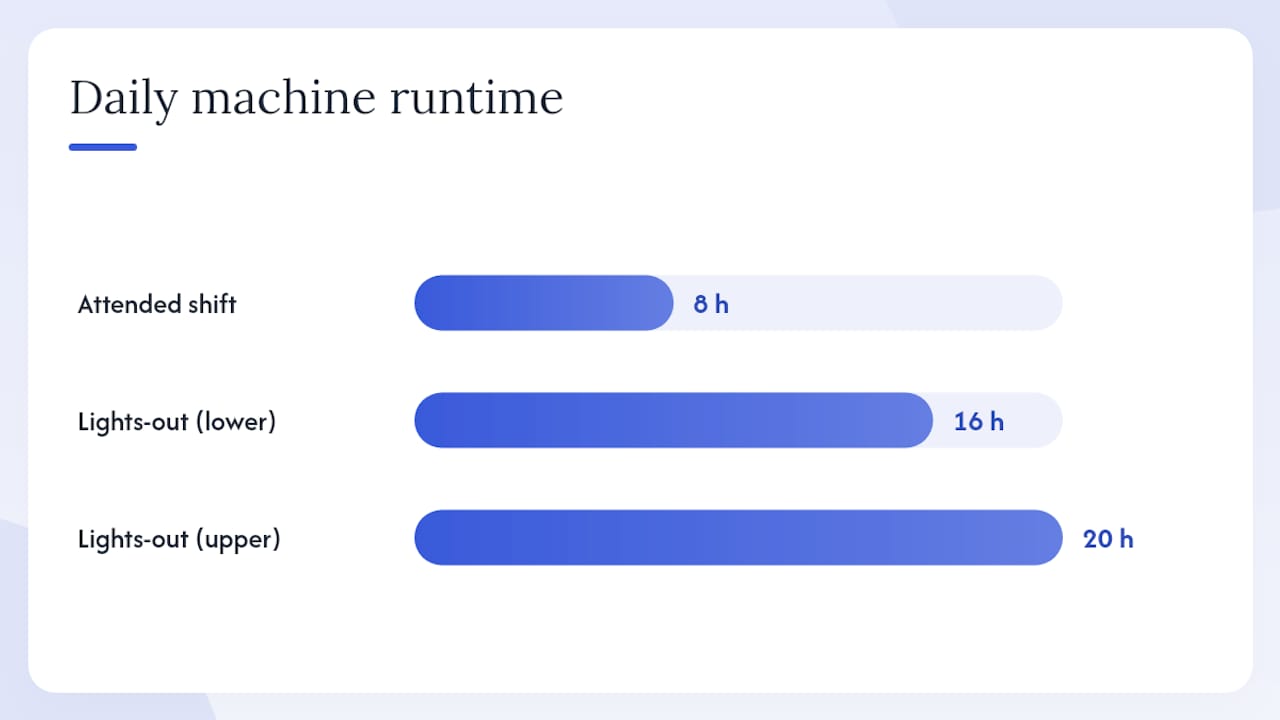
Preventive maintenance schedules must account for the higher utilization that lights-out machining creates. Spindle bearings, axis drives, and coolant systems wear faster when machines run 16–20 hours per day instead of 8. Vibration sensors on spindle housings and axis drives provide early warning of bearing degradation. Coolant concentration checks, filter replacements, and chip conveyor inspections need to happen on a calendar, not when something fails.
KPIs to track:
| KPI | Why it matters for lights-out | Target or measurement approach |
|---|---|---|
| OEE (availability × performance × quality) | Composite measure of how well the unattended cell uses its available time | Baseline first, then improve incrementally |
| Unattended-shift scrap rate | Catches probe failures, tool-life overruns, and fixturing drift | Should match or beat attended-shift rate |
| Alarm frequency per 100 hours | High frequency signals process instability before a crash occurs | Establish baseline; trend downward over time |
| Mean time to recover (MTTR) | Measures how quickly remote operators resolve unattended alarms | Track per alarm type; target reduction each quarter |
| Tool breakage rate | Directly tied to tool-life counter accuracy and sister-tool logic | Zero tolerance for undetected breakage |
Capital costs, ROI framing, and how staffing shifts
The capital investment in lights-out machining is real, and the payback period depends heavily on how honestly you model it.
Primary cost drivers:
- Robotic tenders (Fanuc robotic loaders, Universal Robots cobots) or pallet pools: typically the largest single line item.
- Probing hardware and IIoT monitoring software: Renishaw probing systems, MTConnect adapters, and dashboard licenses.
- Fixturing designed for unattended load/unload: often requires custom workholding that a robot can engage repeatably.
- Engineering and programming time to develop deterministic G-code: frequently underestimated.
Operating changes:
- Night operators are replaced by daytime automation supervisors who monitor multiple cells remotely.
- Maintenance headcount and expertise requirements increase. A cell running 20 hours per day needs more frequent PM than one running 8.
- Spare-parts inventory grows. Critical components, tool changers, probing styli, conveyor drives, must be on the shelf, not on order.
ROI framing:
Labor savings are the obvious line item, but the full model includes scrap reduction from consistent probing, reduced downtime from predictive maintenance, and the revenue value of capturing unstaffed hours. A single machine adding six unattended hours per night, five nights per week, adds roughly 1,560 spindle hours per year. At a realistic shop rate, that number justifies significant capital. The risk side of the model includes potential scrap events, insurance premium changes, and the engineering time to reach a stable unattended state.
Staff transition:
- Automation engineer: owns the monitoring stack, alarm logic, and program structure.
- Remote operator: monitors dashboards during unattended shifts, responds to alarms, and escalates to emergency services when needed.
- Maintenance technician: executes PM schedules, manages spare-parts inventory, and responds to mechanical failures.
- Process owner: owns the part family, validates tool-life data, and approves changes to unattended programs.
Training should cover MTConnect data interpretation, safe-restart procedures, and the specific alarm escalation protocol for each cell.
How Machining Technologies LLC scaled unattended high-volume machining
Machiningtechllc’s path to reliable unattended production followed the staged approach described above, starting with a single part family on a Hydromat system before expanding to additional cells.
The pilot part family was a high-volume, tight-tolerance turned component with a proven tool life curve and consistent bar stock from a qualified supplier. The cell was instrumented with in-machine probing, spindle load monitoring, and a centralized IIoT dashboard before the first unattended window ran.
Measured results from the pilot phase showed a meaningful increase in spindle utilization during previously unstaffed hours, with scrap rates during unattended shifts matching attended-shift performance once probing thresholds were dialed in. The alarm frequency per 100 hours dropped significantly between the first and third month of unattended operation as the team refined restart logic and chip evacuation settings.
Scaling to additional cells required two things the team had not fully anticipated: a larger spare-parts buffer for conveyor drives and probing styli, and a formal conversation with the insurer to confirm coverage for overnight unattended runs. Both were resolved before the second cell went live.
Machiningtechllc now produces over 20 million parts annually across a 70,000 sq. ft. facility, with Hydromat systems and CNC milling and turning cells contributing to that throughput through extended unattended windows.
Pro Tip: Before any unattended weekend run, verify the full alarm notification chain end-to-end. Send a test alarm, confirm the remote operator receives it, and confirm the escalation path to emergency services is current. Do this every time, not just during setup.
A shop-floor perspective on what lights-out machining actually demands
The hardest part of lights out machining is not the hardware. It is accepting that the process must be more disciplined than you think it already is.
Most shops believe their programs are clean. Then they instrument the machine and discover that the operator has been making micro-adjustments every few cycles, compensating for fixturing drift or tool wear that the program never accounted for. Lights-out removes that safety net. Every assumption the operator was silently correcting becomes a potential crash.
The mindset shift has three components. First, accept longer cycle times. The lost cycle time is recovered many times over by the unattended hours gained. Second, treat every unattended shift as a controlled experiment. Log everything, review alarms the next morning, and update the process before the next run. Third, never restart mid-cut. A safe-restart block from a known tool position is not optional; it is the rule that prevents the most common overnight crash scenario.
A short list of floor rules that prevent most failures:
- Never run a program unattended that has not completed at least one full attended cycle without operator intervention.
- Always validate probing results manually before the first unattended cycle on a new fixture.
- Set tool-life limits at 80% of the validated maximum for unattended shifts, not 100%.
- Confirm chip conveyor function at the start of every unattended window.
- Review alarm history from the previous unattended shift before approving the next one.
Pro Tip: For unattended runs, use conservative feed and speed settings, typically 85–90% of your attended-shift parameters. The goal is not maximum material removal rate. It is maximum unattended hours without an alarm.
Machining Technologies LLC: turnkey support for lights-out conversion
Shops that want to run unattended CNC but lack the internal engineering bandwidth to build the stack from scratch have a direct path forward with Machiningtechllc.

Machiningtechllc brings 40 years of precision machining experience, a 70,000 sq. ft. facility, and Hydromat high-volume production capability to contract manufacturing partnerships. For OEMs and industrial manufacturers evaluating lights-out conversion, the practical value is access to a production environment that has already solved the instrumentation, probing, and alarm-logic challenges described in this guide. Rather than building a pilot cell from scratch, you can place production with a partner that runs precision parts manufacturing at scale, validate your part family in an already-instrumented environment, and use the resulting data to inform your own capital decisions. The team supports pilot program scoping, deterministic G-code review, and insurer coordination for clients moving toward unattended production. Contact Machiningtechllc directly to discuss a pilot assessment for your part family.
Sources
The sources below were used to build this guide. Each covers a distinct aspect of lights-out implementation and is worth reading in full.
- Turning the Lights Out to Turn On Greater Productivity – Shop Floor Automations
- When the lights go out: Managing the hidden risks of unattended manufacturing
- Lights-Out Machining | Modern Machine Shop
- Cnccode
- Lights-Out Machining: Best Uses and Risk Planning
The consistent finding across all five sources: the shops that succeed with unattended machining treat it as a process discipline problem first and a hardware problem second. The technology enables it; the programming and operational rigor make it repeatable.
Recommended
- Optimize high-volume machining workflow: aerospace precision | Machining Technologies
- Lean machining principles for higher production efficiency | Machining Technologies
- Industrial machining safety protocols: Proven compliance tips | Machining Technologies
- Advanced machining equipment: efficiency gains and ROI | Machining Technologies