

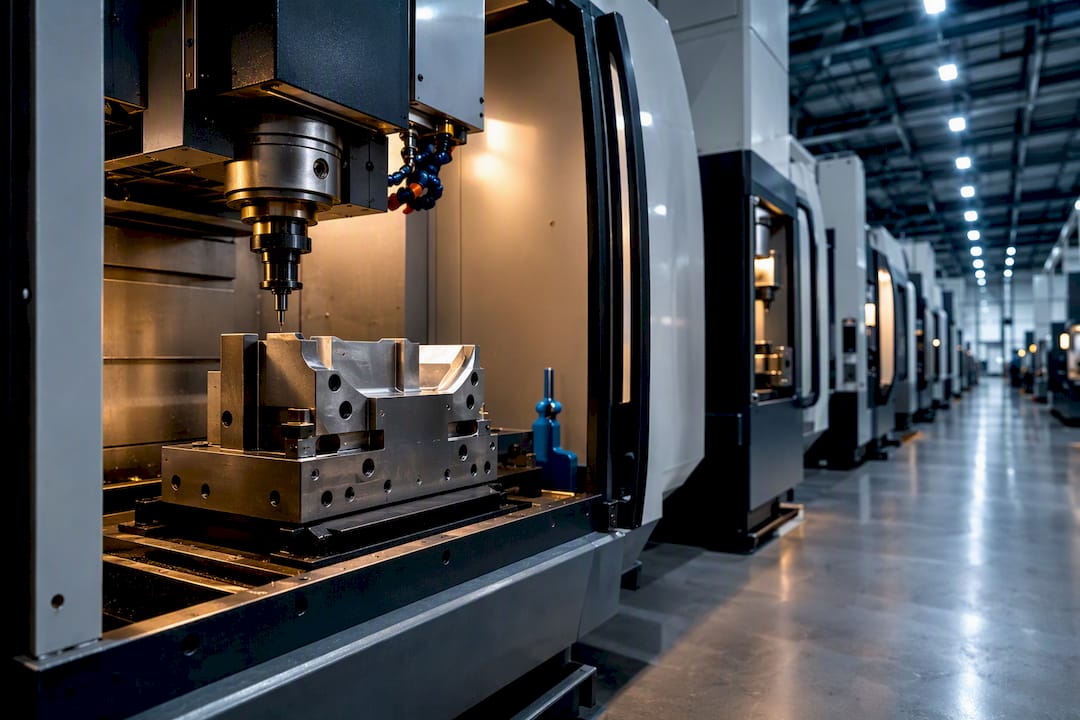
Production CNC machining is the automated, computer-controlled removal of material to make repeatable, high-precision parts at manufacturing scale, using processes like milling, turning, and Wire EDM. It’s the right choice when you need thousands to millions of identical parts holding tight tolerances, in metals or engineering plastics, with a supplier that can ramp from prototype to full-volume runs without a quality drop.
TL;DR:
- Production CNC machining can reliably produce millions of identical parts with tight tolerances using processes like milling, turning, and Wire EDM.
- High-volume manufacturing strategies like rotary transfer and lights-out automation significantly reduce cycle times and per-part costs at large scales.
- Proper quality certifications, detailed inspection records, and robust preventive maintenance are essential for ensuring consistent part quality over time.
- Design for manufacturability, including uniform wall thickness and simplified features, can lower costs and reduce tooling complexity before production.
- Outsourcing to established shops with experience in integrated multi-process facilities minimizes lead times, while in-house production suits small or irregular volumes.
Table of Contents
- What Are the Core Production CNC Processes?
- What Materials and Tolerances Can You Expect?
- How Does a Production CNC Program Go From CAD to Volume?
- What High-Volume Strategies Cut Cost at Scale?
- Which Certifications and Inspections Should You Require?
- What Actually Drives Cost and Lead Time?
- How Do You Design Parts That Are Cheaper to Machine?
- Should You Outsource Production CNC or Build In-House Capacity?
- How Do You Keep Production CNC Machines Running Reliably?
- What Environmental and Safety Practices Matter in a Production Shop?
- A Publisher’s View on What Production Capability Actually Looks Like
- Ready to Move From Design to Production Run?
What Are the Core Production CNC Processes?
Every production CNC program leans on a handful of processes, and matching the right one to your part geometry is the first decision that affects cost, tolerance, and lead time. CNC machining removes material from a workpiece using computer-controlled equipment, and at production scale that process gets built around repeatability rather than one-off flexibility.
CNC milling uses rotating cutting tools to remove material from a stationary or indexed workpiece. It handles flat faces, pockets, slots, and complex 3D contours, and it’s the default choice for housings, brackets, and structural components with multiple features on different faces.
CNC turning rotates the workpiece against a fixed or moving cutting tool, making it the natural fit for cylindrical parts: shafts, pins, bushings, and threaded fittings. Production turning centers often add live tooling so a part can get milled features without a second setup.
Wire EDM uses a thin, electrically charged wire to erode material through controlled sparking rather than cutting. It shines on hardened materials and intricate internal geometries that a cutting tool can’t reach, including tight-radius slots and complex profiles in tool steel.
Multi-axis machining (4-axis and 5-axis) lets the cutting tool or workpiece move on additional rotational planes, cutting complex geometries in one setup instead of several. Production CNC services commonly offer 3-, 4-, and 5-axis capability specifically because it collapses multiple operations into fewer setups.
Production setups differ from prototyping in one key way: dedicated tooling and automation. A prototype job might run on general-purpose fixtures and a standard tool library. A production job typically uses:
- Custom fixtures built for one part number, cutting setup time to seconds
- Dedicated tool offsets and programs locked after first article approval
- Automated part loading or bar-fed turning to run unattended
- In-process gaging built into the cycle instead of manual spot checks
What Materials and Tolerances Can You Expect?
Production CNC machining works across a wide range of metals and engineering plastics, and the material you choose drives both machinability and the tolerance band you can realistically hold.
Common material choices include:
- Aluminum alloys (6061, 7075): fast to machine, good strength-to-weight, common in aerospace brackets and housings
- Stainless steel (303, 304, 316, 17-4PH): corrosion resistance for medical, food, and defense parts, at slower cycle times
- Alloy and tool steels: high strength and wear resistance for gears, dies, and firearm components
- Brass and bronze: excellent machinability, often chosen for fittings and bushings
- Engineering plastics (Delrin, PEEK, nylon): lightweight, chemically resistant, used where metal adds unnecessary weight or cost
Tolerance snapshot: general CNC machining commonly holds around ±0.13 mm under standards like ISO 2768, with tighter bands achievable on critical features through secondary operations.
Standard milling and turning operations typically hold tolerances in that same general range for most features. Tighter tolerances, sometimes down to a few thousandths of an inch, are achievable but usually require secondary operations: precision grinding, honing, or Wire EDM finishing on specific features rather than the whole part. Asking a supplier to hold your tightest tolerance across every dimension drives cost up fast; smart designs reserve tight tolerances for the features that actually need them.
Surface finish follows a similar logic. As-machined finishes work fine for internal structural parts, while cosmetic or sealing surfaces often need bead blasting, anodizing, passivation, or polishing as a secondary step.
How Does a Production CNC Program Go From CAD to Volume?
Getting from a finished design to a stable production run follows a fairly consistent sequence, and how well you prepare the handoff determines whether that sequence takes weeks or months.
- Design handoff. Submit native CAD files (STEP or native format), a GD&T-annotated print, material callout, and any required certifications or finish specs. Vague or incomplete prints are the single biggest cause of quoting delays.
- CAM programming. Programmers build toolpaths optimized for cycle time and tool life, sequencing operations to minimize repositioning and setup changes.
- Fixturing design. For production volumes, a dedicated fixture gets built to hold the part consistently across thousands of cycles, not just one prototype run.
- Pilot run. A limited batch runs to validate the program, tooling, and fixture before committing to full volume. 9 5. First article inspection. The first part off a validated setup gets measured against every print dimension and documented, forming the baseline the rest of the run gets checked against.
- Ramp to volume. Once first article passes, production scales up, often layering in automation or unattended cycles as confidence in the process builds.
The step readers skip most often is submitting real GD&T, not just a nominal dimension. A print showing a “±0.005 in” note on a critical bore, with no reference to datum structure, forces a machinist to guess your functional intent.
Pro Tip: Send your supplier the assembly context, not just the individual part print. Knowing how a bracket mates to its neighboring components lets an engineer flag a tolerance stack-up problem before it becomes a scrapped batch.
For prototype-to-production transitions specifically, understanding how part prototyping gets optimized for OEMs upfront saves rework once the design locks.
What High-Volume Strategies Cut Cost at Scale?
Once volumes climb into the hundreds of thousands or millions of parts, the economics shift from “run it on a CNC cell” to “build a dedicated process around it.” High-volume production workflows lean on automation and standardization specifically to push cycle time and per-part cost down.
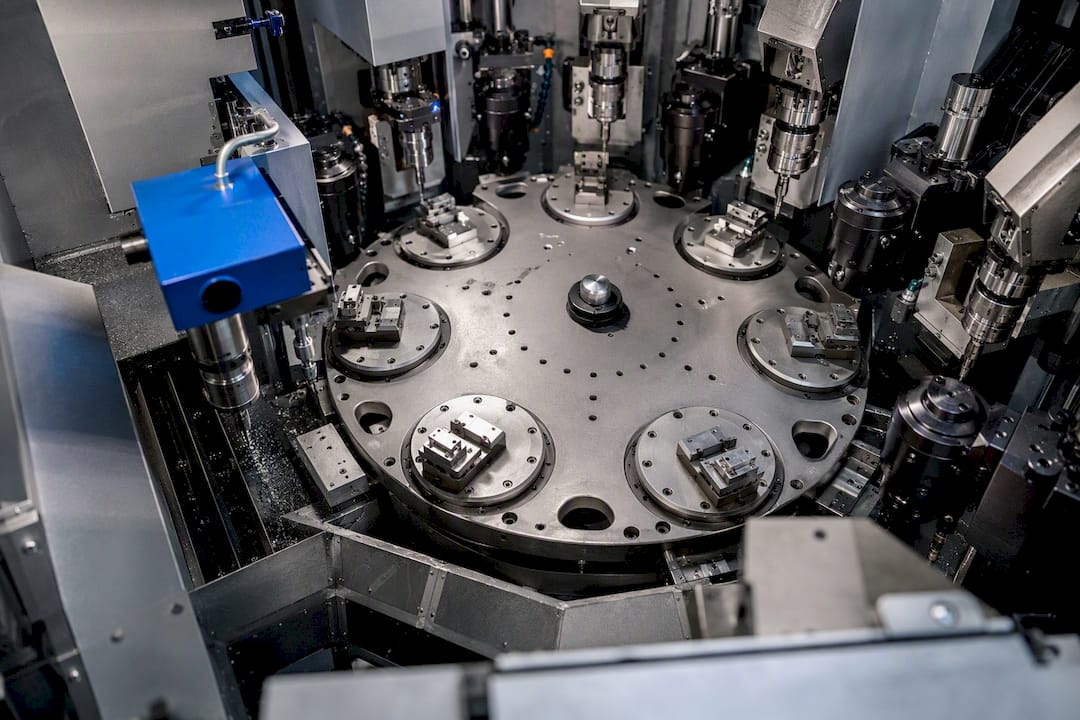
Hydromat rotary-transfer systems move a part through multiple stations arranged around a rotating indexing table, with each station performing one operation simultaneously. Because every station works in parallel, cycle time per part drops dramatically compared to a single CNC spindle running operations sequentially. Rotary-transfer excels on rotationally symmetric parts run at high volume, though it requires meaningful upfront tooling investment and constrains part geometry to features the process can actually produce.
Lights-out automation on standard CNC cells adds robotic part loading, automated tool changes, and in-process gaging so machines keep running unattended overnight or across shifts with no operator present.
The investment decision usually comes down to:
- Volume threshold: Hydromat tooling investment pays off at high part counts; a CNC cell with automation flexes better for moderate volumes with more geometric variety
- Geometry constraints: rotary-transfer works best on turned, rotationally symmetric features; complex milled geometries usually stay on multi-axis CNC
- Lead time tradeoff: dedicated tooling adds weeks of nonrecurring engineering time upfront but slashes per-part cost and cycle time once it’s running
For parts with the right geometry and volume, that upfront tooling cost gets recovered many times over across a production run measured in millions of units rather than thousands.
Which Certifications and Inspections Should You Require?
Quality risk in a production contract shows up long before a bad part ships, and the certifications a supplier holds tell you a lot about how seriously they manage that risk.
- ISO 9001 establishes a documented quality management system covering process control, corrective action, and continuous improvement.
- AS9100 builds on ISO 9001 with aerospace-specific requirements around traceability and risk management, essential for aviation and defense parts.
- IATF 16949 applies the automotive industry’s quality framework, with heavy emphasis on statistical process control and defect prevention.
- ITAR registration matters when parts fall under defense export controls, since it governs who can access technical data and manufacture certain regulated components.
On the inspection side, expect a credible production supplier to run coordinate measuring machine (CMM) verification, in-process gaging on the machine itself, and statistical process control (SPC) sampling across a run rather than checking parts only at the end.
Ask specifically for:
- A documented first article inspection report tied to every print dimension
- Batch or lot traceability records showing material certs and process history
- A written corrective-action procedure, not just a verbal promise to “make it right”
What Actually Drives Cost and Lead Time?
Price on a production CNC quote comes down to five levers, and understanding each one lets you negotiate from a position of knowledge instead of just comparing bottom-line numbers.
- Material cost and machinability: exotic alloys and hardened steels cost more in both raw stock and cycle time than aluminum or brass
- Cycle time: more features, tighter tolerances, and more setups all add machine time per part
- NRE and tooling: fixtures, custom cutting tools, and program development are one-time costs amortized across the run
- Secondary operations: heat treating, plating, anodizing, and grinding add cost and lead time outside the CNC step itself
- Batch size: larger orders spread fixed tooling costs over more parts, dropping per-unit price at volume breaks
Quoting reality check: small DFM adjustments made during design review, not floor-level process tweaks after tooling is cut, typically deliver the biggest cost savings on a production run.
Realistic lead times run from a few weeks for straightforward parts on existing tooling to several months when new dedicated fixturing, long-lead material, or certification testing enters the picture. Be skeptical of any quote promising full-volume production in days for a part that requires new tooling. That timeline usually means corners get cut somewhere in first article validation.
How Do You Design Parts That Are Cheaper to Machine?
Design for manufacturability isn’t an abstract engineering nicety in production CNC. It’s the single highest-leverage place to cut cost before a part ever touches a machine.
- Standardize wall thickness. Thin, uneven walls cause chatter and warping; keep walls as uniform as the part function allows.
- Add generous fillets and radii. Sharp internal corners require slow, specialized tooling; a modest radius often lets a standard tool run at full speed.
- Build in draft and tool access. Deep pockets or blind features with no clearance for a cutting tool force smaller, slower tools or a second setup.
- Pick one clear datum structure. Ambiguous or floating datums force machinists to guess intent, which invites tolerance stack-up errors.
- Reserve tight tolerances for functional features only. Tightening every dimension on the print, instead of just the ones that mate with another part, inflates cost with no functional benefit.
Pro Tip: If you know a part is headed for rotary-transfer or Hydromat production eventually, design it rotationally symmetric from the start. Retrofitting a milled feature onto a turned part after tooling is built usually means starting the tooling investment over.
Relaxing a single noncritical tolerance or adding a small radius to an internal corner has, in practice, cut both cost and tooling complexity enough to change which production process makes sense for a part.
Should You Outsource Production CNC or Build In-House Capacity?
The outsource-versus-in-house decision usually comes down to five factors, and getting the answer wrong locks you into either idle capital equipment or a fragile single-source supply chain.
- Volume and consistency: sporadic or seasonal demand rarely justifies the capital expense of dedicated CNC equipment and staffing
- Capital and workforce: skilled CNC programmers and machinists are hard to hire and retain; a contract shop already has that bench built
- Quality system maturity: building an ISO- or AS9100-certified quality system from scratch takes years, not months
- Time to market: an established shop with existing tooling and certifications can often start production faster than standing up an internal line
- IP and supply-chain resilience: sensitive designs may call for a supplier with ITAR registration and documented data-handling controls, while multi-source strategies reduce single-point-of-failure risk
When you do build an RFQ, include CAD files, annotated tolerances, target volumes and delivery cadence, required certifications, and any secondary operations up front. A complete RFQ package is what separates a same-week quote from a month of back-and-forth clarification emails.
How Do You Keep Production CNC Machines Running Reliably?
Unplanned downtime on a production line doesn’t just cost machine time. It cascades into missed delivery dates across every part number that machine touches. Preventive maintenance is what keeps a fleet of CNC equipment producing parts within tolerance shift after shift.
The core practices that matter most:
Spindle and way lubrication needs to follow the manufacturer’s schedule exactly, not a “when it seems dry” guess. Coolant concentration and filtration get checked regularly, since degraded coolant accelerates tool wear and leaves poor surface finish. Way covers, chip conveyors, and filters need routine cleaning, since chip buildup is one of the most common causes of axis positioning drift.
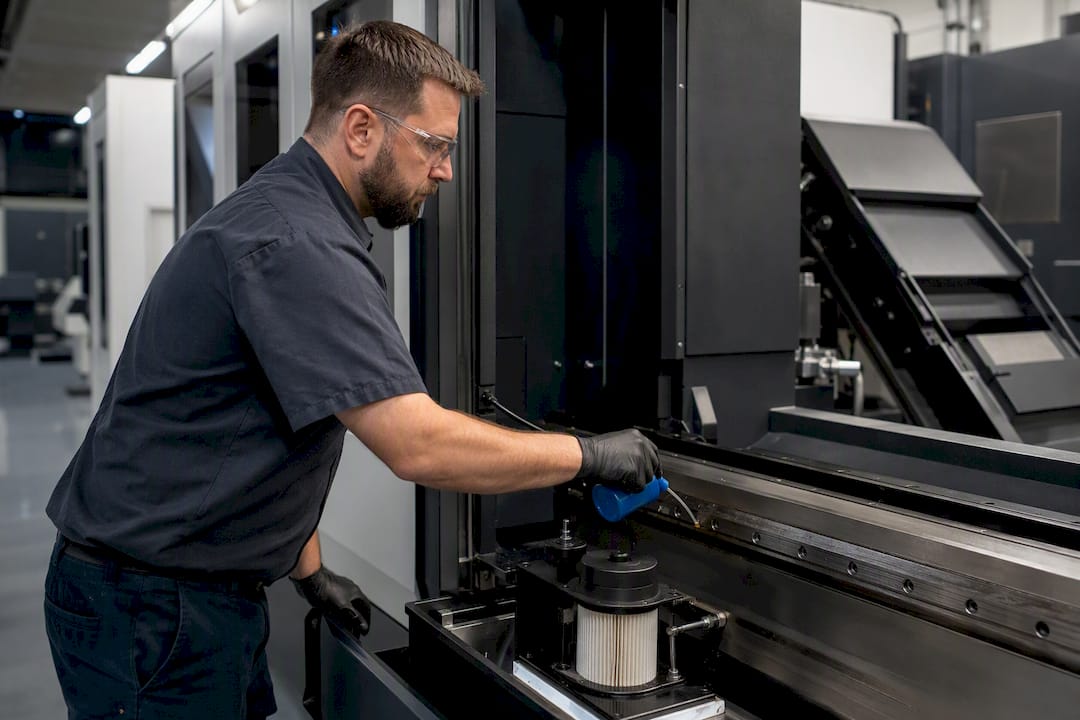
Tool wear tracking matters just as much as machine maintenance. Production shops track tool life against cycle counts, not just visual inspection, and swap tooling on a schedule before it degrades part quality rather than after a part fails inspection.
Calibration checks on machine geometry, ballscrew backlash, and probe accuracy should run on a fixed interval, especially on equipment holding tight tolerances across long runs. A machine that was accurate to half a thousandth six months ago can drift without any obvious symptom until a batch fails first article inspection.
The shops that hold tight tolerances consistently over years, not just on a good day, are almost always the ones treating maintenance as a schedule instead of a reaction to a breakdown.
What Environmental and Safety Practices Matter in a Production Shop?
A production CNC facility running dozens of machines around the clock carries real safety and environmental obligations, and how a supplier handles them is a legitimate part of your vendor evaluation.
Machine guarding, lockout/tagout procedures for maintenance work, and proper personal protective equipment for operators handling coolant and metal chips are baseline requirements, not extras. Facilities running Wire EDM need additional controls around dielectric fluid handling, since that fluid requires proper filtration and disposal protocols.
Coolant and cutting fluid management matters both for worker health and for regulatory compliance. Used coolant, swarf, and metal chips need documented collection and recycling processes rather than informal disposal. Many shops recycle aluminum and steel chips through certified scrap processors, which reduces both waste and raw material cost.
Noise levels from multiple simultaneous CNC operations, dust and mist from certain material machining, and ventilation around any thermal or chemical finishing processes all factor into a safe production floor. A facility running high-volume automation, including unattended lights-out shifts, also needs monitoring systems that can flag a fault condition and shut down safely with no operator present to react manually.
None of this is glamorous, but it’s the difference between a shop that runs reliably for decades and one that accumulates fines, downtime, and turnover.
A Publisher’s View on What Production Capability Actually Looks Like
Most guides to production CNC machining describe processes in the abstract. Fewer connect those processes to what a working facility actually looks like at scale, and that gap is where a lot of procurement decisions go wrong.
Machining Technologies LLC operates a 70,000 square foot facility running Hydromat systems alongside CNC milling, turning, and Wire EDM under one roof. That combination matters more than it sounds: a part that starts as a turned feature and needs a Wire EDM finish on one detail doesn’t have to travel between suppliers.
Since 1985, the company has produced over 20 million parts annually across aerospace, defense, and industrial sectors. That kind of throughput doesn’t happen without disciplined ramp processes. A pilot run gets validated, first article gets measured against print, and only then does volume scale.
What that experience teaches is simple: production capability isn’t about owning the right machine. It’s about the discipline to run it the same way ten thousand times in a row.
— Andrew
Ready to Move From Design to Production Run?
If you’re comparing production CNC quotes right now, the fastest way to get an accurate number is to send a complete package: CAD files in native or STEP format, an annotated print with real GD&T, target volumes and delivery cadence, required material certifications, and any secondary operations the part needs. Skip any of that and you’ll get a rough estimate instead of a real quote.
A trusted contract machining provider works with procurement and engineering teams across the full range, from initial pilot runs and first article inspection through sustained high-volume production, with documented inspection reports and on-time delivery tracked at every milestone. Whether your part fits standard CNC milling and turning or needs Hydromat rotary-transfer economics at scale, the goal on every quote is the same: give you a real number and a real schedule, not a placeholder.
Explore the company’s contract machining capabilities to see how the quoting and ramp process works, or send your part files directly to get a production quote started this week.