

TL;DR:
- ERP connects production, procurement, and inventory into a single system, improving machining efficiency. It delivers measurable gains such as higher on-time delivery and reduced machine downtime through integrated workflows. Proper architecture and phased deployment ensure data quality and maximize ERP’s impact in machining operations.
Enterprise Resource Planning, or ERP, is the centralized platform that connects production scheduling, procurement, inventory, costing, and financial management into a single system for machining operations. The role of ERP systems in machining goes far beyond basic record-keeping. ERP gives operations managers a single source of truth for every order, every part number, and every cost center across the shop floor. For manufacturers producing high-volume, tight-tolerance components, that integration is the difference between controlled throughput and reactive firefighting. Machiningtechllc, operating since 1985 and producing over 20 million parts annually, understands this directly.
How do ERP systems improve machining efficiency and production workflows?
ERP systems improve machining efficiency by eliminating the manual data consolidation that slows most shops down. When production, purchasing, and quality data all live in separate spreadsheets or disconnected systems, errors compound and decisions lag. ERP collapses those silos into one platform, giving every department access to the same real-time picture.
The performance gains are measurable. Integrating ERP for unified production and inventory control produced a 17% increase in on-time delivery and a 15% reduction in machine downtime in one precision machining operation. That same deployment eliminated over 20 weekly hours of manual reporting in the first year alone. Those hours translate directly into capacity for higher-value work.
Machine telemetry integration amplifies these gains further. Automated cycle-time validation through ERP-connected CNC data reduces manual quoting time by 30–50% and boosts parts throughput by 10–15%. Inventory reductions of 30–50% are also common in ERP deployments that include telemetry integration. That is not a marginal improvement. It reshapes the economics of a machine shop.
Key efficiency gains operations managers should expect from ERP include:
- On-time delivery improvement through finite capacity scheduling that prevents overcommitting machines and labor
- Scrap and rework reduction by tracking defect codes and linking them to specific operations, tools, or operators
- Inventory accuracy through real-time lot and serial number tracking tied to work orders
- Reduced manual reporting by automating production confirmations and material consumption postings
- Faster quoting when ERP holds validated cycle times and material costs for repeat part families
Pro Tip: Before going live with ERP scheduling, validate your cycle times against physical time studies on the shop floor. Garbage cycle-time data fed into ERP produces inaccurate costing and unreliable delivery promises.
How does ERP integrate with MES and machine telemetry in machining?
ERP and Manufacturing Execution Systems (MES) are complementary, not interchangeable. Understanding where one ends and the other begins is the most important architectural decision a machining operation can make.
ERP functions as the transactional source of truth, managing orders, costing, inventory balances, and procurement. MES handles real-time machine states, operator events, and shop floor dispatching. Pushing high-frequency machine telemetry directly into ERP overloads the system and creates noise that degrades data quality. The right architecture keeps those data streams separate.
| Layer | System | Primary function |
|---|---|---|
| Planning and finance | ERP | Orders, costing, inventory, procurement |
| Shop floor execution | MES | Machine states, operator events, work order dispatch |
| Data transport | Middleware or edge gateway | Aggregates telemetry before ERP transactions |
| Connectivity | Asynchronous messaging or API | Decouples systems for resilience |
Asynchronous messaging and canonical data models are the correct approach for connecting ERP, MES, and IoT devices. Point-to-point integrations break under load and create brittle dependencies that halt production when one system goes offline. Asynchronous architecture means the shop floor keeps running even if ERP is temporarily unavailable.
Data quality is the hidden risk in any integration project. Cycle-time data from CNC machines must be validated against physical studies before it drives automated work order closures in ERP. Unvalidated telemetry produces inaccurate costing, which corrupts quoting and financial reporting downstream.
Pro Tip: Use an edge gateway or middleware layer to normalize machine events before they reach ERP. This protects ERP performance and keeps your transactional data clean.
What ERP modules are most critical for machining operations?
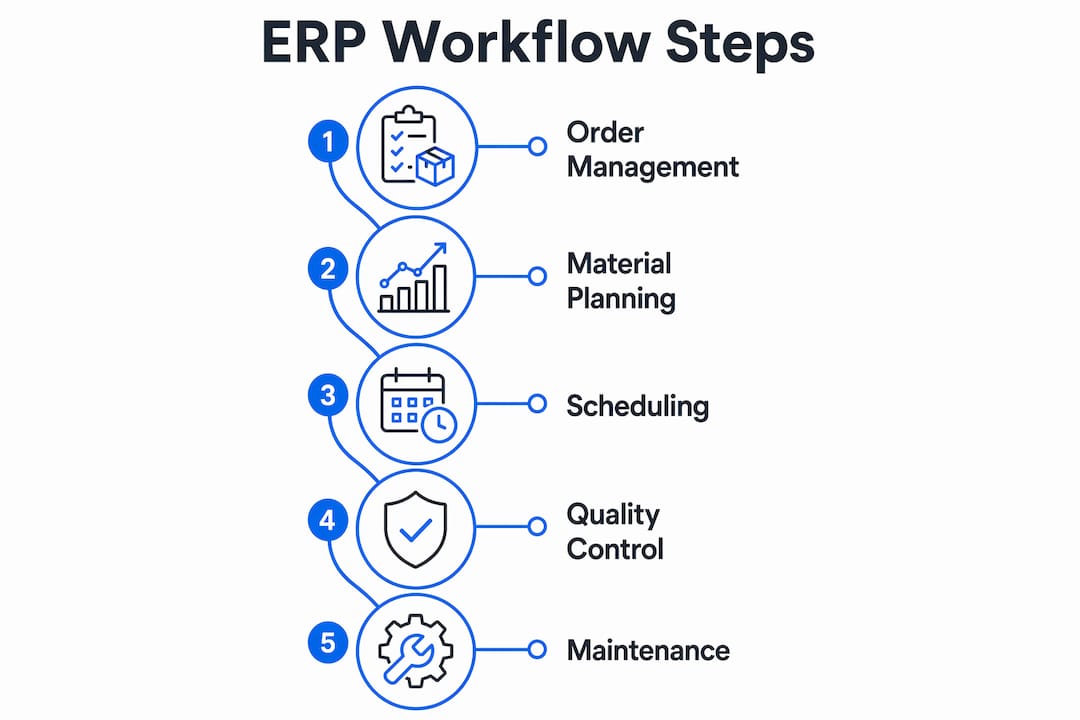
Not every ERP module matters equally in a machining environment. The modules that directly touch production flow, material availability, and quality traceability deliver the most value. ERP modules critical for machining include Material Requirements Planning (MRP), inventory and lot tracking, quality management, finite capacity scheduling, and preventive maintenance.
The five modules that machining operations should prioritize:
-
Material Requirements Planning (MRP): MRP calculates what raw material and purchased components are needed, when, and in what quantity based on open orders and lead times. For shops running aluminum, steel, or titanium bar stock, MRP prevents both stockouts and excess inventory.
-
Inventory and lot or serial tracking: Machining operations serving aerospace or defense customers must trace every part back to its material heat number and inspection record. ERP lot tracking makes that traceability automatic rather than manual.
-
Quality management: Inspection plans, nonconformance records, and corrective action workflows all belong inside ERP. Linking quality events to specific work orders and operations identifies patterns that reduce scrap over time.
-
Finite capacity scheduling: ERP prevents over-planning by scheduling against actual machine hours and labor availability rather than infinite capacity assumptions. Gantt-based scheduling with drag-and-drop rescheduling is now standard in mature ERP platforms. This feature alone prevents the late-order cascades that damage customer relationships.
-
Preventive maintenance scheduling: Unplanned machine downtime is one of the largest hidden costs in a machine shop. ERP maintenance modules schedule service intervals based on machine hours or calendar triggers, reducing emergency repairs and keeping spindles running.
The benefits of automated machining compound when these modules work together. MRP feeds scheduling, scheduling drives work orders, work orders feed quality records, and quality records close the loop back to costing.
What are the best practices for ERP implementation in machining shops?
ERP implementation in machining shops fails most often for the same reason: operations teams try to configure ERP to do everything at once. The shops that succeed treat ERP as the financial and order management backbone while deploying lighter systems for shop floor execution.
Mature machining shops use ERP primarily for finance and order management while delegating shop floor dispatching to lightweight work order or MES systems. Over-configuring ERP routing and scheduling modules adds complexity without adding agility. High-mix CNC environments in particular benefit from keeping ERP authoritative on costs and orders while keeping the shop floor system simple and fast.
A phased implementation approach works best:
-
Establish ERP as the order and costing authority first. Load your part masters, bills of material, routings, and customer orders before touching scheduling or telemetry integration. Clean master data is the foundation everything else depends on.
-
Validate cycle times before automating work order closure. Run ERP and manual tracking in parallel for four to six weeks. Compare ERP-calculated cycle times against physical observations. Fix discrepancies before automation takes over.
-
Deploy middleware or an edge gateway for machine data. Never connect CNC machines directly to ERP. Aggregate and normalize telemetry at the edge, then push summarized completion and scrap transactions into ERP.
-
Design idempotent data exchanges. Every transaction sent between ERP, MES, and IoT systems should be safe to replay without creating duplicate records. Build rollback and reconciliation logic from day one.
-
Build operational dashboards and alerts before go-live. Throughput, scrap rate, on-time delivery, and machine utilization should be visible on a shop floor monitor before the system goes live. Dashboards create accountability and surface problems early.
AI-native ERP implementations in custom job shops can deliver operational benefits equivalent to 5.6–11.3% of total revenue by improving quoting accuracy, reducing scrap and rework, and tightening inventory. For a $5 million revenue shop, that translates to an estimated $278,000 to $564,000 in annual benefit. The payback period in that model runs under two months.
Pro Tip: Assign one internal data owner for each ERP master data domain: parts, routings, customers, and vendors. Without clear ownership, master data degrades within six months of go-live.
Key Takeaways
ERP systems deliver the greatest impact in machining when they serve as the financial and order authority while MES and middleware handle real-time shop floor execution and machine telemetry.
| Point | Details |
|---|---|
| ERP as source of truth | Keep ERP authoritative for orders, costing, and inventory; delegate real-time execution to MES. |
| Measurable efficiency gains | ERP integration produces documented gains in on-time delivery, machine uptime, and inventory accuracy. |
| Module prioritization | MRP, finite capacity scheduling, lot tracking, and quality management deliver the highest machining ROI. |
| Integration architecture | Use asynchronous messaging and middleware to connect ERP, MES, and CNC telemetry without brittle dependencies. |
| Phased rollout discipline | Validate cycle times and master data before automating work order closure to protect costing accuracy. |
ERP in machining is a foundation, not a finish line
I have watched machining operations spend 18 months configuring ERP routing modules to a level of detail that the shop floor never actually uses. The instinct to make ERP do everything is understandable. You are paying for the system, so you want to use every feature. That instinct is wrong.
The shops I have seen get the most from ERP treat it like a financial and planning engine, not a shop floor control system. They use ERP to answer three questions: What did we promise? What does it cost? What do we have in stock? Everything else, including machine states, operator assignments, and real-time cycle tracking, belongs in a lighter, faster system that talks to ERP through a clean interface.
The next wave of ERP capability in machining is predictive. AI-enhanced ERP features are beginning to flag likely late orders before they become late, recommend reorder points based on demand patterns, and surface quality trends before they become scrap events. The shops that have clean master data and solid MES integration today will absorb those features quickly. The shops still fighting data quality problems will not. The precision machining advantages that matter most in 2026 belong to operations that treat data as a production input, not an afterthought.
— Andrew
Machiningtechllc: precision machining built for ERP-driven production
Machiningtechllc works directly with OEMs and industrial manufacturers who run ERP-driven production environments and need a contract machining partner that fits into their workflow without friction.
From its 70,000 square foot facility in Webster, Massachusetts, Machiningtechllc produces over 20 million parts annually using Hydromat systems, CNC milling, turning, and wire EDM. The operation is built for high-volume, tight-tolerance work in aerospace, defense, and industrial machinery. If your ERP is generating purchase orders and your supplier cannot keep pace with your schedule, that is the gap Machiningtechllc fills. Explore contract machining services built for OEM production schedules, or review the full list of machining capabilities to find the right fit for your program.
FAQ
What is the primary role of ERP in machining operations?
ERP serves as the centralized system for managing orders, costing, procurement, and inventory in a machining environment. It provides the transactional source of truth that connects planning decisions to shop floor execution.
How does ERP differ from MES in a machine shop?
ERP manages financial transactions, order management, and inventory balances, while MES handles real-time machine states, operator events, and work order dispatching. The two systems are complementary and should exchange data through middleware rather than direct connections.
What ERP modules matter most for machining?
MRP, finite capacity scheduling, inventory and lot tracking, quality management, and preventive maintenance are the five modules that deliver the most direct value in machining operations.
How long does ERP implementation take in a machining shop?
Implementation timelines vary by shop complexity, but a phased approach that starts with order and costing setup before adding scheduling and telemetry integration typically produces faster, more stable results than a full simultaneous rollout.
Can ERP integration reduce scrap and rework in machining?
Yes. ERP quality management modules link nonconformance records to specific operations and work orders, which identifies the root causes of scrap. Combined with telemetry data, this connection supports measurable reductions in rework costs over time.
Recommended
- The Role of CAD/CAM in Machining: 2026 Guide | Machining Technologies
- Advanced machining equipment: efficiency gains and ROI | Machining Technologies
- Optimize high-volume machining workflow: aerospace precision | Machining Technologies
- Top Machining Equipment Features for Engineers in 2026 | Machining Technologies