
TL;DR:
- Multi-material machining integrates additive deposition with CNC milling to produce complex parts with diverse materials and features. It reduces waste, shortens development cycles, and enhances functional performance, especially for high-value industries. Successful implementation requires deliberate process control, interface engineering, and thorough qualification to achieve its full benefits.
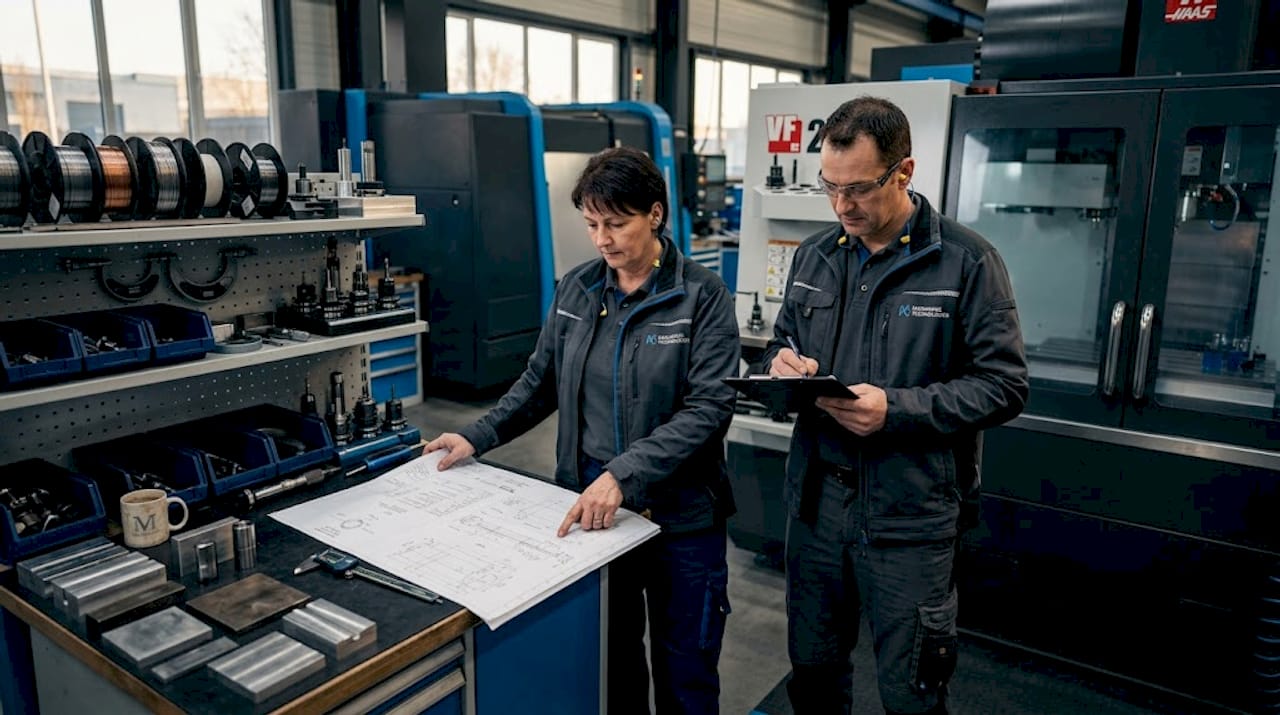
If you’re still designing complex components around a single material, you’re leaving performance on the table. Understanding why multi-material machining matters is no longer a theoretical exercise for engineers and technical managers. It’s a practical decision that affects part performance, production cost, and time to delivery. Modern assemblies in aerospace, defense, and medical devices routinely demand materials that no single alloy or polymer can satisfy simultaneously. Multi-material machining closes that gap by combining the right material with the right geometry at the right location in a single controlled process.
Table of Contents
- Key takeaways
- Why multi-material machining matters: the hybrid process explained
- Core benefits of using multi-material machining
- Technical considerations and challenges in multi-material machining
- Multi-material vs. traditional machining methods
- Real-world applications of multi-material machining
- My take: where the industry gets this wrong
- Work with Machiningtechllc on advanced machining solutions
- FAQ
Key takeaways
| Point | Details |
|---|---|
| Functional material placement | Multi-material machining places specific materials only where needed, reducing waste and improving part performance. |
| Cost and throughput gains | Optimized multi-material processes can cut part costs significantly and multiply single-operator output. |
| Hybrid manufacturing integration | Combining CNC machining with additive deposition creates geometries and tolerances neither method achieves alone. |
| Interface engineering is critical | Bonding surfaces between dissimilar materials must be engineered to prevent delamination and structural failure. |
| Proven across industries | Aerospace, automotive, medical, and electronics sectors have all validated multi-material machining as a production strategy. |
Why multi-material machining matters: the hybrid process explained
Multi-material machining is not simply running two materials through the same CNC machine. The formal term most often used in production environments is hybrid manufacturing, which integrates direct additive deposition with CNC milling and turning into a single qualified process. The additive element deposits near-net-shape geometry. The CNC element machines it to final tolerance. The result is a part with complex internal features, functional surface zones, and material gradients that traditional subtractive machining alone cannot produce.
Understanding the levels of integration helps here. Three practical levels exist in manufacturing today:
- Sequential: Additive and CNC operations occur in separate machines in a defined order. Easiest to implement, but requires careful fixturing to maintain positional references between steps.
- Cellular: Both technologies sit within the same production cell, sharing fixturing and data, reducing handling and repositioning error.
- True hybrid: A single machine platform switches between deposition and machining within one setup. This delivers the tightest tolerances and the most complex geometries but demands the most sophisticated process control.
The technical challenges in all three levels include thermal stability during deposition, maintaining machining reference datums across material transitions, and managing the distinct tool wear behaviors that different materials impose. Ceramic tools that excel on Inconel will behave differently when transitioning to a titanium-deposited zone. These are solvable engineering problems, not showstoppers, but they require deliberate process design from the start.
Pro Tip: When selecting your integration level, consider your part’s tolerance requirements first. True hybrid machines offer the least repositioning error but impose the longest machine qualification cycles. If your tolerances allow it, cellular integration often delivers a better cost-to-precision ratio for production volumes.
Core benefits of using multi-material machining
The case for adopting multi-material machining rests on four measurable categories: precision, cost, development speed, and functional performance.
Precision through material placement. Multi-material machining enables site-specific material properties within a single component. A turbine blade root can carry a wear-resistant alloy while the airfoil section uses a lighter, thermally stable material. Neither section compromises the other. This approach eliminates the need for secondary bonding or assembly operations that introduce their own tolerance stack-up.
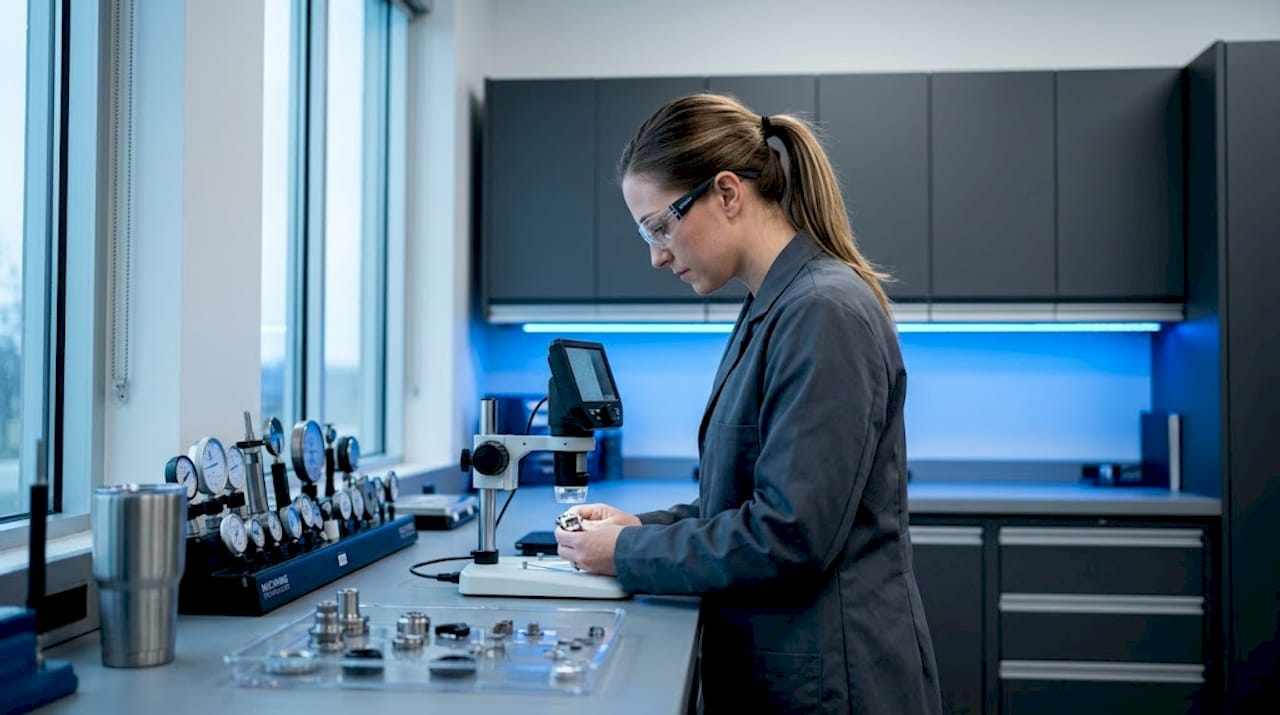
Cost reduction and material efficiency. The buy-to-fly ratio is a well-established metric in aerospace machining. When you start with a solid titanium billet and machine away 80% of it, the economics are painful. Near-net-shape additive manufacturing combined with CNC finishing dramatically reduces that scrap. You deposit material only where the geometry requires it, then machine to tolerance. For high-value materials like Inconel and titanium, this shift can represent significant cost recovery per part. Optimized multi-material production processes can reduce part costs by up to 95% compared to conventional workflows.
Faster development cycles. Consolidating fabrication, machining, and welding into one additive-subtractive process means fewer handoffs, fewer fixturing setups, and fewer opportunities for error accumulation. Rocket component timelines have been shortened by several weeks using multi-metal additive processes that replace multi-step fabrication sequences. For programs under schedule pressure, that kind of compression matters.
Enhanced functional performance. Advanced ceramic-metal multi-material structures with kirigami-inspired designs have demonstrated ultimate strain capacity increases from 4% to 370%. That is not a marginal gain. It represents a category shift in what a single component can withstand, which directly affects product life, safety margins, and maintenance intervals. The ability to engineer functional zones within one part, whether thermal, magnetic, structural, or electrical, is the core competitive advantage of multi-material machining for complex precision work. You can also review CNC machining material strategies to understand how material selection drives both strength and cost outcomes at the component level.
Technical considerations and challenges in multi-material machining
Understanding the benefits is straightforward. Executing the process without introducing failure modes requires more discipline.
Material compatibility assessment. Before committing a design to multi-material production, analyze thermal expansion coefficients, fatigue resistance, and galvanic compatibility between material pairs. A stainless steel zone deposited adjacent to an aluminum substrate will expand at different rates under thermal cycling. If the interface is not designed to accommodate that differential, delamination follows. Designers must engineer bonding surfaces to accommodate differing thermal expansion and prevent exactly this failure.
Deposition strategy selection. Directed energy deposition and powder bed fusion have different thermal footprints, resolution limits, and compatibility profiles. Your material pairing should drive the deposition method, not the other way around.
Thermal monitoring throughout the process. Integrated control of thermal stability during deposition is not optional. Localized heat buildup at material interfaces changes microstructure and residual stress patterns. Real-time thermal feedback loops, either through pyrometers or infrared cameras embedded in the machine, give process engineers the data needed to intervene before a defect propagates.
Machining reference management. Each transition between materials in a hybrid process is a potential datum shift risk. Establish fixed machining references at the part level before any deposition begins and verify them optically or with in-process probing before each CNC operation.
Pro Tip: Do not treat material interface engineering as a post-design fix. Build the bonding surface geometry, including interlocking features or gradient transition zones, into the design at the concept phase. Trying to retrofit interface solutions after the geometry is frozen is expensive and rarely works as well.
Common pitfalls include assuming that additive-deposited zones will have the same machinability as wrought equivalents. They often do not. Residual porosity and anisotropic grain structures affect tool life and surface finish differently. Test your machining parameters on coupon samples from the actual deposition process before committing to production feeds and speeds.
Multi-material vs. traditional machining methods
The benefits of multi-material machining are clearest when you compare it directly to the alternatives.
| Factor | Subtractive-only CNC | Additive-only | Multi-material hybrid |
|---|---|---|---|
| Geometric complexity | Moderate, limited by tool access | High, no tool access constraint | High, combines both |
| Dimensional tolerance | Tight, typically ±0.001 in. | Moderate, typically ±0.005–0.020 in. | Tight on machined surfaces |
| Material breadth | Wide, any machinable material | Limited by printable feedstocks | Expanding, driven by deposition compatibility |
| Material waste | High for complex billets | Low, near-net-shape | Low to moderate |
| Functional zoning | Not possible | Possible with material changes | Fully realized with CNC precision |
| Lead time for complex parts | Moderate to long | Moderate | Shorter through process consolidation |
| Setup complexity | Low to moderate | Moderate | High, requires integrated process control |
The table makes the tradeoffs visible. Subtractive-only CNC gives you the tightest tolerances and the widest material catalog, but it cannot deliver functional material zoning and generates significant waste on complex geometries. Additive-only processes offer geometric freedom but cannot hold the tolerances that aerospace and defense specifications require on mating surfaces and critical features. The hybrid approach captures the geometric freedom of additive manufacturing and applies CNC precision where the part actually needs it, which is the correct engineering answer for most complex, high-value components.
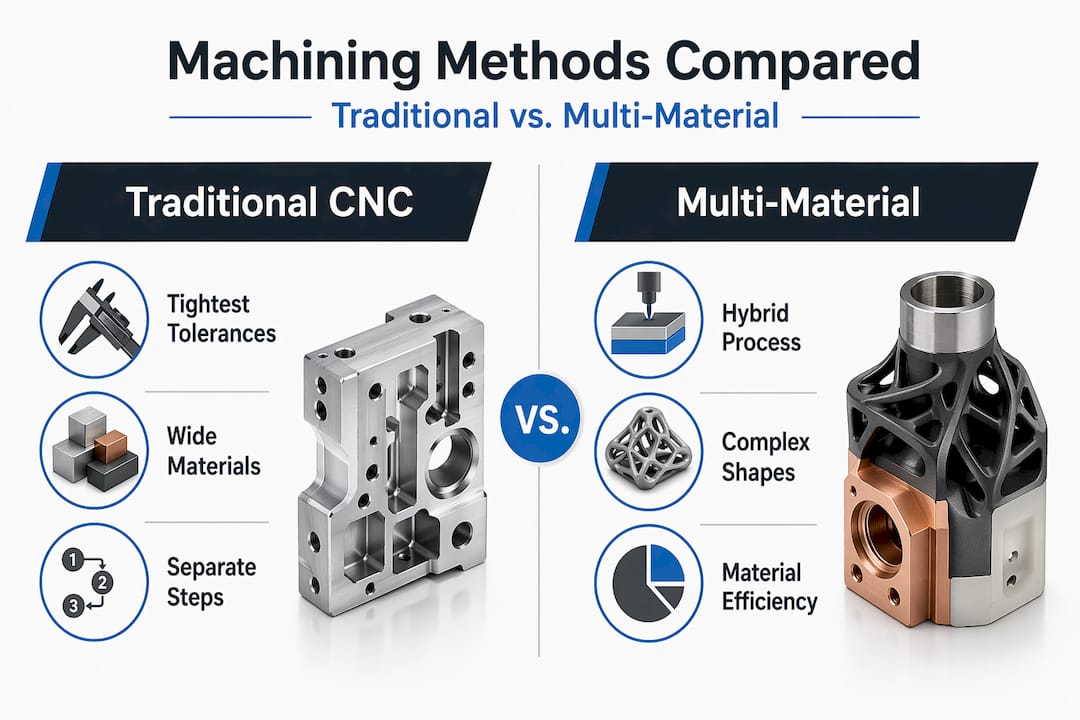
For high-volume production of simpler geometries, traditional CNC remains the right tool. The significance of machining different materials in a hybrid context is most pronounced when part complexity, material cost, or performance requirements push beyond what a single process can deliver economically. Understanding multi-axis machining provides additional context for how geometric complexity drives process selection.
Real-world applications of multi-material machining
The industry use cases that validate multi-material machining span sectors with different requirements but a common thread: single-material, single-process approaches could not meet the specification.
- Aerospace and defense: The EU Enlighten project demonstrated that multi-metal additive manufacturing for rocket components compresses development timelines by eliminating separate welding and assembly steps. Fraunhofer researchers deposited multi-metal gradient structures that would be impossible to produce through conventional forging and machining sequences.
- Medical devices: Implants that require a porous, bone-integrating surface on one side and a dense, load-bearing structure on the other are natural candidates for multi-material additive approaches. The graded properties achievable through additive manufacturing map directly to the functional demands of orthopedic and dental implants.
- Automotive and motorsport: Lightweight structural brackets that need localized reinforcement at bolt bosses can be produced with a high-strength alloy deposited precisely at the stress concentration points, while the rest of the part uses a lighter material. This reduces mass without sacrificing fatigue life.
- Electronics and thermal management: Components that must conduct heat away from a chip while providing structural support in the same envelope benefit from copper-aluminum or copper-ceramic hybrid structures that no conventional machining process can produce in a single operation.
- Repair and refurbishment: Worn turbine blades and tooling inserts can have material deposited on worn surfaces and then finish-machined back to drawing dimensions. This extends the service life of high-value components at a fraction of the cost of replacement, a direct application of multi-material machining efficiency gains.
My take: where the industry gets this wrong
I’ve watched manufacturing teams approach multi-material machining as if it’s simply an extension of their existing CNC or 3D printing workflows. It isn’t. What I’ve seen repeatedly is that teams either overestimate what additive can deliver on its own or underestimate how much process qualification work the hybrid approach demands upfront.
The misconception that bothers me most is the assumption that you can bolt an additive module onto a CNC machine and immediately run production parts. The machine is the easier part of the problem. The harder part is the validated process: the deposition parameters, the thermal monitoring protocol, the interface engineering, and the machining strategy that accounts for the material you’ve deposited rather than the material you would have machined from billet.
What I’ve learned is that successful implementations treat multi-material machining as an integrated discipline, not a technology stack. The teams that get it right bring material science, design engineering, and process control into the same conversation from day one. They design the bonding interfaces deliberately. They test coupon samples before touching production parts. They qualify the full process, not just the individual machines.
The payoff when you do it correctly is real. Fewer parts in an assembly, better performance per kilogram, and shorter lead times for complex geometries. Those are not theoretical benefits. They show up in program cost and delivery performance in ways that justify the qualification investment.
— Andrew
Work with Machiningtechllc on advanced machining solutions
Machiningtechllc has been producing complex, high-precision components since 1985, and the team in Webster, Massachusetts understands exactly what it takes to move from prototype to high-volume production on demanding parts. If your programs involve tight tolerances, dissimilar materials, or complex geometries that conventional approaches have struggled to deliver, the precision machining strategies at Machiningtechllc are worth a direct conversation. For OEMs looking to compress lead times and reduce per-part costs, the contract machining services offer a practical path to faster production without sacrificing quality. Contact the Machiningtechllc team to discuss your specific requirements.
FAQ
What is multi-material machining?
Multi-material machining is a hybrid manufacturing process that combines additive material deposition with CNC subtractive machining in a coordinated sequence. It enables parts with multiple materials, complex geometries, and functional zones that neither process can produce independently.
What are the main benefits of multi-material machining?
The primary benefits include reduced material waste through near-net-shape deposition, site-specific material properties for better part performance, faster development cycles by consolidating process steps, and the ability to meet tolerances that additive manufacturing alone cannot achieve.
What industries use multi-material machining?
Aerospace, defense, medical devices, automotive, and electronics sectors all apply multi-material machining. Rocket component fabrication, orthopedic implants, lightweight structural brackets, and thermal management components are among the validated use cases.
What are the biggest challenges in multi-material machining?
Material compatibility at interfaces, thermal stability during deposition, and maintaining accurate machining datums across material transitions are the primary technical challenges. Each requires deliberate process design and in-process monitoring to control effectively.
How does multi-material machining compare to CNC machining alone?
CNC-only machining delivers tighter tolerances and a wider material catalog but cannot produce functional material zoning or reduce waste on complex geometries. Multi-material hybrid approaches trade some setup simplicity for significantly better performance on high-value, geometrically complex parts.
Recommended
- Machinability of materials guide for precision 2026 | Machining Technologies
- Complex part manufacturing: precision strategies 2026 | Machining Technologies
- 7 Key Benefits of Precision Machining for Manufacturers | Machining Technologies
- CNC Machining Materials: Optimize Strength, Precision, Cost | Machining Technologies