


TL;DR:
- Machining precision directly impacts firearm accuracy, with tolerances of ±0.0002–0.0005 inches often needed for sub-MOA performance.
- Balancing tight tolerances with reliability is crucial, as overly precise parts may reduce function in adverse conditions.
- Continuous inspection and maintenance strategies are essential to manage barrel wear and ensure ongoing accuracy throughout a firearm’s lifecycle.
Modern production rifles routinely achieve 0.5 MOA accuracy due to sub-0.001-inch tolerances, a benchmark that was nearly impossible at scale just decades ago. Most people assume accuracy lives in the shooter’s hands or the ammunition they choose. The truth is more fundamental. The geometry of every machined surface, the concentricity of a chamber, the consistency of lug engagement — these are what separate a rifle that wins contracts from one that generates recalls. This guide walks through the direct relationship between machining precision and firearm performance, explains the tradeoffs engineers face, and gives you actionable frameworks for making smarter manufacturing decisions.
Table of Contents
- How machining precision transforms firearm accuracy
- Processes and measurements that deliver sub-MOA performance
- Tradeoffs between precision, reliability, and durability
- Addressing edge cases: barrel wear, field failure, and compliance risks
- Our take: Why the relentless pursuit of ‘perfect’ tolerances can backfire
- Unlock next-level precision for your firearms manufacturing
- Frequently asked questions
Key Takeaways
| Point | Details |
|---|---|
| Tight tolerances boost accuracy | Production rifles with sub-0.001-inch machining deliver 0.5 MOA or better groups. |
| Advanced QC prevents failures | Metrology, CMMs, and GD&T catch deviations before they risk compliance or safety. |
| Balance precision for end use | Ultra-tight specs aren’t always best; match tolerances to the firearm’s operating environment and purpose. |
| Monitor wear through lifecycle | Track barrel and chamber wear with chronograph and ES/SD data to plan maintenance and prevent surprises. |
How machining precision transforms firearm accuracy
Accuracy in a firearm is not a single variable. It is the cumulative result of dozens of machined surfaces interacting under extreme pressure, heat, and mechanical stress. When any one of those surfaces falls outside specification, the effect compounds. A barrel that is not concentric to the bore axis by even a few ten-thousandths of an inch will shift point of impact in ways no optic adjustment can fully correct.
The industry measures accuracy in MOA, or minute of angle, which equals approximately one inch at 100 yards. A production rifle at 1.5 MOA will place shots in a 4.5-inch group at 300 yards. A match-grade rifle at 0.5 MOA keeps those shots inside 1.5 inches at the same distance. For military, law enforcement, or precision sport applications, that difference is not academic.
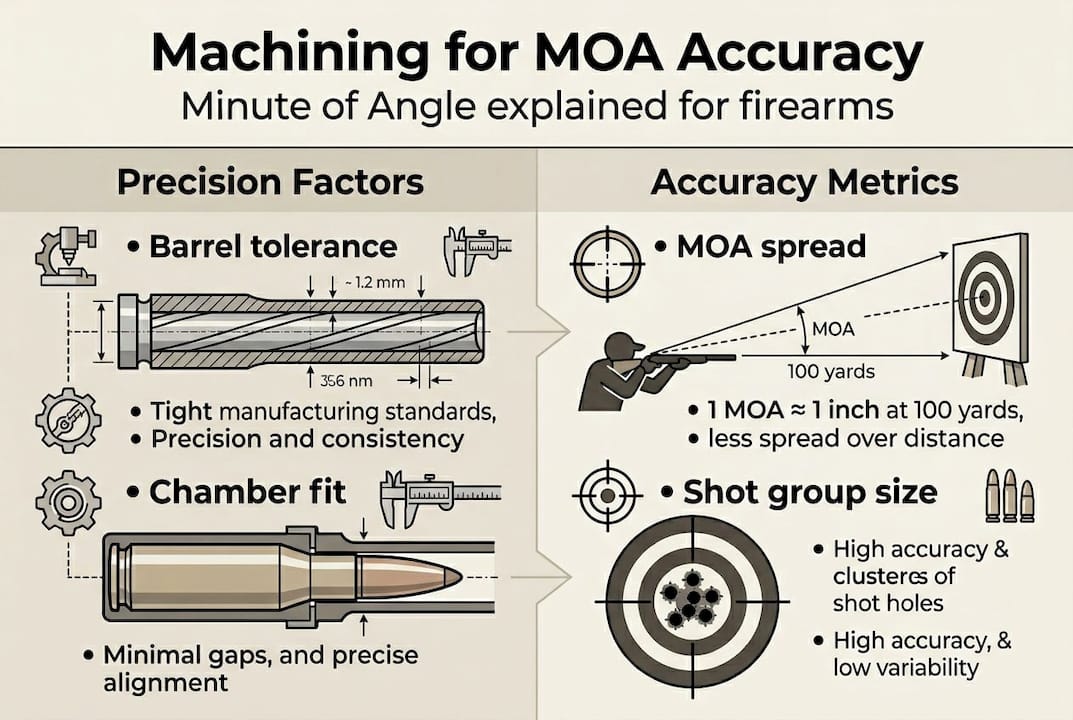
Tight tolerances in barrels, chambers, and lugs, typically ±0.0002–0.0005 inches, achieve consistent bullet engagement and 0.5 MOA or better accuracy. These numbers require precision equipment, rigorous process controls, and experienced operators who understand how materials behave under cutting forces and thermal load.
Typical accuracy benchmarks by rifle class:
| Rifle class | Typical MOA | Primary tolerance zones |
|---|---|---|
| Military/duty | 1.0–2.0 MOA | Chamber, headspace, barrel |
| Production sporting | 0.75–1.5 MOA | Barrel, receiver interface |
| Match/precision | 0.25–0.75 MOA | Lugs, chamber, crown, bore |
The components that most directly affect grouping are:
- Barrel bore and rifling consistency: Uneven rifling causes yaw at the muzzle, degrading grouping immediately.
- Chamber dimensions: An oversize chamber allows case expansion and inconsistent bullet release, raising extreme spread (ES) in velocity.
- Lug engagement: Uneven lug contact causes variable bolt thrust, shifting point of impact between shots.
- Crown geometry: A damaged or off-center crown disrupts gas release and destabilizes the bullet at the muzzle.
Historically, mass-produced military rifles averaged 3–4 MOA. Modern parts manufacturing quality has pushed production-grade rifles below 1.5 MOA as a standard, with match configurations routinely beating 0.5 MOA. That shift is entirely a function of tighter tolerances and better process control, not a change in physics.
Processes and measurements that deliver sub-MOA performance
Knowing what tolerances to target is half the problem. Consistently hitting those tolerances in production is the harder challenge. The manufacturing methods and metrology tools you select define your ceiling.
Processes like CNC machining, EDM, and metrology using CMMs enable sub-0.01 mm deviations for compliance and safety across high-volume production runs. Each process has a specific role in the firearms workflow.
Typical production workflow for a precision barrel:
- Blueprint review and GD&T analysis — Confirm all geometric dimensioning and tolerancing (GD&T) callouts before cutting starts.
- CNC turning for exterior profile — Establish concentricity and surface finish to drawing specs.
- Deep-hole drilling and reaming — Create the bore with tight diameter and straightness controls.
- Button or cut rifling — Engrave the rifling pattern with consistent land and groove dimensions.
- Chamber reaming — Cut the chamber to headspace spec, verified with go/no-go gauges.
- Wire EDM for recoil lugs and fine features — Achieve geometry that CNC milling cannot hold reliably.
- CMM inspection — Verify all critical dimensions against drawing tolerances before release.
Metrology is not a final checkpoint. It is a feedback loop. CMMs and weapons standards require that dimensional data inform process corrections in real time, not just flag rejects after the fact. Headspace gauging at the chamber, air gauging in the bore, and surface profilometry at the crown all feed into a complete quality picture.
Comparison: standard shop tolerances vs. firearms tolerances
| Feature | General machining | Firearms spec |
|---|---|---|
| Bore diameter | ±0.005 in | ±0.0002–0.0005 in |
| Chamber headspace | ±0.010 in | ±0.001–0.002 in |
| Lug engagement | ±0.005 in | ±0.0002–0.0003 in |
| Surface finish | 125 Ra | 16–32 Ra |
For your machining workflow for firearms, the choice of machining methods and materials directly affects which tolerances are achievable at volume.

Pro Tip: Track R99 (the radius containing 99% of shots) and CEP (circular error probable) in addition to ES and SD. These real-world grouping metrics reveal problems that paper specs can hide, especially in barrels that are technically in-tolerance but producing asymmetric wear.
Tradeoffs between precision, reliability, and durability
Here is the counterintuitive reality that many engineers learn the hard way: tighter is not always better. Tighter tolerances boost grouping but can reduce reliability compared to looser, duty-grade specs in harsh or contaminated environments.
Consider what happens when a bolt carrier group machined to match-grade clearances encounters a chamber fouled with carbon and sand. The same tight fit that eliminates wobble and improves accuracy becomes a liability when thermal expansion and debris reduce the available clearance to near zero. The action binds. The weapon fails to cycle.
Precision tradeoffs at a glance:
- Benefits of tight tolerances: Improved grouping, consistent muzzle velocity, reduced ES, better regulatory compliance documentation.
- Risks of extreme tightness: Sensitivity to fouling, higher maintenance frequency, increased manufacturing cost, potential function issues in adverse conditions.
- Benefits of relaxed (duty-grade) tolerances: Greater reliability across temperature extremes, better fouling tolerance, lower per-unit cost.
- Risks of loose tolerances: Wider groups, higher ES, potential headspace issues if specs drift toward maximum.
Chrome lining is a practical example of this tradeoff. A chrome-lined barrel sacrifices roughly 0.25–0.5 MOA of accuracy compared to a bare-steel match barrel, but it gains dramatically extended service life and corrosion resistance. For a military service rifle expected to fire tens of thousands of rounds in austere conditions, that is the right tradeoff between accuracy and precision.
“The goal is not the tightest possible number on a drawing. The goal is the right number for the weapon’s intended mission profile.” This is where tight tolerances matter most — when they are calibrated to purpose, not chased for their own sake.
Smart manufacturers define their tolerance strategy by use case first. A precision bolt-action for competitive shooting demands different specs than a semi-automatic carbine built for law enforcement patrol duty. Getting this decision wrong early in the design phase costs significantly more to correct after tooling is cut.
Addressing edge cases: barrel wear, field failure, and compliance risks
Even a perfectly machined barrel does not stay that way. Every round fired erodes the throat, the area just ahead of the chamber where pressure and temperature are highest. Over time, this erosion degrades accuracy in a predictable pattern.
Barrel wear including throat erosion and fire cracking can degrade accuracy from 0.5 MOA to 1.8 MOA or more through a typical lifecycle. Engineers need to design maintenance and replacement schedules around this reality, not treat initial accuracy as a permanent specification.
Typical barrel accuracy degradation schedule:
| Round count | Expected MOA (match barrel) | Notes |
|---|---|---|
| 0–500 | 0.5–0.75 MOA | Break-in period, stabilizing |
| 500–2,000 | 0.75–1.0 MOA | Normal wear, minor throat erosion |
| 2,000–5,000 | 1.0–1.5 MOA | Measurable throat erosion |
| 5,000+ | 1.5–2.0+ MOA | Significant degradation, replacement zone |
Pro Tip: Use a chronograph to track muzzle velocity and ES at regular intervals. A rising ES, even without visible accuracy loss, is an early indicator of throat erosion. Catching it early lets you plan barrel replacement before a field failure or compliance issue forces the decision.
Out-of-tolerance parts create liability exposure that goes well beyond performance. Firearms that fit and finish matter from a regulatory standpoint must meet SAAMI or MIL-SPEC headspace limits. A chamber that has worn beyond maximum headspace specification is a safety hazard, and a manufacturer who cannot demonstrate traceability through documented QC records faces serious legal exposure in the event of a failure.
Action steps for engineers managing lifecycle precision:
- Establish documented inspection intervals tied to round count, not calendar time.
- Maintain serialized records linking each barrel to its original CMM inspection data.
- Define go/no-go criteria for field return and depot-level inspection.
- Build service life planning into your initial design review, not as an afterthought.
Our take: Why the relentless pursuit of ‘perfect’ tolerances can backfire
After decades of producing precision components for the firearms and defense industries, we have seen a consistent pattern. Engineers arrive with drawings calling for tolerances tighter than the application actually requires. The instinct is understandable. Tighter feels safer. But in practice, chasing tenths of a thousandth where the design does not demand it raises cost, slows throughput, and sometimes creates the very failures it was meant to prevent.
The manufacturers who consistently deliver reliable, accurate products are not the ones with the tightest numbers on their drawings. They are the ones who use GD&T intelligently to specify tolerances where they matter and relax them where they do not. They collaborate early between design, production, and QC to catch over-engineering before it reaches the shop floor.
Our most successful firearms customers build their precision machining workflow around intended performance envelopes, not theoretical perfection. That discipline is what produces audit-ready, field-proven products at volume.
Unlock next-level precision for your firearms manufacturing
The gap between a firearm that meets spec on paper and one that performs reliably in the field comes down to manufacturing discipline: the right tolerances, the right processes, and the right quality controls applied consistently at volume. Machining Technologies LLC has delivered that discipline to firearms manufacturers since 1985, producing over 20 million parts annually from our 70,000 square foot facility in Webster, Massachusetts.

Our team integrates precision machining workflow for firearms with full metrology support, from CMM inspection to headspace verification, so your parts arrive audit-ready. Whether you need prototype development or full-scale production, our parts manufacturing quality standards are built to meet MIL-SPEC and SAAMI requirements. Contact us to discuss your next program.
Frequently asked questions
What level of machining tolerance is required for sub-MOA rifles?
Tolerances as tight as ±0.0002–0.0005 inches in critical areas like lugs and chambers are needed. Rifles with lugs at ±0.0002-inch tolerance routinely achieve sub-MOA accuracy in production.
How does barrel wear affect firearm accuracy?
Barrel wear including throat erosion and fire cracking can degrade precision from an initial 0.5 MOA to 1.8 MOA or more over a barrel’s lifecycle, making scheduled inspection essential.
Can tighter tolerances make firearms less reliable?
Yes. Looser duty-grade specs are sometimes preferable for reliability in harsh or fouled conditions, so matching tolerance strategy to the weapon’s intended use is critical.
What manufacturing process is recommended for firearm lugs and rifling?
EDM and precision rifling techniques enable sub-0.01 mm deviation for MIL-SPEC parts. EDM is preferred for recoil lugs, while button or cut rifling is standard for barrels.
How can manufacturers monitor precision over a firearm’s lifecycle?
Use chronograph data to track muzzle velocity and measure extreme spread at regular round-count intervals. Rising ES is an early indicator of throat erosion before visible accuracy loss appears.