

TL;DR:
- Small parts machining involves precise fabrication methods such as milling, turning, drilling, micro-machining, and EDM. Tolerance, material, and geometry determine the most cost-effective process, with CNC and micro-machining suited for complex features and micro-scale details. Proper process selection, early partner collaboration, and tolerance management are essential to optimize quality and cost at production scale.
Small parts machining is defined as the fabrication of components requiring tight dimensional control, typically produced through milling, turning, drilling, micro-machining, or electrical discharge machining (EDM). The industry standard term is “precision machining,” and understanding the types of small parts machining processes available is what separates a well-specified part from an expensive rework cycle. Turning, milling, and drilling handle most custom parts production, with each process differing by how the tool and workpiece move relative to each other. Tolerance requirements, part geometry, and material hardness determine which method delivers the best result at the lowest cost.
1. Types of small parts machining: the core three processes
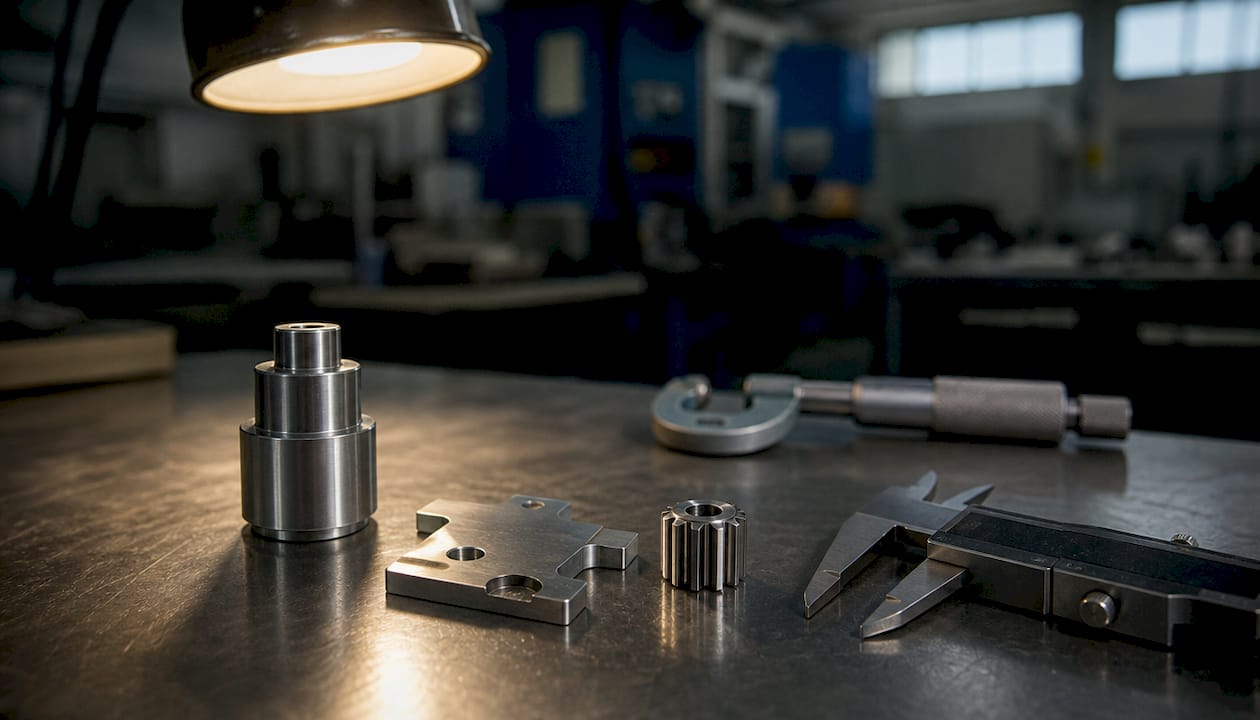
CNC is an automation method applied to turning, milling, and drilling. It is not a machining type itself. That distinction matters when you are specifying a process, because the underlying method determines what geometries are achievable and at what cost.
CNC milling uses a rotating cutting tool against a stationary workpiece. It excels at flat surfaces, pockets, slots, and complex 3D contours. Common materials include aluminum, steel, titanium, and engineering plastics.
- Achieves tolerances of ±0.001" to ±0.005" in standard configurations
- Suited for prismatic parts, brackets, housings, and multi-featured components
- Requires more fixturing time than turning for simple round parts
CNC turning rotates the workpiece against a stationary cutting tool. It is the fastest and most cost-effective method for cylindrical parts such as shafts, bushings, and threaded fasteners.
- Produces concentricity and roundness that milling cannot match
- Handles diameters from sub-millimeter to several inches
- Thread cutting, grooving, and facing are all done in a single setup
Drilling creates precise holes using predetermined drill bit diameters. It is rarely used alone for small parts. Drilling is almost always combined with milling or turning to add hole features to a primary geometry.
- Tolerances depend on bit quality and spindle rigidity
- Reaming and boring follow drilling when tighter hole tolerances are needed
- Peck drilling cycles manage chip evacuation in deep, small-diameter holes
2. Micro-machining: features below 1 mm
Micro-machining is the production of features smaller than 1 mm using specialized equipment and process controls that standard CNC machines cannot replicate. The physics of cutting at this scale change fundamentally. Tool deflection, thermal expansion, and vibration all become dominant variables.
Spindles exceeding 60,000 RPM and tools smaller than 0.1 mm diameter are standard in micro-machining. That speed is necessary because chip load per tooth must stay within a narrow window to avoid tool breakage. A broken 0.05 mm end mill inside a medical implant channel is not a recoverable situation.
Swiss-type lathes provide the rigidity and precision needed for very small or slender parts. They are the dominant platform in medical device and aerospace micro-turning applications. The guide bushing supports the workpiece directly at the cutting zone, eliminating deflection that would otherwise make tight tolerances impossible.
Micro-machining tolerances reach ±0.005 mm to ±0.001 mm, with surface finishes that are often optical grade. Standard CNC milling cannot approach those numbers without specialized tooling and environmental controls.
Applications where micro-machining is the only viable option:
- Surgical instrument tips and bone screw threads
- Fuel injector nozzle orifices in aerospace engines
- Optical fiber alignment ferrules in photonics assemblies
- Microfluidic channels in diagnostic devices
Pro Tip: Bring your machining partner into the design phase before tolerances are locked. Relaxing non-critical tolerances early in a micro-machining project is the single most effective way to cut cycle time and inspection cost.
3. Electrical discharge machining for hard metals and complex shapes
EDM removes material through controlled electrical sparks rather than mechanical cutting. That distinction makes it the correct choice when a part is too hard to cut conventionally or when the geometry requires internal corners that no rotating tool can reach.
Wire EDM uses a thin brass wire as the electrode. The wire never contacts the workpiece. Spark erosion cuts through the material with tolerances that rival grinding. Wire EDM capabilities make it the standard process for die components, turbine blade slots, and firearm components requiring exact profile tolerances.
Sinker EDM uses a shaped electrode to burn a cavity into the workpiece. It is the correct process for blind pockets, complex mold cavities, and features that cannot be reached from the outside. Both EDM variants work on any electrically conductive material regardless of hardness, including hardened tool steel, carbide, and Inconel.
EDM does not generate cutting forces. That matters for fragile thin-wall sections where milling would cause deflection or distortion. The tradeoff is speed. EDM is slower than milling for bulk material removal, so it is reserved for finishing operations or geometries where no other process applies.
4. How tolerance requirements drive process selection
Precision CNC machining achieves tolerances between ±0.0005" and ±0.005", with tighter tolerances increasing cost by 30–100%. That cost increase is not arbitrary. It reflects slower feed rates, additional fixturing, more frequent tool changes, and more rigorous inspection at every stage.
The table below maps common small parts machining methods to their typical tolerance range, geometry fit, and primary inspection method.
| Machining method | Typical tolerance | Best geometry fit | Primary inspection |
|---|---|---|---|
| CNC milling | ±0.001"–±0.005" | Prismatic, complex 3D | CMM, calipers |
| CNC turning | ±0.001"–±0.003" | Cylindrical, threaded | Micrometer, air gauge |
| Micro-machining | ±0.001–±0.005 mm | Sub-mm features | Optical CMM, SEM |
| Wire EDM | ±0.0002"–±0.001" | Profiles, slots, dies | CMM, optical comparator |
| Sinker EDM | ±0.0005"–±0.002" | Blind cavities, molds | CMM, profilometer |
Inspection methods scale with tolerance. A part held to ±0.005" can be verified with a digital caliper. A part held to ±0.0002" requires a coordinate measuring machine (CMM) or optical system. That inspection cost adds to the total part cost and must be factored into your budget from the start.
Multi-axis machining enables complex geometry in fewer setups, which directly improves accuracy. Every time you refixtured a part, you introduce a potential alignment error. Five-axis and 2+3 axis machines eliminate most of those setups for small parts with angled or multi-sided features. For complex part geometries, multi-axis is not a luxury. It is the only way to hold tight tolerances across multiple faces without accumulating setup error.
5. How to choose the right machining method for your part
Machining selection depends on four factors: part geometry, material, required tolerance, and production volume. Getting one of those wrong means either scrapped parts or a process that costs three times more than necessary.
Use this framework to narrow your options:
Start with geometry. Cylindrical parts go to turning first. Flat or multi-featured parts go to milling. Parts with internal profiles, hard materials, or no-contact requirements go to EDM.
Then check material hardness. Aluminum and brass machine easily on standard CNC equipment. Hardened steel, carbide, and titanium alloys require either high-performance tooling or EDM. Micro-machining adds further constraints because tool wear accelerates dramatically in abrasive materials at small diameters.
Match tolerance to process capability. Do not specify ±0.0005" on a feature that only needs ±0.003". That single decision can double your per-part cost. Review how to specify machining tolerances before releasing drawings to a shop.
Factor in production volume. High-volume runs justify dedicated fixturing and automated loading. Low-volume prototype runs favor flexible setups even if cycle time is longer. Machiningtechllc produces over 20 million parts annually using Hydromat systems and automated CNC cells, which makes high-volume small parts production cost-effective at a scale most in-house shops cannot match.
Common mistakes engineers make when selecting a process:
- Specifying EDM when standard milling would achieve the same result at lower cost
- Using turning for a part with significant flat features, forcing secondary milling operations
- Ignoring surface finish requirements until after the process is selected
- Underestimating inspection cost for ultra-tight tolerances
For specialized tooling needs that support precision fabrication setups, precision fabrication tools from industrial suppliers can complement your machining process selection.
Key takeaways
The most effective small parts machining method is determined by part geometry, material, tolerance, and volume. No single process covers every application.
| Point | Details |
|---|---|
| Process drives geometry | Cylindrical parts belong in turning; prismatic and complex 3D parts belong in milling. |
| Tolerance increases cost | Tighter tolerances require slower feeds, more fixturing, and advanced inspection, raising cost by 30–100%. |
| EDM handles the hard cases | Use EDM for hardened materials, internal profiles, and features no rotating tool can reach. |
| Micro-machining needs early collaboration | Lock in your machining partner before tolerances are finalized to avoid unnecessary cost. |
| Inspection scales with precision | Parts held to ±0.0002" require CMM or optical systems, not calipers. |
What I’ve learned from watching engineers over-specify small parts
The most expensive mistake I see repeatedly is not choosing the wrong machining process. It is specifying tolerances that are tighter than the application actually needs. An engineer designs a bracket, applies ±0.001" across every feature because it feels safe, and then wonders why the quote comes back at three times the expected price.
Tolerance is not free. Every digit you add to the right side of the decimal point triggers a cascade: slower feeds, more inspection points, higher scrap rates, and longer lead times. The part that needed ±0.003" on its mounting holes did not become more reliable because you specified ±0.0005". It just became more expensive.
The second pattern I see is treating EDM as a last resort rather than a first-choice tool for the right geometry. Engineers who grew up with milling and turning sometimes force those processes onto parts that EDM would handle faster and more accurately. A hardened steel component with a narrow internal slot is not a milling problem. It is an EDM problem. Recognizing that early saves weeks of rework.
Automation in micro-machining is changing the cost equation faster than most engineers realize. Shops running automated Swiss-type lathe cells can now hold ±0.001 mm tolerances at production volumes that were impossible five years ago. The gap between prototype micro-machining and production micro-machining is closing. If you dismissed micro-machining as too expensive for your volume, revisit that assumption with a current quote.
The best outcome in any small parts project comes from treating your machining partner as an engineering resource, not just a vendor. Bring them in early. Let them push back on tolerances. That conversation is worth more than any design review you will run internally.
— Andrew
Machiningtechllc: precision small parts machining at production scale
Machiningtechllc has delivered precision small parts machining from its 70,000 square foot facility in Webster, Massachusetts since 1985. The shop runs CNC milling, CNC turning, wire EDM, and Hydromat systems across a production floor capable of over 20 million parts per year.
For OEMs sourcing high-volume small components, contract machining through Machiningtechllc delivers up to 80% faster production compared to in-house machining setups. The combination of automated cells, tight tolerance capability, and dedicated quality inspection makes Machiningtechllc a direct fit for aerospace, defense, and industrial manufacturers who need consistent output at scale. Contact the team to discuss your small parts requirements and get a quote.
FAQ
What are the main types of small parts machining?
The main types are CNC milling, CNC turning, drilling, micro-machining, and EDM. Each process suits different part geometries, materials, and tolerance requirements.
When should I use EDM instead of milling for small parts?
Use EDM when the material is hardened, when internal profiles cannot be reached by a rotating tool, or when tolerances are tighter than ±0.001". EDM removes material without cutting forces, which protects fragile features.
What tolerances does micro-machining achieve?
Micro-machining reaches tolerances of ±0.005 mm to ±0.001 mm, with surface finishes that are often optical grade. Standard CNC milling cannot achieve those numbers without specialized equipment.
How does production volume affect machining method selection?
High-volume runs justify dedicated fixturing and automated loading, which lowers per-part cost significantly. Low-volume prototype runs favor flexible setups even when cycle time is longer.
Why do tighter tolerances cost more?
Tighter tolerances require slower feed rates, more frequent tool changes, additional fixturing, and advanced inspection equipment such as CMM or optical systems. These factors combine to increase cost by 30–100% compared to standard tolerance work.
Recommended
- Step-by-step precision part design for high-volume manufacturing | Machining Technologies
- Optimize high-volume machining workflow: aerospace precision | Machining Technologies
- Complex Parts Machining Examples for Engineers | Machining Technologies
- Complex part manufacturing: precision strategies 2026 | Machining Technologies