

TL;DR:
- A well-designed manufacturing workflow connects design, planning, machining, and monitoring into a continuous process. Structural connectivity failures cause most delays and rework, making digital thread integration essential. Stability, proper data management, and feedback loops are key to achieving efficient complex part production.
A well-structured workflow for complex part manufacturing is defined as an integrated process that connects design release, process planning, machining execution, and production monitoring into a single, unbroken chain. Unplanned equipment downtime costs industrial firms approximately $50 billion annually, and the root cause is almost never a single machine failure. The real culprit is broken connectivity between workflow stages. Manufacturing engineers and operations managers who treat each production stage as a standalone function pay for that fragmentation in rework, delays, and scrap. The most effective complex part production process combines lean physical stability, digital thread integration, and iterative data feedback to close those gaps before they become expensive.
What are the critical components of an efficient manufacturing workflow for complex parts?
Complex machined parts are defined as components requiring multiple setups, tight geometric tolerances, and coordinated data handoffs across design, planning, and production teams. An efficient workflow for these parts does not begin on the shop floor. It begins at design stabilization, where part drawings are locked, bills of materials are verified, and engineering change orders are controlled before any chips are cut.
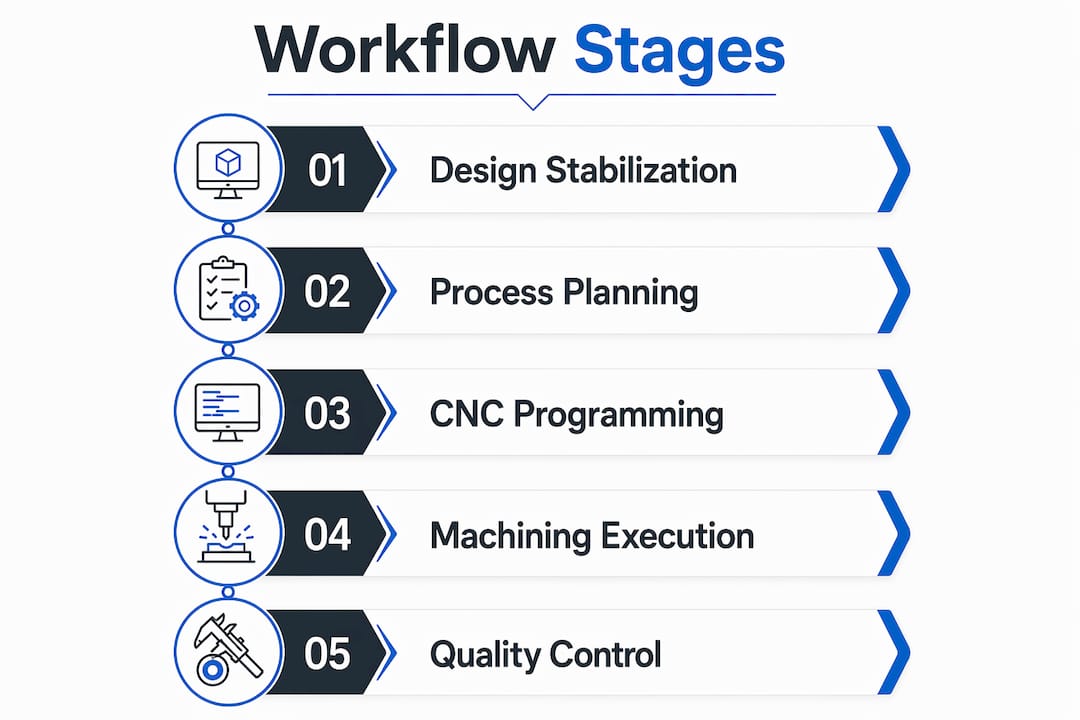
The six foundational stages of a high-performing complex part production process are design stabilization, part drawing extraction, process planning, machining setup, production execution, and real-time monitoring. Each stage depends on clean data from the previous one. A breakdown at the drawing extraction stage, for example, cascades into incorrect toolpaths, wrong material callouts, and first-article failures.
Lean principles such as 5S and flow control establish the physical order that makes digital monitoring meaningful. PLM, ERP, and MES integration then creates the digital thread that carries accurate data from engineering intent to machine execution. The hidden costs of handoff failures between PLM and ERP, and between ERP and MES, are where most expensive rework originates.
| Workflow stage | Key tools and methods |
|---|---|
| Design stabilization | PLM systems, ECO control, drawing revision locks |
| Process planning | CAPP software, tooling databases, cycle time modeling |
| Machining setup | CNC program version control, fixture sheets, setup sheets |
| Production execution | MES work orders, operator instructions, SPC monitoring |
| Quality verification | CMM inspection, first article reports, GD&T callout review |
| Continuous monitoring | IoT sensors, OEE dashboards, ERP live data feeds |
Pro Tip: Establish 5S and physical flow control on every workstation before deploying IoT sensors or digital dashboards. Monitoring an unstable process generates digital waste, not insight.
How to execute the manufacturing workflow step by step for complex machined parts
Execution starts with a controlled design release. Every part drawing must carry a locked revision, a complete GD&T callout, and a verified material specification before it enters the process planning queue. Engineering changes discovered during assembly cost ten times more to fix than those caught at the initial design review. That single fact justifies the investment in front-loaded drawing discipline.
BOM management is the next critical gate. A multi-level BOM that does not match the assembly drawing creates phantom shortages, wrong-revision parts, and inspection failures. Operations managers should require a BOM audit at every engineering change order before any floor traveler is released.
Machining setup priorities follow a fixed sequence: confirm the CNC program revision matches the current drawing revision, verify fixture offsets against the setup sheet, and run a dry cycle before cutting the first part. First article inspection then validates the entire setup against the drawing before production quantities begin. Skipping first article inspection to save time is the most common and most expensive shortcut in custom part manufacturing.
- Lock part drawing revision and verify GD&T completeness.
- Audit the BOM against the assembly drawing and resolve all discrepancies.
- Release the floor traveler only after ECO sign-off.
- Confirm CNC program version matches the current drawing revision.
- Verify fixture offsets and run a dry cycle.
- Complete first article inspection before releasing production quantities.
- Capture SPC data at defined control points throughout the run.
- Close the loop by feeding inspection results back to process planning.
A synchronized data handoff at each step prevents the most common workflow failures. When the CNC program version does not match the drawing revision, the error surfaces at inspection, not at setup. That gap costs hours, not minutes.
Pro Tip: Store all CNC programs in a version-controlled repository linked to the drawing revision number. When a drawing changes, the program change is triggered automatically, not by memory.
What are the main challenges in information flow and process coordination?
Structural connectivity failures, not individual tool limitations, are the primary cause of inefficient workflows in precision manufacturing. 85% of precision manufacturers report that interdepartmental transitions are the largest source of manufacturing information failure. More than 50% specifically identify the gap between the shop floor and the front office as the most damaging breakdown point. That gap is where quoted cycle times diverge from actual cycle times, and where engineering assumptions collide with machining reality.
The front-office-to-floor gap has a specific anatomy. Quoting teams use estimated cycle times. Schedulers use planned capacity. Operators work with actual machine behavior. When those three data sets never synchronize, every production plan is built on assumptions. Integrating ERP to live machine data improved uptime by 27%, utilization by 28%, and delivered a 7x return on investment in one documented implementation. That result is not exceptional. It is what happens when real data replaces assumptions.
Common communication challenges in complex part workflows include:
- Drawing revisions released to the floor without notifying the CNC programming team.
- BOM changes processed in ERP without triggering a review of active floor travelers.
- Inspection rejections logged in quality systems but never fed back to process planning.
- Scheduling decisions made without visibility into actual machine utilization.
- Tooling changes made at the machine without updating the setup sheet or program documentation.
| Coordination approach | Information accuracy | Response to change | Rework risk |
|---|---|---|---|
| Manual paper-based | Low, revision errors common | Slow, relies on verbal communication | High |
| Partial digital integration | Medium, siloed by department | Moderate, requires manual triggers | Medium |
| Full digital thread (PLM/ERP/MES) | High, single source of truth | Fast, automated change propagation | Low |
For manufacturers not ready for full digital thread deployment, incremental connectivity improvements deliver measurable results. Linking precision part design data to live production tracking is a practical first step that does not require a full system overhaul.
Which advanced manufacturing techniques improve complex part production efficiency?
Hierarchical hybrid multi-objective algorithms represent the most documented advance in complex assembly line optimization. Applied to aircraft component assembly, one such algorithm increased line balance rate by 72%, decreased the assembly complexity smoothing index by 92%, and reduced the load balance index by 80.3%. Those are not incremental gains. They reflect what happens when workstation assignments are treated as a mathematical optimization problem rather than a scheduling judgment call.
AI-powered workflow analysis adds a different kind of value. AI reveals that actual shop floor behavior differs significantly from documented standard work. Lean methods alone miss dynamic human behavior variability. AI-driven analysis surfaces real workflow patterns, which enables smarter station design and more accurate cycle time modeling.
The most effective architecture for complex part production combines three tiers: lean physical stability at the base, IoT condition monitoring in the middle, and mixed-integer linear programming optimization at the top. This three-tier approach is not theoretical. Combining lean stability, IoT monitoring, and mathematical optimization reduced total process waste by 32.3% and improved block utilization by 10.72% in a documented implementation.
| Metric | Baseline | Optimized | Method applied |
|---|---|---|---|
| Line balance rate | Baseline | +72% | Hierarchical hybrid algorithm |
| Process waste | 15.28% | 10.35% | Lean plus IoT plus optimization |
| Equipment utilization | Baseline | +28% | ERP to live machine data integration |
| Uptime | Baseline | +27% | Digital thread connectivity |
Pro Tip: Apply optimization algorithms only after lean physical stability is confirmed. Running a multi-objective algorithm on a process with uncontrolled variation produces an optimized version of a broken process.
For manufacturers in aerospace and defense, the high-volume machining workflow principles that govern aircraft component assembly translate directly to complex precision part production.
How can manufacturers maintain continuous improvement in complex part workflows?
Continuous improvement in complex part workflows requires closing the feedback loop from production back to design and quoting. Most manufacturers collect inspection data. Far fewer use that data to update process plans, revise cycle time estimates, or flag recurring failure modes to engineering. The feedback loop is the mechanism that converts production experience into institutional knowledge.
Digital thread connectivity makes that loop automatic rather than manual. When inspection results feed back into the MES, and MES data feeds back into ERP, and ERP data informs the next quoting cycle, the organization learns from every part it produces. That is the practical definition of data-driven continuous improvement in precision parts manufacturing.
Incremental connectivity projects build organizational readiness for more advanced optimization. A team that has successfully linked drawing revisions to CNC program version control is ready to add IoT monitoring. A team that has IoT monitoring in place is ready to apply mathematical optimization. Skipping steps creates the same fragmentation the workflow was designed to prevent.
Effective continuous improvement practices for complex part workflows include:
- Reviewing first article inspection failures weekly and tracing each to its root workflow stage.
- Auditing CNC program versions against current drawing revisions on a defined schedule.
- Using SPC data to identify process drift before it produces out-of-tolerance parts.
- Feeding actual cycle times back to quoting teams after every production run.
- Running quarterly BOM audits to catch revision mismatches before they reach the floor.
- Tracking ECO cycle time from design release to floor implementation as a workflow health metric.
Change management is the non-technical constraint that most improvement programs underestimate. New workflow technologies require operators, programmers, and planners to change how they share information. Training on the process rationale, not just the tool mechanics, is what makes adoption stick. A step-by-step approach to precision manufacturing that mirrors these principles applies across material types and production volumes.
Key Takeaways
A successful workflow for complex part manufacturing requires lean physical stability, digital thread connectivity, and closed-loop feedback before advanced optimization delivers reliable results.
| Point | Details |
|---|---|
| Front-load design control | Lock drawing revisions and audit BOMs before releasing any floor traveler. |
| Establish physical stability first | Apply 5S and flow control before deploying IoT sensors to avoid generating meaningless data. |
| Close the front-office-to-floor gap | Linking ERP to live machine data has documented uptime gains of 27% and a 7x ROI. |
| Apply optimization after stability | Hierarchical algorithms and AI analysis deliver maximum gains only on stable, well-documented processes. |
| Feed production data back upstream | Inspection results and actual cycle times must return to process planning and quoting to sustain improvement. |
What I’ve learned about where complex part workflows actually break
The most persistent myth in manufacturing operations is that workflow problems are technology problems. Engineers buy MES systems, ERP upgrades, and IoT sensor packages, and then discover the same delays and rework they had before. The technology did not fail. The process underneath it was never stable enough to produce reliable data.
I’ve seen this pattern repeatedly: a shop floor with inconsistent fixturing, undocumented tooling changes, and verbal revision communication tries to solve its problems with a digital dashboard. The dashboard shows noise. The team loses confidence in the data. The investment sits unused.
The shops that get lasting results start with the fundamentals. They lock drawing revisions. They control program versions. They run first article inspection without exception. Only then do they add monitoring layers. The sequence matters more than the technology.
AI and hybrid optimization algorithms are genuinely powerful tools. But they are amplifiers, not foundations. They make a stable, well-documented process significantly better. They make an unstable process expensively worse. The operations managers who understand that distinction are the ones who get the 7x ROI on their digital investments, not the ones who buy the technology first and hope the process catches up.
Start with one connectivity gap. Fix it completely. Measure the result. Then move to the next one. That approach is slower than a full system overhaul on paper. In practice, it is the only approach that actually works.
— Andrew
How Machiningtechllc supports complex part manufacturing workflows
Manufacturing engineers who have mapped their workflow gaps often reach the same conclusion: producing complex, tight-tolerance parts in-house at high volume requires capital, capacity, and process maturity that takes years to build. Outsourcing to a specialist contract manufacturer removes that constraint immediately.
Machiningtechllc has operated from its 70,000-square-foot facility in Webster, Massachusetts since 1985, producing over 20 million parts annually for aerospace, defense, and industrial OEMs. Its equipment lineup includes Hydromat systems, CNC milling, CNC turning, and wire EDM, all running within a documented quality system built for tight-tolerance, high-volume production. For OEMs evaluating the contract machining benefits of outsourcing complex part production, Machiningtechllc offers the process depth and throughput capacity to match demanding production requirements.
FAQ
What is a workflow for complex part manufacturing?
A workflow for complex part manufacturing is an integrated sequence connecting design release, process planning, machining setup, production execution, and quality monitoring into a single, data-connected process. Its purpose is to eliminate handoff failures that cause rework, delays, and scrap.
What are complex machined parts?
Complex machined parts are components that require multiple setups, tight geometric tolerances, and coordinated data management across engineering, planning, and production teams. Examples include aerospace structural components, firearm receivers, and precision hydraulic bodies.
Why do manufacturing workflows break down between departments?
85% of precision manufacturers identify interdepartmental transitions as the largest source of information failure, with the front-office-to-floor gap cited most often. The root cause is structural: data systems that do not share information automatically force manual handoffs that introduce errors.
How much does digital workflow integration improve manufacturing performance?
Linking ERP to live machine data has produced documented gains of 27% in uptime and 28% in utilization, with a 7x return on the monitoring technology investment. Those results depend on lean physical stability being in place before the digital layer is added.
When should manufacturers apply optimization algorithms to their workflows?
Optimization algorithms deliver reliable gains only after lean physical stability, drawing revision control, and digital data connectivity are established. Applying them to an unstable process produces an optimized version of a broken workflow, not a fixed one.
Recommended
- Complex part manufacturing: precision strategies 2026 | Machining Technologies
- Step-by-step precision part design for high-volume manufacturing | Machining Technologies
- Master Precision Machining Workflow for Firearms Components | Machining Technologies
- Custom Component Fabrication Steps: Engineer’s Guide | Machining Technologies