

Military rifle reliability depends on components most operators take for granted. The forward assist assembly often gets dismissed as optional, yet field studies show a 15-25% increase in bolt failures without it. For aerospace and defense OEMs, this translates to critical manufacturing challenges: meeting stringent tolerances, ensuring material compliance, and delivering consistent quality under military specifications. This guide breaks down the function, materials, precision manufacturing techniques, compliance protocols, design variations across platforms, and practical workflows to produce defect-free forward assist assemblies that extend service life and operational reliability.
Table of Contents
- Understanding Forward Assist Assemblies: Function And Importance
- Materials And Design Specifications For Defense Applications
- Precision Manufacturing Techniques And Equipment
- Regulatory Compliance And Quality Assurance Protocols
- Comparing Forward Assist Designs Across Military Firearm Platforms
- From Design To Delivery: Practical Manufacturing Workflows
- Discover Expert Forward Assist Assembly Manufacturing Solutions
- Frequently Asked Questions About Forward Assist Assemblies
Key takeaways
| Point | Details |
|---|---|
| Precision requirements | Forward assist assemblies demand ±0.01 mm tolerances to ensure reliable bolt closure under extreme conditions. |
| Material specifications | High-strength alloy steel hardened to 48-55 HRC with corrosion-resistant coatings meeting MIL-STD-810 standards. |
| Manufacturing efficiency | Advanced CNC machining and Hydromat automation boost production throughput by 40% while maintaining sub-0.05 mm accuracy. |
| Regulatory compliance | MIL-DTL-23699 mandates dimensional inspection, hardness testing, and functional cycling up to 10,000 actuations. |
| Platform variations | Design differences between M4 and HK416 systems require customized manufacturing programs and inspection protocols. |
Understanding forward assist assemblies: function and importance
Forward assist assemblies serve a single critical purpose: forcing the bolt fully into battery when adverse conditions prevent complete closure. Dirt, debris, moisture, or extreme temperatures can interfere with normal bolt operation. Without the forward assist mechanism, the weapon won’t fire reliably.
The mechanical tolerances for these assemblies are unforgiving. Critical features must maintain dimensions within ±0.01 mm to guarantee proper engagement with the bolt carrier. Even minor deviations compromise the cam action that drives the bolt forward. Field studies show a 15-25% increase in bolt fail-to-close incidents without functioning forward assist mechanisms.
Operational reliability isn’t negotiable in military applications. Soldiers depend on weapons that function regardless of environmental stress or maintenance intervals. The forward assist provides a manual backup when automatic cycling fails, turning a potential catastrophic malfunction into a manageable situation.
For OEMs, understanding this functional criticality shapes every manufacturing decision. Material selection, machining tolerances, surface treatments, and quality control all trace back to ensuring the assembly performs under extreme stress. Your precision machining workflows must account for these demands from the initial design phase through final inspection.
Pro Tip: Map out failure modes during design review. Identify which dimensional variations cause engagement problems, then set inspection parameters to catch those specific deviations before parts leave your facility.
Critical function requirements:
- Cam surface geometry must match bolt carrier profile within 0.02 mm to prevent binding
- Engagement force specifications typically range from 15 to 25 pounds depending on platform
- Spring return mechanism must cycle consistently through temperature extremes from -40°F to 160°F
- Assembly must withstand minimum 10,000 actuation cycles without mechanical wear exceeding 0.05 mm
Materials and design specifications for defense applications
Material selection directly determines whether your forward assist assemblies meet military durability requirements. High-strength alloy steels dominate defense applications, specifically grades hardened to 48-55 HRC. This hardness range provides the mechanical strength to withstand repeated high-stress engagement without deformation or surface wear.
Surface treatments add another layer of protection. Manganese phosphate coating reduces surface corrosion compared to untreated steel by over 50% per ASTM B117 salt spray tests, extending service life by up to 60%. This coating also improves lubricity, reducing friction during engagement cycles.
Compliance with MIL-STD-810 environmental durability testing is mandatory. Your materials must survive temperature cycling, humidity exposure, salt fog, and vibration testing without degradation. Defense contracts typically specify these tests by reference, so understanding the specific protocols saves time during qualification.
Material choices cascade through your entire manufacturing process. Harder steels require carbide tooling and slower feed rates. Coating processes add steps to your workflow and require careful masking of precision surfaces. Heat treatment must be controlled tightly to hit the narrow hardness window without inducing distortion.
Material specification summary:
- Base material: 8620 or 4140 alloy steel for optimal strength-to-weight ratio
- Heat treatment: Case hardening or through hardening to achieve 48-55 HRC
- Surface finish: Manganese phosphate or nitride coating for corrosion resistance
- Dimensional stability: Material must maintain tolerances through heat treatment and coating
Performance comparison of surface treatments:
Forward assist assemblies with manganese phosphate coating demonstrate 60% longer service life in accelerated corrosion testing compared to untreated components, while maintaining engagement force specifications within ±5% over 15,000 actuation cycles.
Precision manufacturing techniques and equipment
Achieving sub-0.05 mm tolerances on complex geometries requires advanced CNC machining capabilities. Multi-axis milling centers handle the intricate cam surfaces and engagement features that define forward assist function. Turning operations create the cylindrical features and threads with the concentricity demanded by military specifications.
Hydromat multi-spindle machines maintain tolerances within 0.01 mm while increasing output by 40%. These systems excel at high-volume production where consistency matters more than flexibility. Once programmed and validated, they produce thousands of identical parts with minimal variation.

Machine calibration can’t be treated as an annual checkbox. Thermal drift affects precision over production runs. Smart manufacturers implement real-time monitoring and compensation systems that adjust tool offsets as machines warm up. This attention to detail separates acceptable parts from truly precision components.
Tooling selection impacts both accuracy and throughput. Carbide inserts with precise geometries cut cleaner than generic tools. Coolant delivery must reach the cutting zone to prevent thermal expansion of the workpiece. Tool life monitoring prevents using worn cutters that gradually degrade surface finish and dimensional accuracy.
Pro Tip: Run statistical process control on critical dimensions every 50 parts during production. This frequency catches tool wear or machine drift before you produce significant scrap quantities.
Manufacturing equipment requirements:
- 5-axis CNC milling for complex cam surface geometries
- CNC turning with live tooling for cylindrical features and cross-hole operations
- Automated machining processes for consistent high-volume output
- CMM inspection equipment with 0.001 mm resolution for dimensional verification
- Hardness testing capability for material qualification
Integrating CNC milling and turning operations in a single setup reduces handling errors and improves dimensional relationships between features. Modern mill-turn centers complete entire forward assist assemblies without repositioning, eliminating cumulative tolerance stack-up from multiple setups.
Regulatory compliance and quality assurance protocols
MIL-DTL-23699 quality assurance provisions require dimensional and hardness testing as well as functional cycling up to 10,000 actuations to ensure reliability. These aren’t suggestions. Defense contracts typically incorporate military standards by reference, making compliance legally binding.
Dimensional inspection verifies that critical features fall within ±0.01 mm tolerance bands. This requires calibrated measurement equipment and trained inspectors who understand GD&T principles. Simple go/no-go gauges won’t suffice for features with tight positional tolerances or complex geometric relationships.
Hardness testing confirms that heat treatment achieved the specified 48-55 HRC range. Rockwell testing at multiple locations catches variations from inconsistent heating or quenching. Parts outside the hardness window get scrapped regardless of dimensional accuracy because they won’t survive field stress.
Functional cycling simulates actual service conditions. Each assembly must complete 10,000 engagements without mechanical failure, excessive wear, or force degradation. This test reveals problems that dimensional inspection might miss, such as inadequate surface treatment or marginal spring specifications.
Quality control workflow:
- Incoming material certification review to verify alloy composition and material properties
- First article dimensional inspection measuring all critical features before production run
- In-process inspection every 25 parts to monitor dimensional stability and surface finish
- Post-heat treatment hardness verification at three locations per part
- Final functional cycling test on sample parts from each production batch
- Documentation package preparation including material certs, inspection data, and test results
Systematic quality assurance in precision parts manufacturing prevents defective components from entering military supply chains. The cost of field failures far exceeds the expense of thorough testing during production.
Inspection frequency and acceptance criteria:
| Feature Type | Inspection Frequency | Acceptance Criteria | Measurement Method |
|---|---|---|---|
| Cam surface profile | Every part | ±0.01 mm | CMM with surface scanning |
| Overall length | Every 10 parts | ±0.02 mm | Calibrated micrometer |
| Thread specifications | First/last + samples | Class 2A per ASME B1.1 | Thread gauges + optical |
| Surface hardness | Every 25 parts | 48-55 HRC | Rockwell hardness tester |
| Engagement force | Batch sampling | 15-25 lbs ±10% | Calibrated force gauge |
Comparing forward assist designs across military firearm platforms
M4 and HK416 forward assist assemblies illustrate how platform differences drive manufacturing adaptations. While both serve the same function, dimensional and material specifications vary significantly. M4 designs follow traditional specifications with ±0.01 mm tolerances, 50-55 HRC hardness, and manganese phosphate coating.
HK416 assemblies differ by approximately 20% in overall dimensions and require higher engagement forces. The piston-driven operating system generates different bolt carrier dynamics, demanding stronger spring rates and modified cam geometry. Surface treatment switches to nitride instead of manganese phosphate for enhanced corrosion resistance in maritime environments.
These differences aren’t trivial. You can’t run HK416 parts through M4 programs and expect acceptable results. CNC programs need platform-specific tool paths, feed rates, and inspection protocols. Fixtures must accommodate different geometries. Even packaging and identification systems need customization to prevent cross-contamination.
Manufacturers serving multiple platforms face complexity that scales with each new variant. Smart production planning segregates platforms through dedicated production cells or clearly defined changeover procedures. Mixed production runs increase error risk and complicate quality control.
M4 vs. HK416 specification comparison:
| Specification | M4 Platform | HK416 Platform |
|---|---|---|
| Overall length | 1.85 inches ±0.01 mm | 2.10 inches ±0.01 mm |
| Engagement force | 18-22 lbs | 22-28 lbs |
| Surface treatment | Manganese phosphate | Salt bath nitride |
| Hardness requirement | 50-55 HRC | 52-56 HRC |
| Spring rate | 12-15 lbs/inch | 16-20 lbs/inch |
Platform-specific considerations:
- M4 assemblies prioritize weight reduction while maintaining strength requirements
- HK416 designs accommodate piston system dynamics with reinforced engagement surfaces
- European military contracts often specify HK416 variants with metric dimensional callouts
- Aftermarket replacement parts must match OEM specifications exactly to maintain weapon certification
Understanding these platform differences prevents production errors and ensures parts function reliably in their intended weapons systems. Documentation must clearly identify which platform each production batch serves.
From design to delivery: practical manufacturing workflows
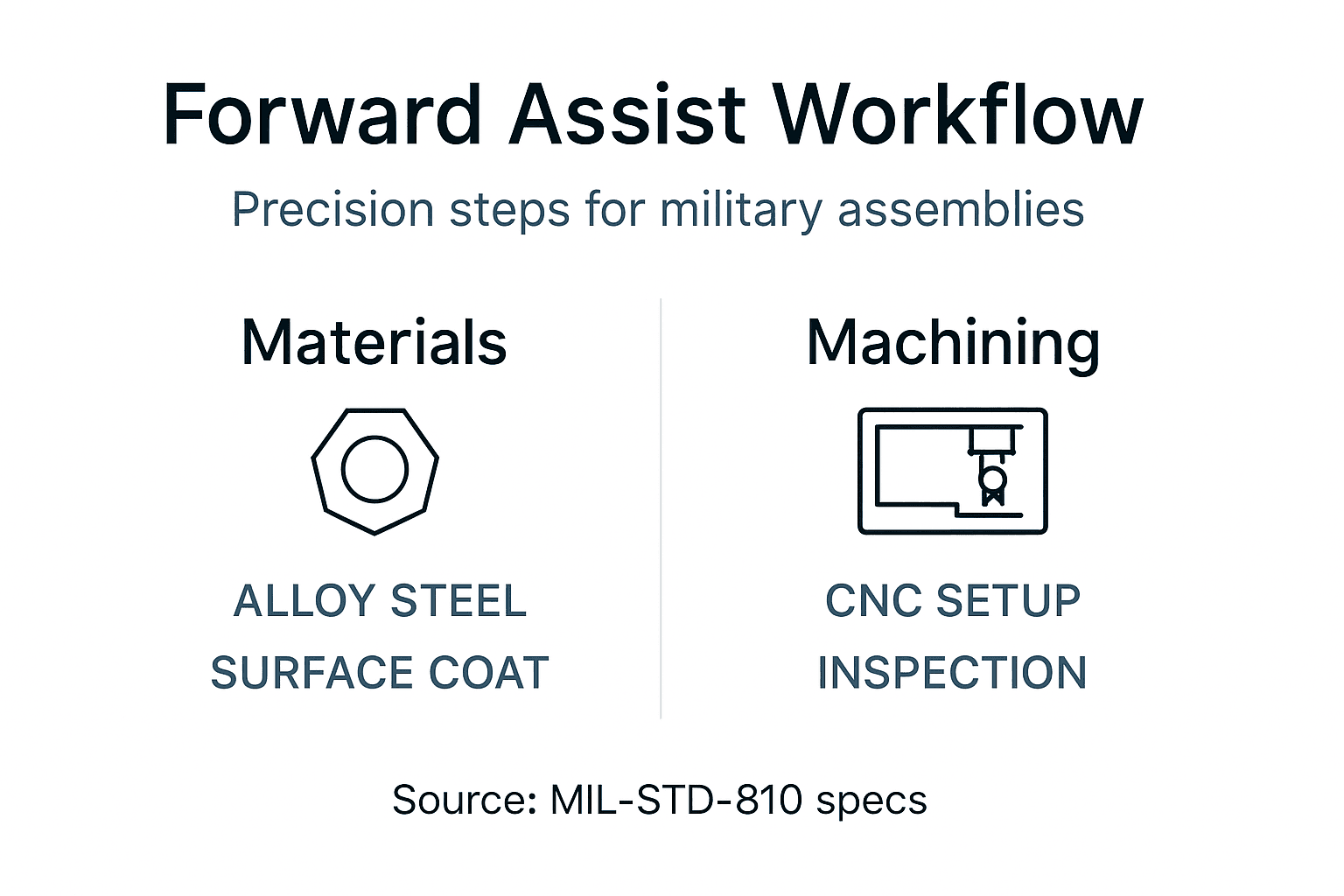
Optimized manufacturing workflows integrate automation, inspection, and post-machining treatments to achieve both quality and efficiency targets. Start with detailed design analysis to identify critical features and their tolerance requirements. This analysis drives decisions about machining sequence, fixturing strategy, and inspection intervals.
Materials selection happens early, with procurement specifying certified alloy steels that meet military standards. Material certifications become part of your quality documentation package. Verify chemistry and mechanical properties before cutting the first chip.
CNC machining setup incorporates multi-axis equipment and automation to hit required tolerances while maintaining production throughput. Precision machining workflows optimize cutting parameters, tool selection, and coolant delivery for each operation. Programs include automated tool measurement and offset compensation to maintain accuracy over long production runs.
In-process inspection catches problems early, reducing scrap and rework costs. Check critical dimensions after roughing operations to verify adequate stock remains for finishing. Measure finished features before moving to the next operation. This incremental validation prevents compounding errors.
Post-machining surface treatments require careful process control. Heat treatment must achieve specified hardness without inducing distortion. Coating application needs uniform coverage while protecting precision surfaces from buildup. Final cleaning removes all processing residues.
Pro Tip: Create a production traveler that documents each operation with specific acceptance criteria. Operators initial each step, creating traceability if problems appear during final inspection or field use.
Complete manufacturing sequence:
- Design review and manufacturing planning to establish process parameters and inspection points
- Material procurement with certification documentation for alloy composition and properties
- Rough machining to establish basic geometry with stock allowance for finishing operations
- Semi-finish machining approaching final dimensions while leaving minimal finish stock
- Heat treatment to achieve specified hardness range with distortion compensation
- Finish machining to final dimensions using compensation for heat treatment effects
- Surface coating application per military specifications with masking of critical features
- Final inspection including dimensional verification, hardness testing, and functional cycling
- Documentation package assembly with material certs, inspection reports, and test data
This systematic approach ensures consistent results across production batches. Each step builds on validated previous operations. Automated machining processes handle repetitive operations while skilled technicians focus on setup, inspection, and problem-solving.
Partnering with experienced custom manufacturing services providers accelerates your path to qualified production. Their established processes, proven equipment, and trained workforce eliminate the learning curve that delays new programs.
Discover expert forward assist assembly manufacturing solutions
Producing forward assist assemblies that meet military specifications demands more than standard machining capabilities. You need advanced CNC equipment, proven process control, and deep understanding of defense quality requirements.
Machining Technologies brings 40 years of precision manufacturing experience to aerospace and defense applications. Our 70,000 square foot facility houses Hydromat multi-spindle systems, 5-axis CNC milling centers, and advanced turning equipment capable of maintaining ±0.01 mm tolerances across high-volume production runs. We’ve produced over 20 million precision components annually, with established workflows for firearm assemblies, defense systems, and aerospace applications.
Our precision manufacturing services include complete process development from initial design review through final inspection and packaging. We handle heat treatment coordination, surface coating application, and functional testing to deliver fully qualified components ready for assembly. Automated production cells ensure consistency while reducing lead times by up to 40% compared to manual operations.
Partner with us to access firearms precision machining workflow expertise that accelerates your program timelines and ensures regulatory compliance. Our quality systems meet military standards, with documented procedures for inspection, testing, and traceability. Let our CNC milling and turning services deliver the precision, reliability, and production capacity your forward assist assembly programs demand.
Frequently asked questions about forward assist assemblies
Why are forward assist assemblies mandatory for military rifles?
Military specifications require forward assist mechanisms because field conditions frequently prevent normal bolt closure. Dust, carbon buildup, and extreme temperatures interfere with automatic cycling, making manual bolt closure capability essential for weapon reliability.
What material properties ensure durability in forward assist assemblies?
High-strength alloy steels hardened to 48-55 HRC provide mechanical strength for repeated engagement cycles. Corrosion-resistant coatings like manganese phosphate or nitride protect against environmental degradation, extending service life beyond 10,000 actuation cycles in harsh conditions.
How tight are machining tolerances for military-spec forward assist assemblies?
Critical features require ±0.01 mm tolerances to ensure proper engagement with bolt carriers. Cam surfaces, spring seats, and mounting dimensions must maintain these specifications through heat treatment and coating processes to guarantee reliable function under stress.
What quality tests validate forward assist assembly reliability?
MIL-DTL-23699 mandates dimensional inspection, hardness verification, and functional cycling tests. Parts must complete 10,000 engagement cycles without excessive wear or force degradation, proving they’ll survive extended field service under combat conditions.
How do manufacturing processes differ between M4 and HK416 forward assist assemblies?
HK416 assemblies require modified CNC programs for 20% larger dimensions and different cam geometries. Surface treatment changes from manganese phosphate to nitride coating, and spring specifications differ to accommodate piston-driven operating system dynamics, necessitating platform-specific production setups.
Can contract manufacturers handle both prototyping and full production of forward assist assemblies?
Experienced precision machining providers offer complete services from initial prototype development through high-volume production. They maintain equipment, quality systems, and process documentation needed for military qualification while scaling efficiently from samples to thousands of parts per month.