

TL;DR:
- Precision grinding is essential for achieving micron-level tolerances and superior surface finishes in aerospace, defense, and firearms components, where standard CNC machining cannot reliably meet strict specifications. It is integrated into the production sequence to ensure consistent, high-quality results, reducing scrap and costly rework, especially for high-volume parts. Early process planning and collaboration with experienced grinding specialists are critical to prevent design flaws and optimize total manufacturing costs.
When procurement managers and engineers specify tight tolerances for aerospace actuator housings, defense fire control components, or firearms barrels, a dangerous assumption often enters the conversation: that a high-end CNC machining center can get the job done alone. In reality, once you cross into sub-0.01 mm fit requirements, standard machining reaches a hard limit. Precision grinding is the process that picks up where CNC leaves off, and understanding when and how to apply it is the difference between predictable first-pass quality and costly rework cycles.
Table of Contents
- Understanding precision grinding: The basics
- Key precision grinding methods and their applications
- Precision grinding and process selection: Tolerance chain thinking
- Surface finish, consistency, and quality: The operational payoffs
- Why “just machining tighter” isn’t enough: An industry reality check
- Partnering with proven experts in precision grinding
- Frequently asked questions
Key Takeaways
| Point | Details |
|---|---|
| Precision grinding defined | Precision grinding is a finishing process enabling micron-level tolerances and surface finishes impractical with machining alone. |
| Method selection matters | Choosing OD, ID, or centerless grinding depends on geometry, material, and tolerance needs. |
| Critical for compliance | Aerospace, defense, and firearms components often require grinding to meet quality and regulatory requirements. |
| Tight tolerances achieved | Centerless grinding delivers consistent diameters within ±0.0001 inches and high-quality surface finishes. |
| Early process planning | Success and cost reduction start with aligning tolerance chains and grinding process selection up front. |
Understanding precision grinding: The basics
Precision grinding is a material removal process that uses abrasive wheels to achieve extremely tight dimensional tolerances, controlled surface finishes, and geometric accuracy that standard cutting tools simply cannot match reliably. The word “precision” is not marketing language here. It refers specifically to tolerances measured in microns, surface finishes measured in microinches Ra (roughness average), and part-to-part consistency that holds across high-volume production runs.
Standard CNC turning or milling cuts material with defined-geometry inserts. Those processes are fast and highly capable, but tool deflection, thermal growth, and material springback create inherent variability. Precision grinding removes material through controlled abrasion, which generates less cutting force and maintains much tighter control over the final geometry. The result is a process optimized for quality and throughput in precision parts manufacturing where every micron of deviation carries real consequences.
Here is what precision grinding is designed to achieve:
- Sub-micron dimensional tolerances on critical diameters, bores, and faces
- Surface finish optimization on sealing surfaces, bearing journals, and mating fits
- Correction of geometric deviations left over from prior machining steps
- Consistent, repeatable results across long production runs without process drift
Precision grinding achieves micron-level tolerances and is specifically used for aerospace and defense-critical components where standard machining cannot reliably hold the required fit or finish.
Where does grinding actually appear in a production sequence? You find it on bearing journals that must seat without play, on hydraulic valve bores where a 2-micron deviation causes leakage, on firearm barrel extensions requiring sub-thousandth concentricity, and on sealing surfaces for aerospace fuel system components. The methods for industrial component machining that support these industries treat grinding not as an optional finishing step but as a designed-in process stage.
Key precision grinding methods and their applications
There are three primary grinding methods that matter most for industrial, aerospace, and firearms manufacturing. Each serves a different geometry and production scenario. Choosing the wrong method for your part design is expensive, so understanding the distinctions is worth your time.
| Grinding method | Workpiece type | Part holding | Achievable tolerance | Primary application sectors |
|---|---|---|---|---|
| OD (cylindrical) grinding | External cylindrical features | Centers or chucks | ±0.0001 in or better | Aerospace shafts, hydraulic rods, defense actuators |
| ID (internal) grinding | Bores, internal diameters | Chuck or fixture | ±0.0002 in typical | Valve bodies, firearm chambers, aerospace bushings |
| Centerless grinding | Through-feed cylindrical parts | Workrest blade, regulating wheel | ±0.0001 in | High-volume pins, rollers, firearm components |
OD grinding mounts the workpiece between centers or in a chuck and traverses a grinding wheel along the external diameter. It offers excellent form control and is well suited for low-to-medium volume runs on shafts, spindles, and actuator rods where profile accuracy matters as much as dimensional tolerance.
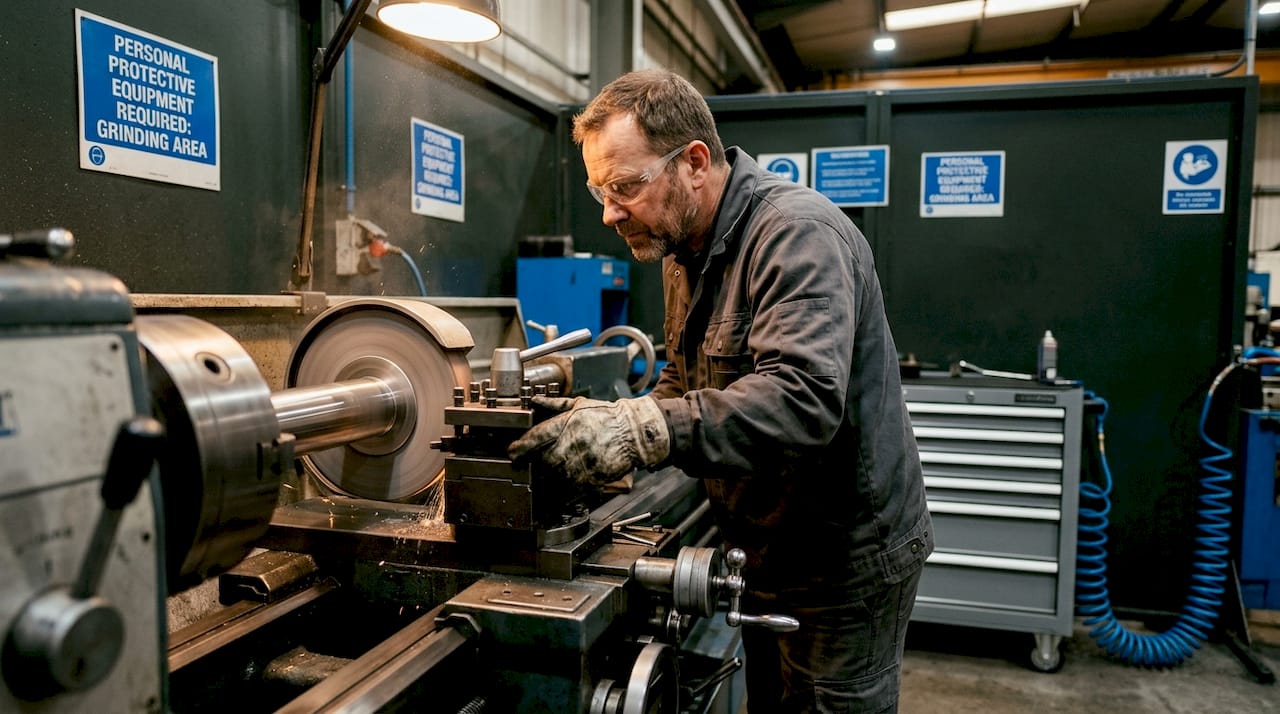
ID grinding targets internal bores and is frequently the only viable path to a precisely sized and finished bore in a hardened steel component. A small grinding spindle enters the bore and removes material in controlled passes. Concentricity between the bore and an external reference diameter is one of ID grinding’s key advantages.
Centerless grinding is where high-volume production really benefits. Here is how the process works:
- The cylindrical workpiece is placed on a workrest blade positioned between two wheels: the grinding wheel and the regulating wheel.
- The regulating wheel controls both the rotational speed of the part and the feed rate through the machine.
- Material is removed by the grinding wheel while the regulating wheel keeps the part perfectly positioned without any chuck or fixture contact.
- Parts flow through continuously in a through-feed configuration, which makes the process ideal for long runs of consistent-diameter components.
As centerless grinding process guides confirm, this approach processes cylindrical parts without clamping them in centers or chucks, enabling continuous feeding and the kind of consistency that chucked methods cannot match at volume.
Pro Tip: If your part is a cylindrical component produced in quantities of thousands per month and your tolerance band is tighter than ±0.001 inches, centerless grinding should be your default process conversation with your contract manufacturer. The throughput-to-tolerance ratio is unmatched by any other method.
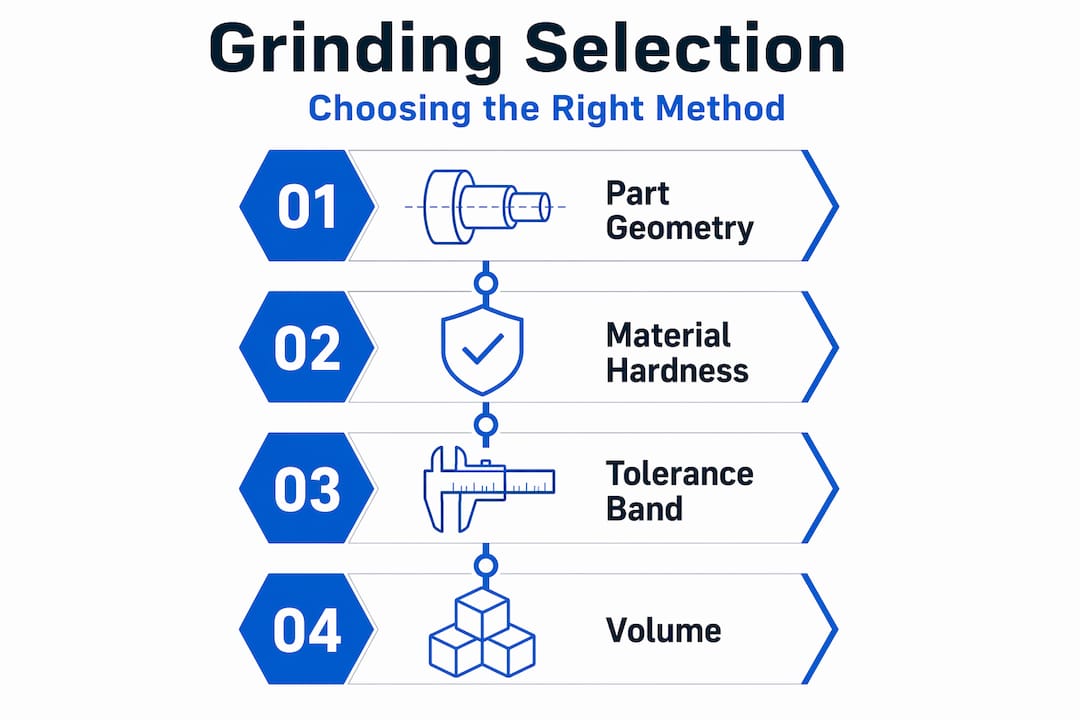
Selecting the right grinding method depends on four factors: part geometry, material hardness after heat treat, required tolerance, and production volume. For the aerospace machining workflow optimization that high-mix, high-volume programs demand, process selection early in the design phase prevents expensive retooling later. Referencing best tolerance practices for aerospace during drawing review is a practical way to catch grindability issues before a part reaches the shop floor.
Precision grinding and process selection: Tolerance chain thinking
Most engineers understand individual tolerances. Fewer think systematically about how tolerances stack. A tolerance chain is the cumulative effect of multiple dimensional variations across mating features. When a shaft must fit a bearing, which fits a housing, which bolts to a frame, every dimensional variation in that chain adds or subtracts from the final assembly fit. If any single feature in the chain is off by more than its allocated budget, the assembly fails inspection or performs below spec.
This is where specifying machining tolerances correctly becomes strategic, not just technical. A key insight for procurement and engineering teams: when precision grinding is needed depends on whether the required fit or finish is tighter than what machining alone can hold, especially for sealing and bearing surfaces. That threshold is generally around ±0.01 mm for high-end CNC, and tighter than that, grinding becomes the only reliable path.
| Feature type | High-end CNC typical tolerance | After precision grinding | Industry application |
|---|---|---|---|
| External cylindrical diameter | ±0.005 to ±0.010 mm | ±0.002 mm or better | Aerospace shaft fits |
| Internal bore diameter | ±0.008 to ±0.015 mm | ±0.003 to ±0.005 mm | Defense valve bodies |
| Surface finish (Ra) | 63 to 125 μin | 8 to 32 μin | Firearm sealing surfaces |
| Roundness | 0.003 to 0.005 mm | 0.001 mm or better | Bearing journal fits |
The risks of skipping grinding when the tolerance chain demands it are not theoretical. They show up as:
- Elevated scrap rates during final inspection, discovered only after full machining cost is sunk
- Unreliable press fits that fail assembly torque specs
- Sealing surfaces that pass visual inspection but leak under pressure testing
- Bearing journals that wear prematurely because surface finish was too rough to form an adequate oil film
Pro Tip: Bring your contract manufacturer into tolerance chain reviews during the design phase, not after first article inspection fails. Identifying features that require grinding early gives the manufacturing team time to sequence operations correctly and prevents the costly mistake of designing a ground feature into a part that was quoted as a machining-only job.
For complex parts where several critical features interact, precision strategies for complex parts integrate grinding into the process plan from the start, treating it as a designed-in operation rather than a remedial step.
Surface finish, consistency, and quality: The operational payoffs
Tolerances are half the story. Surface finish is the other half, and in regulated industries it carries its own compliance weight. Aerospace sealing interfaces, fire control actuator bores, and hydraulic valve spools all have Ra requirements written directly into engineering drawings. These are not suggestions. They are functional requirements tied to seal life, friction characteristics, and fatigue resistance.
Centerless grinding for cylindrical parts can achieve tight diameter control to ±0.0001 inches with surface finishes from 8 to 32 micro-inches Ra. To put that in perspective, 8 μin Ra is a mirror-like surface that supports positive seal contact across the full interface. 32 μin Ra is still significantly finer than what most CNC turning operations deliver on a finished pass. For firearms components, that finish quality directly affects how consistently a barrel extension mates with the receiver and how reliably a bolt carrier rides its guide rails.
The quality metrics that precision grinding consistently improves include:
- Roundness: Critical for rotating components in defense gyroscopes and aerospace turbomachinery
- Straightness: Essential for long shafts in actuators where runout causes vibration
- Dimensional repeatability: The ability to hold the same diameter across 10,000 consecutive parts
- Surface finish (Ra): Directly tied to seal life, bearing performance, and component fatigue life
- Concentricity: The alignment of a bore centerline to an external reference, critical in firearms chambers and aerospace bushings
Repeatability deserves special emphasis. A process that achieves the right dimension on part one but drifts by part 500 is not a precision process. It is a lottery. Precision grinding, particularly centerless grinding in through-feed mode, is designed for process stability. The regulating wheel and workrest blade maintain consistent part positioning throughout the entire run, and wheel dressing cycles are programmed to maintain cutting characteristics without operator intervention.
For firearms accuracy and compliance machining, this repeatability is what separates production-scale firearms manufacturing from one-off gunsmithing. When a procurement manager needs to certify that 50,000 barrel assemblies meet the same dimensional specification, precision grinding is the process foundation that makes that certification credible.
Why “just machining tighter” isn’t enough: An industry reality check
Here is an uncomfortable truth that many procurement teams only learn after a painful first article rejection: advanced CNC machining centers are extraordinary machines, but they are not magic. When a salesperson promises that their 5-axis machining center can hold ±0.0002 inches on a hardened shaft diameter, they are technically not lying. Under perfect conditions, with a fresh insert, ideal fixturing, and stable thermal environment, it might happen. Once. Maybe five times in a row.
What it will not do reliably is hold that tolerance across a production run of 5,000 parts after thermal variation, tool wear, and material batch-to-batch hardness variation have all taken their toll. The physics of cutting-tool machining create variability that accumulates in ways that are difficult to fully compensate for with in-process measurement alone.
We have seen programs where engineers specified ±0.005 mm on a bearing journal, accepted a quote based on machining-only, and then discovered at first article that scrap rates were running at 15 to 20 percent. Moving that feature to a centerless grinding operation brought scrap to under 1 percent. The grinding operation cost more per cycle. The total program cost dropped significantly because you stop paying for scrap.
The lesson for procurement and engineering teams is straightforward. Do not optimize process selection around unit cost per operation. Optimize around total cost of conformance. A machining tolerances guide helps you identify which features are candidates for grinding before you commit to a cost model that underestimates scrap risk. And thinking about part design for high-volume manufacturing from the beginning means you are not retrofitting grinding into a design that was never intended to accommodate it.
The most expensive mistake in precision manufacturing is not specifying grinding. It is discovering you needed grinding after 3,000 parts have been machined and failed inspection.
Partnering with proven experts in precision grinding
Precision grinding expertise is not a commodity. For procurement managers sourcing components for aerospace flight control systems, defense fire control assemblies, or regulated firearms programs, your contract manufacturer’s grinding capability is as critical as their machining capacity.
Machining Technologies LLC has been producing precision components since 1985 from our 70,000 square foot facility in Webster, Massachusetts. We produce over 20 million parts annually across aerospace, defense, and firearms programs, and our process planning integrates grinding decisions at the design stage, not as an afterthought. Our team understands tolerance chain analysis, regulated industry documentation requirements, and the production economics that determine when grinding pays off at scale. Whether you need contract machining for OEMs at high volume, specialized precision machining for firearms components, or full aerospace precision machining solutions with grinding integrated into the production flow, our team is ready to engage at the engineering level where these decisions matter most.
Frequently asked questions
How tight are the tolerances achievable with precision grinding?
Precision grinding routinely achieves tolerances of ±0.0001 inches or better on cylindrical features, making it the standard process for aerospace bearing journals and defense actuator shafts.
Which types of parts require precision grinding over CNC machining only?
Parts with sub-micron tolerance requirements, high-quality sealing surfaces, or tightly controlled bearing journals typically require precision grinding because machining alone cannot hold these fits and finishes with production-level reliability.
What surface finish levels are possible with centerless grinding?
Surface finishes from 8 to 32 μin Ra are achievable with centerless grinding, which is substantially finer than typical CNC turning finish passes and suitable for aerospace and defense sealing interfaces.
What is the main risk if precision grinding is skipped on high-tolerance components?
Omitting precision grinding on features that require it leads to elevated scrap rates and failed inspections, with unreliable fits discovered late in the production cycle when the cost of correction is highest.
Recommended
- Precision Parts Manufacturing: Maximizing Quality and Throughput | Machining Technologies
- Optimize high-volume machining workflow: aerospace precision | Machining Technologies
- Precision machining: engineering firearms for accuracy & compliance | Machining Technologies
- 7 Key Benefits of Precision Machining for Manufacturers | Machining Technologies