

TL;DR:
- True firearm quality relies on integrated process design, inspector training, and regulatory compliance.
- Mil-Spec claims often lack essential testing records and full process traceability.
- Automated inspection combined with skilled judgment ensures safety-critical parts meet standards.
Stamping ‘Mil-Spec’ on a part does not make it reliable. For firearm manufacturers and OEMs, that label is often the beginning of a quality conversation, not the end of one. True quality assurance in firearms parts manufacturing is a system-driven discipline that combines process design, operator training, inspection, and regulatory compliance into a single, cohesive framework. QA in firearms parts manufacturing involves proactive systems that prevent defects, while QC includes inspections that verify conformance after the fact. This guide covers both, from foundational principles through inspection methodologies, compliance pathways, and the hard lessons that separate elite manufacturers from the rest.
Table of Contents
- Core principles of quality assurance vs. quality control
- What Mil-Spec really requires: Standards, TDP, and materials
- Inspection methodologies: From CMM metrology to live fire testing
- Navigating compliance: Regulatory requirements and certification pathways
- Beyond the spec sheet: Hard truths about real-world QA
- How Machining Technologies can elevate your QA process
- Frequently asked questions
Key Takeaways
| Point | Details |
|---|---|
| QA vs. QC clarity | True quality assurance prevents defects through systems and training, while quality control only detects them at the final step. |
| Mil-Spec requires proof | Just claiming ‘Mil-Spec’ is not enough; documentation and full TDP compliance are essential for real quality and contract eligibility. |
| Inspections must combine methods | Dimensional checks, automated CMMs, and live fire testing together ensure both safety and reliability in critical firearm components. |
| Compliance is non-negotiable | Maintaining proper licenses, thorough records, and current certifications is mandatory for legal and commercial success. |
| Cutting corners has consequences | Shortcuts during ramp-up or unverified offshore parts can seriously undermine quality and safety in firearms manufacturing. |
Core principles of quality assurance vs. quality control
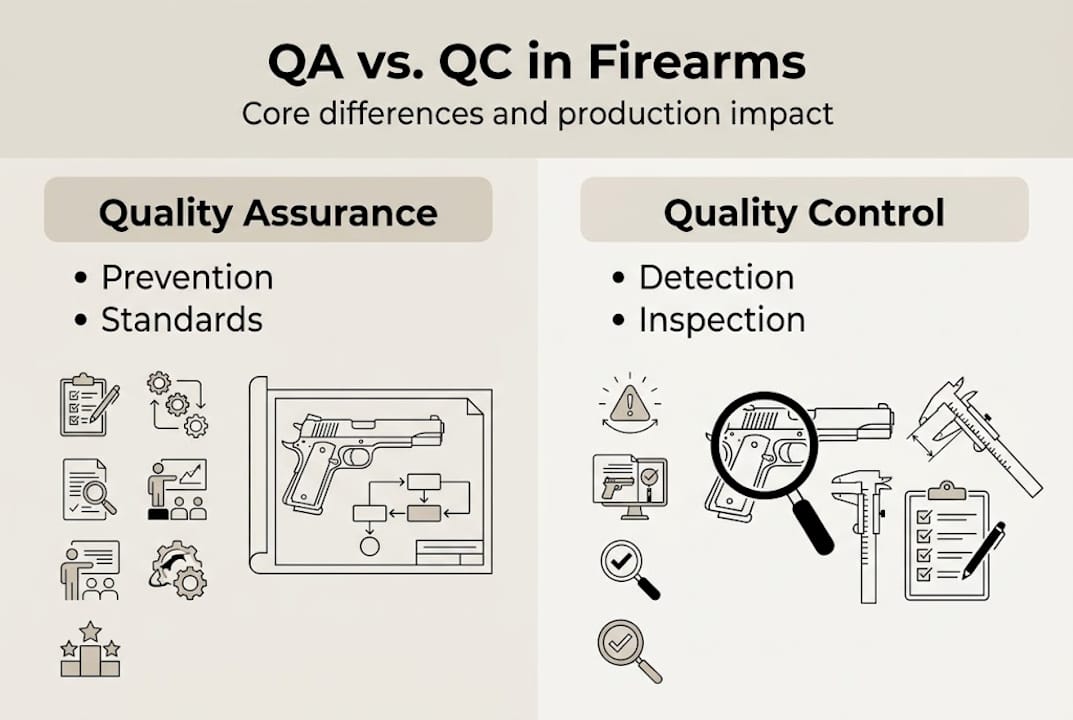
The terms quality assurance and quality control get used interchangeably, but they describe fundamentally different activities. Getting them confused means building your quality program on the wrong foundation.
QA is proactive, QC is reactive. Quality assurance encompasses the systems, procedures, and training that prevent defects from occurring. Quality control is the inspection layer that catches defects after they have been introduced. You need both, but if your QA systems are weak, no amount of inspection will save you from rework, scrap, and recalls.
In firearms parts manufacturing, QA activities typically include:
- Process design with defined control plans and material flow
- Operator training and certification tied to specific part families
- Calibration schedules for all gauging and measurement equipment
- Statistical process control (SPC) to monitor trends before failures occur
- Supplier qualification to ensure incoming materials meet spec before machining begins
QC activities, by contrast, focus on:
- First article inspection (FAI) to verify new setups before production runs
- In-process gauging at defined intervals
- Final dimensional and functional testing before parts ship
- Nonconformance reporting and disposition of rejected parts
Here is how the two disciplines compare in a firearms context:
| Attribute | Quality Assurance | Quality Control |
|---|---|---|
| Timing | Before and during production | After production or at defined checkpoints |
| Goal | Prevent defects | Detect defects |
| Owner | Process engineers, operators | Inspection technicians, QC managers |
| Tools | Control plans, SPC, training | CMMs, gauges, test fixtures |
| Output | Stable, repeatable processes | Conformance data, accept/reject decisions |
Pro Tip: Applying Six Sigma and LEAN principles to your machining workflow reduces defect opportunities at the source. Fewer defects in process means fewer surprises at final inspection, which directly protects your delivery schedules and your reputation.
When you build tolerances for reliability into your QA system from the start, you stop chasing problems and start preventing them. A disciplined machining workflow for QA integrates these controls at every stage, making quality a byproduct of good process design rather than a last-minute inspection gamble.
What Mil-Spec really requires: Standards, TDP, and materials
Mil-Spec is not a single standard. It is a collection of specific requirements covering materials, finishes, dimensional tolerances, process controls, and functional testing. For AR-platform components, Mil-Spec AR parts require specific materials, finishes, dimensional tolerances, processes such as heat treatment and shot peening, and 100% high-pressure testing (HPT) and magnetic particle inspection (MPI). That is a long list, and most consumer-grade ‘Mil-Spec’ claims address only a fraction of it.
Here is what true compliance looks like for common AR components:
| Component | Material Requirement | Key Process | Required Testing |
|---|---|---|---|
| Bolt carrier group | 8620 or 9310 steel | Carburizing, shot peening | 100% HPT and MPI |
| Barrel | 4150 CMV or 4140 steel | Chrome lining or nitride | Proof testing, bore gauging |
| Lower receiver | 7075-T6 aluminum | Type III hard anodize | Dimensional FAI, fit check |
Verifying true Mil-Spec compliance requires more than reading a data sheet. Follow these steps:
- Request the full Technical Data Package (TDP) from your supplier, including drawings with GD&T callouts.
- Verify material certifications trace back to the mill heat number.
- Confirm process certifications for heat treatment, surface finishing, and shot peening.
- Review HPT and MPI records for bolt carriers and barrels; 100% testing is required, not sampling.
- Cross-reference final dimensional inspection reports against TDP tolerances.
“Consumer Mil-Spec claims often lack HPT/MPI documentation and full TDP traceability, making the label a marketing statement rather than a quality guarantee.”
Pro Tip: Always request full certification packages and batch traceability documents before accepting Mil-Spec parts, even from established suppliers. One missing process step, like skipped shot peening on a bolt, can create catastrophic field failures that no visual inspection will catch.
The choice of methods and materials quality defines whether your parts will perform across the full service life or fail early under sustained use.
Inspection methodologies: From CMM metrology to live fire testing
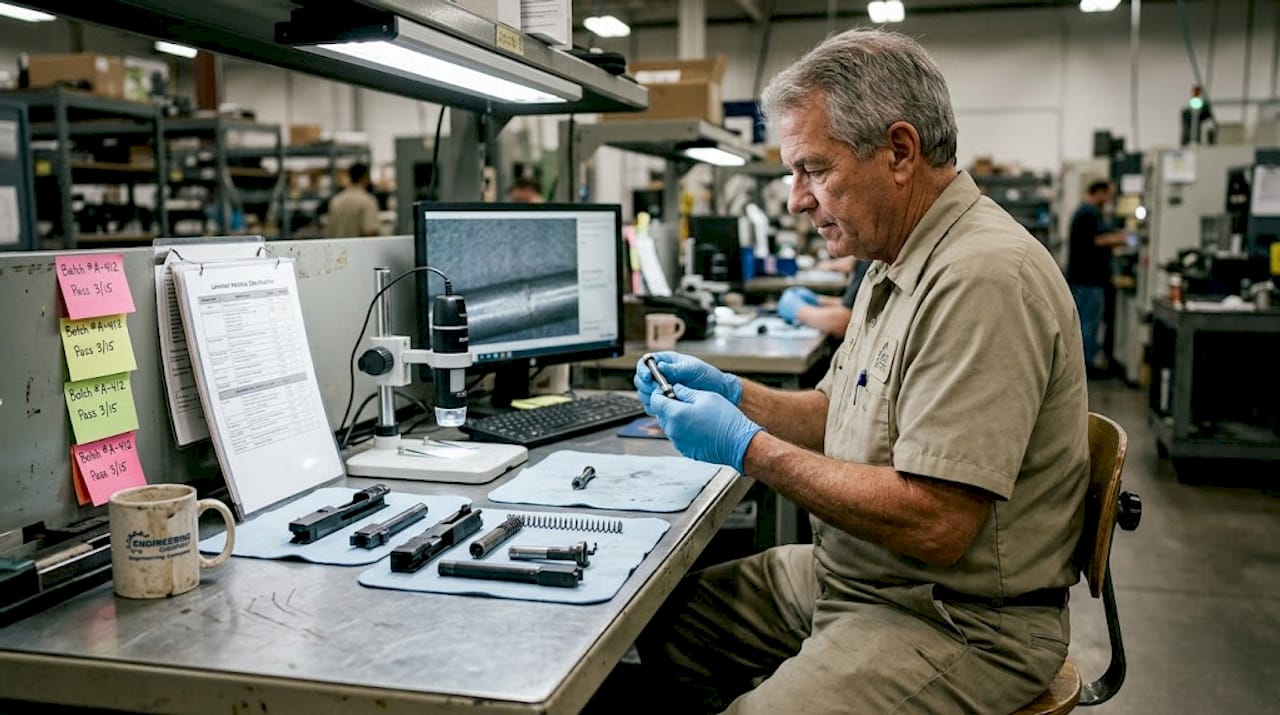
Producing a part to print is necessary. Proving it is conformant is non-negotiable. Once parts come off the machine, your inspection methodology determines whether problems get caught before they reach your customers or after.
CMM metrology, dimensional gauging, and live fire testing confirm conformity, and automation significantly enhances speed and repeatability. Franklin Armory implemented automated CMM inspection and cut lower receiver inspection time from one hour down to five minutes per part. Their approach also introduced 3% batch CMM inspection across production runs, which improved throughput traceability without slowing the line.
For BCGs, receivers, and barrels, critical inspection points include:
- BCGs: Bolt face diameter, cam pin hole location, gas key staking depth, and carrier key screw torque
- Receivers: Trigger pin and hammer pin hole diameter and spacing, buffer tube thread form, and mag well dimensions
- Barrels: Bore diameter, groove depth, chamber headspace, gas port diameter, and crown condition
Headspace checks deserve special attention. An out-of-spec headspace condition can cause case head separation under firing pressure, which is a safety failure, not just a performance issue. Gas port gauging is equally important for reliable cycling under varied ammunition loads.
Pro Tip: Never rely solely on dimensional inspection for safety-critical parts. Combine CMM measurement with functional testing, including live fire or pressure testing, to verify real-world performance under load. Dimensional conformance is necessary but not sufficient.
For OEMs building at scale, machining for compliance means building inspection into the production rhythm, not bolting it on at the end. If you want to verify machined part quality with confidence, the inspection plan must be engineered alongside the machining plan.
Navigating compliance: Regulatory requirements and certification pathways
Inspection verifies your parts. Compliance protects your business. For firearms parts manufacturers, the regulatory environment covers federal licensing, export controls, defense contracting requirements, and quality management certification.
Manufacturers need FFLs, unique serial numbers, ATF records, ITAR/CMMC compliance for defense work, and certifications such as ISO 9001/AS9100. Here is the path to full compliance:
- Obtain the appropriate Federal Firearms License (FFL) from ATF before manufacturing or transferring firearms or regulated components.
- Assign unique serial numbers to all serialized parts per ATF requirements.
- Maintain a compliant Acquisition and Disposition (A&D) bound book for all regulated items.
- Register with the State Department’s DDTC under ITAR if you export or share technical data with foreign persons.
- Achieve CMMC Level 2 certification if you hold or pursue Department of Defense contracts, as this is increasingly mandatory for defense supply chain participation in 2026.
- Pursue ISO 9001 or AS9100 certification to formalize your quality management system and satisfy many OEM customer requirements.
Key documents every firearms parts manufacturer must maintain include:
- A&D records for all regulated firearms and components
- ATF Form 2 for NFA item manufacture and Form 3 for inter-licensee transfers
- Material certifications traceable to the source mill heat or lot
- Inspection records with part numbers, serial numbers, and operator identification
- ITAR export authorizations and technology control plans
“ATF, CMMC, and ITAR enforcement activity makes robust record-keeping a legal necessity, not an administrative preference.”
Traceability is the thread connecting compliance to quality. When a field failure or recall occurs, your documentation chain determines how quickly you can identify affected lots, notify customers, and correct the process. Weak records mean wide recalls. Strong records mean targeted, controlled responses. Learn how defense industry certifications structure this traceability framework for complex defense programs.
Beyond the spec sheet: Hard truths about real-world QA
After four decades in precision machining, we have seen one pattern repeat itself across firearms manufacturing programs: the companies that treat ‘Mil-Spec’ as a marketing shortcut eventually pay for it. The label means nothing without full TDP backing, certified processes, and documented testing. A part stamped Mil-Spec without HPT/MPI records is not Mil-Spec. It is a liability.
The MIM versus forged/billet debate is another area where process selection matters more than most buyers realize. Metal injection molded parts can meet dimensional specs while carrying internal porosity that only shows up under sustained high-cycle fatigue. Forged and billet parts cost more and machine differently, but the material integrity is verifiable in ways MIM simply is not.
Automation is genuinely powerful for throughput and repeatability, but it does not replace skilled operators on critical signoff steps. A CMM will confirm a dimension. It will not catch a tooling drift trend that an experienced machinist spots on the third part of a new setup. Operator judgment is still the last line of defense.
The most dangerous moment in any manufacturing program is rapid volume ramp-up. Tolerance stacking in AR systems and rising risk from cutting QC corners in high-volume production are real threats, not theoretical ones. Discipline must hold at 500,000 parts the same way it held at 5,000. When it does not, the results make headlines. Protecting quality in part manufacturing means treating every production run with the same rigor as the first.
How Machining Technologies can elevate your QA process
Building a compliant, inspection-driven firearms parts program requires more than the right equipment. It requires a machining partner who understands the regulatory environment, integrates QA into every production stage, and delivers documentation you can stake your FFL on.
At Machining Technologies, we bring 40 years of precision machining experience, a 70,000 square foot facility, and over 20 million parts produced annually to every firearms program we support. Our precision engineering for compliance covers CNC milling, turning, Hydromat systems, and wire EDM, all backed by inspection workflows built for traceability. When your program demands tight tolerances and full documentation, we deliver both. Contact us to learn how we maximize quality manufacturing for OEMs who cannot afford to compromise.
Frequently asked questions
What is the difference between quality assurance and quality control in firearms components?
Quality assurance prevents defects through proactive process design and systems, while quality control identifies defects through inspections and testing after parts are produced. Both are necessary, but QA is where long-term reliability is actually built.
What documents are required for ATF compliance in firearms manufacturing?
You must maintain A&D records, assign unique serial numbers to all regulated parts, and complete required ATF forms including Form 2 for NFA manufactured items.
How do you verify a part truly meets Mil-Spec standards?
Request full TDP, HPT/MPI records, material certifications traceable to the mill heat number, and process certifications for heat treatment and surface finishing. Documentation is the proof.
Why is CMM inspection important in firearms parts manufacturing?
CMM metrology provides highly accurate dimensional verification of critical features like bolt lugs and bore geometry, delivering repeatable results far faster than manual gauging at production volume.
What certifications are most relevant for firearms parts OEMs?
ISO 9001, AS9100, and CMMC Level 2 are the most relevant certifications, particularly for OEMs supplying defense programs or seeking to formalize their quality management systems.
Recommended
- Firearm parts machining: ±0.001″ tolerance ensures reliability | Machining Technologies
- Firearm parts machining: methods, materials & quality | Machining Technologies
- Master Precision Machining Workflow for Firearms Components | Machining Technologies
- Precision machining: engineering firearms for accuracy & compliance | Machining Technologies