

TL;DR:
- Machining equipment with thermal stability, automation, and rigid architecture delivers the best precision and efficiency. Automated features like tool center point control and collision detection reduce errors and downtime. Prioritizing these features over spindle speed helps maintain accuracy in high-volume, complex manufacturing.
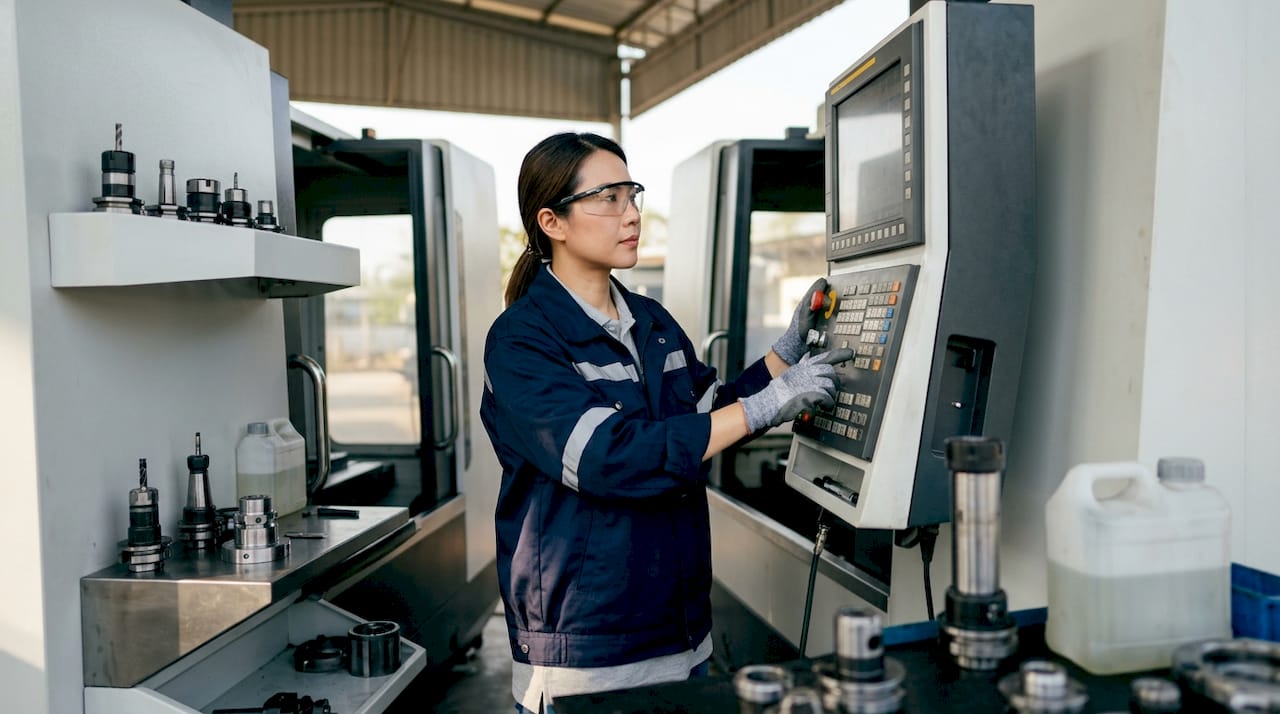
Top machining equipment features are the core attributes that determine precision, throughput, and consistency in modern manufacturing. Engineers evaluating CNC machines, horizontal machining centers, or multi-axis systems need more than spindle speed specs. They need to understand how automation, thermal stability, rigidity, and probing work together as a system. ISO machining standards and industry bodies like the IPC set the baseline, but the best shops go further. Machiningtechllc has operated at this level since 1985, producing over 20 million parts annually from its 70,000 square foot facility in Webster, Massachusetts.
1. What are the critical automation features in modern machining equipment?
Automation is the single biggest differentiator between average and high-output machining equipment. The features that matter most are not flashy. They are the ones that reduce human intervention at every step of the cycle.
Key automation capabilities to evaluate:
- Tool Center Point (TCP) control: Programs tool paths based on the tool tip rather than the machine spindle. TCP control reduces setup errors on complex multi-axis parts by eliminating manual offset recalculations.
- Automatic tilting collision detection: Identifies interference between the tool, fixture, and machine body before a crash occurs. Modern 5-axis systems integrate this detection directly into the control software as of early 2026.
- GPU-accelerated simulation: Verification speeds up to 10x faster compared to CPU-only processing. That speed means shops can validate complex tool paths between jobs without adding hours to the schedule.
- Voice-activated programming: AI-assisted input tools are reducing the skill barrier for CNC programming, directly addressing the skilled labor shortage that affects most shops.
Pro Tip: If your shop runs lights-out or unattended shifts, prioritize collision detection and TCP control over raw spindle speed. Those two features prevent the crashes that cost you the most time and money.
Automation features also compound. A machine with TCP control, collision detection, and GPU simulation handles complex geometry faster and with fewer errors than a machine with a higher spindle speed but no automation layer.
2. How does thermal stability affect machining precision?
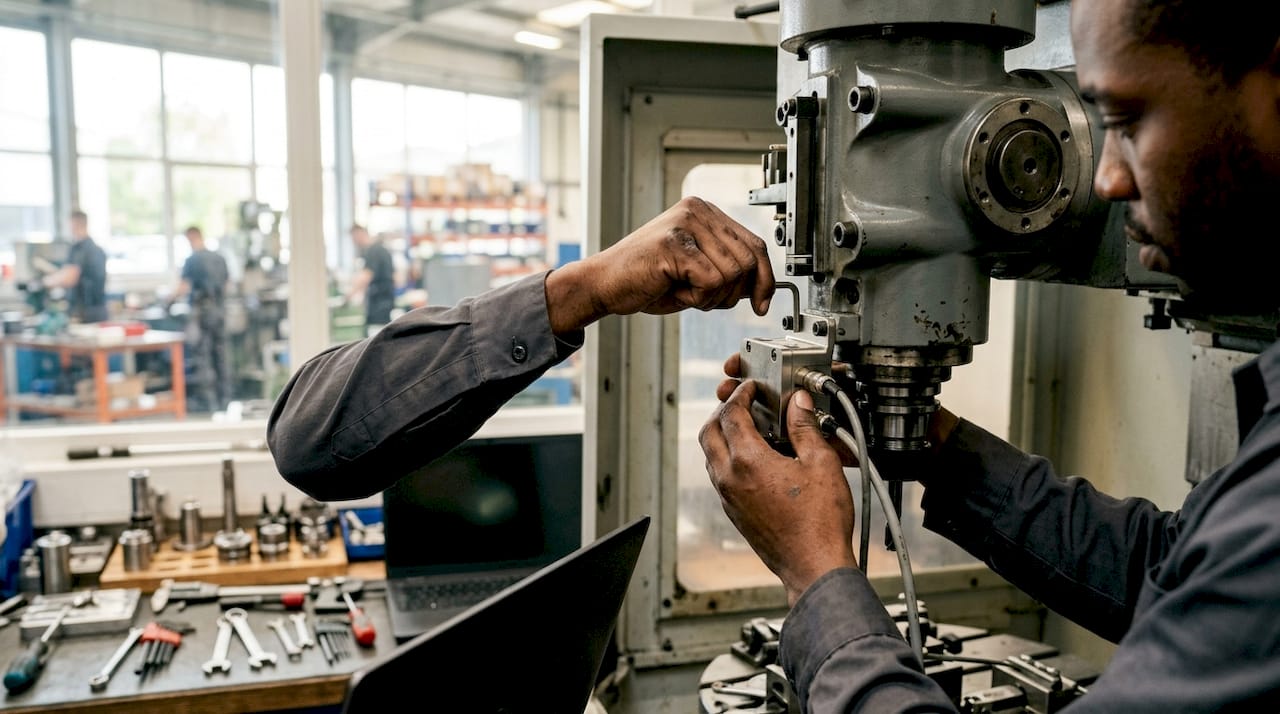
Thermal stability is the most underrated feature in a machining equipment buying guide. Heat generated during cutting causes dimensional drift. That drift turns a part that was in tolerance at the start of a run into a reject by the end of it.
The design features that control thermal behavior include:
- Core-cooled ballscrews: Circulate coolant through the ballscrew core to prevent thermal expansion along the axis. Core-cooled ballscrews and temperature-controlled motors maintain sub-micron accuracy during extended production runs.
- Temperature-controlled direct-drive motors: Separate the heat source from the spindle structure, reducing thermal transfer to the machine frame.
- Low-conductivity structural materials: Slow the rate at which heat moves from the spindle into the machine body, preserving geometric accuracy over time.
- Separated spindle and motor design: Thermal displacement control through separated components underpins long-term accuracy in precision machining centers.
Operational efficiency is less about maximum spindle speed and more about stable thermal control, integrated automation, and vibration management for consistent quality. Shops that chase headline specs often discover their accuracy degrades after the first hour of a production run.
Thermal stability features rarely appear in a machine’s marketing summary. Ask the builder specifically how they manage thermal growth on each axis before you commit to a purchase.
3. What mechanical design features enhance rigidity and cutting performance?
Rigidity is not simply a function of machine weight. A heavier machine is not automatically a more rigid one. Architecture determines how well a machine resists deflection under cutting forces.
The design elements that deliver real rigidity:
- Box-in-Box structures: A double-box column design encloses the spindle head within a rigid outer frame. Box-in-Box structures and T-shaped bases provide superior vibration absorption compared to traditional heavy-cast designs.
- T-shaped machine bases: Distribute cutting forces more evenly across the machine bed, reducing localized deflection during heavy cuts.
- Roller guide systems: Carry higher loads than ball-type linear guides and resist vibration more effectively at high feed rates.
- 3-point leveling systems: High rigidity designs using 3-point leveling achieve superior dimensional stability during high-speed, heavy cutting by eliminating twist in the machine base.
- Optimized guide spacing: Wider spacing between guide rails reduces the moment arm on the carriage, lowering deflection under lateral cutting forces.
Rigidity directly affects tool life and surface finish. A machine that flexes under load generates chatter, which shortens tool life and degrades the surface. The connection between architecture and cutting performance is direct and measurable.
4. How do multi-axis control and integrated probing improve efficiency?
Multi-axis machining reduces the number of setups required to complete a complex part. Fewer setups mean less fixturing time, less opportunity for positional error, and faster throughput. The features that make multi-axis machining practical rather than theoretical are TCP control and integrated probing.
Integrated probing capabilities to look for:
- In-process tool wear monitoring: Measures the tool after each pass and adjusts offsets automatically. Integrated in-process probing enables automated tool wear monitoring and breakage detection, reducing manual interventions.
- Tool breakage detection: Stops the cycle immediately when a tool breaks, preventing damage to the part and the machine.
- Workpiece probing: Measures the part on the machine and confirms it is within tolerance before the operator removes it from the fixture.
- Collision avoidance in multi-axis moves: Prevents the rotary axes from driving the tool or head into the fixture during complex simultaneous moves.
- High-speed automatic tool changers: Reduce the time between cuts. The FANUC ROBODRILL α-D21LiB5 ADV Plus achieves spindle speeds up to 24,000 RPM with rapid traverse rates of 54 m/min, showing what high-speed tool change systems can deliver in a compact vertical format.
Pro Tip: Treat in-process probing as a non-negotiable feature, not an optional add-on. Shops that add probing to existing cells consistently report fewer scrapped parts and lower inspection labor costs.
In-process probing transforms a standard CNC machine into a near-autonomous manufacturing cell. That shift is what makes unattended operation viable for precision parts.
5. How to compare machining equipment capabilities for different scenarios
Selecting equipment based on a single spec is the most common mistake in manufacturing procurement. The right machine depends on your production volume, part complexity, and tolerance requirements. The table below maps key feature categories to typical production scenarios.
| Feature category | Small batch / prototype | High-volume production |
|---|---|---|
| Spindle speed | 12,000–15,000 RPM | 18,000–24,000 RPM |
| Rapid traverse rate | 30–40 m/min | 41–60 m/min |
| Thermal stability | Standard coolant | Core-cooled ballscrews, separated motor |
| Automation level | Manual offsets, basic probing | TCP control, in-process probing, collision detection |
| Tool capacity | 20–30 tools | 40–120 tools |
| Axis configuration | 3-axis or 4-axis | 5-axis simultaneous |
Rapid traverse rates of 60 m/min are now standard for high-productivity horizontal machining centers. That rate matters most in high-volume environments where idle travel time accumulates across thousands of cycles per shift.
For complex multi-sided parts, 5-axis capability with TCP control and collision avoidance is the correct choice regardless of volume. For simple geometry at high volume, a well-configured 3-axis horizontal with strong thermal management and fast tool change will outperform a 5-axis machine running below its capability.
The advanced machining equipment ROI calculation changes significantly when you factor in probing, thermal stability, and automation. Shops that evaluate only purchase price consistently underestimate total cost of ownership.
Key takeaways
The most effective machining equipment strategy combines thermal stability, integrated automation, and architectural rigidity rather than prioritizing any single headline specification.
| Point | Details |
|---|---|
| Automation drives output | TCP control and collision detection reduce errors more than raw spindle speed increases. |
| Thermal stability is underrated | Core-cooled ballscrews and separated motor designs preserve sub-micron accuracy over long runs. |
| Rigidity is architectural | Box-in-Box structures and 3-point leveling outperform heavy-cast designs in cutting stability. |
| Probing enables autonomy | In-process probing reduces scrapped parts and supports unattended cell operation. |
| Match features to scenario | High-volume runs need fast traverse and deep tool magazines; complex parts need 5-axis and TCP control. |
What I’ve learned about buying machining equipment the right way
Most equipment decisions I’ve seen go wrong follow the same pattern. The buyer focuses on spindle speed and price, then discovers six months later that thermal drift is killing their accuracy on long runs.
Experts consistently advise viewing machine tools as part of an integrated tooling ecosystem, prioritizing chip management, probing, and thermal stability over headline spindle speeds. That framing is correct, and it is still ignored more often than not.
The features that deliver the best return are the ones that reduce human intervention: probing, TCP control, and GPU-accelerated simulation. These features address the labor shortage directly. A machine that can run unattended for four hours is worth more than a machine that is 10% faster but requires an operator at the door.
The trend I am watching most closely in 2026 is AI-assisted programming. Voice-activated input and AI tool path suggestions are moving from experimental to production-ready. Shops that adopt these tools early will close the skills gap faster than those waiting for the technology to mature further.
My honest advice: build your feature checklist around thermal stability, probing, and automation first. Spindle speed is the last box to check, not the first.
— Andrew
Machiningtechllc: precision machining built around the right equipment
Machiningtechllc has operated from its Webster, Massachusetts facility since 1985, running advanced equipment including Hydromat systems, CNC milling, turning, and wire EDM across 70,000 square feet of production space.
The shop produces over 20 million parts annually for aerospace, defense, firearm manufacturing, and industrial machinery customers. That volume is possible because the equipment and processes are built around the features that matter: thermal stability, automation, and multi-axis capability. If you are evaluating contract machining services for high-volume or complex precision parts, Machiningtechllc brings the equipment depth and process discipline to deliver consistent results at scale. Their full precision machining services cover the complete range from prototype to full production.
FAQ
What are the most important features of CNC machines?
The most important features of CNC machines are thermal stability, TCP control, in-process probing, and collision detection. These features directly control accuracy, uptime, and the ability to run complex parts with minimal operator intervention.
How does thermal stability affect machining accuracy?
Thermal drift causes dimensional errors that accumulate over a production run. Core-cooled ballscrews and temperature-controlled motors prevent this drift, maintaining sub-micron accuracy even during extended high-volume cycles.
What is Tool Center Point control and why does it matter?
TCP control programs tool paths based on the tool tip position rather than the machine spindle. It eliminates manual offset recalculations during multi-axis moves, reducing setup errors on complex parts.
What rapid traverse rate should I look for in a machining center?
For high-volume production, look for rapid traverse rates of 41–60 m/min. Rates in that range reduce idle cycle time significantly when multiplied across thousands of parts per shift.
How do I evaluate machining equipment for complex parts?
Prioritize 5-axis simultaneous capability, TCP control, integrated probing, and collision avoidance. For complex multi-sided parts, these features reduce setups and prevent the positional errors that cause scrapped parts.