
TL;DR:
- Advances in digital and CNC automation now enable high-volume customization without traditional trade-offs.
- Successful customization relies on organizational processes, data sharing, and modular design, not just equipment.
- When volume exceeds 450 units, customized CNC becomes cost-competitive and drives speed and customer satisfaction.
Unlock customization for precision manufacturing success
Many OEMs assume that custom components automatically mean slower timelines, higher costs, and operational headaches. That assumption is costing manufacturers real competitive ground. The gap between custom and standard production has narrowed dramatically, thanks to advances in CNC automation, modular design systems, and digital process integration. Today, high-volume precision machining and true component customization can work together without compromise. This article explains what customization actually means for manufacturers, demonstrates its proven impact on speed and revenue, breaks down when it makes financial sense, and gives you a clear framework to implement it effectively in your operation.
Table of Contents
- Defining customization in modern manufacturing
- How customization drives value: Speed, range, and satisfaction
- The cost equation: When does customization pay off?
- Implementing customization: Success factors and pitfalls
- What most OEMs miss about customization and scale
- Connect with a proven precision manufacturing partner
- Frequently asked questions
Key Takeaways
| Point | Details |
|---|---|
| Customization enables value | Smarter processes and tools make mass customization possible without sacrificing efficiency. |
| Cost depends on volume | Customization becomes financially viable at 450-1200 parts by leveraging high-volume CNC manufacturing. |
| Bundling strategies is key | Combining modular design, digital tools, and customer knowledge significantly amplifies customization capability. |
| Success needs integration | True gains come from integrating teams and processes, not just buying new equipment. |
Defining customization in modern manufacturing
For OEMs and industrial manufacturers, customization is not a simple switch you flip on a production line. It means designing and producing components or assemblies that are specifically tailored to a customer’s exact requirements, whether those involve unique geometry, specific material grades, tolerances measured in microns, or application-specific performance characteristics. Understanding which type of customization fits your operation is essential before committing to any process change.
There are three main forms of customization relevant to precision manufacturing:
- Modular customization: Standard building blocks are combined or configured to meet project-specific needs. Think of it like a base component architecture where interchangeable modules create distinct end products without retooling from scratch each time.
- High-mix low-volume (HMLV) manufacturing: A wide variety of parts are produced in relatively small quantities. This approach serves aerospace and defense applications where specialized, low-run components are the norm.
- Mass customization: Large volumes of personalized products are produced at near mass-production efficiency. This is where digital tools, modularity, and deep customer integration converge to create genuinely scalable custom production.
The benefits of doing this well are significant. Components that fit their intended application precisely perform better, last longer, and reduce assembly rework downstream. For the OEM, this translates into sharper competitive positioning and tighter integration with your customers’ design processes. Understanding the difference between custom vs standard machining approaches helps teams make the right call before a project enters the production queue.
Mass customization, in particular, is not just a theoretical concept. It is an operational capability built on three interconnected practices: absorbing customer knowledge into the design process, building product architectures with genuine modularity, and using digital configurators to translate customer inputs into manufacturing-ready specifications. Research on bundled mass customization practices across 213 plants shows these practices together explain 41.9% of mass customization capability variance, compared to just 13.9% when applied in isolation.
“Mass customization is not a product feature. It is a process capability that must be built deliberately across engineering, sales, and production.”
That distinction matters. Too many manufacturers treat customization as a one-time design exercise rather than an ongoing operational competency. When it is built into the system, it becomes a durable advantage rather than a costly exception.
How customization drives value: Speed, range, and satisfaction
With a clear definition in place, it is critical to understand why customization matters for value creation. The instinct to avoid customization because it seems operationally risky runs directly against the evidence from companies that have committed to it at scale.
The numbers are striking. Carl Zeiss Vision and Eaton Corporation both invested in AI-driven and digital twin-enabled custom production, and the results were measurable. According to documented manufacturing case studies, Zeiss expanded its personalized lens product range by 400%, reduced lead time by 29%, and achieved customer satisfaction scores of 99 out of 100. Eaton cut lead time by 39% and drove revenue growth of 129% by using AI and digital twins to manage high-mix custom production.
| Company | Product range change | Lead time reduction | Revenue/satisfaction impact |
|---|---|---|---|
| Carl Zeiss Vision | +400% product mix | 29% faster | 99/100 customer satisfaction |
| Eaton Corporation | High-mix custom parts | 39% faster | +129% revenue growth |
These are not small operational tweaks. These are structural improvements in how manufacturing capacity is used. The key insight is that both companies achieved better speed and greater variety, which directly challenges the traditional trade-off between customization and efficiency.
Digital tools are the reason this is now possible. AI-driven demand planning, digital twin simulation, and automated CNC programming let manufacturers shift between part specifications without the setup time penalties that used to make HMLV production financially punishing. In practical terms, what once required a full shift changeover now happens in minutes with the right systems in place.
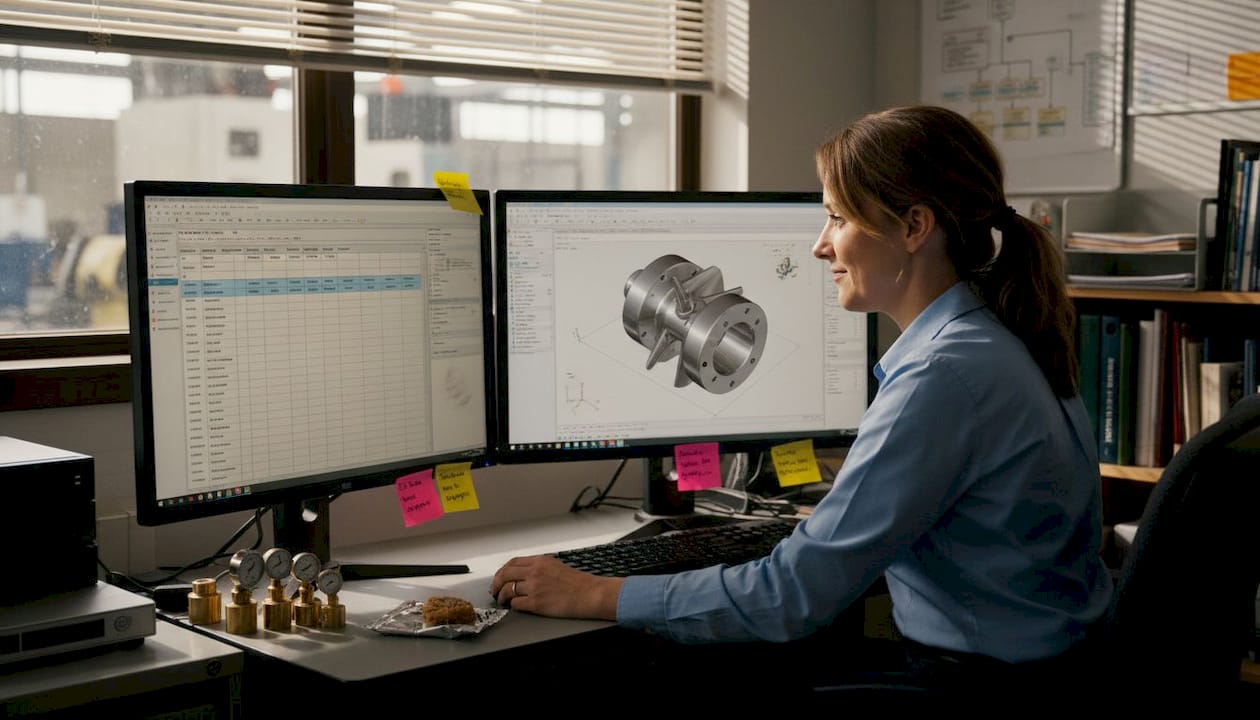
For OEMs considering this path, high-volume manufacturing strategies that incorporate smart scheduling and modular fixturing are the backbone of scalable custom programs.
Pro Tip: Do not wait until you have a large custom order to build modularity into your process. Invest in modular fixturing, standardized tooling libraries, and configurable CNC programs now. When the high-mix demand arrives, your floor will be ready to absorb it without disrupting your existing output.
Customer satisfaction data reinforces the revenue argument. When a component fits its application precisely, your customer’s assembly process runs smoother, warranty claims drop, and reorder rates climb. Customization done right does not just satisfy a purchase order. It builds the kind of long-term supplier relationships that are difficult for competitors to displace.
The cost equation: When does customization pay off?
Understanding value is essential, but cost concerns remain the decisive factor for most decision-makers. Customization does carry a different cost structure than mass production, and it is important to be clear-eyed about that before committing.
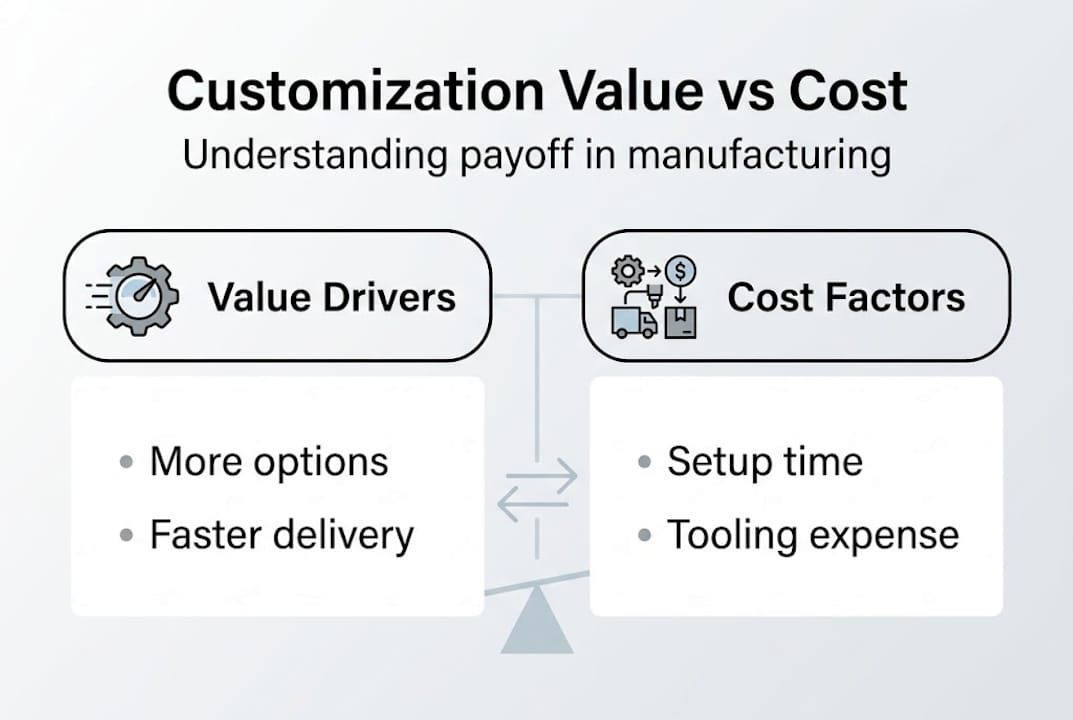
In standard mass production, tooling costs, setup expenses, and programming time are spread across enormous part volumes, driving the per-unit cost down dramatically. Custom runs do not automatically benefit from that amortization. Higher per-part costs are real, especially at low volumes. However, high-volume CNC production changes that equation. When CNC setups are automated and toolpaths are reusable across part families, the break-even point between custom and bulk production typically falls in the range of 450 to 1,200 units.
| Production type | Per-part cost driver | Break-even range | Best for |
|---|---|---|---|
| Mass production | Amortized tooling, low setup | N/A (scale default) | Commodity, high-volume, stable design |
| Custom CNC machining | Setup amortized at scale | 450 to 1,200 units | Application-specific, tight-tolerance parts |
| Low-volume custom | Full setup per run | Below 450 units | Prototypes, specialty components |
Here is a practical decision framework for evaluating when customization is financially viable:
- Assess your volume forecast. If your projected order exceeds 450 units per run, custom CNC becomes cost-competitive with standard production at comparable quality levels.
- Calculate the downstream value. A custom part that eliminates $15 of rework per assembly at the OEM level easily offsets a $3 premium per part at the machining stage. Always evaluate total cost of ownership, not just piece price.
- Evaluate design stability. If the part specification is likely to change within 12 months, invest in modular tooling that can accommodate revisions without a complete retool.
- Compare setup amortization. Ask your machining partner how many parts it takes to fully amortize their setup cost. That number is your real break-even, not an industry average.
- Account for material costs. Custom parts often require specific alloys or treated materials. Price those inputs before finalizing your cost comparison.
The contract machining benefits of partnering with an established high-volume shop are significant here. A contract manufacturer with automated CNC systems, dedicated tooling libraries, and experienced process engineers can shift the break-even point in your favor because their overhead is already distributed across a large production base.
Implementing customization: Success factors and pitfalls
Once cost thresholds are understood, turning strategy into practice is the next challenge. Many manufacturers that struggle with customization are not struggling because they lack equipment. They are struggling because they have not addressed the process and organizational elements that make customization scalable.
The three critical enablers, when deployed together, produce results that isolated investments cannot match. Data from a survey of 213 manufacturing plants confirms that bundling customization practices explains 41.9% of mass customization capability improvement, compared to 13.9% for individual efforts. That is nearly three times the impact.
The core enablers are:
- Customer knowledge absorption: Build formal processes for capturing design intent, application requirements, and performance specifications from your customers before parts enter production planning.
- Product modularity: Architect your component designs around a core of shared geometry with configurable features. This is what allows rapid variation without full redesign cycles.
- Digital configurators: Use digital tools that translate customer inputs directly into manufacturing specifications, reducing the manual translation work that typically slows custom quoting and setup.
A practical implementation path follows four steps:
- Assess your current capability. Audit your existing product lines for modular potential. Identify which features are truly unique per customer and which are standardized in practice.
- Plan the transition. Prioritize the part families with the highest customization demand and model the process changes needed before investing in new equipment.
- Pilot with a low-risk project. Choose one product line or customer program to pilot your new customization workflow. Measure setup time, defect rate, and delivery performance against your baseline.
- Scale what works. Expand your modular architecture and digital configurator capabilities to additional product lines based on the pilot results.
Explore complex part manufacturing strategies to understand how process design supports complex custom requirements at volume.
Pro Tip: The most common pitfall in customization programs is over-customization. Every additional variant adds scheduling complexity, inventory risk, and potential for error. Define your customization envelope clearly. Offer meaningful variation within a controlled architecture, not unlimited flexibility that collapses your production efficiency.
“The benefits of precision machining are multiplied when customization is built on a foundation of disciplined process design, not just flexible equipment.”
Flexible equipment is necessary but not sufficient. The organizations that sustain competitive customization capability over time are those that invest equally in how they design processes, manage data, and communicate across engineering, sales, and production.
What most OEMs miss about customization and scale
Here is the uncomfortable truth that most articles on this topic skip entirely: the technology is the easy part. CNC systems, digital twins, AI scheduling tools — these are all available for purchase. What you cannot buy off the shelf is the organizational process that makes them work together.
In our experience working with manufacturers since 1985 and producing over 20 million parts annually, the operations that struggle with customization almost always have the same root problem. Engineering, sales, and production are not speaking the same language. Sales commits to custom specs without understanding the manufacturing implications. Engineering designs for performance without accounting for setup constraints. Production tries to execute requirements that were never fully defined.
The real differentiator for manufacturers who scale customization successfully is the speed and accuracy of their internal feedback loops. When a customer requirement changes, how fast does that change reach the CNC program? When a machining problem emerges on the floor, how quickly does that signal reach design? Teams that streamline precision for high-volume production invest in cross-functional communication structures as seriously as they invest in equipment.
Customization at scale is not a technology problem. It is a process integration challenge that requires deliberate organizational design. Fix that first, and the technology investment pays off immediately.
Connect with a proven precision manufacturing partner
If you are ready to put these customization insights to work for your next project, here is a trusted resource you can partner with.
Machining Technologies LLC has delivered precision custom components since 1985, operating from a 70,000 square foot facility in Webster, Massachusetts. We produce over 20 million parts annually using Hydromat systems, CNC milling, turning, and wire EDM.
Whether you need precision parts manufacturing for aerospace applications or are scaling into high-volume manufacturing examples across industrial machinery, our engineering team is ready to support your transition from prototype through full production. We offer rapid quoting, dedicated engineer support, and end-to-end process oversight. Contact us today to discuss your project requirements and get a tailored manufacturing solution built around your specifications.
Frequently asked questions
Is customizing components always more expensive than standard manufacturing?
Customization can cost more per part, but high-volume CNC setups amortize setup costs effectively, making custom production cost-competitive around the 450 to 1,200 unit range.
What practices help OEMs boost customization capability?
Bundling modular design, customer knowledge processes, and digital configurators improves mass customization capability by nearly three times compared to adopting any single practice alone.
Do digital tools really reduce lead times for custom projects?
Yes, Zeiss and Eaton achieved 29% and 39% lead time reductions respectively by integrating AI and digital twin technology into their custom production workflows.
How do I decide between custom and standard machining for my project?
Evaluate your projected volume against the 450 to 1,200 unit break-even threshold, factor in downstream assembly savings, and consider whether a modular architecture can deliver the performance variation you need without a full custom tooling investment.
Recommended
- Complex part manufacturing: precision strategies 2026 | Machining Technologies
- Precision Parts Manufacturing: Maximizing Quality and Throughput | Machining Technologies
- 7 Key Benefits of Precision Machining for Manufacturers | Machining Technologies
- Step-by-step precision part design for high-volume manufacturing | Machining Technologies