

TL;DR:
- Secondary machining refines primary-formed parts by applying precise removal, heat treatment, and surface finishing processes to meet final specifications. It is essential across industries like aerospace, firearms, and medical devices to ensure parts achieve tight tolerances, improved surface quality, and functional features. Proper planning of secondary operations during design and production optimizes quality, reduces costs, and enhances efficiency.
Secondary machining is defined as the set of manufacturing operations applied after initial shaping processes to refine parts to final specifications, including tight tolerances, enhanced surface finishes, and additional functional features. Where primary processes like casting, injection molding, or rough CNC turning produce a near-net shape, secondary operations close the gap between that raw form and a finished, functional component. For manufacturers at Machiningtechllc and across industries like aerospace, firearms, and medical devices, understanding secondary machining processes is the difference between a part that ships and a part that performs.
What is secondary machining and what processes does it include?
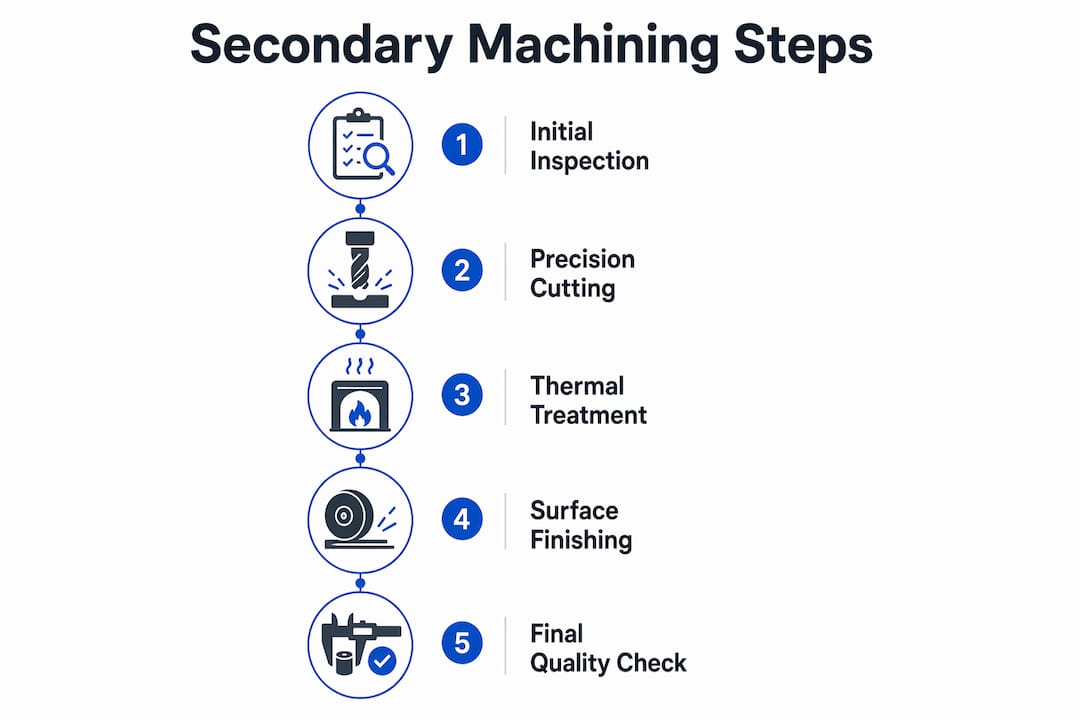
Secondary machining covers a broad spectrum of operations, and the right mental model is to think of it in three categories: precision material removal, thermal treatment, and surface finishing. Each category addresses a different gap left by primary manufacturing.
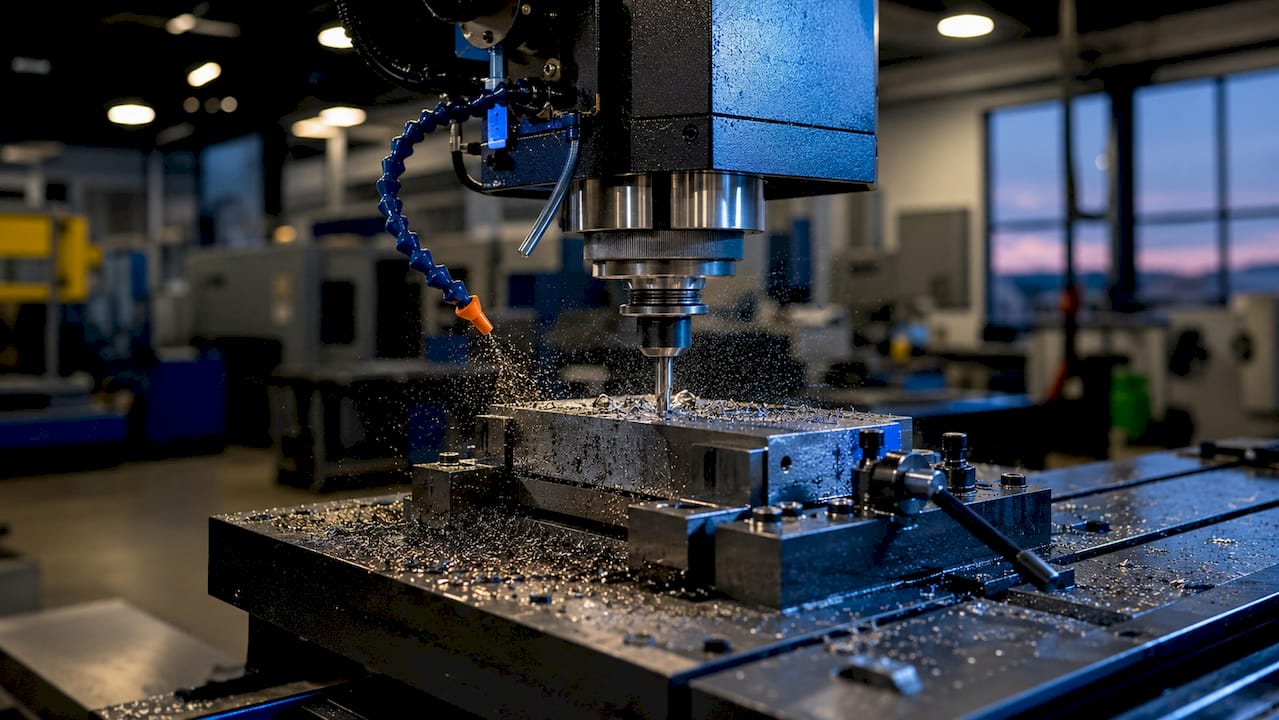
Precision material removal includes operations like drilling, tapping, reaming, milling, turning, and grinding. Drilling and tapping add fastener compatibility and threaded interfaces that would be impractical to form in a mold or casting. Reaming refines hole dimensions to tolerances that a drill alone cannot hold. Grinding and lapping push dimensional accuracy to within 0.0001 inches and achieve surface finishes below 16 Ra microinches, which is beyond what primary CNC passes can reliably deliver. That level of precision matters in bearing bores, sealing surfaces, and hydraulic valve bodies.
Thermal treatments include heat treating, annealing, tempering, and case hardening. These processes alter the material’s internal structure rather than its geometry. A steel firearm component, for example, may be rough-machined to shape and then case-hardened to achieve surface wear resistance while retaining a tough core. Annealing is used to relieve residual stresses introduced during primary machining, which prevents dimensional drift in precision assemblies.
Surface finishing covers deburring, polishing, anodizing, electroplating, powder coating, and passivation. Deburring removes sharp edges that would otherwise cause assembly failures or operator injuries. Anodizing aluminum parts adds corrosion resistance and a controlled surface hardness. Powder coating provides both protection and a specified color or texture for industrial or consumer-facing components.
| Process | Purpose | Typical application | Precision achievable |
|---|---|---|---|
| Grinding | Dimensional accuracy and surface finish | Bearing races, valve seats | ±0.0001 inches, below 16 Ra |
| Tapping | Add threaded features | Fastener holes in castings | Thread class 2B or 3B |
| Heat treating | Alter hardness and toughness | Gears, shafts, firearm parts | Controlled case depth |
| Anodizing | Corrosion and wear resistance | Aerospace aluminum components | 0.0002 to 0.001 inch layer |
| Deburring | Edge quality and safety | All machined parts | Controlled edge break |
Pro Tip: When specifying secondary operations on a drawing, call out the sequence explicitly. Applying heat treatment before final grinding is standard practice because heat treatment introduces dimensional growth that grinding then corrects to final size.
How does secondary machining improve part quality and production efficiency?
The most direct quality benefit is tolerance achievement. Post-production secondary processes can reach tolerances as tight as ±0.0005 inches on critical features, which primary casting or molding cannot approach. This matters because a single out-of-tolerance bore in a hydraulic manifold can cause leakage failures in the field, regardless of how well every other dimension was held.
Secondary machining also corrects distortions introduced by primary processes. Sintered powder metal parts, for instance, experience predictable but unavoidable dimensional changes during the sintering furnace cycle. Secondary sizing operations restore those features to specification without scrapping the part. Powder metallurgy components achieve near-net shape with less than 5% scrap in primary production, and secondary machining then delivers the tight tolerances and surface finish that the sintered form alone cannot provide.
From an efficiency standpoint, secondary machining reduces overall cycle time when operations are planned correctly. Concentrating tight-tolerance work on a dedicated secondary grinding cell, for example, frees the primary CNC turning center to run at higher feed rates without stopping to take precision finishing passes. The result is higher throughput on both machines. Strategic secondary equipment reduces scrap rates and overall cycle time even when only a few critical features require the additional operation.
| Secondary method | Tolerance achievable | Surface finish achievable | Best suited for |
|---|---|---|---|
| Cylindrical grinding | ±0.0001 inches | Below 16 Ra microinches | Shafts, bores, bearing seats |
| Lapping | ±0.00005 inches | Below 4 Ra microinches | Sealing surfaces, gauge blocks |
| Secondary milling | ±0.0005 inches | 32 to 63 Ra microinches | Flat features, pockets, slots |
| Electropolishing | Not dimensional | Below 8 Ra microinches | Stainless medical components |
Pro Tip: Track the scrap rate on primary-only runs versus primary-plus-secondary runs for the same part family. Most shops find the secondary operation pays for itself within the first production lot by eliminating rework on high-value castings or forgings.
What industries and real-world examples benefit most from secondary machining?
The applications of secondary machining span nearly every precision manufacturing sector, but four industries depend on it most heavily.
Aerospace components must meet AS9100 quality standards and often carry life-of-aircraft tolerances. A turbine blade root form machined from a forging requires secondary grinding to hold the fir-tree profile within microns. Aerospace machining standards demand secondary operations for critical surfaces because primary forging or casting cannot achieve the required geometry repeatability.
Firearms manufacturing relies on secondary machining for functional fit and reliability. Barrel threading, chamber reaming, and trigger group pin holes all require secondary operations after the primary turning or forging step. A chamber reamed 0.001 inches out of specification will cause feeding failures or unsafe headspace conditions. The precision machining workflow for firearms components treats secondary operations as non-negotiable steps in the production sequence.
Automotive and industrial machinery use secondary machining for gear tooth grinding, crankshaft journal polishing, and hydraulic valve body drilling. These are high-volume applications where the cost per secondary operation must be minimized, but the tolerance requirements are unforgiving.
Medical device manufacturing applies secondary machining for surface passivation of stainless steel implants, precision grinding of orthopedic joint surfaces, and electropolishing of surgical instruments. Regulatory compliance under FDA 21 CFR Part 820 requires documented process control at every step, including secondary operations.
Key benefits across these industries include:
- Functional features like cross-holes, threads, and undercuts added after primary shaping
- Surface finishes that meet tribological or biocompatibility requirements
- Dimensional corrections after heat treatment or sintering distortion
- Compliance with industry-specific standards that primary processes cannot satisfy alone
- Aesthetic requirements for consumer-visible or customer-specified finishes
How to select and optimize secondary machining operations in production
Choosing the right secondary operations requires evaluating four factors: material behavior, part functionality, production volume, and tolerance requirements. Skipping this analysis leads to over-processing, which adds cost, or under-processing, which produces nonconforming parts.
Follow this sequence when vetting secondary machining choices for a new part:
- Map the critical features. Identify which dimensions, surfaces, or features carry functional or regulatory requirements. Not every surface needs secondary attention. Focus resources on the features that drive fit, function, or compliance.
- Assess primary process capability. Determine what tolerances and finishes your primary process reliably delivers. The gap between primary capability and final specification defines the secondary work required.
- Select operations by material behavior. Aluminum responds well to anodizing and high-speed grinding. Hardened steel requires CBN grinding wheels. Powder metal parts need sizing dies rather than cutting tools for certain features. Choosing the right secondary operations depends directly on material, desired finish, part function, volume, and tolerance.
- Evaluate the build sequence. Secondary operations must follow a logical order. Heat treatment before final grinding is standard. Deburring before plating prevents adhesion failures. Threading before anodizing requires masking or tap oversize allowances.
- Calculate the break-even point. For low- to medium-volume production, compare the cost of modifying primary tooling to hold tighter tolerances against the cost of adding a secondary operation. Evaluating the break-even point for secondary operations versus tooling modifications is critical to optimizing cost and precision. In most cases, secondary operations win on cost when the tight tolerance applies to fewer than 20% of the part’s features.
Pro Tip: Build secondary operations into your PFMEA (Process Failure Mode and Effects Analysis) from the start of program planning. Treating them as afterthoughts leads to scheduling conflicts, missing fixtures, and unplanned tooling costs that erode margin on the first production run.
Key takeaways
Secondary machining transforms near-net-shape primary parts into finished, specification-compliant components by applying targeted precision removal, thermal treatment, and surface finishing operations where primary processes fall short.
| Point | Details |
|---|---|
| Definition is precise | Secondary machining applies post-primary operations to achieve final tolerances, finishes, and functional features. |
| Precision gains are measurable | Grinding achieves ±0.0001 inches and surface finishes below 16 Ra microinches, beyond primary CNC capability. |
| It is a planned strategy | Secondary machining is a deliberate cost-saving choice, not a corrective fallback for primary process failures. |
| Industry applications are broad | Aerospace, firearms, automotive, and medical manufacturing all depend on secondary operations for compliance and function. |
| Selection requires analysis | Material behavior, volume, tolerance gaps, and break-even cost calculations drive the right secondary operation choices. |
Why secondary machining deserves a seat at the design table
Most engineers I have worked with treat secondary machining as something that gets figured out after the primary process is locked. That instinct is understandable but expensive. By the time a part reaches production, the tolerance callouts are fixed, the material is specified, and the primary tooling is built. If secondary operations were not considered during design, you end up retrofitting them into a schedule that was not built to accommodate them.
The more productive approach is to treat secondary machining as a deliberate design tool. When you know that a casting will need a ground sealing surface, you can design in the stock allowance from the start. When you know that a powder metal part will be sized after sintering, you can hold the sintered dimensions to a looser tolerance and reduce scrap in the furnace. That kind of upstream thinking is where real cost savings live.
I have also seen the opposite mistake: over-specifying secondary operations on features that do not need them. Grinding every surface on a bracket because the drawing says “all surfaces 32 Ra” adds cost with no functional benefit. The discipline is in knowing which features actually drive performance and applying secondary operations only there. That is where lean machining principles and secondary machining strategy intersect most powerfully.
The shops that compete well in 2026 are the ones that treat secondary machining as a planned, costed, and sequenced element of the production system. Not an afterthought. Not a sign that something went wrong. A deliberate choice that makes the part better and the process cheaper.
— Andrew
How Machiningtechllc can support your secondary machining needs
Machiningtechllc has delivered precision contract machining from its 70,000 square foot Webster, Massachusetts facility since 1985, producing over 20 million parts annually for aerospace, defense, firearms, and industrial clients. The team applies secondary machining operations including grinding, threading, heat treatment coordination, and surface finishing as integrated steps in the production sequence, not add-ons. If you are evaluating contract machining options for parts that require tight tolerances and controlled secondary processes, Machiningtechllc offers the equipment depth, process documentation, and volume capacity to deliver. Contact the team to discuss your part requirements and get a production-ready assessment.
FAQ
What is the definition of secondary machining?
Secondary machining refers to manufacturing operations performed after primary shaping processes to achieve final tolerances, surface finishes, and functional features. These operations include grinding, tapping, heat treatment, deburring, and surface finishing applied to parts produced by casting, molding, or initial CNC machining.
What is the difference between primary and secondary machining?
Primary machining creates the initial near-net shape of a part through processes like casting, forging, or rough CNC turning. Secondary machining refines that shape to final specifications, adding features and achieving tolerances that primary processes cannot reliably deliver.
What are common examples of secondary machining processes?
Common secondary machining examples include cylindrical grinding, thread tapping, reaming, heat treating, anodizing, deburring, electroplating, and powder coating. Each operation targets a specific gap between the primary part form and the final functional requirement.
Is secondary machining always necessary after CNC machining?
Not always. Secondary machining is required when the primary CNC process cannot hold the specified tolerance, achieve the required surface finish, or produce a functional feature like a thread or cross-hole. For parts with relaxed tolerances and no special surface requirements, primary machining alone may be sufficient.
How does secondary machining affect production cost?
Secondary machining adds per-part cost but typically reduces total program cost by lowering scrap rates, enabling simpler primary tooling, and concentrating tight-tolerance work on dedicated equipment. Strategic secondary operations reduce tooling expense, particularly in low- to medium-volume production where modifying primary tooling is disproportionately expensive.
Recommended
- Optimize high-volume machining workflow: aerospace precision | Machining Technologies
- Machinability of materials guide for precision 2026 | Machining Technologies
- Aerospace machining: precision processes and standards | Machining Technologies
- Custom vs standard machining: choosing the right fit | Machining Technologies