

TL;DR:
- Titanium’s high strength-to-weight ratio and corrosion resistance make it the primary metal for aerospace structures. Machining titanium requires specialized tooling, coolant strategies, and strict process discipline to manage heat, work hardening, and thermal expansion. Certified grades like Ti-6Al-4V and Grade 23 are essential for meeting aerospace standards and design requirements.
Titanium is defined as the aerospace industry’s primary structural metal because no other material matches its combination of high tensile strength, low density, corrosion resistance, and thermal stability. The question of why titanium in aerospace machining comes down to physics: Ti-6Al-4V Grade 5 delivers tensile strength exceeding 900 MPa at a density of just 4.43 g/cm³, outperforming steel at roughly half the weight. That ratio directly reduces airframe weight, cuts fuel consumption, and extends service life on every flight cycle. For aerospace engineers, machinists, and procurement specialists, understanding titanium’s advantages and its machining demands is not optional. It is the foundation of every precision aerospace component produced to AS9100 standards.
Why titanium in aerospace machining matters: core material advantages
Titanium’s strength-to-weight ratio is the primary reason it dominates aerospace structural applications. Steel offers comparable strength but at nearly twice the density. Aluminum is lighter but cannot match titanium’s tensile performance or its resistance to fatigue under cyclic loading, which is exactly the stress profile of aircraft structures.
The corrosion resistance of titanium comes from a stable TiO₂ oxide layer that forms instantly on any exposed surface. This layer protects the metal in salt spray, hydraulic fluid, and jet fuel environments without any coating or treatment. That self-healing property eliminates the corrosion maintenance cycles that aluminum airframe sections require.
Thermal performance separates titanium from aluminum in engine-adjacent applications. Titanium retains structural integrity up to approximately 400°C, while aluminum begins to lose strength well below that threshold. Engine pylons, compressor blades, and firewall structures all operate in temperature ranges where aluminum is not a viable option.
Fatigue resistance is the property that procurement specialists often undervalue. Titanium’s fatigue endurance limit is proportionally high relative to its ultimate tensile strength. Aircraft components experience millions of load cycles over their service lives, and titanium’s fatigue behavior under cyclic stress is a key reason it appears in landing gear frames and wing attachment fittings.
| Property | Titanium (Ti-6Al-4V) | Aluminum (7075-T6) | Steel (4340) |
|---|---|---|---|
| Tensile strength | >900 MPa | ~570 MPa | ~1,080 MPa |
| Density (g/cm³) | 4.43 | 2.81 | 7.85 |
| Thermal conductivity (W/m·K) | 6.7 | 130 | 44.5 |
| Max service temp (approx.) | ~400°C | ~150°C | ~300°C |
| Corrosion resistance | Excellent | Moderate | Poor (uncoated) |
Why is titanium difficult to machine, and how do machinists solve it?
Titanium’s low thermal conductivity of 6.7 W/m·K is the root cause of most machining problems. Steel transfers roughly 75% of cutting heat into the chip, which exits the cut zone with the chip. Titanium traps approximately 80% of that heat at the tool edge instead. The result is accelerated tool wear, thermal deformation of the part, and surface integrity problems that violate aerospace finish requirements.
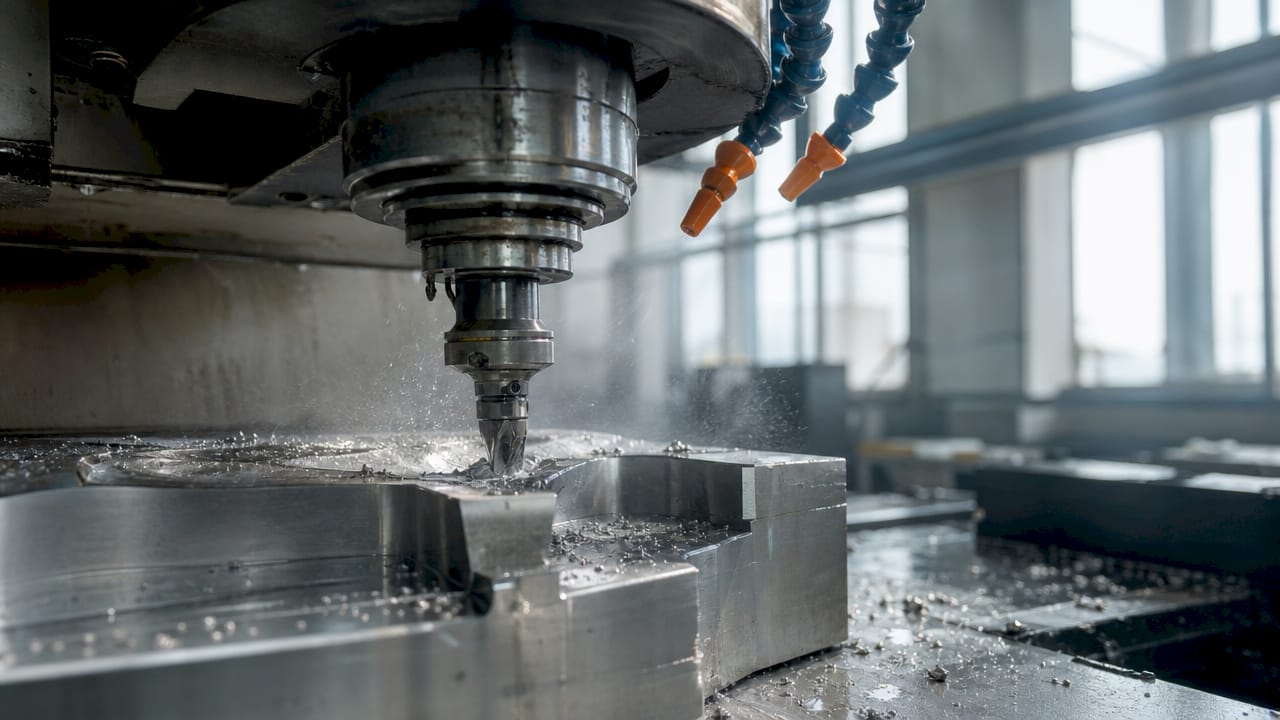
Work hardening compounds the thermal problem. Cutting below 0.003" IPT causes the tool to plow through the material rather than shear it cleanly. That plowing raises surface hardness from roughly 36 HRC to above 40 HRC in the affected zone. Once the surface hardens, the next pass encounters a tougher material than the original billet, accelerating wear in a self-reinforcing cycle.
Thermal expansion adds a dimensional stability challenge that is unique to tight-tolerance aerospace work. Parts can grow 0.001 to 0.003 inches during a machining cycle. Aerospace tolerances routinely call for ±0.0002 inches. That gap between thermal growth and required tolerance means temperature control is not a convenience. It is a process requirement.
Experienced machinists address these challenges with a combination of tooling, coolant strategy, and process discipline:
- AlTiN coatings form an aluminum oxide layer at cutting temperatures around 700–800°C, acting as a thermal barrier that protects the carbide substrate. This coating is the standard choice for titanium roughing and semi-finishing passes.
- High-pressure through-tool coolant above 1,000 PSI reaches the cutting zone directly, breaking chip curls and flushing heat before it concentrates at the edge. Standard flood coolant does not penetrate chip curls effectively in titanium.
- Cryogenic cooling with liquid nitrogen is used in high-value aerospace parts where surface integrity requirements are most demanding.
- Feed rates above 0.002 inches per tooth keep the tool shearing rather than rubbing, preventing the work-hardening cycle from starting.
- Low cutting speeds reduce heat generation at the source, which is the opposite of the approach used for aluminum.
Pro Tip: Maintain shop ambient temperature at 20°C ± 1°C and schedule alternating roughing passes with rest periods. Machinists who control thermal growth through process sequencing hold ±0.0002 inch tolerances consistently without scrapping parts.
How do titanium alloy grades and aerospace specifications shape machining decisions?
Ti-6Al-4V Grade 5 accounts for approximately 50% of all titanium used in aerospace. Its combination of tensile strength, machinability, and availability in AS9100-certified billet form makes it the default choice for structural components, fasteners, and engine hardware. The extensive fatigue database built around Grade 5 also satisfies the A-basis design value requirement, meaning 99% of material samples must meet minimum mechanical properties with 95% statistical confidence under AMS 4911 standards.
Grade 23, also called ELI (Extra Low Interstitial), is the choice for fatigue-critical parts where fracture toughness matters more than maximum strength. Lower oxygen and iron content reduces crack initiation sites. The tradeoff is that Grade 23 is harder to machine than Grade 5 and commands a higher material cost. Procurement specialists working on rotating engine components or primary structure should specify Grade 23 when the design calls for maximum fracture toughness.
Heat treatment condition changes the machining equation significantly. Annealed titanium offers better fracture toughness and is more forgiving to machine than Solution Treated and Aged (STA) material. STA condition delivers maximum tensile and yield strength but lower ductility, which increases cutting forces and accelerates tool wear. Machinists who receive STA billets need to reduce cutting speeds and increase coolant pressure compared to their annealed parameters.
Procurement compliance for aerospace titanium centers on three requirements:
- Mill Test Reports (MTR) must accompany every lot, providing chemical composition and mechanical test data traceable to the original melt. No MTR means no compliant part, regardless of dimensional accuracy.
- AMS 4911 and AMS 4928 govern plate and bar stock respectively, setting the material specification floor for aerospace structural titanium.
- AS9100 certification at the machining facility confirms that the quality management system can maintain the traceability chain from raw material through finished component.
Pro Tip: Always verify that your MTR hydrogen content is within specification before machining. Elevated hydrogen causes embrittlement that does not appear until the part is in service. This check takes minutes and prevents catastrophic failures.
What machining strategies produce aerospace-grade titanium parts?
Five-axis CNC machining is the standard approach for complex titanium aerospace components. The ability to reach undercuts, thin walls, and compound angles in a single setup eliminates datum shift errors that accumulate across multiple setups. Finishing in a single clamping is not a preference. It is a requirement for parts where thermal growth and mechanical relaxation during reclamping cause deviations that exceed tolerance.
Typical aerospace titanium parts produced by contract machinists include:
- Turbine engine components: compressor blades, fan disks, and engine casings where temperature resistance and fatigue life are primary design drivers.
- Airframe structural sections: wing spars, bulkheads, and rib sections where the strength-to-weight ratio directly affects aircraft payload and range.
- Fasteners: titanium bolts and rivets used throughout primary structure, where corrosion resistance eliminates galvanic incompatibility with carbon fiber composites.
- Landing gear frames: high-load structural members that experience severe cyclic stress on every landing.
Toolpath strategy has a measurable impact on tool life and surface quality. Climb milling, where the cutter engages the material with the chip thinning from thick to thin, reduces rubbing at tool entry and lowers heat generation compared to conventional milling. Trochoidal toolpaths, which use circular arc motion to maintain constant chip load, extend tool life significantly on deep-pocket features common in aerospace structural parts.
Buy-to-fly ratio is the metric procurement specialists use to evaluate titanium machining efficiency. Aerospace titanium billets are expensive, and aggressive material removal from a large billet to produce a near-net-shape part drives cost. Machining strategies that reduce stock allowance, use near-net forgings, or apply 5-axis machining to minimize setups all reduce buy-to-fly ratio and lower per-part cost.
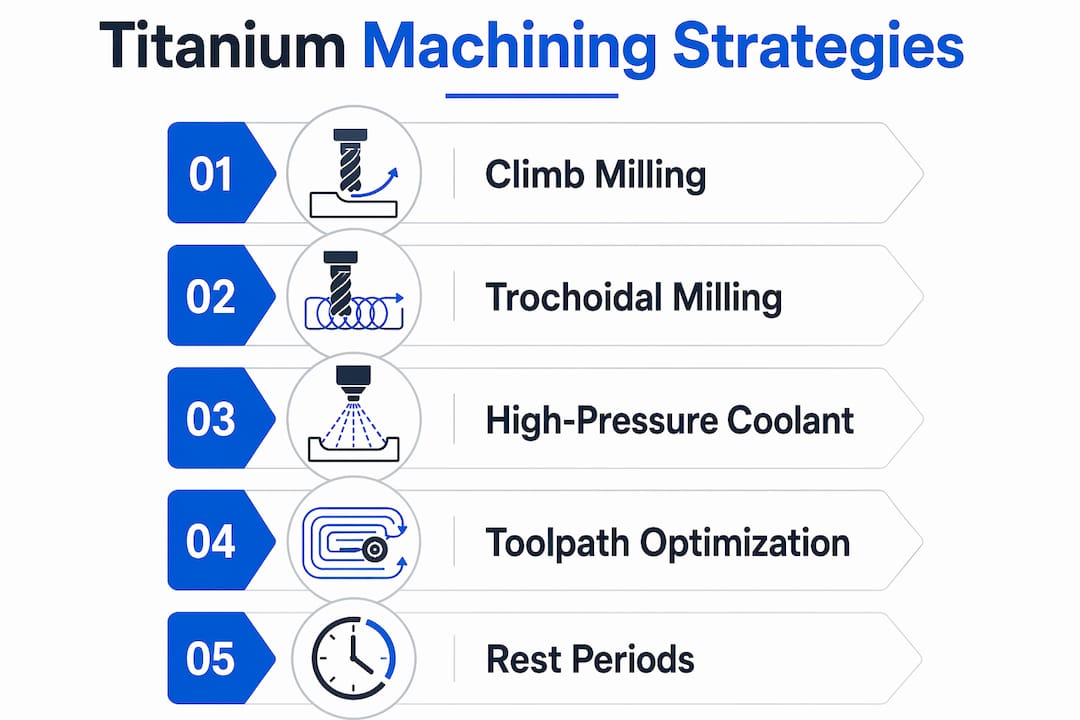
Pro Tip: Use trochoidal milling for titanium pockets deeper than 2x tool diameter. The constant arc engagement prevents the sudden chip load spikes that snap end mills and ruin expensive titanium billets.
| Machining strategy | Primary benefit | Best application |
|---|---|---|
| 5-axis CNC | Single-setup accuracy | Complex structural parts |
| Trochoidal toolpath | Consistent chip load | Deep pockets, thin walls |
| Climb milling | Reduced tool rubbing | All titanium cuts |
| High-pressure coolant | Heat removal at cutting edge | Roughing and semi-finishing |
| Single-clamping finish | Eliminates datum shift | Final tolerance features |
Key Takeaways
Titanium dominates aerospace machining because its strength-to-weight ratio, corrosion resistance, and thermal stability meet requirements that no other metal satisfies at equivalent weight.
| Point | Details |
|---|---|
| Ti-6Al-4V is the standard | Grade 5 covers roughly 50% of aerospace titanium use due to certified strength and fatigue data. |
| Heat is the main machining risk | Low thermal conductivity traps 80% of cutting heat at the tool edge, driving wear and dimensional error. |
| Feed rate controls work hardening | Keeping chip load above 0.003" IPT prevents surface hardening that destroys tools and rejects parts. |
| MTR compliance is non-negotiable | AMS 4911 traceability and A-basis design values are mandatory for every aerospace titanium lot. |
| Single-clamping finishing is required | Reclamping causes relaxation and thermal deviation that pushes finished parts outside aerospace tolerances. |
Titanium machining: what 20 years of aerospace work actually teaches you
The textbook explanation of titanium’s properties is accurate. The part that textbooks skip is how unforgiving the material is when process discipline slips even slightly. I have seen shops with the right equipment and the right tooling still scrap expensive titanium parts because they treated temperature control as a secondary concern. Thermal management is not a finishing detail. It is the foundation of every decision from toolpath design to coolant selection.
The other lesson that took time to internalize is that Grade 5 and Grade 23 are not interchangeable just because they look identical on the floor. The machining parameters that work cleanly on annealed Grade 5 will accelerate tool wear on STA Grade 23 at the same speeds and feeds. Shops that do not adjust for heat treatment condition pay for it in tooling costs and scrapped billets.
The demand for titanium in aerospace is not slowing. Next-generation commercial aircraft and spacecraft programs specify titanium in structural roles that previous generations assigned to steel. CNC automation is making high-volume titanium production more repeatable, but the underlying material knowledge still determines whether a shop can hold the tolerances that aerospace programs require. Shops that invest in thermal management systems, AlTiN tooling, and high-pressure coolant infrastructure now will be positioned to take on the programs that matter in the next decade.
— Andrew
Machiningtechllc’s aerospace titanium machining capabilities
Aerospace titanium programs demand a machining partner with the equipment, process knowledge, and quality infrastructure to deliver compliant parts on schedule. Machiningtechllc has operated from its 70,000 square foot Webster, Massachusetts facility since 1985, producing over 20 million parts annually across aerospace, defense, and industrial programs.
The facility runs CNC milling, turning, and wire EDM on titanium aerospace components, with process controls built around AS9100 requirements and tight-tolerance production. Machiningtechllc’s contract machining services cover prototypes through full-scale production runs, with thermal management and single-clamping finishing protocols standard on aerospace titanium work. For procurement specialists and program engineers sourcing precision aerospace parts, contact Machiningtechllc directly to discuss your titanium component requirements.
FAQ
What makes titanium the preferred metal for aerospace structures?
Titanium delivers tensile strength exceeding 900 MPa at a density of 4.43 g/cm³, giving it a strength-to-weight ratio that steel cannot match at equivalent weight. Its self-healing TiO₂ oxide layer also eliminates corrosion maintenance requirements in harsh aerospace environments.
Which titanium grade is most common in aerospace machining?
Ti-6Al-4V Grade 5 accounts for approximately 50% of aerospace titanium use. Its certified fatigue database, AS9100-compliant billet availability, and balance of strength and machinability make it the default structural alloy.
Why does titanium cause more tool wear than steel or aluminum?
Titanium’s low thermal conductivity traps roughly 80% of cutting heat at the tool edge rather than transferring it into the chip. That concentrated heat degrades tool coatings and carbide substrates far faster than machining steel or aluminum at comparable material removal rates.
What coolant strategy works best for titanium aerospace machining?
High-pressure through-tool coolant above 1,000 PSI is the standard recommendation. It reaches the cutting zone directly, breaks chip curls, and removes heat before it concentrates at the tool edge. Cryogenic cooling with liquid nitrogen is used for the most demanding surface integrity requirements.
How do aerospace specifications affect titanium procurement?
AMS 4911 and AMS 4928 govern plate and bar stock, requiring Mill Test Reports with full chemical and mechanical traceability for every lot. A-basis design values require that 99% of samples meet minimum mechanical properties with 95% statistical confidence, making MTR verification a mandatory procurement step.