

TL;DR:
- CNC programming in aerospace demands rigorous simulation, strict state management, and validated safety protocols to prevent costly errors and ensure regulatory compliance. Proper restart procedures, advanced toolpath optimization, and thorough documentation form the foundation of error-proof manufacturing processes. Implementing disciplined programming practices and validation frameworks significantly reduces production risks and maintains high-precision standards.
CNC programming is routinely dismissed as a coding task, something you hand off to a technician who writes G-code and presses run. In aerospace and defense manufacturing, that assumption is dangerous. A single misconfigured modal state or an unvalidated toolpath restart can scrap a titanium structural part worth thousands of dollars, trigger a nonconformance report, or worse, compromise component integrity in a flight-critical assembly. This guide breaks down what CNC programming actually requires at the highest precision tiers, covering simulation, state management, AI-assisted optimization, and the team disciplines that separate safe programs from risky ones.
Table of Contents
- What is CNC programming—and why is it different in aerospace?
- Simulation and verification: The first line of defense
- Restart, recovery, and the dangers of ambiguous machine state
- AI-assisted toolpath optimization: Opportunities and global risks
- Why “error-proof” CNC programming is about more than code
- How expert CNC programming accelerates your precision goals
- Frequently asked questions
Key Takeaways
| Point | Details |
|---|---|
| Simulation is essential | Rigorously simulate and verify every program before running parts to avoid costly errors. |
| State control enables safety | Handling machine state for restarts is as important as getting toolpaths correct the first time. |
| Holistic optimization | AI or other optimizations should balance speed, quality, and compliance—not just surface finish. |
| Process over code | Superior CNC programming relies on error-proof process discipline, not just lines of code. |
What is CNC programming—and why is it different in aerospace?
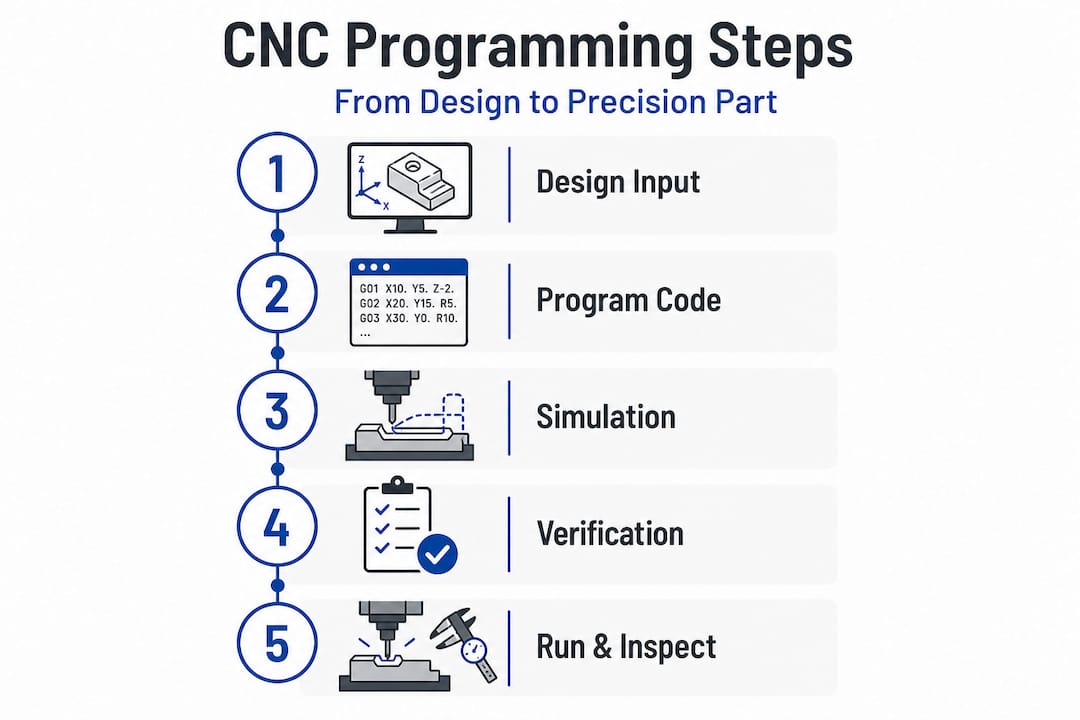
At its core, CNC programming translates digital designs into precise machine actions: spindle speeds, feed rates, axis movements, tool changes, coolant activation, and dozens of other coordinated commands. For general manufacturing, this process is largely about efficiency. For aerospace and defense, it becomes a structured engineering discipline with compliance, traceability, and repeatability requirements at every step.
The difference in rigor is not subtle. When you’re producing brackets for a satellite structure, actuator housings for a missile guidance system, or turbine blade features that must meet AS9100 dimensional requirements, the aerospace machining best practices you apply to programming directly affect certification outcomes. A program that produces acceptable parts 98% of the time is not acceptable when nonconformances trigger full supply chain investigations.
Several capabilities separate standard CNC programming from aerospace-grade programming:
- Modal state handling: The controller tracks its current operating mode at all times. Poorly managed modal conditions mean the machine may apply the wrong compensation or feed rate after a tool change.
- Toolpath optimization: Not just for speed, but for maintaining dimensional control across a full production run of hundreds or thousands of identical parts.
- Restart safety: Programs must be structured so that a mid-run interruption can be resolved cleanly, without corrupting part geometry.
- Compliance traceability: Program revisions must be documented, version-controlled, and tied to part drawing revisions.
“Good CNC programming for aerospace is not measured by surface finish alone or cycle time. It is measured by repeatability under production conditions, safe restart capability, and zero ambiguity in modal state across the entire program structure.”
Understanding why tight tolerances in aerospace demand this level of programming discipline helps procurement teams ask better questions when qualifying suppliers. The program is not just the code. It is the engineered intent of the machining process.
Simulation and verification: The first line of defense
Understanding the unique demands on CNC programming, it’s clear why aerospace and defense rely so heavily on simulation and verification. Before a single chip is cut, a well-managed program goes through layered digital validation to catch errors that would be expensive or dangerous on real material.
Simulation and verification are core methodologies for detecting errors in toolpaths, speeds, feeds, and modal conditions before execution on actual equipment. In aerospace environments, this step is not optional, it is a contract requirement in many cases.
Here’s a breakdown of the most common error types that simulation catches, and the consequences if they reach the shop floor:
| Error type | What simulation catches | Shop floor consequence if missed |
|---|---|---|
| Tool collision | Tool body or holder intersects fixture or part | Destroyed tooling, scrapped part, possible machine damage |
| Over/underfeed | Feed rate set too high or too low for material | Poor surface finish, broken tools, or out-of-tolerance features |
| Modal violation | Incorrect compensation or cycle state carried forward | Wrong geometry, failed inspection, nonconformance report |
| Incorrect rapid moves | Tool traverses through part geometry at G00 speed | Catastrophic tool crash, part destruction |
| Tool length mismatch | Programmed depth conflicts with actual tool data | Undercut or overcut features, scrap part |
Collaborative verification matters just as much as the software itself. When the programmer, process engineer, and quality team all review the simulation output before sign-off, the rate of first-article failures drops significantly. Verification and simulation reduce the risk of wrong toolpaths and ambiguous modal states ever reaching the shop floor, which is particularly critical during first-article qualification runs.
Pro Tip: For any first-article or low-volume aerospace component, run the simulation twice: once with nominal tool data and once with worst-case tool wear offsets applied. This reveals whether your program tolerances have enough margin to survive real production conditions.
The process of verifying part quality does not end at simulation. Physical first-article inspection using CMM or optical measurement ties program verification to actual dimensional outcomes, closing the loop between digital intent and physical reality. Organizations that want to optimize their measurement processes alongside programming workflows see faster first-article approval cycles and fewer mid-production interruptions.
Key considerations for effective simulation workflows include:
- Use machine-specific kinematics in simulation software, not just generic post-processor output
- Include fixture and workholding geometry in the simulation model
- Verify all tool change positions to confirm clearance before and after the change
- Document simulation results and attach them to the traveler package for the job
Restart, recovery, and the dangers of ambiguous machine state
After verifying a program is error-free, programmers must still plan for the unpredictable: when machine state is lost or interrupted. A tool breaks at operation 14 of 22. A power spike stops the machine mid-cycle. An operator hits the emergency stop during a critical bore operation. What happens next determines whether you lose a single tool or lose the part.
Machine state refers to everything the controller currently “knows”: active tool offsets, work coordinate system, compensation modes, canned cycle context, and coolant status. When a program is interrupted, the controller may retain incorrect state information, and restarting without explicitly rebuilding state is one of the most common causes of crashes, scrap, and safety incidents in precision machining.
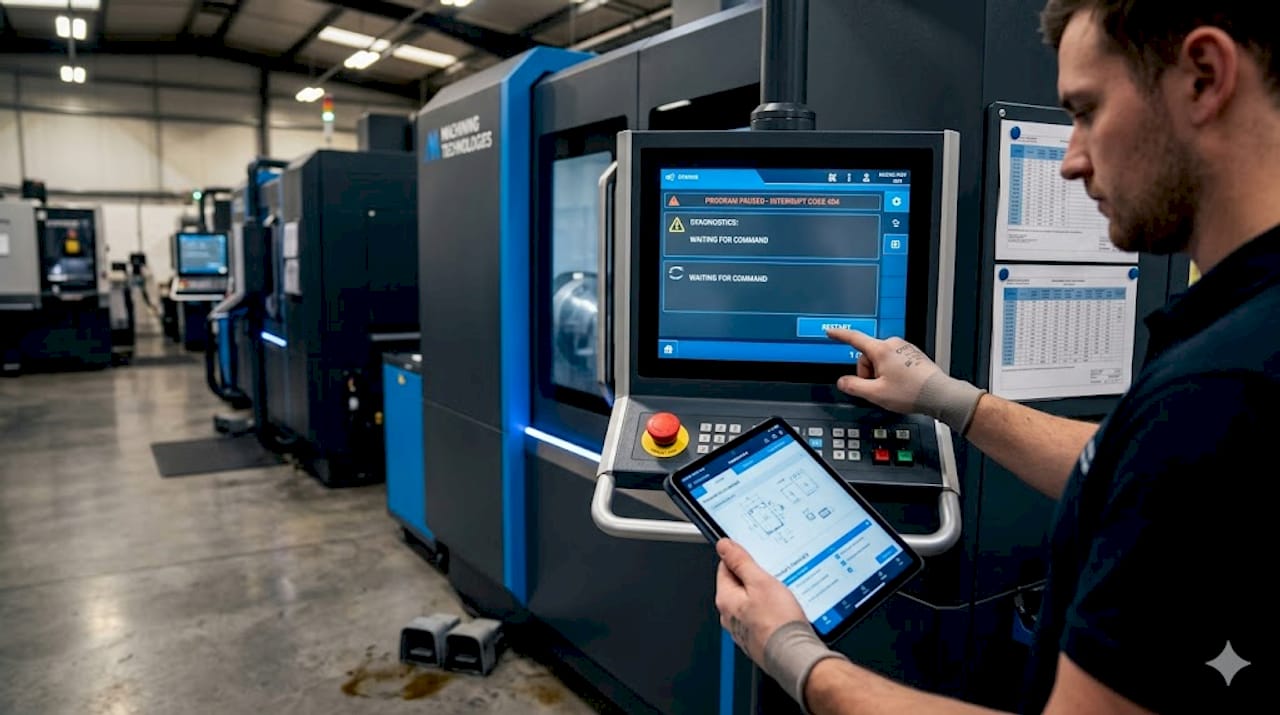
Edge-case risk management for CNC programs must include safe restart and recovery logic after interruptions, because modal state can differ significantly from what the controller expects at the moment of re-entry. This is not a niche concern. Any shop running complex aerospace components must treat restart discipline as a core programming standard.
Compare the two approaches:
| Restart approach | Characteristics | Risk level |
|---|---|---|
| Ambiguous restart | Operator re-enters at nearest block, assumes state is correct | High: tool offsets, compensation, or work coordinates may be wrong |
| Disciplined restart | Program includes state rebuild block sequence before re-entry | Low: controller state is explicitly verified before cutting resumes |
Best practices for controlled state reconstruction after a program interruption follow a specific sequence:
- Cancel all active compensations (G40, G49, G80) to eliminate canned cycle and offset carryover.
- Explicitly call the correct work coordinate system (G54, G55, etc.) for the restart position.
- Re-establish the correct tool length offset with a safe tool call block.
- Move to a known safe intermediate position before approaching the part.
- Restore feed and speed to programmed values explicitly, never assume they are retained.
- Resume cutting from a position that allows gradual re-engagement, not from a buried tool position.
Pro Tip: Build a standard restart header block into every program template at your facility. This block cancels all compensation modes, calls the work coordinate, and positions the machine at a safe Z height before any re-engagement logic. This single discipline change eliminates the majority of restart-related scrap events.
The connection between tolerance best practices and restart discipline is direct. A part that is within tolerance after operation 13 can be scrapped instantly if an ambiguous restart at operation 14 applies the wrong tool offset or cuts at an incorrect depth. State handling is not a programming nicety. It is a precision control mechanism.
AI-assisted toolpath optimization: Opportunities and global risks
Advancements like AI promise big gains, but sometimes results can be misleading if broader constraints are ignored. AI-assisted toolpath optimization is a genuine advancement for CNC programming, but treating it as an automatic improvement carries real risk in aerospace and defense contexts.
Empirical research on AI-assisted CNC toolpath optimization demonstrates that local improvements, such as faster cycle times or smoother surface finish results, can come with global risks including geometric non-compliance and unexpected tool wear patterns. The AI is optimizing for the parameters you give it. If those parameters do not include every aerospace drawing specification, the optimized program may produce parts that look better on surface roughness measurements but fail dimensional or GD&T requirements.
Here is a summary of what current research shows:
| Optimization target | AI-driven improvement | Potential global risk |
|---|---|---|
| Cycle time | 8 to 15% reduction in some materials | Increased vibration, compromised feature accuracy |
| Surface finish (Ra) | Measurable improvement in roughness values | Higher tool wear rate, shorter tool life |
| Feed rate profiles | Smoother transitions reduce load spikes | Can violate chip load limits for hard alloys |
| Spindle speed | Better harmonic avoidance | May conflict with material-specific hardness constraints |
AI-based toolpath optimization must be evaluated against aerospace drawing compliance and safety constraints, not just performance metrics. This is a critical point for procurement specialists reviewing supplier programming capabilities. Asking whether a shop uses AI optimization is far less important than asking how they validate AI-generated programs against drawing requirements.
Practical implications for procurement and engineering teams include:
- Require suppliers to demonstrate simulation validation of all AI-optimized programs against full drawing GD&T requirements
- Ask for first-article inspection data that directly correlates to the AI-optimized program version
- Insist on version-controlled program documentation that tracks when AI optimization was applied and what parameters were used
- Evaluate tool life data before and after AI optimization to confirm no unexpected wear acceleration
Staying current with machining trends in 2026 means understanding that AI tools are maturing quickly, but integration into high-compliance environments requires more than vendor claims. The shops doing this well are building validation frameworks around AI suggestions, not just accepting outputs as final programs.
Why “error-proof” CNC programming is about more than code
Bringing it all together, let’s reconsider what “good” CNC programming really means in your context. After more than four decades of working with aerospace and defense supply chains, our perspective at Machining Technologies is direct: most CNC-related failures in high-precision environments do not come from bad code. They come from ambiguous state management, skipped verification steps, and missing restart logic.
The industry tends to evaluate programming talent by code elegance or speed metrics. Procurement teams often ask about equipment capabilities without asking about programming discipline. That gap is where failures hide. A machining center with 5-axis capability and a modern control system can still produce scrap at scale if the programming methodology lacks structure.
When procurement specialists evaluate CNC programming quality, the strongest signal is state-handling discipline: safe program structures that explicitly support mid-program restarts and minimize ambiguous modal conditions throughout the entire operation sequence. This is a concrete, auditable quality indicator that any supplier should be able to demonstrate.
Simulation, restart planning, and collaborative cross-functional review are not overhead. They are the infrastructure that keeps high-volume aerospace production running without costly interruptions. The shops that treat these disciplines as optional are the same shops generating nonconformance reports that ripple up through your supply chain.
Our view is that procurement teams at aerospace and defense organizations should include programming methodology questions in supplier qualification. Ask to see a restart recovery procedure. Ask how simulation is validated against drawing requirements. Review how the shop documents program revisions. The answers reveal more about a supplier’s quality culture than any equipment list. Review how precision processes and standards translate into tangible supplier qualifications for your next sourcing decision.
How expert CNC programming accelerates your precision goals
If you’re ready to translate theory into real performance improvements, here’s how our experts can help. At Machining Technologies LLC, we have built our programming methodology around the principles covered in this guide: simulation-first validation, disciplined state management, and structured restart logic that protects every part across our entire production volume.

Our team in Webster, Massachusetts runs over 20 million parts annually from a 70,000 square foot facility equipped with Hydromat systems, multi-axis CNC milling, turning, and wire EDM. Simulation and verification are standard practice, not an upsell, for every aerospace and defense program we accept. If you want to understand how our aerospace workflow optimization approach protects your quality requirements while reducing lead time, our engineering team is ready to review your component requirements and provide a tailored assessment. Contact us to start a conversation about your next precision program.
Frequently asked questions
What does CNC programming actually involve?
CNC programming involves creating, testing, and verifying machine instructions that translate digital designs into precise, physical parts with controlled speeds, feeds, and toolpath sequences.
Why is simulation vital before running real parts?
Simulation and verification prevent costly errors by identifying problems in toolpaths, speeds, and modal conditions before the program ever touches real material or equipment.
What is the risk of improper restart after a CNC program interruption?
Improper restart logic can result in tool crashes or dimensionally incorrect parts when the machine controller’s modal state does not match what the program expects at the point of re-entry.
Does AI make CNC programming error-proof?
Not automatically. AI-optimized programs can improve surface finish and cycle time but may introduce geometric non-compliance if the optimization is not validated against full aerospace drawing requirements.
How do procurement teams evaluate strong CNC programming?
Look for documented simulation validation, explicit restart recovery procedures, and version-controlled program histories. State-handling discipline and safe program structures are the most reliable indicators of mature CNC programming practice.
Recommended
- Step-by-step precision part design for high-volume manufacturing | Machining Technologies
- CNC Turning: Impact on Precision Manufacturing | Machining Technologies
- Complex part manufacturing: precision strategies 2026 | Machining Technologies
- CNC Machining Materials: Optimize Strength, Precision, Cost | Machining Technologies