

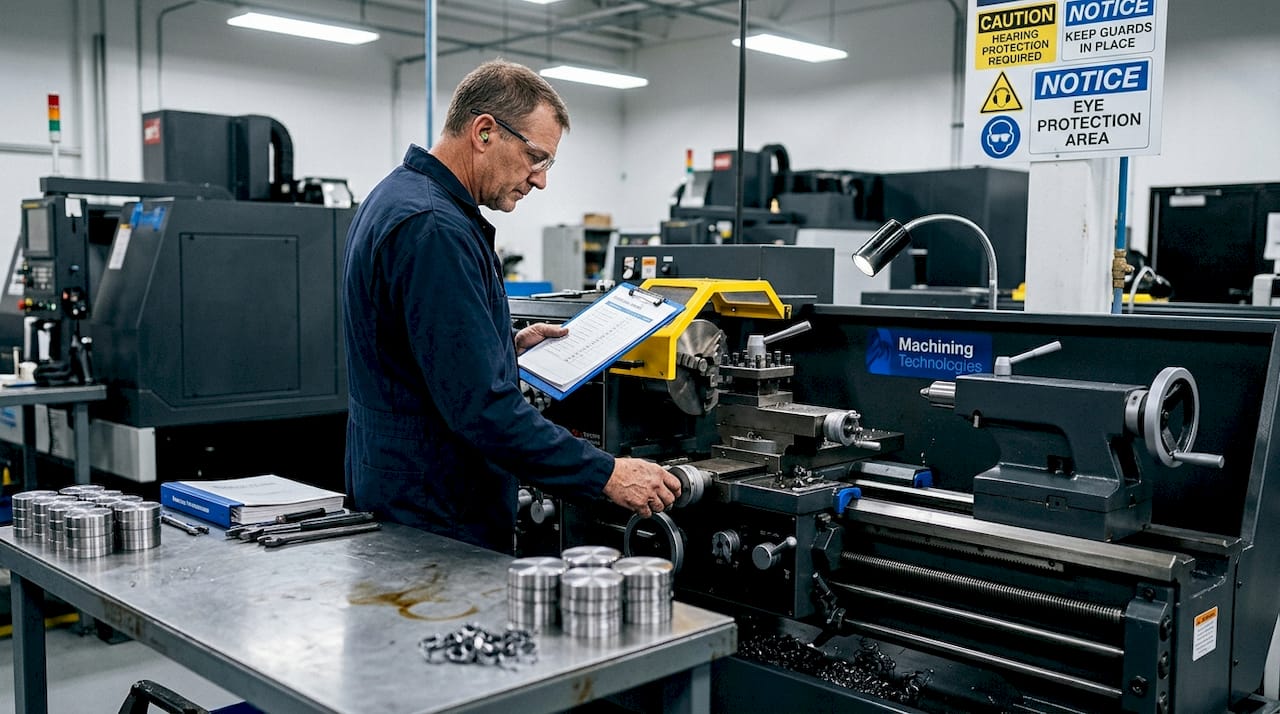
TL;DR:
- Proper machine guarding, PPE, and rigorous operator training are essential to prevent incidents and ensure OSHA compliance. Implementing layered risk controls, maintaining workspace cleanliness, and conducting regular audits further reduce hazards in machining environments. Integrating safety as an operational discipline enhances both safety performance and manufacturing efficiency.
A single bypassed interlock or a floor wet with coolant can put an operator in the hospital and your facility under OSHA scrutiny before the shift ends. Safety managers in aerospace, defense, and industrial manufacturing know the stakes are not just regulatory. Incidents disrupt production schedules, damage supplier relationships, and expose organizations to liability that dwarfs the cost of prevention. This guide delivers a structured, evidence-based set of machining safety protocols, from guarding fundamentals through integrated risk management, so you can strengthen compliance, reduce incidents, and keep high-volume operations running at full capacity.
Table of Contents
- Master the essentials: Guarding and compliance foundations
- Go beyond the basics: PPE, training, and operator protocols
- Control the workspace: Prevent slips, trips, and debris hazards
- Precision processes: Cutting parameters and pre-operation inspections
- Integrated risk management: The hierarchy of controls in practice
- Audits and continuous improvement: Ensuring compliance and addressing violations
- Our take: Safety that transcends checklists and compliance
- Next steps: Partnering for safer, more efficient machining
- Frequently asked questions
Key Takeaways
| Point | Details |
|---|---|
| Mandatory machine guarding | OSHA requires guarding for all key danger points, which is non-negotiable for compliance and injury prevention. |
| Integrated PPE and operator training | Comprehensive PPE protocols and routine trainings are essential to protect workers from direct and indirect risks. |
| Effective workplace housekeeping | A clutter-free, dry workspace actively prevents slips, trips, and secondary hazards in machining environments. |
| Inspection and parameter control | Systematic tool, guard, and parameter checks before operation reduce accidents from equipment malfunction or misuse. |
| Risk-focused continuous improvement | Regular audits and a layered control approach fortify compliance and foster long-term operational safety. |
Master the essentials: Guarding and compliance foundations
Every robust machining safety program starts at the machine itself. Point-of-operation hazards represent the most immediate threat to operators: rotating spindles, ingoing nip points, reciprocating tool paths, and flying chips all present serious injury potential during normal operation. Understanding where these breach points occur is not optional knowledge for a safety manager; it is the baseline.
OSHA 29 CFR 1910.212 mandates guarding for point of operation, ingoing nip points, rotating parts, flying chips, and sparks in industrial machining environments to protect every operator. This is the federal floor. What commonly trips up facilities is not ignorance of the rule but implementation gaps: guards removed for maintenance and not reinstalled, fixed barriers damaged and not replaced, or barrier placement that technically satisfies the standard but leaves a residual gap an operator can reach through.
Common missteps safety managers should watch for include:
- Guards stored near machines rather than secured in place after maintenance
- Splash shields cracked or discolored to the point of zero visibility, left in service
- Adjustable guards not properly reset after tool changes
- Interlocks on hinged access doors defeated with tape or zip ties
- Perimeter guarding with gaps that exceed OSHA-allowable opening sizes
One contrast worth keeping in mind is the difference between OSHA’s prescriptive approach and the performance-based risk assessment framework used in AS9100-certified aerospace environments. OSHA tells you what to guard and how. AS9100 asks you to assess what hazard each configuration creates and demonstrate you have reduced risk to an acceptable level. The most effective programs use both lenses simultaneously.
“Engineering controls are not a starting point for negotiation. Administrative controls and PPE supplement guarding; they cannot replace it. If a guard has been removed, the machine should not be running.”
Pro Tip: Never rely on warning signs or operator awareness as your primary hazard control. Engineering guards are the mandatory first layer, and every other protocol builds on top of them.
Go beyond the basics: PPE, training, and operator protocols
Building on guarding as the cornerstone, workers must also wear proper PPE and follow documented training protocols to achieve a full-circle defense. This is where many facilities have policy on paper but inconsistency on the floor.
PPE for CNC machining includes safety glasses or goggles, hearing protection, gloves, and steel-toed boots to protect against flying debris, noise, coolant splashes, and slip hazards. That list is the minimum. In aerospace and defense environments where titanium and hardened alloys are common, upgraded cut-resistant gloves and face shields for certain operations are also standard practice. The key is matching PPE selection to the specific hazard profile of each task, not issuing one-size-fits-all kits.
For operator training, a structured certification approach is required. Operator training and certification on machine risks, safe operation, and emergency procedures is essential, and bypassing guards or interlocks must carry clear, enforced consequences. Here is a sequence that works in high-volume facilities:
- Initial machine-specific onboarding covering hazards, guarding function, and emergency stop locations
- Supervised hands-on operation with a qualified lead before independent work begins
- Documentation of competency sign-off filed in the operator’s training record
- Annual refresher certification covering any incident history from the prior year
- Real-time safety briefings at shift start when a new process, tool, or material is introduced
- Immediate retraining and written documentation whenever a near-miss or interlock bypass occurs
Understanding the material being machined also matters for training depth. Safety managers who want operators to understand why certain speeds and feeds create additional hazard should review CNC materials safety considerations for material-specific risk profiles.
Pro Tip: Conduct brief safety talks at the start of each shift using a real incident example, even from another facility or industry. Abstract warnings do not change behavior the way concrete stories do.
Control the workspace: Prevent slips, trips, and debris hazards
While PPE shields individual operators, an uncontrolled workspace creates ambient hazards that PPE cannot address. The floor around a CNC cell tells you a great deal about the overall safety culture of a facility.
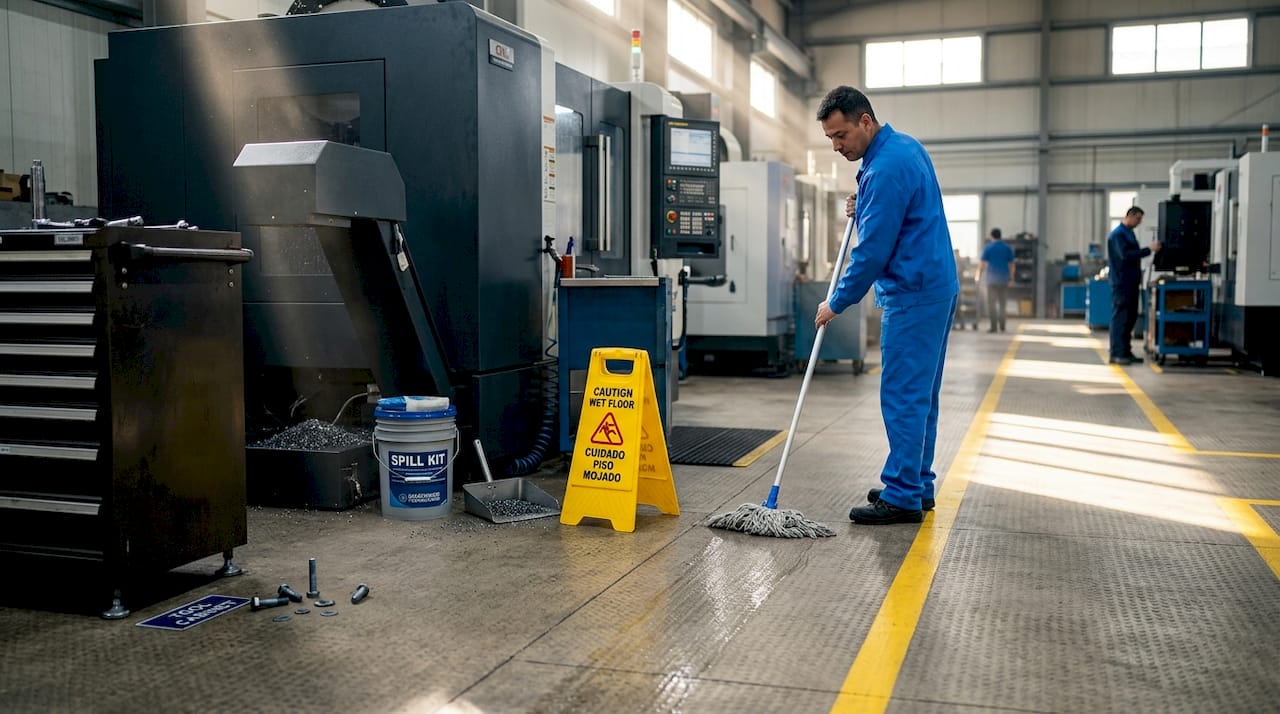
Maintaining clutter-free workspaces, clearing chips and coolant regularly, keeping floors dry, and anchoring fixed machinery are foundational workspace controls that prevent slips, trips, and falls. In facilities running coolant-intensive operations on aluminum or stainless steel, chips accumulate faster than operators typically expect, and coolant mist settles on floors several feet from the machine envelope.
Key workspace controls every manager should enforce include:
- Scheduled chip removal intervals, not just end-of-shift cleanups
- Marked walking zones with visual floor tape maintained in good condition
- Drip pans and coolant containment trays at every coolant-intensive station
- Non-slip mats at operator standing positions, inspected weekly for degradation
- Overhead lighting above walking zones inspected monthly for outages
The following table summarizes the most common slip and trip causes in machining environments alongside practical prevention strategies:
| Hazard source | Common cause | Prevention strategy |
|---|---|---|
| Coolant on floor | Overflow, mist settling | Drip trays, scheduled floor wiping, anti-slip mats |
| Metal chips | Accumulation near machines | Interval chip removal, chip conveyors where feasible |
| Cables and hoses | Poor routing across walkways | Overhead routing or cable management tracks |
| Tooling left on floor | Disorganized storage habits | Designated tool carts and shadow boards |
| Poor lighting | Burned bulbs, fixture obstructions | Monthly lighting audits, LED upgrade for even coverage |
Facilities that handle abrasive or particulate materials alongside machining should also consider external dust and separator systems to capture airborne debris. Insights on maintaining clean work environments in heavy-grit settings are well-documented in sandblast room housekeeping practices, and many of the principles transfer directly to machining floors with grinding or deburring stations.
Precision processes: Cutting parameters and pre-operation inspections
Safe workspaces set the stage. Now consider how systematic pre-operation checks and auditable parameter control prevent incidents before the spindle turns.
Pre-operational inspections must confirm guards are secured, emergency stops are functional, workholding is correctly clamped, cables are undamaged, and the machine envelope is clear of debris before any cycle begins. Skipping this step to save two minutes at the start of a run is one of the most common routes to tool breakage, ejected workpieces, and operator injuries. Improper cutting parameters, including spindle speed and feed rate mismatches for a given material and tool, can cause catastrophic tool failure and send fragments across a wide zone.
| Setup method | Primary risk | Control measure |
|---|---|---|
| Manual parameter entry | Keying errors, outdated revision | Dual-check against signed parameter sheet |
| Automated parameter transfer | Software sync errors, revision mismatch | Revision-controlled upload with log confirmation |
| Copy from prior job | Carry-over errors from different material | Force fresh parameter review for every new job |
| Operator judgment adjustment | Undocumented changes, no audit trail | Require supervisor sign-off for any field change |
Advanced operations increasingly use nano-minimum quantity lubrication (nano-MQL) as both a process improvement and a risk reduction tool. By reducing heat generation at the cutting zone, nano-MQL lowers the probability of thermal tool failure and reduces airborne mist, directly improving both part quality and operator exposure. Facilities optimizing for safety and throughput simultaneously should explore aerospace machining workflow optimization and precision machining best practices for more on integrating these methods. Teams working in regulated environments may also find relevant parallels in defense industry machining insights.
Pro Tip: Always audit parameter sheets after setup is complete, not just before the first run. Operators sometimes make mid-setup adjustments that are not captured in the pre-run review. Post-setup verification catches those changes before they become incidents.
Integrated risk management: The hierarchy of controls in practice
Inspection and setup controls are part of a larger strategy, which is a layered risk management framework that ensures no single failure point leads to an injury.
The hierarchy of controls places engineering controls (guards, interlocks, machine enclosures) at the top, followed by administrative controls (procedures, training, schedules), with PPE as the last line of defense. This ordering is not a suggestion. It reflects the statistical reality that relying on human behavior for safety fails more often than engineered barriers do.
Here is a practical risk assessment and mitigation cycle for a machining operation:
- Identify every hazard present at the machine: pinch points, projectile paths, electrical exposure, noise levels, chemical exposure from coolants
- Estimate the severity and probability of each hazard without any controls in place
- Apply engineering controls first: guards, two-hand controls, interlocks, enclosures
- Document residual risk after engineering controls and determine whether administrative controls are needed
- Specify PPE requirements for tasks where residual risk remains after engineering and admin controls
- Verify controls are in place and functional before authorizing production
- Review the assessment whenever a machine is modified, relocated, or used for a new material or process
Understanding the full value of this approach connects directly to industrial component machining methods, where engineered process controls are not just safety measures but quality assurance mechanisms.
Pro Tip: Involve your shop-floor operators in every control review. They know which guards are awkward to reinstall after maintenance, which procedures nobody follows because they add time without reducing real risk, and where the actual hazard points are. Top-down safety programs that ignore operator input leave real gaps on the floor.
Audits and continuous improvement: Ensuring compliance and addressing violations
Effective protocols depend on regular review and rapid corrective action, not just initial implementation. Audits are where paper compliance meets operational reality.
Common violations include missing guards, bypassed interlocks, and inadequate lockout/tagout (LOTO) procedures. Proactive audits and consistent training prevent both OSHA fines and the injuries those violations make more likely. Facilities that wait for an OSHA inspection to find these issues pay far more in citations, production disruption, and reputational damage than they would have paid to find and correct them internally.
Common audit findings that safety managers should prioritize correcting include:
- LOTO procedures missing for specific machines or outdated for current machine configurations
- Guards present but not secured, making them decorative rather than functional
- Training records incomplete or showing gaps in annual refresher documentation
- Emergency stop testing not documented as part of pre-shift or pre-run checks
- Near-miss reports not being collected or reviewed, eliminating a primary source of proactive hazard data
“An unguarded machine that has not injured anyone yet is not a safe machine. It is a machine that has not had the right conditions for an injury yet. The risk is present whether or not an incident has occurred.”
Scheduling walkthroughs on a regular cadence, with written findings and assigned corrective actions with deadlines, transforms audits from compliance theater into genuine risk reduction. Tying audit findings to machined part quality verification processes also reinforces that safety and quality are not competing priorities but mutually reinforcing ones.
Our take: Safety that transcends checklists and compliance
We have been running precision machining operations since 1985, and here is the uncomfortable truth that most safety training programs avoid: facilities that treat safety primarily as a compliance exercise perform worse on both safety metrics and production metrics than those that treat it as an operational discipline.
Focusing only on avoiding OSHA fines means your safety program is always reactive. You are building the minimum viable barrier between your operators and a recordable incident. That is not a program; it is a liability management strategy. Real safety leadership in aerospace, defense, and high-volume industrial machining means engineering risk out of processes before operators ever touch the machine.
The contrast between OSHA’s prescriptive rules and AS9100’s risk-based logic is not a conflict. It is an opportunity. Use OSHA requirements to define your non-negotiable floor and use AS9100-style risk assessment to identify where your actual exposure exceeds what regulations require you to address. That gap, the space between regulatory minimum and actual risk, is where serious incidents happen.
Consider nano-MQL lubrication as an example of what safety innovation looks like when it is also an operational improvement. Reducing heat at the tool-workpiece interface does not just lower the probability of thermal tool failure. It extends tool life, improves surface finish, and reduces coolant mist exposure for operators. Safety and throughput reinforce each other when you approach the problem from an engineering standpoint rather than a compliance standpoint. Teams exploring this integration should look at 2026 machining efficiency trends for a broader view of where innovation and safety are converging.
The facilities with the best safety records we have seen are not the ones with the thickest policy binders. They are the ones where operators understand why each control exists, where near-misses are treated as valuable data rather than embarrassments, and where engineers, supervisors, and floor workers review hazards together.
Next steps: Partnering for safer, more efficient machining
At Machining Technologies LLC, our 70,000 square foot Webster, Massachusetts facility is built around precision, compliance, and throughput that does not trade one for the other. Every process we run, from Hydromat rotary transfer machining to CNC milling, turning, and wire EDM, integrates engineering controls, documented inspection protocols, and operator training as standard operating procedure, not add-ons.
Safety managers and compliance officers who partner with a contract manufacturer operating at this standard gain more than capacity. They gain a production partner whose quality and safety processes are already structured to support aerospace and defense compliance requirements. Explore the benefits of contract machining for your OEM operations, and see how our wire EDM capabilities deliver precision in the most demanding material and tolerance environments. Let us help you align operational excellence with a safety record you are confident putting in front of any customer or auditor.
Frequently asked questions
What are the most common OSHA violations in industrial machining?
Missing guards, bypassed interlocks, and inadequate LOTO procedures are the most frequently cited OSHA machining violations, all of which proactive audits and consistent training directly address.
How often should machine operators receive safety training?
Operator training and certification should include initial onboarding, annual refresher certification, and regular shift-start safety briefings, especially when new materials or processes are introduced.
Which PPE is essential for CNC machining environments?
PPE for CNC machining must include safety glasses or goggles, hearing protection, gloves, and steel-toed boots as the minimum baseline to guard against debris, noise, coolant, and slip hazards.
How can workspace housekeeping reduce slip and trip incidents?
Regular removal of chips and coolant, maintaining dry and clearly marked walking zones, and anchoring fixed equipment significantly reduces the probability of floor-level incidents in active machining environments.
What is the hierarchy of controls for machining safety?
The hierarchy of controls places engineering solutions like guards and interlocks first, followed by administrative controls such as procedures and training, with PPE serving as the last layer of risk mitigation rather than the primary defense.
Recommended
- Optimize high-volume machining workflow: aerospace precision | Machining Technologies
- Industrial component machining: methods, precision, value | Machining Technologies
- Aerospace machining best practices for precision | Machining Technologies
- Machining in defense industry: precision and innovation | Machining Technologies