


TL;DR:
- Machining cost estimation involves calculating material, setup, tooling, inspection, and machining time to determine accurate part prices.
- Proper separation of fixed and variable costs, along with detailed review of GD&T and batch size effects, prevents margin loss and underpricing errors.
Machining cost estimation is the structured calculation of material, machining time, setup labor, tooling, and inspection costs to predict an accurate part price before production begins. Engineers, manufacturers, and procurement professionals who skip this discipline routinely underprice complex parts or lose margin on tight-tolerance work. The standard industry term is part cost modeling, though “machining cost estimation” describes the same practice across most U.S. job shops. Tools like CNC machining cost calculators help apply this formula consistently, but the underlying logic must be understood before any calculator produces reliable numbers.
What are the key cost components in machining?
Machining cost estimation uses five line-item components: material cost, machining cycle time, setup amortization, tooling amortization, and margin. Each component feeds a single formula:
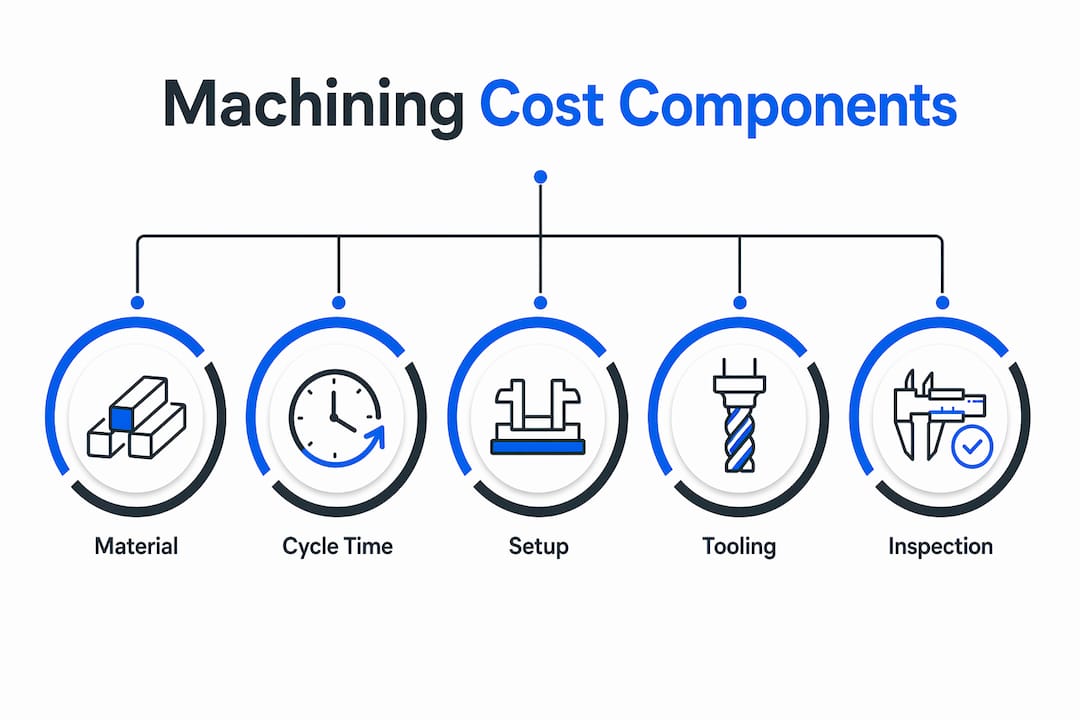
Part Price = ((Material × Weight) + (Cycle × Rate) + (Setup × Rate ÷ Qty) + (Tooling ÷ Qty)) × (1 + Margin)
This formula separates fixed costs from variable costs. That separation is what makes it reliable across different order quantities.
Material cost
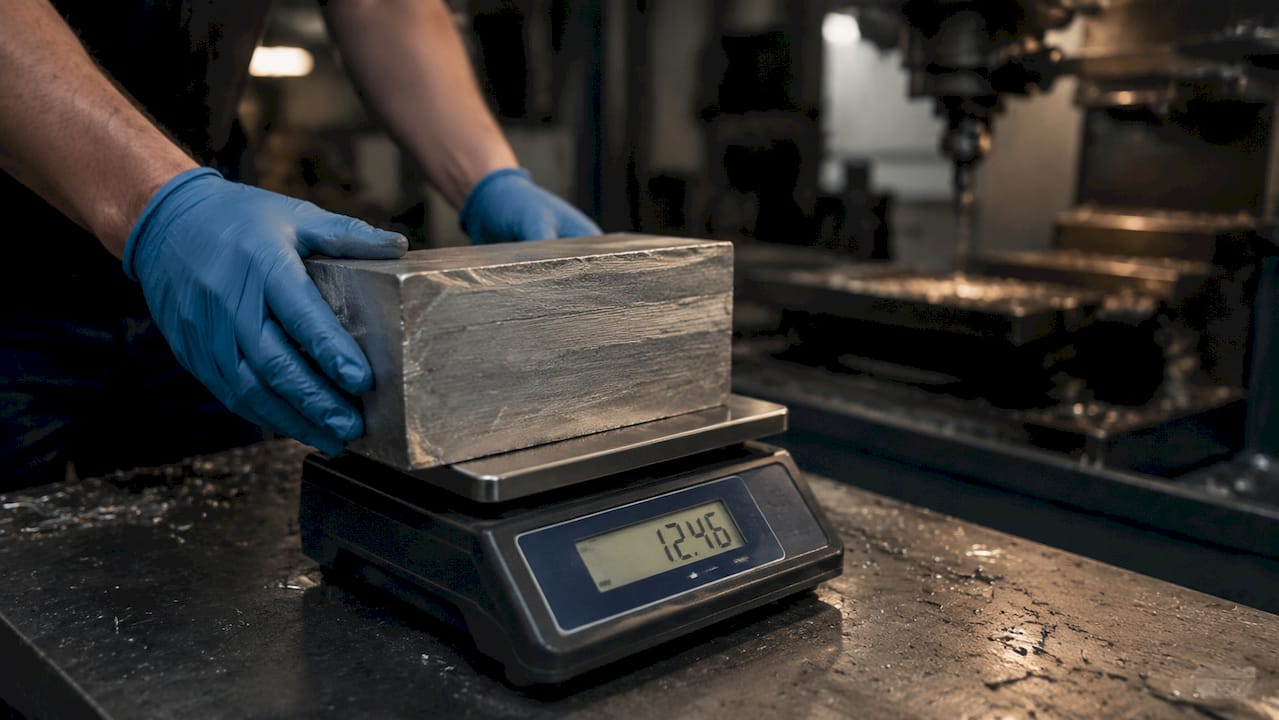
Material cost starts with stock weight, not finished part weight. A 6061 aluminum billet weighing 2.5 lbs may yield a finished part of 0.8 lbs. The difference is chips and waste. Estimators must price the full stock weight and account for material removal rate in the cycle time calculation.
Machining cycle time and hourly rates
Machining time accounts for 40–60% of total cost in most CNC jobs. That single line item dominates the estimate. Typical U.S. shop rates break down as follows:
| Process | Typical Hourly Rate |
|---|---|
| 3-axis CNC milling | $85/hr |
| 5-axis CNC milling | $135/hr |
| CNC turning | $75/hr |
These rates reflect machine depreciation, overhead, and operator labor. A 5-axis job costs more per hour because the machine is more expensive and the programming is more complex.
Tooling and margin
Tooling costs cover end mills, inserts, drills, and specialty cutters consumed during the job. These are fixed costs per batch, so they get divided by quantity just like setup. Margins in U.S. job shops typically run 25–45%, applied as a multiplier at the end of the formula.
Pro Tip: Break out tooling costs per operation, not per job. A job with five operations may burn through three different insert grades. Lumping tooling together hides cost overruns until the invoice arrives.
How do tolerances and GD&T influence machining and inspection costs?
Geometric dimensioning and tolerancing (GD&T) callouts are manufacturing instructions, not quality labels. Every callout on a drawing dictates a specific process, piece of equipment, and inspection method. Estimators who treat GD&T as annotation rather than process requirements consistently underestimate both machining and inspection costs.
Tightening tolerances from ±0.05 mm to ±0.01 mm can double or triple part cost. That cost increase comes from slower feeds and speeds, additional finishing passes, and dedicated inspection time. The machining impact and the inspection impact must be budgeted separately.
Inspection costs tied to GD&T
CMM (coordinate measuring machine) inspection time adds up fast on complex parts. Specific time costs include:
- Flatness measurement: 5–8 minutes of CMM time per surface
- Position per hole: 5 minutes plus 10 minutes for datum setup
- Profile of a surface: approximately 20 minutes of CMM time per surface
- Aerospace bracket with 18 GD&T callouts: 3–4 hours of CMM inspection costing $225–$300
A bracket with 18 callouts is not unusual in aerospace or defense work. That inspection bill alone can erase margin on a small batch if it was not priced into the quote.
Machining process impacts
Tight true position tolerances often require surface grinding or lapping after the primary milling operation. These are separate setups with separate machine rates. A flatness callout of 0.002 inches may require a dedicated surface grinder pass at a different hourly rate than the machining center. Estimators must budget inspection needs and machining impacts as two distinct line items for every GD&T callout on the drawing.
Pro Tip: Build a dual-budget habit. For each GD&T callout, write down the machining time impact in one column and the inspection time impact in a second column. This cost map approach prevents late-stage quoting surprises that kill margin.
Why does setup amortization affect per-part cost so much?
Setup is a fixed cost charged once per batch. It covers tooling changes, fixture installation, workholding setup, and program verification. Setup time typically runs 15–45 minutes of skilled labor, but complex parts with multiple operations can push setup well beyond that range.
The math is straightforward and the impact is significant:
- A 1.5-hour setup at $85/hr costs $127.50 total.
- At a quantity of 10 parts, that setup adds $12.75 per part.
- At a quantity of 100 parts, the same setup adds $1.27 per part.
- At a quantity of 1,000 parts, setup cost per part drops to $0.13.
Setup count and time are major drivers of cost, especially in prototype or low-volume work. A part requiring three setups at a quantity of 10 carries nearly $38 in setup cost per piece before a single chip is cut. That same part at 500 pieces carries less than $0.77 per piece in setup cost.
Batch size and pricing strategy
Prototype pricing and production pricing are structurally different because of setup amortization. A prototype quote at quantity 1 must absorb 100% of setup and tooling costs. A production run at quantity 500 spreads those fixed costs thin. Procurement professionals who compare prototype unit prices to production unit prices without understanding this math will always find the numbers confusing.
Batch size affects setup amortization by up to 70% per part in high-setup operations. That is not a small rounding error. It is the difference between a profitable job and a loss.
Pro Tip: Reduce setup time with precision tooling vises and electronic edge finders. Cutting a 90-minute setup to 45 minutes on a 10-piece run saves $63.75 in fixed cost. That saving goes directly to margin or competitive pricing.
What are best practices for reading drawings to estimate machining costs?
Accurate cost estimation starts with the drawing. Every error in drawing interpretation translates directly into a quoting error. The most common mistakes are avoidable with a disciplined review process.
The core rules for drawing review are:
- Use the current revision. An outdated drawing may be missing tolerance updates, added features, or revised GD&T callouts. Always confirm the revision level with engineering before quoting.
- Read tolerances as process requirements. A ±0.001-inch tolerance is not a note. It specifies a grinding or lapping operation and a CMM inspection step. Price both.
- Map every GD&T callout to a machining step and an inspection step. This cost map approach links each callout to a time estimate for both operations.
- Check the BOM for material specifications. Material grade, heat treat condition, and surface finish requirements all affect cost. A 17-4 PH stainless part costs more to machine than a 304 stainless part of the same geometry.
- Cross-check with procurement and engineering. Functional requirements sometimes exist outside the drawing. A part used in a safety-critical assembly may require additional inspection documentation not called out on the print.
Misreading GD&T as a quality annotation rather than a manufacturing requirement causes estimators to miss required equipment, inspection steps, and tooling needs. The cycle time calculation may be accurate, but the quote is still wrong because entire operations were omitted. That error creates margin loss even when the shop runs the job efficiently.
Procurement teams often receive quotes that look competitive but carry hidden risk. A quote that omits CMM inspection time on an aerospace bracket with 18 callouts is not a good deal. It is a future cost overrun. Cross-checking quotes against drawing requirements is a procurement skill that directly protects project budgets. Machiningtechllc recommends that procurement professionals review precision parts manufacturing quality standards before finalizing supplier selection on tight-tolerance work.
Key Takeaways
Accurate machining cost estimation requires separating fixed costs from variable costs, budgeting GD&T callouts as dual machining and inspection line items, and adjusting per-part pricing based on batch size and setup amortization.
| Point | Details |
|---|---|
| Use the five-component formula | Price every part using material, cycle time, setup, tooling, and margin as separate line items. |
| Budget GD&T as dual costs | Every tolerance callout adds both machining time and inspection time; price both separately. |
| Setup amortization drives unit price | A $127.50 setup costs $12.75/part at qty 10 but only $1.27/part at qty 100. |
| Machining time dominates cost | Machining time accounts for 40–60% of total part cost, making cycle time accuracy critical. |
| Drawing review prevents margin loss | Misreading GD&T or using outdated revisions causes omitted operations and lost margin. |
What I’ve learned about where machining estimates actually break down
After working closely with shops and procurement teams on complex machined parts, the pattern is consistent. Estimating errors almost never come from the cycle time calculation. They come from what gets left out entirely.
The two most common omissions are inspection costs and secondary operations triggered by GD&T. An estimator can calculate milling time to the minute and still produce a losing quote because they treated a flatness callout as a note instead of a surface grinding requirement. That is not a math error. It is a process knowledge gap.
The fix is not a better calculator. It is a better review habit. Separating fixed and variable costs in the model forces the estimator to think about each cost driver individually. When setup, tooling, and inspection each have their own line, nothing hides inside a lump sum.
Procurement professionals who understand this structure become better buyers. They can evaluate whether a low quote is genuinely efficient or simply incomplete. That skill protects project budgets more reliably than any negotiation tactic.
The collaboration between designers, estimators, and machinists also matters more than most teams realize. A designer who understands machining cycle times can make tolerance decisions that reduce cost without compromising function. That conversation, held early, is worth more than any post-quote revision.
— Andrew
Machiningtechllc: precision machining with transparent cost structures
Machiningtechllc has delivered contract machining services from its 70,000-square-foot Webster, Massachusetts facility since 1985, producing over 20 million parts annually for aerospace, defense, and industrial OEMs.
For procurement professionals and engineers who need accurate quotes on complex, tight-tolerance parts, Machiningtechllc brings the process knowledge to price every operation correctly the first time. The team handles CNC milling and turning across a wide range of materials and tolerances, with full CMM inspection capability in-house. OEMs looking to reduce quoting risk and production lead times can learn more about contract machining benefits and what a structured cost estimation process looks like in practice.
FAQ
What is machining cost estimation?
Machining cost estimation is the calculation of material, cycle time, setup, tooling, and inspection costs to determine an accurate part price before production. The standard formula separates fixed costs from variable costs to produce reliable pricing across different order quantities.
How does batch size affect machining cost per part?
Batch size directly affects how fixed setup and tooling costs are spread across parts. A $127.50 setup cost adds $12.75 per part at a quantity of 10 but only $1.27 per part at a quantity of 100.
Why do tight tolerances increase machining costs so much?
Tight tolerances require slower machining speeds, additional finishing operations like surface grinding, and dedicated CMM inspection time. Tightening tolerances from ±0.05 mm to ±0.01 mm can double or triple total part cost.
What is the biggest mistake in machining cost estimation?
The most common error is treating GD&T callouts as quality annotations rather than manufacturing process requirements. This causes estimators to omit required operations and inspection steps, producing quotes that lose margin even when cycle time is calculated correctly.
How much does CMM inspection add to part cost?
CMM inspection time varies by feature count and complexity. An aerospace bracket with 18 GD&T callouts can require 3–4 hours of CMM time, adding $225–$300 to the part cost before any machining margin is applied.
Recommended
- Optimize high-volume machining workflow: aerospace precision | Machining Technologies
- Aerospace machining: precision processes and standards | Machining Technologies
- Machining cycle times: Optimize for precision and efficiency | Machining Technologies
- Custom vs standard machining: choosing the right fit | Machining Technologies