

TL;DR:
- Automation significantly reduces labor costs by 35 to 55 percent and cuts cycle times by over 50 percent.
- Automated systems deliver high precision, enabling zero-defect production with in-process measurement and traceability.
- Proper automation manages energy use efficiently and enhances overall equipment effectiveness, yet requires continuous process oversight.
Procurement managers at aerospace, defense, and industrial firms face a relentless squeeze: customers demand higher volumes, tighter tolerances, and faster delivery, all while cost pressure never lets up. Automation reduces labor costs by 35 to 55% and trims cycle times by 40%, making it the most powerful lever available for contract buyers who need to scale without sacrificing quality. This article maps the top evidence-backed benefits of automated manufacturing and flags the critical cautions every sourcing decision should address.
Table of Contents
- Automation’s impact on productivity and cost savings
- Precision and repeatability: Unlocking zero-defect manufacturing
- Efficiency and sustainability: Lower errors, smarter energy use
- Throughput and effectiveness: Maximizing OEE in automated environments
- Summary comparison: Major benefits and potential risks
- A procurement manager’s lens: What the numbers don’t tell you
- Elevate your manufacturing: Next steps for procurement teams
- Frequently asked questions
Key Takeaways
| Point | Details |
|---|---|
| Dramatic cost reduction | Automated manufacturing can cut labor costs by 35-55% and reduce cycle times up to 51.5%. |
| Zero-defect precision | In-process probing and automation produce parts with near-zero defects at tight tolerances. |
| Energy and error savings | Integrated automation reduces energy wastage and process errors, improving sustainability. |
| Reliable OEE benchmarks | Automated lines deliver consistent OEE of 50-70%, with world-class at 75% or higher. |
| Risks require oversight | Without predictive monitoring and SLAs, automation can lead to tool failures and downtime. |
Automation’s impact on productivity and cost savings
The productivity case for automation is no longer theoretical. Real-world data from aerospace and industrial machining environments shows consistent, measurable gains that directly affect your cost per part and your ability to meet contract volumes.
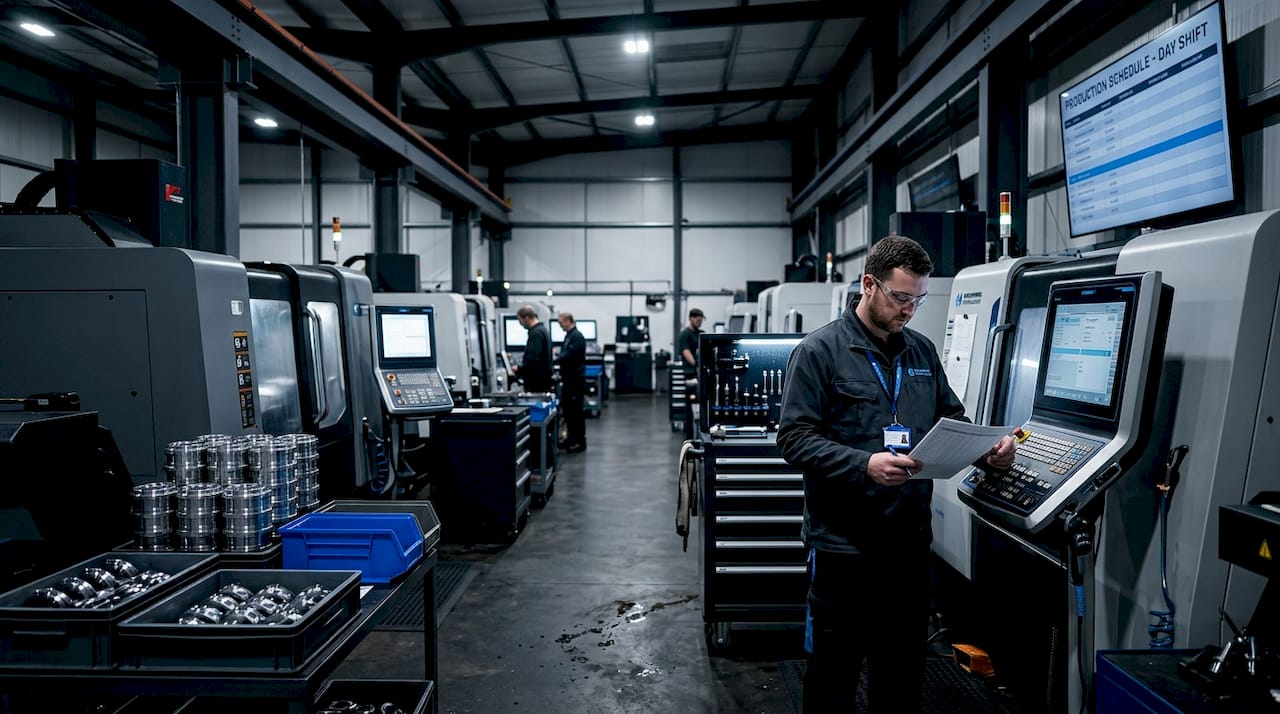
Labor cost savings of 35 to 55% are documented across aerospace machining operations, and those savings compound when you factor in reduced rework, lower scrap rates, and fewer quality escapes. Cycle time reductions are equally significant. A case study from Saratech shows that multi-axis automation cut cycle time from 33 minutes to 17 minutes per part, a 51.5% improvement, while simultaneously increasing equipment uptime by 30%. That kind of performance shift changes the economics of a production contract entirely.
Understanding why automate machining processes matters at the sourcing stage, not just the engineering stage. Procurement teams who build automation requirements into RFQs from the start lock in better pricing and more predictable delivery windows.
| Metric | Manual operation | Automated operation | Improvement |
|---|---|---|---|
| Labor cost per part | Baseline | 35 to 55% lower | Significant |
| Cycle time (example) | 33 minutes | 17 minutes | 51.5% reduction |
| Equipment uptime | Baseline | 30% higher | Substantial |
| Throughput scalability | Limited by headcount | Scales with machine capacity | High |
Key productivity benefits procurement teams should verify with any supplier:
- Labor cost reduction: Documented savings of 35 to 55% in comparable environments
- Cycle time compression: Multi-axis cells routinely cut part cycle times by more than half
- Uptime improvement: Automated scheduling and predictive alerts reduce unplanned downtime by 30% or more
- Volume scalability: Automated lines can ramp output without proportional headcount increases, critical for aerospace and defense contracts with surge requirements
“The shift to automated multi-axis machining is not just about cutting labor. It restructures the entire cost model, from tooling amortization to floor space utilization.”
The key benefits of automated machining for OEMs extend beyond the obvious labor line. When a supplier runs lights-out or near-lights-out shifts, your parts keep moving through the cell while their competitors’ floors sit idle. That translates directly to shorter lead times and more reliable on-time delivery for your programs.
Pro Tip: When evaluating suppliers, ask specifically about their multi-axis automation configuration and CNC program optimization practices. A facility running five-axis cells with optimized toolpaths will consistently outperform a shop that simply added a robot to a conventional three-axis setup. The automated manufacturing advantages are real, but they depend heavily on how well the automation is programmed and maintained.
Precision and repeatability: Unlocking zero-defect manufacturing
Cost savings matter, but for aerospace and defense buyers, precision is non-negotiable. Automated systems deliver repeatability that manual setups simply cannot match at high volumes, and the data backs this up at the sub-micron level.
Machine tool probing integrated into flexible manufacturing systems (FMS) has been shown to boost FMS productivity by 60% while achieving zero-defect production runs. Automated part alignment in these cells reaches tolerances of 1 micrometer, a level of precision that manual inspection cannot consistently verify at production speeds.
The financial case for precision automation is equally compelling. Process-controlled hard turning cells equipped with in-process gauging have achieved ROI in as little as 18 days, producing 600 to 700 parts per day at tolerances of ±0.001 inches. For a procurement manager evaluating capital-intensive contract suppliers, that kind of payback speed signals a well-run, financially healthy operation.
| Quality metric | Manual QC | Automated QC |
|---|---|---|
| Defect detection speed | Post-process, delayed | In-process, real time |
| Tolerance capability | Operator dependent | Sub-micron, consistent |
| Throughput impact | Inspection slows line | Integrated, no slowdown |
| Compliance documentation | Manual records | Automated traceability |
| Scrap rate | Higher variability | Dramatically reduced |
When verifying machined part quality for aerospace programs, the difference between manual and automated inspection is not just speed. It is the elimination of operator fatigue, measurement drift, and documentation gaps that create compliance risk. Automated systems generate traceable records automatically, which matters enormously for AS9100 and ITAR-controlled programs.
The automated material handling advantages extend into precision parts manufacturing as well. When parts move through a cell without manual handling between operations, you eliminate a major source of surface damage, contamination, and measurement error.
Pro Tip: When writing SLAs or supplier qualification criteria, specify that in-process gauging and laser verification must be standard on any automated cell producing your critical components. Do not accept post-process inspection alone as a substitute. The value of automation in quality control comes from catching deviations before they become scrap, not after.
Efficiency and sustainability: Lower errors, smarter energy use
Precision and cost savings are the headline benefits, but automated manufacturing also delivers measurable gains in energy efficiency and process sustainability. These factors are increasingly important to procurement teams managing ESG commitments and long-term supply chain risk.
Research on CNC milling operations shows that automation-supported energy measurement reduces spindle power error from 34.17% to just 2.7%. That is not a minor calibration improvement. It means the machine is operating with dramatically better control over its own energy consumption, which translates to lower utility costs, more consistent tool life, and reduced thermal variation in the part.
Real-time parameter optimization is a direct result of this measurement accuracy. When a CNC cell knows exactly how much power the spindle is drawing, it can adjust feeds, speeds, and coolant flow dynamically. The result is a process that wastes less energy, generates less heat, and produces more consistent parts across long production runs.
| Parameter | Before automation | After automation | Change |
|---|---|---|---|
| Spindle power error | 34.17% | 2.7% | 92% reduction |
| Energy waste per cycle | High variability | Tightly controlled | Significant reduction |
| Thermal drift impact | Measurable | Minimized | Improved part consistency |
| Coolant usage | Fixed rate | Dynamically optimized | Reduced consumption |
Sustainability is becoming a procurement priority, not just a marketing talking point. Buyers at major aerospace OEMs and defense primes are now including energy efficiency metrics in supplier scorecards. A contract machining partner that can demonstrate lower energy consumption per part produced is a better long-term bet than one that cannot measure or manage its own process energy.
The advanced machining equipment ROI case includes these sustainability gains. Lower energy costs improve the supplier’s margin, which protects pricing stability over multi-year contracts. Smarter coolant and lubricant use reduces hazardous waste disposal costs. These are real financial benefits that show up in your total cost of ownership analysis.
The automation for efficiency and control extends beyond the machine tool itself. Automated material handling, scheduling, and monitoring systems create a connected production environment where inefficiencies are visible and correctable in real time.
Pro Tip: Ask suppliers for energy consumption data per part produced, not just total facility energy use. A supplier who can provide this metric has the monitoring infrastructure in place to manage sustainable production. One who cannot is likely operating without the real-time visibility needed to control process variability.
Throughput and effectiveness: Maximizing OEE in automated environments
Overall equipment effectiveness, or OEE, is the standard metric for measuring how well an automated line performs. Understanding OEE benchmarks helps procurement teams set realistic expectations and ask the right questions during supplier qualification.
OEE benchmarks for metal and CNC automation typically fall between 50 and 70% for average operations, with world-class automated facilities reaching 75 to 85%. If a supplier claims OEE above 85% without automated measurement systems in place, treat that number with skepticism. Manual OEE tracking is known to overstate actual performance by 8 to 12 percentage points because operators tend to record planned downtime differently than automated systems do.
Steps to improve OEE with advanced automation:
- Implement automated OEE measurement at the machine level, not the shift report level
- Reduce changeover time through standardized tooling, preset offsets, and automated part alignment
- Deploy predictive maintenance using spindle load monitoring and vibration analysis to prevent unplanned stops
- Optimize scheduling with production planning software that accounts for actual machine availability, not theoretical capacity
- Track micro-stoppages separately from major downtime events, since these are often the largest hidden OEE drain in high-volume cells
“An OEE of 65% measured automatically is more valuable than a claimed 80% measured manually. The first number tells you where you actually stand. The second tells you where someone wishes they stood.”
When evaluating suppliers for CNC automation aerospace advantages, ask directly how OEE is measured and what the trailing 90-day average looks like. A supplier confident in their numbers will share them. One who deflects or offers only anecdotal performance claims is telling you something important about their operational maturity.
Summary comparison: Major benefits and potential risks
Automation delivers clear advantages across cost, quality, throughput, and sustainability. But procurement teams who treat it as a guaranteed solution without managing the associated risks will encounter problems that erode those gains quickly.
| Factor | Benefit | Risk | Mitigation |
|---|---|---|---|
| Labor cost | 35 to 55% reduction | Skill gaps in programming | Require certified CNC programmers |
| Cycle time | Up to 51.5% faster | Setup time for changeovers | Standardized tooling and offsets |
| Quality | Zero-defect runs possible | Tool failure in unattended runs | Real-time monitoring and SLAs |
| Energy use | 92% reduction in power error | Sensor calibration drift | Scheduled calibration protocols |
| OEE | 75%+ at world-class sites | Manual tracking overstates by 8 to 12% | Require automated OEE systems |
The most significant hidden risk in automated machining is tool failure during unattended operation. Unattended automation inflates tool failures without telemetry, and setting SLAs for diagnostics under five minutes mitigates 41% of downtime risk. This is not a theoretical concern. It is a documented failure mode that affects otherwise well-run automated facilities.
Questions every procurement team should ask before awarding a contract to an automated machining supplier:
- What tool monitoring system is in place, and what is the diagnostic response time?
- Does the facility comply with ISO 13399 tool data standards?
- How is OEE measured, and what is the trailing average?
- What is the escalation protocol when an unattended cell stops unexpectedly?
- Can the supplier provide in-process quality records, not just final inspection reports?
Pro Tip: Always require real-time monitoring as a contractual requirement, not a nice-to-have. Specify ISO 13399 tool data compatibility in your supplier qualification checklist. Suppliers who already meet this standard are operating at a level of process maturity that protects your program from the most common automation failure modes.
A procurement manager’s lens: What the numbers don’t tell you
The statistics in this article are real, and they are compelling. But after decades of working with high-volume precision machining programs, we have learned that the numbers are only part of the story.
Process transparency matters more than any single performance metric. A supplier who shares OEE data, tool life records, and in-process gauging results is a supplier you can manage proactively. One who only provides finished part inspection reports is asking you to manage risk you cannot see. That asymmetry of information is where most supply chain problems originate.
Human oversight remains critical even in the most advanced automated environments. The growing role of automation in aerospace is clear, but hybrid human oversight is still needed for exceptions involving complex materials, unusual alloy behavior, and mid-run changeovers. No automated system handles every edge case perfectly. The question is whether your supplier has experienced machinists who can intervene quickly when the cell encounters something outside its programmed parameters.
Beware of inflated OEE claims from suppliers using manual tracking. We have seen facilities claim 80%+ OEE that, when measured automatically, came in at 65 to 68%. That gap matters enormously when you are planning production schedules for a defense program with fixed delivery milestones.
Automation is a lever, not a cure-all. The precision strategies for complex parts that actually work combine advanced equipment with rigorous process control and active vendor management. The best automated facilities we work with treat their automation as a system to be continuously improved, not a capital investment to be depreciated and forgotten. Procurement teams who build that expectation into their supplier relationships consistently get better outcomes than those who treat automation as a binary yes or no qualification criterion.
Elevate your manufacturing: Next steps for procurement teams
If the evidence in this article has you rethinking your current supplier mix or preparing for a new program award, the next step is straightforward: evaluate whether your contract machining partners have the automation infrastructure, process transparency, and quality systems to deliver on the promises automation makes.
At Machining Technologies LLC, we have operated automated, high-volume precision machining since 1985 from our 70,000 square foot facility in Webster, Massachusetts. We produce over 20 million parts annually for aerospace, defense, and industrial customers using Hydromat systems, multi-axis CNC, and wire EDM. The high-volume precision machining benefits we deliver are backed by real OEE data, in-process quality records, and on-time delivery performance our customers can verify. Explore our precision parts manufacturing quality capabilities or contact us to request a custom quote for your next contract.
Frequently asked questions
What is the typical return on investment timeline for automated machining cells?
ROI for automated turning cells can be as fast as 18 days when producing 600 to 700 parts per day at ±0.001 inch tolerance with in-process gauging. The payback speed depends heavily on part volume and the degree of process control built into the cell.
How does automation improve defect rates in precision machining?
Machine tool probing in FMS environments boosts productivity by 60% while achieving zero-defect production runs through real-time part alignment and in-process verification. Automated inspection eliminates the measurement drift and operator fatigue that drive defects in manual quality control.
What energy and sustainability gains are achievable through automation?
Automation-supported CNC energy measurement reduces spindle power error from 34.17% to 2.7%, enabling smarter real-time energy management and consistent process control across long production runs. These gains translate directly to lower utility costs and reduced thermal variation in finished parts.
Which OEE benchmarks should procurement teams use for automated metal processing?
OEE benchmarks for metal and CNC automated lines run 50 to 70% for average operations and 75 to 85% for world-class facilities. Require automated OEE measurement from any supplier, since manual tracking overstates actual performance by 8 to 12 percentage points.
How do I mitigate tool failure risks in unattended automated lines?
Require predictive monitoring with SLAs for diagnostics under five minutes and specify ISO 13399 tool data compatibility in your supplier qualification criteria. These requirements together address the 41% downtime risk associated with unmonitored unattended automation.
Recommended
- 5 key benefits of automated machining for OEMs in 2026 | Machining Technologies
- Why Automate Machining Processes: Boosting OEM Efficiency | Machining Technologies
- High-Volume Manufacturing Benefits for Precision Parts | Machining Technologies
- Precision Parts Manufacturing: Maximizing Quality and Throughput | Machining Technologies