

TL;DR:
- Post-processing in machining is essential to remove imperfections and ensure parts meet performance and regulatory standards. It provides consistent surface finish, dimensional accuracy, and fatigue resistance, especially in high-volume aerospace, defense, and firearms manufacturing. Proper integration and validation of finishing processes reduce costs, improve quality, and support audit readiness for critical applications.
Even the most advanced CNC equipment cannot guarantee a ready-to-use part straight off the machine. Machining can leave imperfections such as burrs, tool marks, and micro-scale surface defects that, if left unaddressed, create assembly failures, fatigue fractures, or outright regulatory non-compliance in aerospace, defense, and firearms applications. For OEMs running high-volume programs where a single non-conforming lot can trigger costly corrective action, post-processing is not optional. It is the controlled bridge between a machined blank and a finished component that performs as specified under real operating conditions.
Table of Contents
- Why post-processing is required in modern machining
- Common post-processing techniques and their impact
- Integrated finishing for high-volume and repeatability
- Validating and controlling post-processing quality
- The overlooked ROI of diligent post-processing
- Choosing the right partner for precision post-processing
- Frequently asked questions
Key Takeaways
| Point | Details |
|---|---|
| Crucial for quality | Post-processing eliminates defects and ensures machined parts meet strict aerospace or defense specifications. |
| Right technique matters | Each post-processing method uniquely affects surface quality and must be matched to your part’s requirements. |
| Integrate for scale | Automating post-processing improves consistency and throughput in high-volume operations. |
| Validate the outcomes | Rigorous measurement and control in post-processing prevent costly part failures and guarantee compliance. |
Why post-processing is required in modern machining
With context around machining output established, let’s clarify why the finishing steps make all the difference between a part that passes inspection and one that fails in the field.
Primary machining operations, whether CNC turning, milling, or multi-spindle work on a Hydromat system, are optimized for material removal rates and dimensional accuracy. That focus, while necessary, leaves behind a category of surface and edge conditions that directly threaten part performance:
- Burrs and sharp edges formed at hole exits, slot ends, and part intersections create assembly interference and can injure operators or damage mating surfaces.
- Tool marks and feed lines increase the actual surface roughness (Ra) value beyond what functional fits or sealing surfaces can tolerate.
- Residual stresses introduced during cutting can distort thin-walled components or initiate cracking under cyclic loading if not relieved through appropriate post-processing.
- Dimensional variation from thermal growth during long production runs may require final grinding or lapping to restore compliance with tight-tolerance callouts.
- Contamination and oxidation layers on titanium or stainless steel components can affect fatigue life and coating adhesion if not removed before surface treatment.
“Machining can leave imperfections such as burrs and tool marks; post-processing addresses these to improve surface finish and other functional requirements.”
In regulated industries, these are not theoretical risks. Aerospace suppliers operating under AS9100 and defense contractors holding ITAR-registered processes face mandatory documentation that proves each finishing step was performed and verified. Skipping or shortchanging post-processing is not a cost-saving move. It is a compliance exposure. Proper methods for verifying machined part quality begin long before final inspection. They start with a disciplined post-processing plan that is built into the manufacturing routing from day one.
When tolerances in aerospace machining run at plus or minus 0.0005 inches or tighter, any surface anomaly that alters the effective contact geometry becomes a functional defect. The part may measure in print on its primary diameter but fail in service because the seating surface was not finished to the correct roughness. That is the hidden risk that disciplined post-processing eliminates.
Common post-processing techniques and their impact
Once you know why post-processing is necessary, it is critical to understand what methods are available and how they differ in terms of application, cost, cycle time, and achievable surface quality.
The most widely used finishing methods in precision machining each serve a distinct purpose:
- Deburring is the baseline operation. Manual deburring uses hand tools or brushes to remove edge material. Automated deburring uses robotic cells or specialized machines for consistent results on complex geometries. It does not significantly alter dimensions but eliminates sharp-edge risks.
- Tumbling and vibratory finishing immerse parts in a media-filled bowl or trough that continuously contacts all surfaces. The process removes light burrs, improves Ra uniformly across complex shapes, and produces a consistent matte or satin appearance. It is well-suited to high-volume firearm components and small structural hardware.
- Precision grinding removes stock to a controlled depth, correcting dimensional variation and achieving very low Ra values on flat or cylindrical surfaces. It is the standard finishing method for bearing journals, seating surfaces, and components requiring flatness within microns.
- Polishing and lapping push Ra values to near-mirror levels, which is required for sealing faces, optical mounts, and fluid-handling components in aerospace systems.
- Abrasive blasting (shot, grit, or bead blasting) cleans surfaces, induces compressive stress on the part exterior through shot peening, or prepares the surface for coatings. Each variant produces a different roughness profile, so selection must match the downstream requirement.
- Electrolytic polishing uses an electrochemical process to selectively remove surface peaks, producing extremely low Ra values on stainless and titanium parts while simultaneously passivating the surface for corrosion resistance.
| Method | Typical Ra achievable | Best application | Production volume fit |
|---|---|---|---|
| Deburring | No change to Ra | Edge quality, safety | All volumes |
| Tumbling/vibratory | 0.4 to 1.6 µm | Bulk small parts, firearms hardware | High volume |
| Precision grinding | 0.1 to 0.8 µm | Journals, flat surfaces | Medium to high |
| Lapping/polishing | 0.01 to 0.2 µm | Sealing faces, optical surfaces | Low to medium |
| Shot/bead blasting | 0.8 to 3.2 µm | Coating prep, peening | All volumes |
| Electrolytic polishing | 0.05 to 0.4 µm | Stainless/titanium, corrosion-critical | Medium volume |
Surface-finish tuning is tightly tied to achieving Ra values compatible with demanding aerospace applications, and research on aerospace milling confirms that finishing strategy directly affects surface quality and cutting time. Choosing the wrong method for a given material or geometry is not a minor inefficiency. It can require rework or outright rejection of the lot.
Likewise, selection and process validation of finishing methods have measurable, empirically documented impacts on surface characteristics. This is why experienced contract manufacturers validate each finishing step with the same rigor they apply to primary machining operations.
Pro Tip: Always specify the final Ra requirement and the functional purpose of each surface in your drawing notes. A number alone is not enough. A gun barrel bore, a hydraulic valve bore, and an aerospace structural fastener hole may all call for the same Ra value but need entirely different finishing methods to get there reliably.
Understanding the right mix of aerospace machining processes alongside validated finishing sequences is what separates suppliers who can hold a spec from those who can only hope to. For complex part manufacturing where multiple surfaces carry different functional requirements, the post-processing routing must be as precisely engineered as the machining plan itself.
Integrated finishing for high-volume and repeatability
After grasping individual processes, let’s see how the best operations deliver consistency and scale across tens of thousands or millions of parts per program.
Running a few hundred prototype parts through manual post-processing is manageable. Running millions is not, unless the finishing steps are integrated into the production flow as controlled, repeatable operations. This is where the architecture of a high-volume machining facility matters enormously.
The most effective approaches to integrated finishing include:
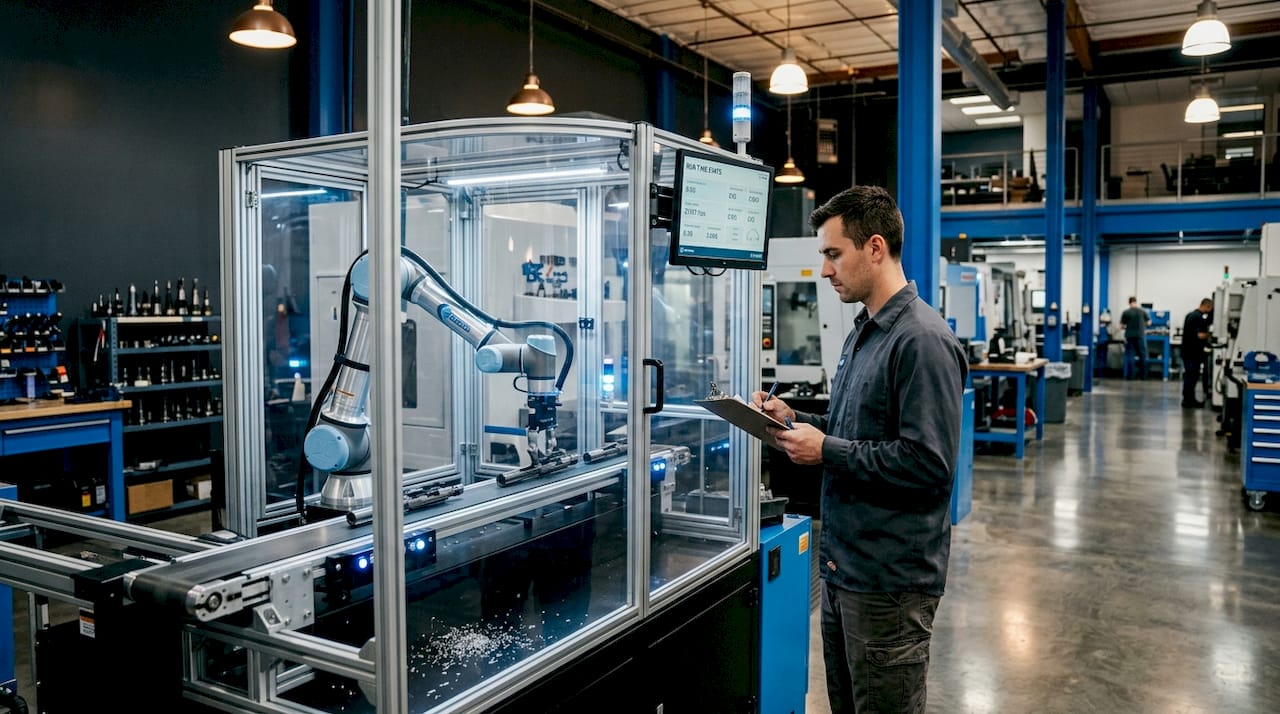
- Automated deburring cells placed in-line with CNC equipment, using robotic arms with compliant tooling that adapts to part geometry variation within the production lot.
- Continuous vibratory finishing systems fed directly from parts washers, eliminating manual handling and ensuring every part receives identical media contact time and pressure.
- Statistical process control (SPC) checkpoints at the entry and exit of finishing operations to detect shifts before they become lot-wide escapes.
- Dedicated part fixturing for grinding or lapping cells that reproduces part orientation to within a few microns, ensuring the same surfaces receive the same stock removal on every cycle.
| Production scenario | Manual finishing risk | Integrated finishing benefit |
|---|---|---|
| 50,000 firearm bolt carriers per quarter | Operator fatigue, inconsistent edge break | Uniform deburring, documented cycle time |
| 200,000 aerospace fasteners per year | Variable Ra, missed burrs on internal threads | Consistent Ra, automated inspection gate |
| 500,000 defense hardware components | Lot-to-lot variation, audit exposure | Repeatable results, SPC data trail |
A real example of this in practice is M16 bolt carrier deburring. Post-processing integration in high-volume flows, using automated finishing cells and tumbling or vibratory systems, reduces labor and maintains consistent results across large lots. A single Hydromat-style multi-station system that machines the part can be paired with an in-line vibratory bowl that processes every part in controlled batches, then routes to automated inspection before final packaging.
For OEMs evaluating suppliers, the questions to ask are specific. Does the supplier have documented cycle times for each post-processing step? Can they show SPC data from finishing operations across multiple production lots? Is finishing performed in house, or subcontracted to a third party with an uncontrolled quality handoff?
Pro Tip: Request a process flow diagram from your machining supplier that includes every post-processing step, not just primary operations. If finishing is subcontracted, ask for evidence of approved supplier status and inspection records from those vendors. Gaps in this documentation are almost always where non-conformances originate.
Knowing how a supplier structures their high-volume machining workflow tells you more about their real capability than their equipment list does. Similarly, reviewing high-volume manufacturing strategies across sectors shows that the most reliable operations treat finishing as a first-class production step, not an afterthought.
Validating and controlling post-processing quality
Understanding how results are monitored will help you trust that each part truly meets its critical specs before it leaves the facility.
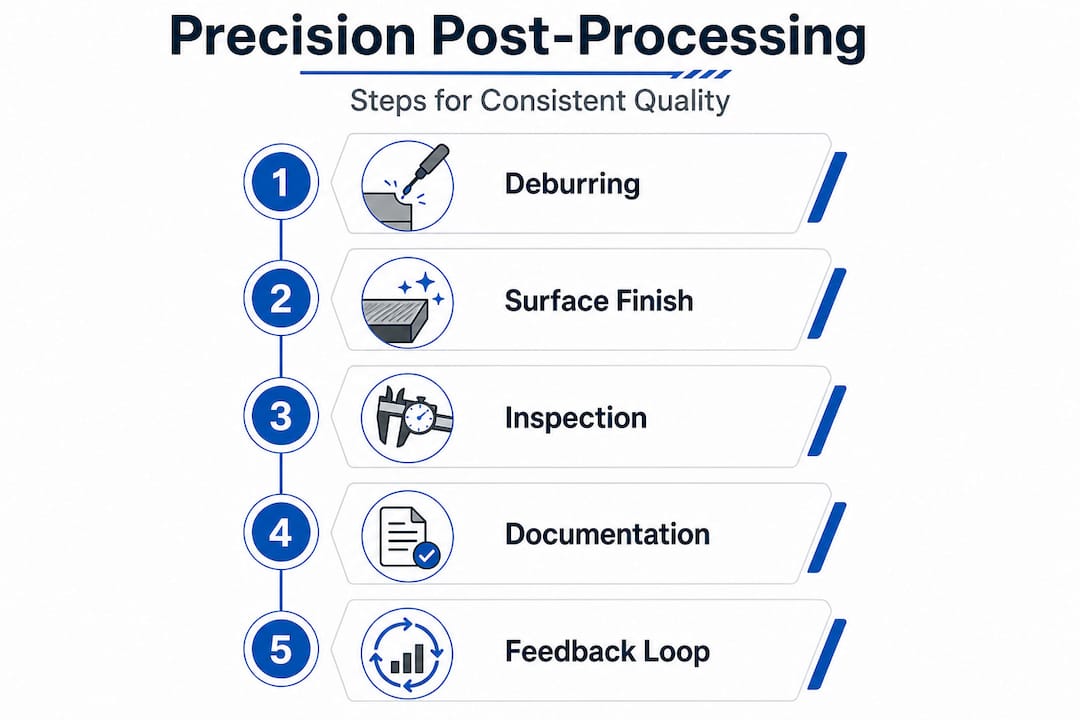
Post-processing quality control is not a final check at shipping. It is a structured system of measurement, feedback, and corrective action that runs parallel to production. For aerospace and defense customers, this is a contractual expectation, not a courtesy.
The key metrics that must be measured and documented include:
- Surface roughness (Ra and Rz): Measured with profilometers or optical surface measurement systems at defined locations on each part or on a statistically sampled basis. Ra tells you average roughness. Rz captures peak-to-valley height, which is more sensitive to isolated surface defects.
- Dimensional accuracy post-finishing: Grinding, lapping, and even aggressive blasting can alter part dimensions. CMM (coordinate measuring machine) verification confirms that stock removal during finishing has not moved critical features outside tolerance.
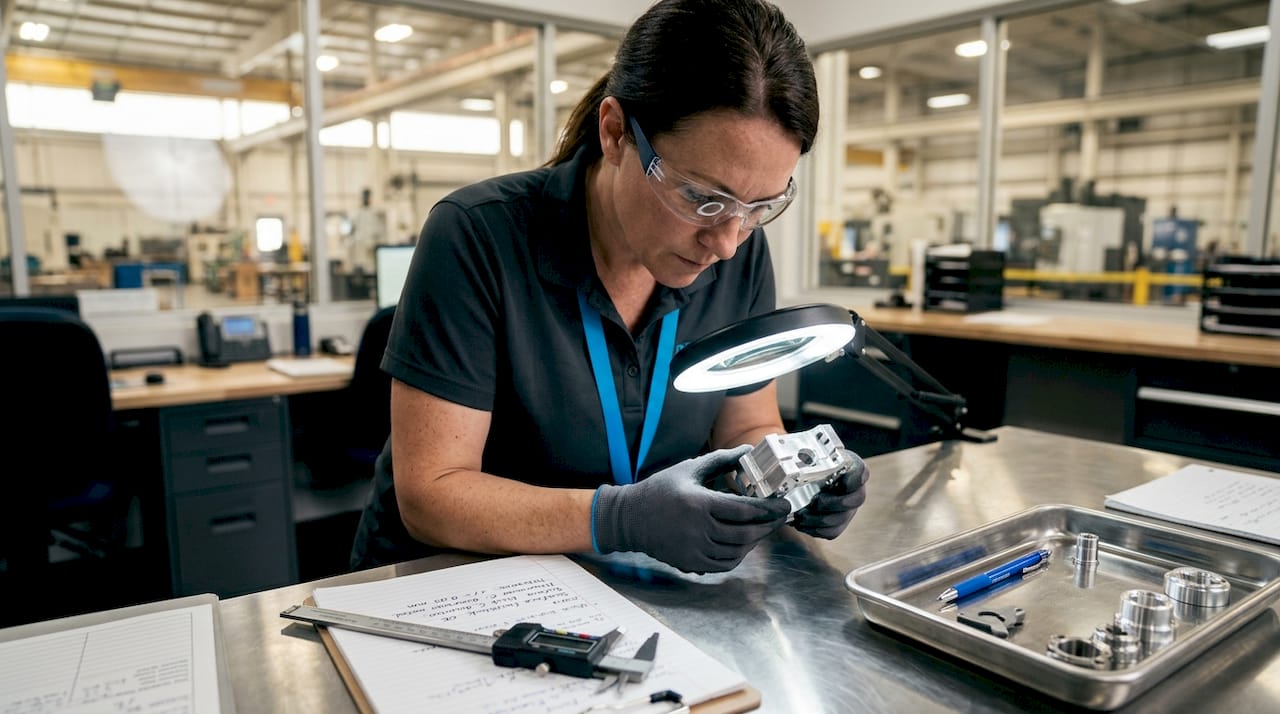
- Edge condition and burr-free status: Verified by visual inspection under magnification, or by tactile probing on automated systems. Edge break dimensions must meet drawing callouts, not just be “smooth enough.”
- Surface integrity indicators: For fatigue-critical aerospace components, X-ray diffraction or Barkhausen noise analysis can verify that surface residual stresses are compressive rather than tensile after finishing.
“Surface-finish tuning is tied to achieving low roughness compatible with demanding applications; research on aerospace milling emphasizes achieving Ra within specifications and that finishing strategy affects surface quality and cutting time.”
Continuous improvement in post-processing quality means feeding measurement data back into the process parameters. If Ra values are trending toward the upper limit of spec across a production run, the vibratory finishing cycle time or media type should be adjusted before parts go out of spec. This is the same closed-loop logic that governs cutting parameter adjustments in primary machining.
Buyers who prioritize precision part quality control understand that supplier documentation of post-processing is not paperwork overhead. It is the evidence chain that supports PPAP submissions, first article inspection reports, and customer audits. For ITAR-controlled defense programs in particular, that documentation also satisfies regulatory review requirements. Following aerospace best practices means building this validation structure into the manufacturing plan before a single part is cut.
The overlooked ROI of diligent post-processing
Here is the uncomfortable truth most purchasing decisions ignore: post-processing is consistently undervalued in cost models, and that undervaluation shows up as warranty costs, field failures, and audit findings that cost orders of magnitude more than the finishing operations that would have prevented them.
Conventional wisdom frames post-processing as a cost center. Get the part to print, ship it, move on. The flaw in that logic is that it only accounts for the cost of the finishing step, not the cost of skipping it. A single field failure on a defense-critical component can trigger a fleet-wide inspection, a product recall, and potential contract termination. The post-processing step that would have caught the subsurface burr causing fatigue crack initiation costs a fraction of one percent of that exposure.
There is also a less obvious benefit: audit readiness. Suppliers with documented, validated post-processing programs sail through customer audits and AS9100 surveillance reviews. Those without them spend weeks scrambling to produce evidence that may not exist. That scramble has a real labor cost, and it erodes the customer relationship in ways that take years to repair.
The long-term picture for OEMs who demand disciplined post-processing from their suppliers is measurably better. Lower defect rates. Shorter incoming inspection cycles. Fewer corrective action requests. Better on-time delivery because there are no surprise rework loops. Reviewing examples of high-volume manufacturing programs that have run cleanly for years consistently shows one common factor: finishing was planned, controlled, and validated from the start.
Post-processing done right is not overhead. It is risk management with a quantifiable return.
Choosing the right partner for precision post-processing
Ready to turn insight into action? Here is what to look for in a machining partner.
When you are sourcing components for aerospace, defense, or firearms programs, the supplier’s post-processing capability is as important as their primary machining equipment. A shop that machines beautifully but finishes inconsistently will deliver inconsistent parts. Period.

Machining Technologies LLC has operated from its 70,000 square foot facility in Webster, Massachusetts since 1985, producing over 20 million parts annually across aerospace, defense, and firearms programs. Our integrated finishing capabilities, validated quality systems, and documented post-processing routings mean you receive parts that meet spec every lot, not just on first article. Whether your program requires precision machining for firearms components with tight edge and surface requirements, or a high-throughput aerospace machining workflow with full SPC and CMM documentation, we have the equipment, experience, and process discipline to support your quality requirements from prototype through full production.
Contact our team to review your post-processing specifications and discuss how our capabilities align with your program requirements.
Frequently asked questions
What are the main goals of post-processing in machining?
The main goals are to remove residual imperfections like burrs, achieve strict surface finish requirements, and ensure parts meet dimensions and regulatory specs. Post-processing addresses burrs and tool marks to improve surface finish and other functional requirements.
Why is surface roughness critical for aerospace and defense parts?
Surface roughness directly affects fatigue life, sealing performance, and compliance with strict industry regulations in aerospace and defense applications. Surface-finish tuning is tied to achieving low Ra values compatible with these demanding applications.
How does automated post-processing improve part consistency?
Automation eliminates the variability introduced by operator fatigue and technique differences, producing tightly controlled results across large production lots. Post-processing integration using automated finishing cells and vibratory systems reduces labor and maintains consistent outcomes.
What measurements verify post-processing effectiveness?
Typical verification measures include surface roughness values (Ra and Rz), CMM-based dimensional checks post-finishing, and visual or microscopic edge inspection. Achieving Ra within specifications is a primary benchmark that confirms the finishing strategy has delivered the required surface quality.
Recommended
- Optimize high-volume machining workflow: aerospace precision | Machining Technologies
- Precision machining: engineering firearms for accuracy & compliance | Machining Technologies
- Step-by-step precision part design for high-volume manufacturing | Machining Technologies
- Precision Parts Manufacturing: Maximizing Quality and Throughput | Machining Technologies